
Last Updated: September 9, 2026
Between 9:00 AM and 9:15 AM, you can place orders on NSE — but none of them execute. That 15-minute window has a name, a purpose, and rules most beginners don’t know exist.
So what exactly happened in that one minute?
Understanding share market timings in India is one of the most important first steps for any beginner investor. The stock market does not open randomly — it runs on a strict, predictable schedule managed by India’s two major exchanges, the NSE and the BSE. Once you understand this schedule, placing trades, planning your day, and avoiding costly mistakes becomes significantly easier.
In this guide, you will learn exactly how market timings work, what happens before 9:15 AM, which hours are best for trading, and when markets stay closed. Whether you are based in Mumbai, Delhi, or tracking markets as an NRI from abroad, this guide gives you a reliable foundation to start from.
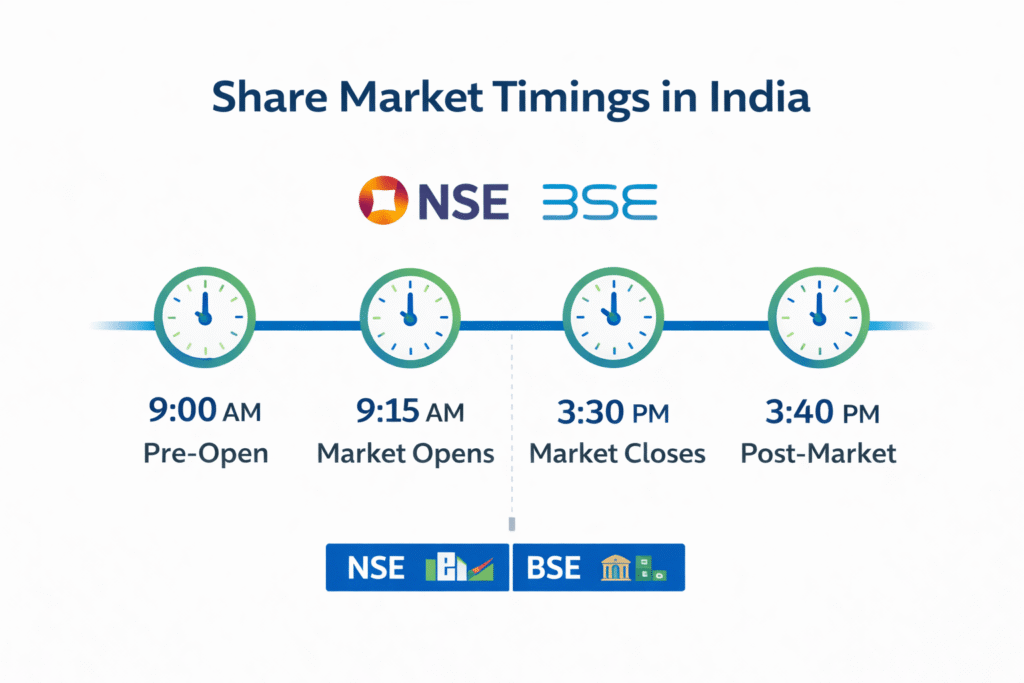
NSE and BSE trade Monday to Friday, 9:15 AM to 3:30 PM IST.
📋 Table of Contents
- Share Market Opening and Closing Time
- How Share Market Timings Work (All Sessions)
- What is Pre-Open Session?
- Demand, Supply and Why Pre-Open Session Exists
- Real Stock Market Examples
- Best Time for Intraday Trading in India
- NSE and BSE Weekly Trading Schedule
- Other Market Timings — MCX and Currency
- Share Market Holiday List India 2026
- Key Takeaways
- Frequently Asked Questions
- Conclusion
What is Share Market Timings in India
Share market timings refer to the fixed hours during which stocks can be bought and sold on India’s exchanges. All trading in India takes place on two main platforms: the National Stock Exchange (NSE) and the Bombay Stock Exchange (BSE). Both follow an identical daily schedule.
The primary trading session runs from 9:15 AM to 3:30 PM, Monday to Friday. This is when the market is fully active and most of the day’s volume is traded.
Share Market Opening and Closing Time — Quick Reference
| Session | Timing (IST) |
|---|---|
| Market Opens | 9:15 AM |
| Market Closes | 3:30 PM |
This simple two-row answer is what most beginners are looking for — bookmark it, and read on to understand everything that happens around these two times.
📌 Also read: What is Stock Market for Beginners
How Share Market Timings Work in India
Complete Trading Sessions Explained
The stock market does not simply switch on at 9:15 AM and off at 3:30 PM. The full trading day is divided into several sessions, each designed to keep prices fair and orderly. Here is the complete picture:
| Step | Session | Time (IST) | What Happens |
|---|---|---|---|
| 1 | Pre-Open Session | 9:00 AM – 9:15 AM | Orders placed, opening price decided |
| 2 | Regular Trading Session | 9:15 AM – 3:30 PM | Full buying and selling — main session |
| 3 | Closing Price Calculation | 3:00 PM – 3:30 PM | Weighted average of last 30 minutes |
| 4 | Post-Market Session | 3:40 PM – 4:00 PM | Limited orders at closing price only |
| 5 | F&O Pre-Open ⭐ New | 9:00 AM – 9:15 AM | Derivatives price discovery (from Dec 2025) |
New in 2025: Starting December 8, 2025, the NSE introduced a pre-open session for Futures & Options (F&O) — similar to how equities already work. This runs from 9:00 AM to 9:15 AM and allows derivative traders to discover prices before the regular session begins.
Pre-Open Session (9:00 AM – 9:15 AM)
NSE runs a 15-minute pre-open call auction before regular trading starts, to discover a fair opening price. Here’s how the window is currently structured.
| Phase | Time | Market Orders |
|---|---|---|
| Order entry (full) | 9:00 AM – 9:05 AM | Allowed |
| Order entry (limit only) | 9:05 AM – 9:10 AM* | Rejected |
| Order matching | 9:10 AM – 9:12 AM | — |
| Buffer period | 9:12 AM – 9:15 AM | — |
*Random closure in the last 2 minutes (9:08–9:10 AM) — the exact cutoff isn’t predictable.
For the full breakdown of why this changed and what it means for your orders, see our detailed guide on the September 2026 pre-open rule change.
Demand, Supply and Why the Pre-Open Session Exists
Stock prices are driven by one simple principle: demand and supply. When more people want to buy a stock than sell it, the price rises. When more people want to sell than buy, the price falls. This same rule governs every transaction on the NSE and BSE, from a ₹10 penny stock to a ₹3,000 blue-chip share.
The pre-open session exists specifically to manage this dynamic in a controlled way. Imagine a major news event breaks overnight — a company reports strong quarterly results, or the government announces a policy change. Without the pre-open window, the moment the market opened at 9:15 AM, thousands of orders would hit the exchange simultaneously, causing the price to jump or crash erratically.
Instead, the pre-open session collects all those orders quietly in phases — market and limit orders between 9:00 and 9:05 AM, limit orders only until around 9:10 AM — calculates a balanced opening price during the matching phase, and delivers a far smoother start to the regular session.Real Stock Market Examples
Understanding market timings becomes much clearer when you look at how they affect real companies you already know. Here are three examples using well-known Indian stocks.
Reliance Industries
During the pre-open session, strong demand for Reliance Industries shares can push the opening price noticeably higher by 9:15 AM. For instance, if positive news about the company’s energy projects or quarterly results breaks overnight, buyers flood in during the early order entry phase of the pre-open session. This buying pressure not only lifts Reliance’s opening price but also ripples through the broader Nifty index, influencing the entire market’s direction from the very first minute of trading.
TCS (IT Sector)
Strong earnings from TCS often attract a surge of buyers during the pre-open window. Suppose the company reports better-than-expected quarterly results after the previous day’s market close. Orders pour in during the pre-open order entry window, helping set a stronger opening price at 9:15 AM.. This boosts sentiment across the IT sector and frequently lifts related stocks as traders react throughout the regular session. Those early minutes set the tone for the rest of the day.
HDFC Bank
Banking stocks like HDFC Bank carry significant weight in major indices, which makes their early movement especially influential. When positive economic data or an RBI announcement creates demand, orders placed in the pre-open session help establish a stable opening price at 9:15 AM. On high-volatility days, how HDFC Bank behaves in those first 15 minutes often signals how the broader banking index will trade for the rest of the session.
Key Insight: Market timing directly connects to stock movement. When you know what session is active and why, you start to understand why prices behave the way they do throughout the day.
Why Investors Pay Attention to Market Timing
Experienced investors and traders do not simply log in and place orders at random. They pay close attention to the time of day because different periods within the session behave very differently. Understanding these patterns helps with entry and exit decisions, especially for intraday traders.
The key reasons investors follow market timing are:
- To enter or exit positions at the most suitable price
- To avoid periods of unusually high volatility
- To plan intraday trades around predictable market behaviour
- To understand how global overnight developments affect the opening
Best Time for Intraday Trading in India
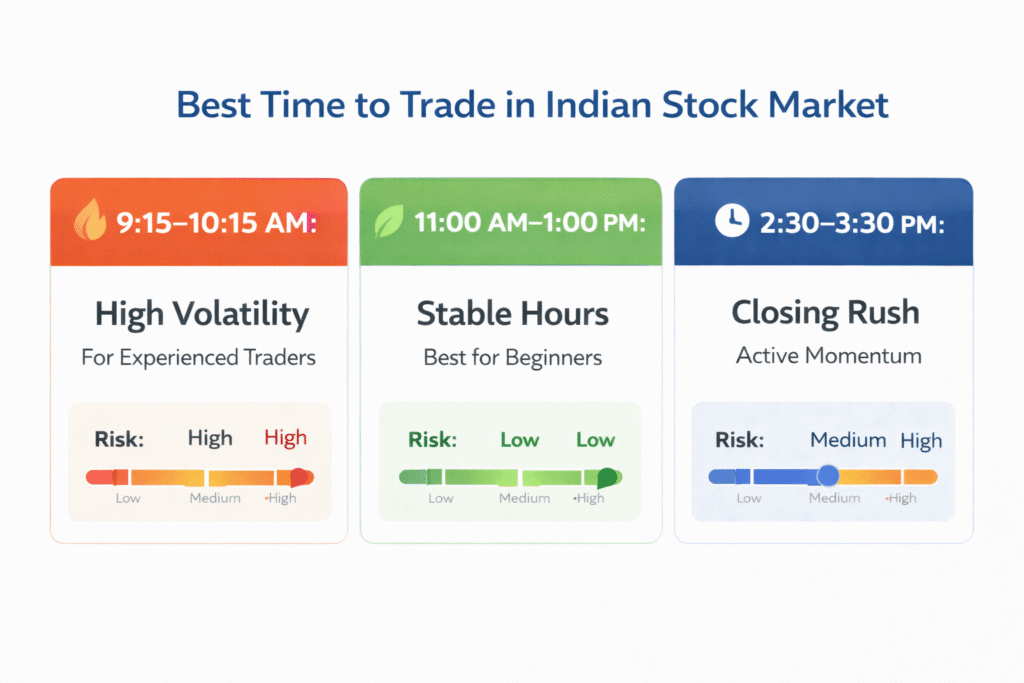
The 11 AM–1 PM window is widely considered the safest zone for beginner intraday traders in India.+
Not all hours of the trading session are equally useful for intraday traders. The table below shows how market behaviour typically shifts throughout the day:
| Time Window | Market Behaviour | Best For |
|---|---|---|
| 9:15 AM – 10:15 AM | High volatility, rapid price moves | Experienced traders |
| 11:00 AM – 1:00 PM | Stable, predictable movement | Beginners ✅ |
| 2:30 PM – 3:30 PM | Closing momentum, active volume | Active traders |
NSE and BSE Trading Schedule (Monday to Friday)
The Indian stock market operates five days a week, from Monday to Friday. It remains closed on all Saturdays and Sundays. This weekly rhythm gives investors time to review their portfolios, catch up on news, and plan their next week’s trades without any market noise.
Does the Stock Market Open on Saturday in India?
No, the NSE and BSE are closed every Saturday and Sunday. There is, however, one well-known exception: Muhurat Trading, a special one-hour session that takes place on Diwali every year.
In 2026, Muhurat Trading is confirmed for Sunday, November 8, 2026 (Diwali Laxmi Pujan). The exact timing will be announced by NSE closer to the date. This is considered an auspicious occasion to make a symbolic investment and is widely observed by retail investors across India.
📌 Also read: What is Stock Market for Beginners
Other Market Timings — MCX Commodity and Currency Segments
India’s financial markets extend well beyond equities. Two other important segments have different trading hours that are worth knowing about, especially as you expand your investing knowledge.
MCX Commodity Market
The Multi Commodity Exchange (MCX) trades commodities such as gold, silver, crude oil, and copper. Its session runs from 9:00 AM all the way to 11:30 PM — significantly longer than the equity market. This extended window allows commodity traders to respond to global market movements, including international oil prices and precious metal rates, long after the equity session has closed.
Currency Market (NSE)
The NSE also facilitates trading in currency derivatives — pairs such as USD-INR, EUR-INR, and GBP-INR. The currency segment trades from 9:00 AM to 5:00 PM, giving currency traders an extra 90 minutes beyond the equity close to react to international foreign exchange developments.
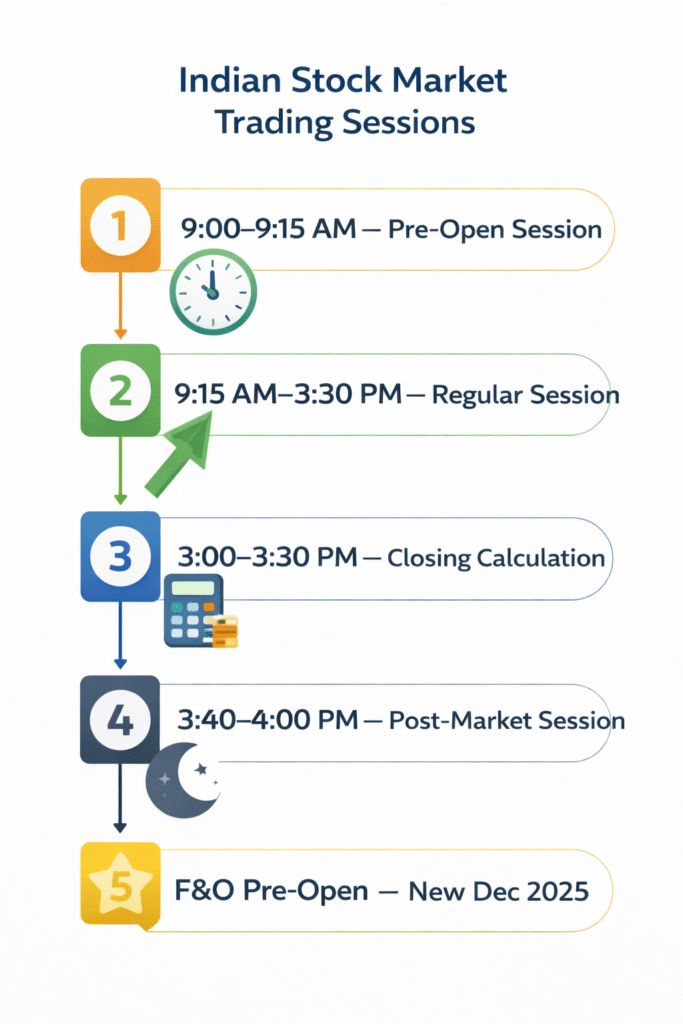
The Indian trading day has five sessions, each with a specific role in price discovery and execution
Share Market Holiday List India 2026 — Key Dates to Know
The NSE and BSE observe 15 official trading holidays on weekdays in 2026. Being aware of these dates is essential for planning trades, managing settlements, and avoiding unexpected disruptions to your positions.
Here are the major upcoming holidays for quick reference:
| Date | Day | Holiday |
|---|---|---|
| January 26 | Monday | Republic Day |
| February 19 | Thursday | Chhatrapati Shivaji Maharaj Jayanti |
| March 31 | Tuesday | Mahavir Jayanti |
| April 3 | Friday | Good Friday |
| April 14 | Tuesday | Dr. Ambedkar Jayanti |
| May 1 | Friday | Maharashtra Day |
| October 2 | Friday | Gandhi Jayanti |
| October 20 | Tuesday | Dussehra |
| November 9 | Monday | Diwali (Laxmi Pujan) |
| December 25 | Friday | Christmas Day |
For the complete 2026 holiday list, including commodity and currency segment closures, refer to the official NSE holiday calendar.
📌 We have also published a dedicated article covering all NSE and BSE holidays for 2026 — Share Market Holiday List 2026 India — add your internal link here once that article is published.
What is Muhurat Trading India 2026?
Muhurat Trading is a special one-hour session conducted on Diwali every year. It is considered auspicious by many Indian investors, who make a symbolic purchase of shares or mutual funds on this day. Despite being conducted outside regular trading hours — and sometimes on a Sunday — the session is fully functional with real orders and live price discovery. In 2026, Muhurat Trading is confirmed for Sunday, November 8, with exact timings to be announced by NSE closer to the date.
Why Investors Rely on Market Timings
Understanding the daily schedule does more than just tell you when to log in. It shapes how you approach every trade. Investors who know the schedule make better-timed decisions, avoid high-risk volatility windows, and plan their day with confidence. The structure also protects them from reacting emotionally to prices that are still settling during the pre-open phase.
Advantages of the Indian Market Schedule
- Predictable structure: A fixed daily timetable makes planning straightforward for both new and experienced investors.
- Price fairness: The pre-open session ensures no single trader gains an unfair advantage from overnight news.
- Global alignment: The 9:15 AM opening allows Indian markets to absorb overnight cues from US and Asian markets before trading begins.
- Transparency: Every session has a clear purpose, and all price information is publicly available in real time.
Limitations to Be Aware Of
- Limited hours: Unlike some international crypto or commodity markets, Indian equity markets do not trade 24 hours.
- Overnight risk: When markets close at 3:30 PM, major global events can still unfold overnight, creating price gaps at the next morning’s open.
- Global market impact: Significant moves in the US markets (NYSE, Nasdaq) or Asian exchanges often influence India’s opening prices the following morning.
- Missed opportunities: If a major corporate announcement comes after 3:30 PM, investors must wait until the next trading day to act.
Key Takeaways
- ✅ Share market timings in India are fixed for all trading days
- ✅ Main session runs from 9:15 AM to 3:30 PM, Monday to Friday
- ✅ The pre-open session (9:00–9:15 AM) stabilises opening prices
- ✅ A new F&O pre-open session was introduced in December 2025
- ✅ Saturday and Sunday are non-trading days (Muhurat Trading is the exception)
- ✅ The MCX commodity market has extended hours until 11:30 PM
- ✅ In 2026, there are 15 official trading holidays on weekdays
- ✅ The 11:00 AM–1:00 PM window is generally the calmest time for beginners
Frequently Asked Questions (FAQs)
1. What time does the share market open in India?
The share market in India opens at 9:15 AM IST, Monday to Friday. Both the NSE and BSE follow this same opening time. Before 9:15 AM, the pre-open session runs from 9:00 AM to 9:15 AM, during which orders can be placed but full trading has not yet begun.
2. What time does the share market close in India?
The regular trading session closes at 3:30 PM IST. After this, a short post-market session runs from 3:40 PM to 4:00 PM, during which limited orders can be placed at the official closing price.
3. Does the stock market open on Saturday in India?
No, the NSE and BSE are closed every Saturday and Sunday. The only exception is Muhurat Trading, a special one-hour session on Diwali. In 2026, Muhurat Trading is scheduled for Sunday, November 8.
4. Can I trade after 3:30 PM in India?
Regular intraday and delivery trading ends at 3:30 PM. However, from 3:40 PM to 4:00 PM, a post-market session allows you to place orders that will be executed at the official closing price. This is useful for investors who prefer a confirmed closing price rather than a live market price.
5. What is the pre-open session in the Indian stock market?
The pre-open session runs from 9:00 AM to 9:15 AM and has four phases (updated September 2026): order entry with market and limit orders (9:00–9:05), limit-orders-only entry (9:05–9:10), order matching (9:10–9:12), and a buffer period (9:12–9:15). Its main purpose is to reduce opening price volatility by collecting and matching orders before the regular session begins. A similar pre-open session for F&O (derivatives) was introduced in December 2025.
📌 Also read: What is Sensex and Nifty
Conclusion
Understanding share market timings in India is one of the simplest yet most overlooked foundations for new investors. Once you know that the market opens at 9:15 AM with a pre-open phase before it, closes at 3:30 PM with a post-market window after it, and follows a clear weekly schedule, the entire trading day starts to make far more sense.
These timings are not arbitrary — every session exists for a specific reason that protects both individual investors and the market as a whole. From the opening bell to the closing auction, each phase plays a role in keeping trading fair, transparent, and predictable.
Continue building your understanding of the Indian stock market with these related guides:
Disclaimer: This article is published for educational and informational purposes only. It does not constitute financial or investment advice. All investments in the stock market are subject to market risks. Please conduct your own research or consult a qualified financial advisor before making any investment decisions.
1 thought on “Share Market Timings in India: Simple & Complete NSE BSE Guide (2026)”