
Introduction
Have you ever heard someone mention “Nifty is up today” or “Reliance shares are rising” and wondered what it actually means? If so, you are not alone. Understanding what is stock market for beginners can feel overwhelming at first — but once you grasp the basics, everything starts to fall into place.
In simple terms, the stock market is a place where people buy and sell small pieces of ownership in companies. When you purchase a share of Reliance Industries or TCS, you become a very small part-owner of that company. Companies sell these shares to raise money for growth, and investors benefit when the company performs well.
In India, stock trading takes place on two major exchanges: the National Stock Exchange (NSE) and the Bombay Stock Exchange (BSE). Every weekday from 9:15 AM to 3:30 PM, millions of people — from first-time investors to seasoned professionals — trade shares using platforms like Zerodha, Groww, and Upstox.
This guide is designed for complete beginners in 2026. No complicated jargon, no investment tips — just clear, honest explanations to help you understand what is stock market for beginners without feeling lost.

Overview of how the stock market works in India including NSE and BSE
Table of Contents
- What is the Stock Market
- How it Works
- Key Concept: Demand, Supply and Market Index
- Real Indian Stock Market Examples
- Why Investors Use the Stock Market
- Advantages
- Limitations
- Key Takeaways
- Frequently Asked Questions
- Conclusion
- Disclaimer
1. What is the Stock Market
So, what is stock market for beginners in simple words? It is a regulated platform where shares of publicly listed companies are bought and sold. Think of it as a large, organized marketplace — but instead of goods, people are trading ownership stakes in businesses.
Here is how it works at a basic level:
- A company divides itself into millions of small units called shares
- When you buy a share, you become a part-owner of that company
- These shares are bought and sold on stock exchanges like NSE and BSE
The equity market basics come down to one simple idea — it connects two groups of people:
- Companies — who need funds to grow their business
- Investors — who want to grow their savings over time
2. How the Stock Market Works
Understanding what is stock market for beginners becomes easier when you break the process into clear steps.. This beginner stock market guide will walk you through each stage.
Step-by-Step Process:
- A company lists its shares on a stock exchange through an IPO (Initial Public Offering)
- Investors buy shares through registered brokers or apps like Zerodha and Groww
- Shares are traded daily on NSE and BSE during market hours
- Prices rise and fall based on demand and supply
Key Participants:
- Investors — individuals and institutions who buy and sell shares
- Brokers — platforms and intermediaries that execute trades
- Stock Exchanges — NSE and BSE, where trades take place
- SEBI — the regulator that ensures fair and transparent trading
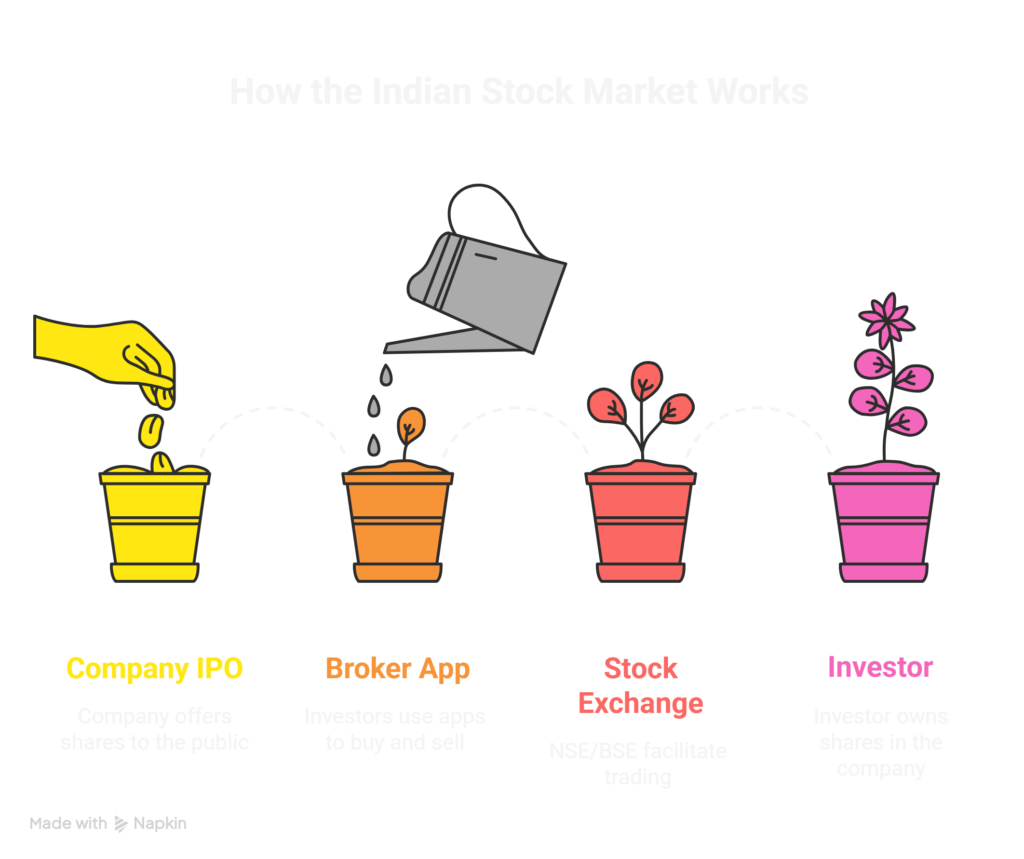
Simple step-by-step process explaining how the stock market works in India for beginners
3. Key Concept: Demand, Supply and Market Index
Two core concepts drive everything you need to understand about what is stock market for beginners.
Demand and Supply:
High demand + Low supply = Share price increases
Low demand + High supply = Share price decreases
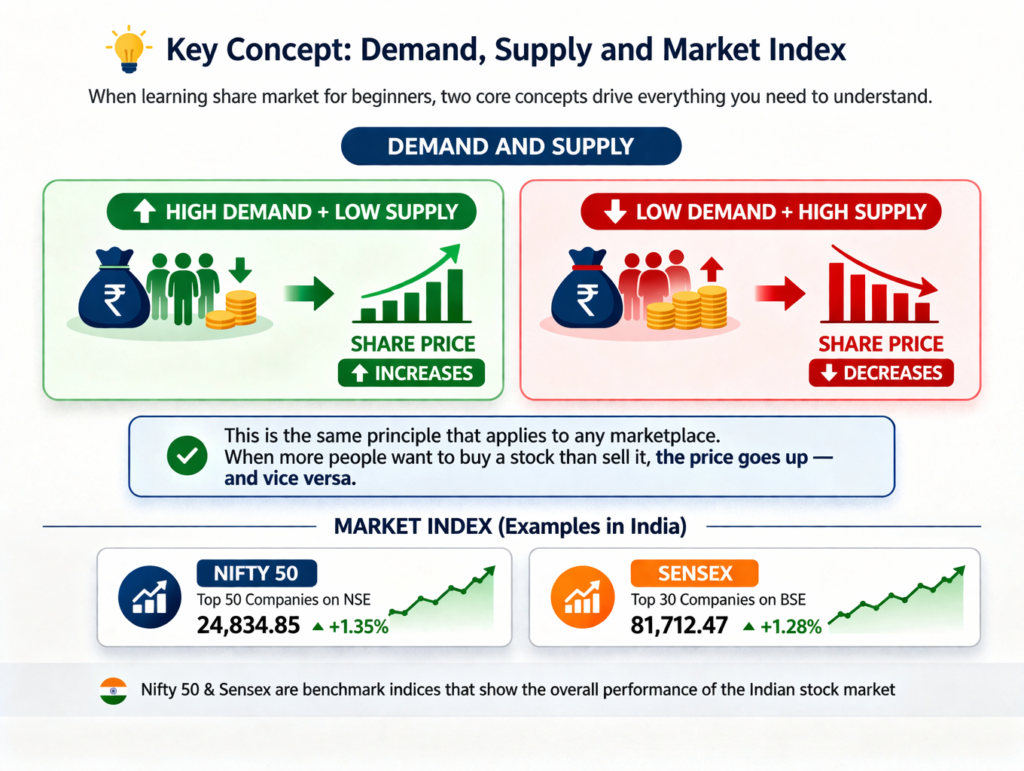
This diagram shows how demand and supply influence stock prices, helping beginners understand why share prices go up or down in the market
This is the same principle that applies to any marketplace. When more people want to buy a stock than sell it, the price goes up — and vice versa.
Market Index — What is Nifty 50?
A market index like Nifty 50 tracks the performance of the top 50 companies listed on the NSE. It gives investors a quick snapshot of how the overall equity market is performing.
- If most companies in the Nifty 50 rise, the index goes up
- If most companies fall, the index drops
When you hear “the market is up today,” it usually means the Nifty 50 or Sensex has risen.
4. Real Indian Stock Market Examples
Let us look at real examples to make these stock market basics more practical.
Reliance Industries
Reliance started as a textile company and expanded into telecom (Jio), retail, and energy. Its share price grew significantly over the years as the business scaled. Investors who held Reliance shares long-term saw strong returns as the company continued to grow.
TCS (Tata Consultancy Services)
TCS is one of India’s largest IT companies with a global client base. Consistent earnings growth over the years led to a steady increase in its share price — making it a favorite among long-term investors.
HDFC Bank
HDFC Bank is one of India’s most trusted private sector banks. Its consistent financial performance has made it one of the most stable stocks on the NSE and BSE.
Nifty 50 as a Benchmark
The Nifty 50 includes companies like Reliance, TCS, Infosys, and HDFC Bank. Tracking this index gives anyone learning about the share market for beginners a clear picture of the overall direction of Indian markets.
Key takeaway: Stock prices reflect real business performance — not random movements.
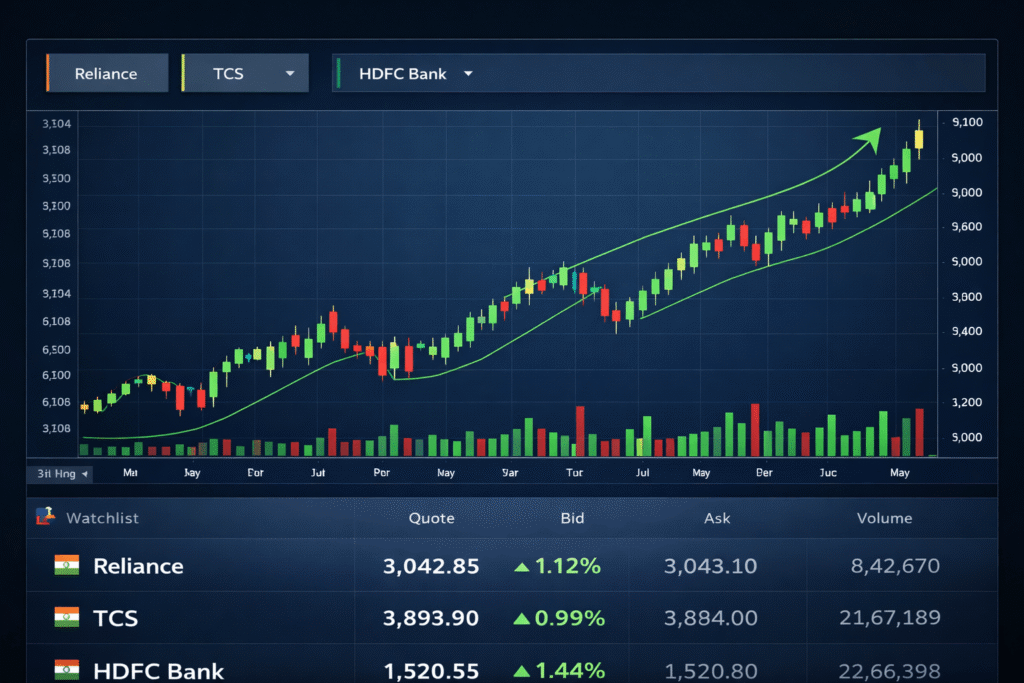
Examples of Indian stocks like Reliance, TCS, and HDFC Bank showing how share prices can grow over time
5. Why Investors Use the Stock Market
Once you understand what is stock market for beginners, you will see why people choose it for a variety of reasons
- Wealth creation — long-term investing has historically delivered strong returns
- Beating inflation — stock returns have the potential to outpace rising prices
- Participating in company growth — you benefit when businesses you invest in expand
- Passive income — some companies pay dividends, providing regular income
- Accessibility — NRIs and global investors can also participate in Indian markets
Many investors in India are shifting from traditional fixed deposits toward equity markets in search of higher long-term growth potential. For anyone exploring what is stock market for beginners, this shift reflects a growing awareness of investing.
6. Advantages of the Stock Market
- Easy access — start investing with as little as a few hundred rupees
- High growth potential — long-term returns can significantly outperform savings accounts
- Liquidity — shares can be bought and sold quickly during market hours
- Transparency — prices are visible in real time on public platforms
- Ownership — shareholders are part-owners of the companies they invest in
- Regulated environment — SEBI ensures investor protection and fair trading
7. Limitations of the Stock Market
- Market volatility — prices can change significantly in a short period
- No guaranteed returns — unlike fixed deposits, stock returns are not assured
- Emotional decision-making — fear and greed can lead to poor investment choices
- Requires patience — short-term losses are common, especially for new investors
- Information overload — the volume of market news can overwhelm beginners
8. Key Takeaways
- What is stock market for beginners — a regulated platform for buying and selling company shares
- NSE and BSE are India’s two main exchanges, overseen by SEBI
- Share prices are driven by demand and supply
- Indexes like Nifty 50 reflect overall market performance
- Long-term investing generally reduces risk and improves returns
- Understanding equity market basics is more important than rushing to invest
9. Frequently Asked Questions (FAQs)
What is stock market for beginners and is it safe?
The stock market is a regulated marketplace where shares of publicly listed companies are bought and sold. When you buy a share, you become a part-owner of that company and benefit if its value grows over time.
How much money do I need to start investing?
You can begin with as little as ₹500 to ₹1,000. Many platforms allow fractional investing or SIP-based entry into mutual funds linked to the stock market.
Is the stock market safe for beginners?
All investments carry some risk. However, beginners can reduce that risk by starting small, choosing well-known companies, and focusing on long-term goals. Learning the beginner stock market guide basics first is always a smart move.
What is the difference between the stock market and the share market?
The two terms are used interchangeably. Both refer to the same marketplace where company shares are bought and sold.
Do I need to monitor the market every day?
Not necessarily. Many successful investors follow a long-term strategy and review their portfolio periodically rather than tracking it daily.
10. Conclusion
Now that you understand what is stock market for beginners, the next step is to keep learning. You do not need a finance degree or years of experience to get started — just a clear understanding of the basics.
In India, companies like Reliance, TCS, and HDFC Bank represent real business growth. The stock market reflects this growth, giving investors an opportunity to participate in it. Whether you are based in India or investing as an NRI from abroad, knowing what is stock market for beginners makes this opportunity accessible to everyone.
Start with the basics, invest consistently, and let time do the work. For deeper learning, check out the Zerodha Varsity free course and NSE India Investor Education — both are excellent free resources.
Disclaimer
This article is for educational purposes only. It does not constitute financial advice, investment recommendations, or stock tips of any kind. All investments in the stock market are subject to market risks. Please conduct your own research and consult a qualified financial advisor before making any investment decisions.