
Last Updated: May 13, 2026
Nifty dropped 9% in early 2026. Half of India’s retail investors called it a bear market. The other half called it a correction. Only one group was right — and the difference matters more than you think.”
Understanding what is bull and bear market in India is one of the most important foundations for any investor — whether you are just starting out or tracking the market from abroad as an NRI. Once you understand these two phases clearly, every market swing begins to make far more sense.If you clearly understand what is bull and bear market in India, you will never panic during market falls and corrections.
In this guide, you will get a plain-language breakdown of both market types, the standard rules used to identify them, real Indian examples from the Nifty and Sensex, and a clear answer to one of the most searched questions of 2026: was the recent Nifty dip actually a bear market?
📋 Table of Contents
- What is Bull and Bear Market in India
- How Bull and Bear Markets Work
- The 20% Rule — Correction vs Bear Market
- Real Stock Market Examples (India)
- How to Identify Bull and Bear Market
- Why Investors Track Market Phases
- Advantages
- Limitations
- Key Takeaways
- Frequently Asked Questions
- Conclusion
What is Bull and Bear Market in India
Bull Market Meaning (India)
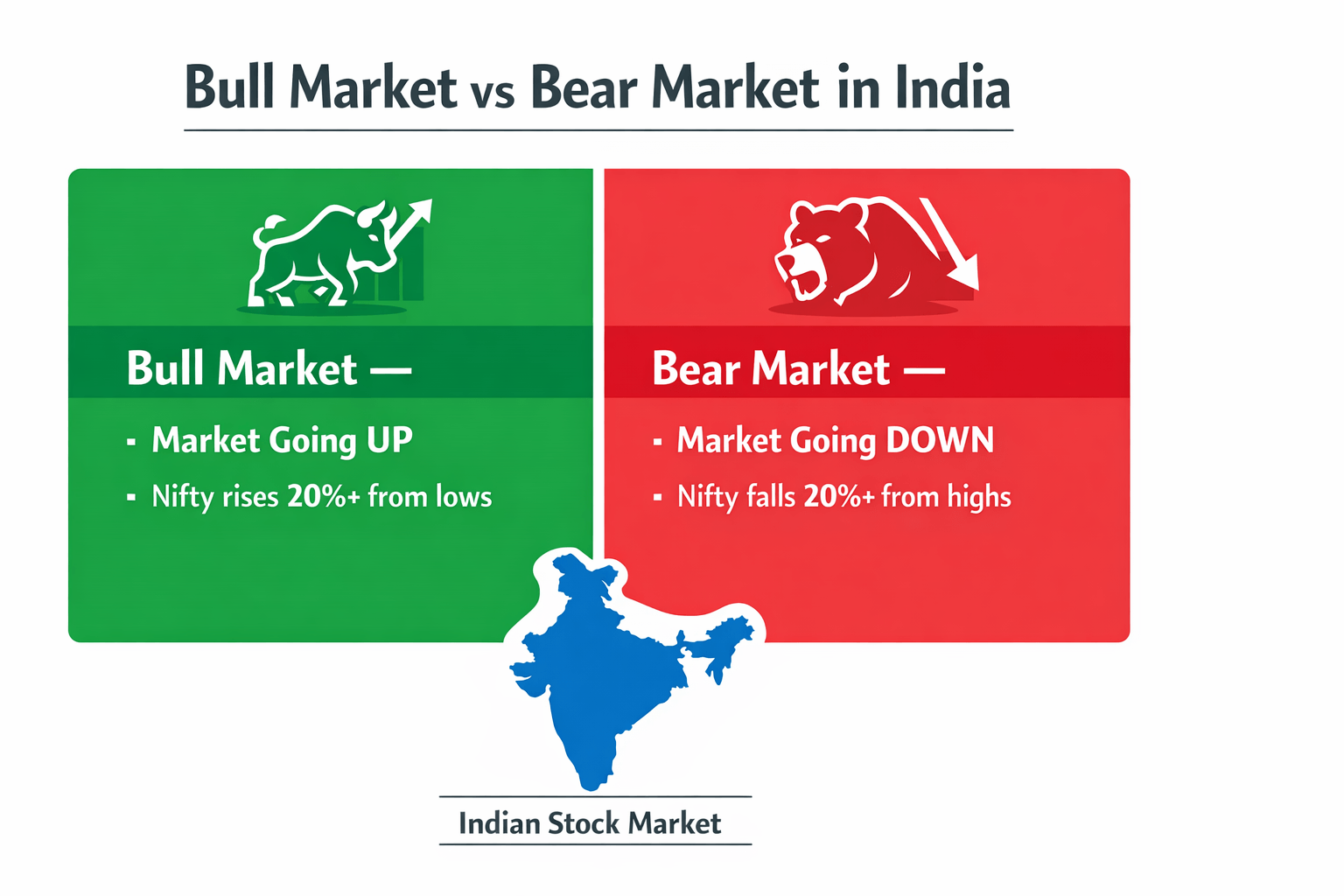
A bull market is a sustained period during which stock prices are rising steadily. Investors feel confident, the economy shows healthy growth, and buying activity increases across the market.
- Overall market indices like the Nifty 50 and Sensex trend upward
- Investor sentiment is optimistic — more people are buying than selling
- Stocks across sectors, including Reliance, TCS, and HDFC Bank, tend to climb
- Corporate earnings generally improve, reinforcing the positive mood
In simple words: Bull market = Market going UP 📈
Example: After the COVID crash in 2020, India entered a powerful bull run. The Sensex nearly doubled between 2020 and 2021, rewarding investors who stayed disciplined through the recovery.
The Nifty or Sensex show a clear downward trend over weeks or months
- Investor sentiment is pessimistic — more people are selling than buying
- Even strong companies can see their share prices decline during this phase
- Economic concerns such as inflation, rising interest rates, or global uncertainty often fuel the drop
In simple words: Bear market = Market going DOWN 📉
Example: During the 2020 COVID crash, the Sensex fell close to 38% in a matter of weeks. Even strong companies saw sharp price declines as investors rushed to safety.
Now that the core meanings are clear, let us look at how these two phases actually unfold in the market over time.
How Bull and Bear Markets Work
Markets do not move randomly — they follow natural cycles driven by economic conditions, company performance, and the collective behavior of millions of investors. Understanding these cycles removes a great deal of the fear that comes with market volatility.
Bull Market Cycle
A bull phase typically begins when economic conditions improve. Companies start reporting stronger profits, consumer spending rises, and investor confidence returns. As more buyers enter the market, prices climb — which attracts even more buyers. This self-reinforcing cycle can last for months or even years, as India experienced between 2020 and 2021.
Bear Market Cycle
A bear phase often starts when negative news — inflation spikes, geopolitical tensions, or fears of a global slowdown — causes investors to reduce risk. Selling increases, prices fall, and fear spreads further through the market. This cycle can also feed on itself, as falling prices prompt more selling. However, bear markets in India have historically been followed by recoveries, which is why staying invested through cycles matters more than timing them.
📌 Also read:Share Market Holiday List 2026 India: NSE BSE Complete & Easy Calendar
The 20% Rule — and Why Correction ≠ Bear Market
There is no single formula for bull and bear markets, but one widely accepted rule of thumb gives investors a clear benchmark.
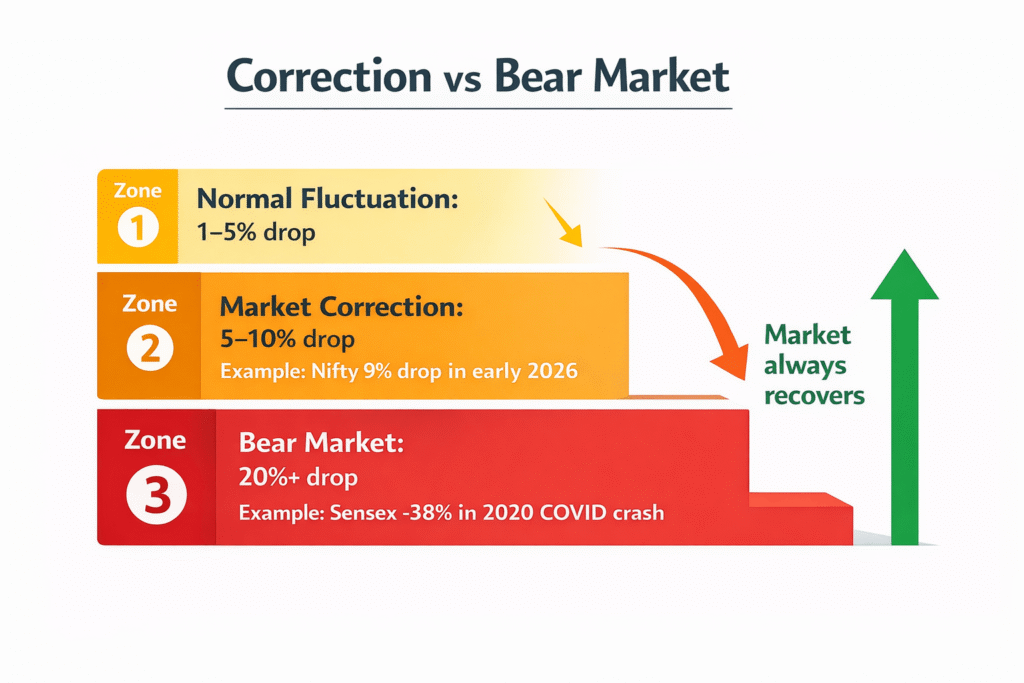
A-9%-Nifty-drop-in-early-2026-is-a-correction-—-a-bear-market-needs-20%+-sustained-decline.
| Market Phase | Definition | India Example |
|---|---|---|
| Bull Market 📈 | Nifty / Sensex rises 20% or more from recent lows | 2020–2021: Sensex nearly doubled from COVID lows |
| Correction ⚠️ | A moderate decline of 5% to 10% — temporary and normal | Early 2026: Nifty fell ~9% from January highs |
| Bear Market 📉 | Nifty / Sensex falls 20% or more from recent highs | 2020 COVID crash: Sensex down ~38% in weeks |
⚠️ Important: The Nifty’s 9% drop in early 2026 is a correction — NOT a bear market. A genuine bear market requires a sustained decline of 20% or more. Understanding this single distinction prevents many beginners from making the most common investing mistake: selling during a temporary dip and missing the recovery.
Real Stock Market Examples (India)
The best way to understand what is bull and bear market in India is through events that actually happened in the Indian market. Here are three examples every beginner should know. These real examples make it easier to understand what is bull and bear market in India with practical context.
1. Bull Market Example — The 2020–2021 Recovery
After the sharp COVID crash in March 2020, the Indian market entered one of its most powerful bull phases in recent history.
- The Nifty 50 rose from around 7,500 to over 18,000 — more than doubling in value
- Reliance Industries more than doubled as the company accelerated its expansion into telecom, retail, and clean energy
- TCS hit fresh highs as global demand for technology services surged during the remote-work era
- HDFC Bank delivered steady gains, supported by improving loan growth and a recovering economy
This period demonstrated how bull markets reward investors who stay patient and invested through volatility.
2. Bear Market Example — The 2020 COVID Crash
The same year began with one of India’s sharpest bear markets in modern history.
- The Sensex fell close to 38% in just a few weeks between February and March 2020
- Panic selling spread across every sector, pulling down even fundamentally strong companies
- Many first-time investors saw their portfolios fall significantly — some sold in panic, missing the recovery that followed just months later
This example shows both the pain of a bear market and the importance of staying calm during it.
3. Current Scenario — 2026 Correction
In early 2026, the Nifty fell approximately 9% from its January highs, triggering widespread concern among retail investors.
- Foreign institutional investors (FIIs) reduced some positions, reflecting global risk aversion
- Domestic institutional investors (DIIs) — including Indian mutual funds — stepped in as buyers, providing a stabilising force
- Stocks like Reliance, TCS, and HDFC Bank showed mixed but broadly resilient performance
This 9% pullback does not qualify as a bear market. It is a healthy correction within the broader market cycle — the kind that has occurred many times before and has always been followed by recovery.
📌 Also read: What is IPO in Stock Market India? Beginner Guide (2026)
How to Identify Bull and Bear Market in India
You do not need complex tools to identify where the market stands. Here are five straightforward indicators that any beginner can check.
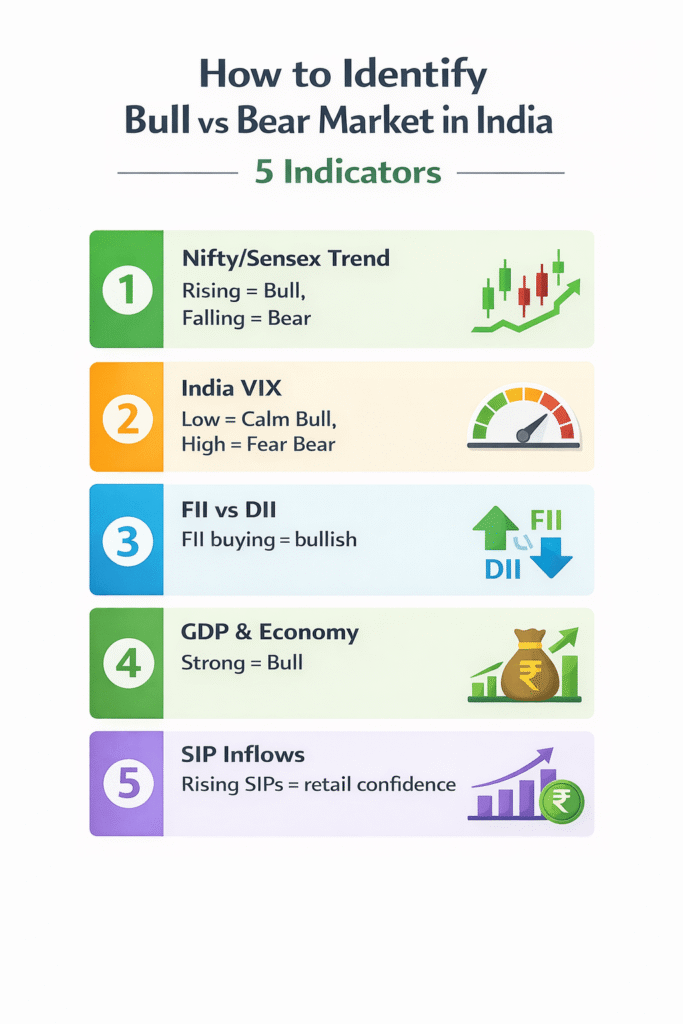
Track five simple indicators — Nifty trend, India VIX, FII/DII data, GDP, and SIP inflows — to identify market phases.
| # | Indicator | Bull Signal | Bear Signal |
|---|---|---|---|
| 1 | Nifty / Sensex Trend | Consistently rising over weeks | Falling 20%+ from recent highs |
| 2 | India VIX (Fear Index) | Low VIX (below 15) = calm market | High VIX (above 20) = fear rising |
| 3 | FII vs DII Activity | FII net buyers = bullish signal | FII heavy selling = caution zone |
| 4 | GDP & Economic Growth | Rising GDP, low unemployment | Slowing growth, high inflation |
| 5 | SIP Inflows (Retail Participation) | Rising monthly SIP numbers | SIP pauses or cancellations rising |
India VIX — the “Fear Meter”: The India VIX measures how much fear or uncertainty exists in the market. In March 2026, the India VIX rose sharply, approaching levels near 24 — reflecting genuine investor anxiety. A VIX above 20 often signals that the market is nervous, even if it has not yet entered a full bear phase. You can check the India VIX on the NSE website for free.
FII vs DII in 2026: In early 2026, Foreign Institutional Investors (FIIs) — overseas funds and investors — were net sellers in several sessions. However, Domestic Institutional Investors (DIIs) — which includes Indian mutual funds available on Groww, Zerodha, and Upstox — continued buying consistently. This DII buying acted as a stabilising cushion, preventing a deeper fall. When you see FII selling but DII buying, it signals resilience rather than the start of a true bear market.
Why Investors Track Market Phases
Understanding the difference between a bull and bear market is not just academic — it has a direct impact on everyday investment decisions.
- Avoid panic selling: Knowing that a 9% dip is a correction and not a bear market keeps you from selling at the wrong moment and locking in unnecessary losses
- Plan entries and exits: Investors who recognise bull phases early can position their portfolios for stronger returns
- Stay consistent with SIPs: During bear markets, SIP investors actually accumulate more units at lower prices — which leads to better long-term returns when the market recovers
- Reduce emotional decisions: Understanding market cycles replaces fear with perspective.
This is why understanding what is bull and bear market in India is important for every beginner investor.
Bull vs Bear Market — Full Comparison Table (India 2026)
| Feature | Bull Market 📈 | Bear Market 📉 |
|---|---|---|
| Definition | Nifty / Sensex rises 20%+ from lows | Nifty / Sensex falls 20%+ from highs |
| Investor Mood | Confident, optimistic, buying | Fearful, cautious, selling |
| India VIX Level | Low — typically below 15 | High — often above 20 |
| FII Behavior | Net buyers — inflows into India | Net sellers — outflows from India |
| SIP Advice | Continue — enjoy rising NAVs | Continue — buy more units at lower prices |
| Duration in India | Often 2–5 years | Often 8–12 months on average |
| India Example | 2020–2021: Sensex nearly doubled | 2020 COVID: Sensex fell ~38% in weeks |
Advantages of Understanding Market Phases
- Clearer market direction: You can immediately see whether the broader trend is up or down, giving you a reliable big-picture view for decision-making
- Panic prevention: Recognising a small dip as a correction — rather than a bear market — stops emotional selling at the worst possible time
- Better long-term planning: Investors who understand cycles tend to think in years rather than weeks, which is exactly how wealth is built in the Indian stock market
- Smarter SIP decisions: Understanding that bear markets create buying opportunities helps investors stay consistent with their SIPs instead of pausing them at the wrong moment
📌 Also read:Share Market Timings in India — NSE BSE Complete Guide (2026)
Limitations to Keep in Mind
- No exact timing: The 20% rule tells you what phase the market is in after the fact — it cannot predict exactly when each phase will begin or end
- Oversimplification: Real markets are influenced by dozens of factors simultaneously. Labelling everything as simply “bull” or “bear” can miss important nuances
- Emotional bias: Some investors assume bull markets mean endless gains and bear markets mean total loss — neither is accurate
- Short-term confusion: Normal daily fluctuations can feel alarming if you are watching them closely, even when the broader trend remains healthy
Key Takeaways
- ✅ Bull market = prices rising 20%+ from recent lows — optimism, buying
- ✅ Bear market = prices falling 20%+ from recent highs — fear, selling
- ✅ A correction (5–10%) is very different from a full bear market
- ✅ The Nifty’s 9% dip in early 2026 was a correction, not a bear market
- ✅ India VIX rising above 20 signals increasing market fear
- ✅ FII selling + DII buying = market is resilient, not collapsing
- ✅ SIPs should continue in both phases — bear markets mean cheaper units
- ✅ Markets always move in cycles — patience through downturns is the key discipline
- ✅ Knowing what is bull and bear market in India helps you stay calm and invest smarter through every market cycle
Frequently Asked Questions (FAQs)
1. What is bull and bear market in simple words?
A bull market means stock prices are generally rising — investors are confident and buying. A bear market means prices are generally falling — investors are cautious and selling. The names come from how the animals attack: a bull thrusts its horns upward (rising prices), while a bear swipes its paws downward (falling prices).
2. How do you identify bull and bear market in India?
Apply the 20% rule: if the Nifty or Sensex has risen 20% or more from its recent lows, the market is in a bull phase. If it has fallen 20% or more from its recent highs, it is in a bear phase. You can also watch the India VIX (available free on the NSE website), FII/DII data, and overall economic indicators like GDP growth.
3. Is the Indian stock market in a bear market in 2026?
No. The Nifty’s decline of approximately 9% from its January 2026 highs is classified as a market correction, not a bear market. A true bear market requires a sustained fall of 20% or more. While volatility increased in early 2026 — with the India VIX rising and FII selling — domestic institutions continued buying, providing stability.
4. Should I stop my SIP during a bear market in India?
Continuing your SIP during a bear market is generally considered a disciplined approach — when markets fall, each SIP instalment buys more mutual fund units at lower prices. When the market recovers, those additional units generate better returns. Pausing a SIP during a downturn often means missing the recovery phase, which is typically when the largest gains occur.
5. Which is better — bull market or bear market?
Neither is permanently better — both are natural parts of the market cycle. Bull markets reward investors who hold quality stocks and mutual funds. Bear markets create buying opportunities for long-term investors who stay patient. The most important thing is not which phase you are in, but how you respond to it.
Conclusion
Understanding what is bull and bear market in India is one of the most practical foundations you can build as an investor. Whether the Nifty is climbing to new highs in a bull phase or pulling back in a correction, this knowledge helps you see the market for what it actually is — rather than reacting to how it feels in the moment.
The key takeaway is simple: market cycles are normal, corrections are not collapses, and bear markets — though temporary — always give way to recoveries. The investors who thrive over the long term are not the ones who time markets perfectly. They are the ones who understand the cycle, stay disciplined, and keep investing through it.
Continue building your understanding of the Indian stock market with these related guides:
For live Nifty data and market analysis, visit the NSE India official website. To learn more about investing concepts, Zerodha Varsity is a free and comprehensive resource.
Disclaimer: This article is published for educational and informational purposes only. It does not constitute financial advice or investment recommendations. All investments in the stock market are subject to market risks. Please conduct your own research or consult a qualified financial advisor before making any investment decisions.