
Last Updated: September 12, 2026
A stock can gain 20% in a single day and still not let you buy a single share. That’s what upper circuit means — and it catches most beginners completely off guard.
Thousands of new investors across India face the same confusion every single week. Understanding what is upper circuit and lower circuit in stock market India is one of the most practical skills you can build as a beginner. These rules work like built-in safety brakes on a busy highway — they stop prices from shooting up or crashing down too sharply within a single trading day.
In this clear, step-by-step guide, you will learn exactly what these terms mean, why they exist, and how to respond calmly the next time you see them on your screen.
Table of Contents
- What is Upper Circuit and Lower Circuit
- How Circuit Limits Work in India
- Formula & Calculation
- Real Stock Market Examples
- Why Investors Use It
- Advantages
- Limitations
- Key Takeaways
- FAQs
- Conclusion
- Disclaimer
What is Upper Circuit and Lower Circuit in Stock Market India
Upper Circuit Meaning & Lower Circuit Meaning
Upper circuit meaning: the highest price a stock is allowed to touch in a single trading day. Lower circuit meaning: the lowest price it is allowed to fall to in a single trading day.
- Upper Circuit = The highest price a stock is allowed to reach in one trading day
- Lower Circuit = The lowest price a stock is allowed to fall in one trading day
In simple terms, the stock price cannot move beyond these set limits during a single trading session. This keeps trading orderly and protects everyone involved — from large institutions to first-time retail investors.
Upper Circuit vs Lower Circuit — Quick Comparison
| Feature | Upper Circuit | Lower Circuit |
|---|---|---|
| Direction | Price goes UP | Price goes DOWN |
| Market Condition | Very high demand | Heavy selling pressure |
| Who Can Trade? | Only buyers — no sellers available | Only sellers — no buyers available |
| Investor Emotion | Greed / excitement | Fear / panic |
| Can I sell my shares? | Yes — existing holders CAN sell | Difficult — very few buyers available |
Important for beginners: If you already own a stock that hits the upper circuit, you can still sell your shares. The restriction only applies to new buyers who cannot find sellers at that price. Many investors mistakenly believe trading is completely frozen — it is not. Sellers can still exit; it is new buyers who face difficulty entering.
📌 Also read: What is SEBI in Stock Market? Complete Beginner-Friendly Guide (2026)
How Circuit Limits Work in India (SEBI Rules)
Now that you have the basic idea, let us look at how these limits actually operate in the Indian market. Circuit limits are set by the Securities and Exchange Board of India (SEBI) and enforced by the two major exchanges — the National Stock Exchange (NSE) and the Bombay Stock Exchange (BSE).
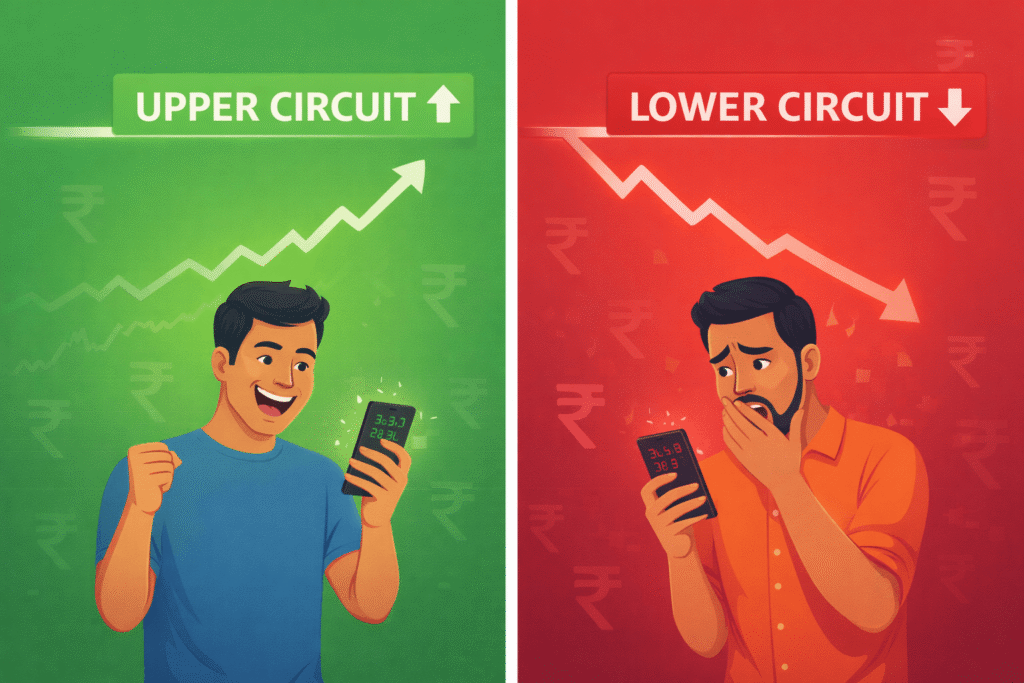
In upper circuit, buyers outnumber sellers — in lower circuit, sellers outnumber buyers.
This system ensures the market remains fair and stable, even when investor emotions run high during major news events or earnings announcements.
📌 Also read: Difference Between NSE and BSE: Simple Guide for Beginners in India (2026)
Circuit Limit Bands in India (NSE / BSE)
| Stock Category | Circuit Limit | Example |
|---|---|---|
| Low volatility / Large caps | 2% | Nifty 50 index heavyweights |
| Moderate volatility stocks | 5% | Mid-cap, select sector stocks |
| Normal stocks | 10% | Most listed stocks |
| High volatility / Small caps | 20% | Penny stocks, newly listed SME stocks |
The exact percentage assigned to each stock depends on its category and historical volatility. This approach helps calibrate the protection to the actual risk level of each stock — a large, stable company naturally gets a tighter limit than a small, speculative one.
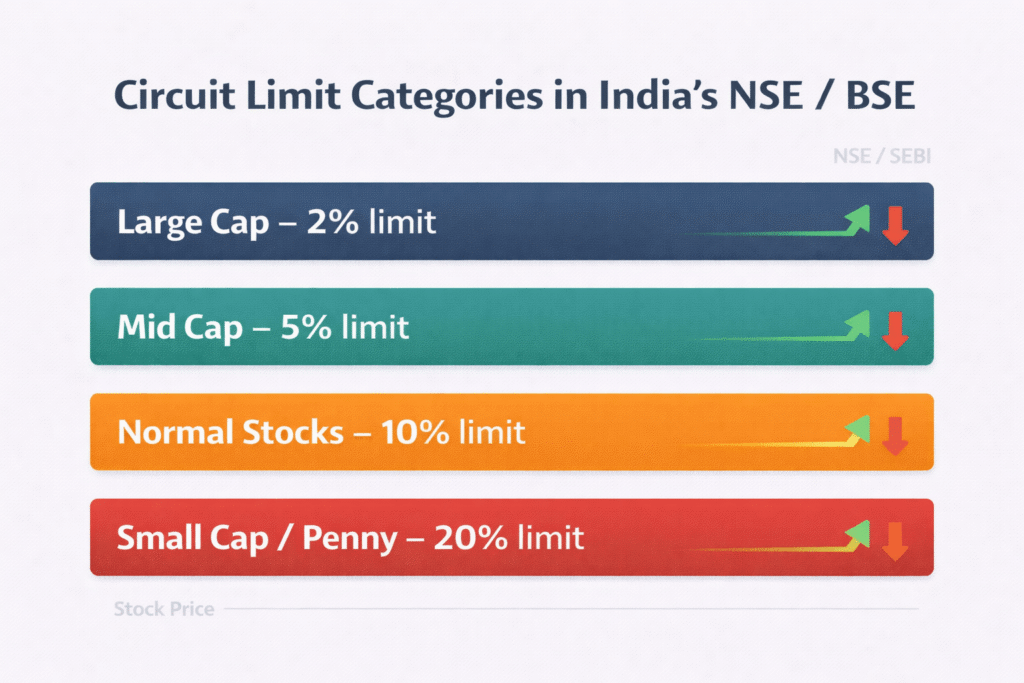
SEBI assigns circuit limits ranging from 2% to 20% based on each stock’s category and historical volatility.
Formula & Calculation
Circuit Calculation Formula
Upper Circuit = Previous Close × (1 + Limit%)
Lower Circuit = Previous Close × (1 − Limit%)
The math is refreshingly simple — and once you understand it, you can quickly check the limits for any stock you are watching.
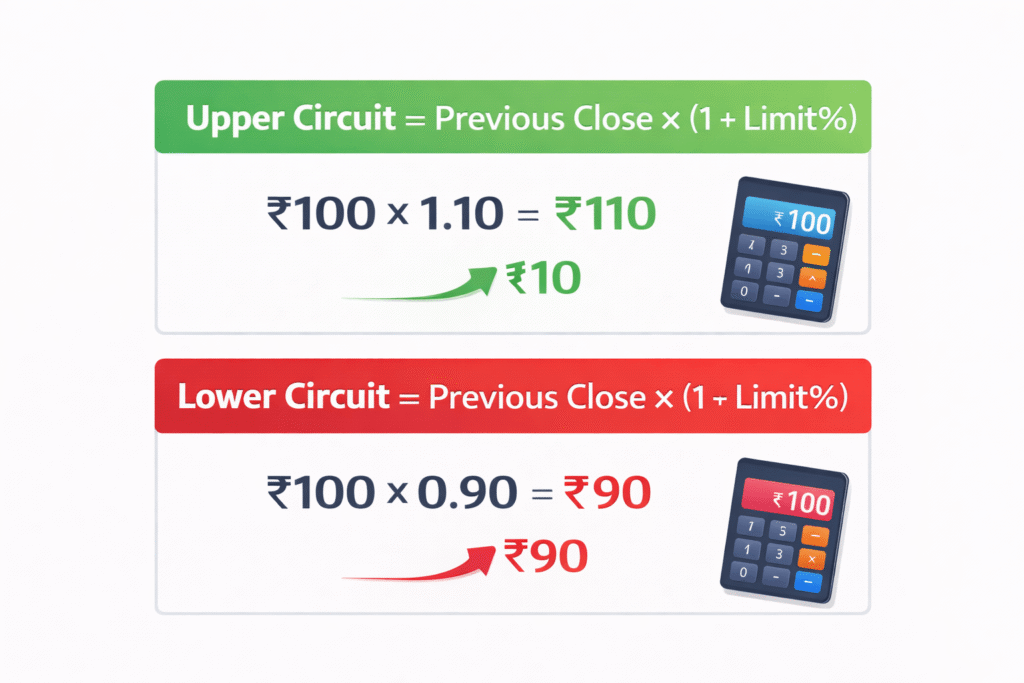
Upper Circuit = Previous Close × (1 + Limit%) — Lower Circuit = Previous Close × (1 − Limit%)
Worked Example
| Detail | Value |
|---|---|
| Previous closing price | ₹100 |
| Applicable circuit limit | 10% |
| Upper Circuit Price | ₹110 (₹100 × 1.10) |
| Lower Circuit Price | ₹90 (₹100 × 0.90) |
With this formula, you can calculate the exact price ceiling and floor for any stock before the market opens — a useful habit to build, especially during high-volatility periods.
Why Circuit Limits Exist
These limits were introduced to prevent sudden, extreme price swings that could harm everyday investors. They serve three clear purposes: stopping potential market manipulation by large players, giving the market time to breathe during episodes of panic buying or selling, and maintaining overall stability so that all participants can trade with reasonable confidence.
Real Stock Market Examples (India)
Let us bring these concepts to life with practical examples from well-known Indian companies. These real-world situations show exactly how upper and lower circuits play out during live trading sessions.
Example 1 — Upper Circuit (Reliance Industries)
Suppose Reliance Industries releases strong quarterly results that comfortably beat market expectations. The news spreads quickly, and buyers rush in from all sides. The stock price climbs fast and hits its +10% limit early in the session. At that point, there are no sellers willing to match the elevated price, so trading effectively pauses at the upper circuit level. Existing shareholders enjoy a significant single-day gain, while new buyers must wait for the next trading session to enter.
Example 2 — Lower Circuit (HDFC Bank)
Now consider a scenario involving HDFC Bank. If the bank announces weaker-than-expected quarterly results or faces negative regulatory news, investors begin selling heavily. The stock price drops sharply until it reaches its lower circuit limit — say −10%. At this stage, very few buyers are willing to step in, so the stock remains locked at the lower level for the rest of the day. This pause gives the broader market time to absorb the news without triggering a complete free-fall.
Example 3 — Market-Wide Circuit Breaker (COVID Crash, March 2020)
During the sharp market crash in March 2020, the Nifty 50 index fell rapidly due to COVID-19 panic. When the index crossed certain percentage thresholds, trading across the entire market was halted temporarily. This is known as a market-wide circuit breaker — and it is fundamentally different from the stock-specific upper and lower circuits discussed above.
| Nifty/Sensex Drop | Trading Halt Duration | Applies To |
|---|---|---|
| 10% drop | 15 minutes (before 1 PM) / 45 minutes (after 1 PM) | Entire market (NSE + BSE) |
| 15% drop | 45 minutes | Entire market (NSE + BSE) |
| 20% drop | Full trading day shutdown | Entire market (NSE + BSE) |
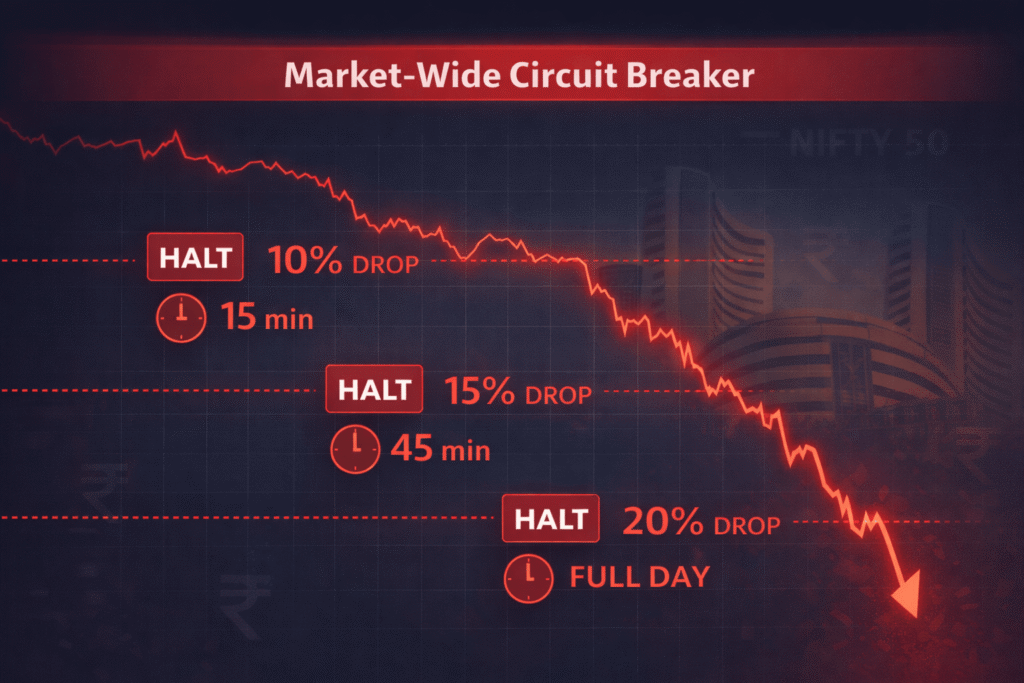
If Nifty drops 10%, 15%, or 20% in a single day, trading across the entire NSE and BSE is halted — this is different from an individual stock circuit.
Key distinction: An individual stock hitting its upper or lower circuit does not stop the rest of the market from trading. A market-wide circuit breaker, however, halts all trading across every stock simultaneously. This is an important difference that many beginners overlook.
📌 Also read: What is Sensex and Nifty: Simple Guide for Beginners in India
Why Investors Use It
Understanding upper and lower circuits helps investors make smarter, calmer decisions every day. When a stock suddenly freezes, you can assess the situation rationally — is strong demand driving the upper circuit, or is panic selling triggering the lower one? This knowledge lets you spot genuine market trends early, protect your capital during volatile periods, and avoid impulsive decisions that could hurt your portfolio. Over time, it builds the kind of confidence that separates informed investors from reactive ones.
Advantages
1. Protects Investors
By capping extreme price movements within a single trading day, circuits provide a safety net for both new and experienced investors against sudden market shocks.
2. Reduces Panic Selling
When prices fall sharply, the lower circuit creates a brief pause. This breathing room often prevents fear-driven sell-offs from spiraling out of control and turning a temporary dip into a prolonged crash.
3. Prevents Manipulation
By limiting how far a price can move artificially in one session, the system makes it significantly harder for large market players to engineer fake rallies or crashes that could mislead retail investors.
4. Improves Market Discipline
Traders are nudged to focus on real company performance rather than short-term hype, which fosters healthier and more rational buying and selling behaviour across the market.
Limitations
1. Trapped Situation
If a stock hits the lower circuit, you may be unable to sell even when you urgently need to exit. This can be particularly frustrating when you need immediate liquidity or wish to cut your losses.
2. Missed Opportunity
On the upper circuit side, eager buyers sometimes cannot enter a position because no sellers are available at the capped price. A potentially profitable trade can slip away entirely for that trading day.
3. Delay in Price Discovery
The true market value of a stock may not be immediately reflected when trading is restricted. This temporary freeze can make it harder to gauge actual supply and demand, which is information the market normally reveals in real time.
4. Not Applicable to All Segments
Futures and options (F&O) contracts follow different rules. Instead of the fixed 2%, 5%, 10%, or 20% limits used for equities, F&O instruments use a dynamic price band — typically 10% — that adjusts based on real-time conditions. If you trade in the derivatives segment, always verify the specific rules that apply to your contract.
Key Takeaways
- Upper circuit sets the maximum price cap a stock can reach in one trading day
- Lower circuit sets the minimum price floor a stock can fall to in one trading day
- Circuit limits in India range from 2% to 20%, depending on the stock’s category
- The formula always uses the previous day’s closing price as the starting point
- If you own shares in upper circuit, you can still sell — new buyers simply cannot enter
- A market-wide circuit breaker is different from individual stock circuits — it halts all trading simultaneously
- F&O segments use dynamic price bands, not fixed circuits
- Understanding these rules helps every beginner stay calm and trade with greater confidence
Frequently Asked Questions (FAQs)
1. What is upper circuit in simple words?
Upper circuit is the highest price a stock is allowed to reach in a single trading day. Once this price ceiling is hit, no further buying can push the price higher until the next session.
2. Can I buy a stock that is in upper circuit?
In most cases, no. When a stock hits the upper circuit, there are no sellers willing to sell at that capped price. Without sellers, buy orders cannot be filled, and new buyers must wait for the next trading day.
3. Can I sell my stock when it is in upper circuit?
Yes. If you already own the shares, you can place a sell order even when the stock is at its upper circuit. Your sell order will be matched if any buyer is available at that price. Existing holders are not locked out — only new buyers face difficulty.
4. Why do stocks hit lower circuit?
Heavy selling pressure — triggered by bad news, weak quarterly results, sector headwinds, or broader market panic — can push a stock down to its lower circuit limit. Once reached, very few buyers are willing to absorb the selling, so the stock locks at that floor for the rest of the day.
5. Who decides circuit limits in India?
SEBI sets the overall regulatory framework and determines which percentage band applies to which category of stock. The NSE and BSE then implement and enforce these specific circuit limits for every listed security on a daily basis.
6. How is the upper circuit price calculated?
The formula is: Upper Circuit = Previous Closing Price × (1 + Circuit Limit%). For example, if a stock closed at ₹200 and has a 10% circuit limit, its upper circuit for the next day is ₹220. The lower circuit in the same case would be ₹180.
7. What is the difference between upper circuit and a market-wide circuit breaker?
An upper or lower circuit applies to a single stock and pauses trading in that stock only. A market-wide circuit breaker, by contrast, is triggered when the Nifty 50 or Sensex drops by 10%, 15%, or 20% in a single day — and it halts trading across the entire NSE and BSE simultaneously.
8. Do Futures and Options (F&O) have circuit limits?
Not in the same way as equities. F&O contracts do not have fixed 2%, 5%, 10%, or 20% circuits. Instead, they use a dynamic price band (typically around 10%) that adjusts based on real-time market conditions. Always check the exchange circulars for the specific rules applicable to your derivative contract.
Conclusion
Understanding what is upper circuit and lower circuit in stock market India gives you a much clearer picture of how stock prices behave during intense buying or selling pressure. Instead of feeling confused or anxious when a stock freezes on your trading app, you will know exactly what is happening — whether strong demand is driving an upper circuit or heavy selling is triggering a lower one.
For beginners especially, this knowledge is genuinely empowering. It helps you stay calm, think clearly, and avoid the emotional decisions that can quietly damage a portfolio over time. Whether you trade on Groww, Zerodha, or any other platform, circuits are a feature of the market designed to protect you — not work against you. Keep learning, stay patient, and let these safety mechanisms do exactly the job they were built to do.
Disclaimer
This article is intended for educational purposes only and does not constitute financial or investment advice. Always conduct your own research and consult a SEBI-registered financial advisor before making any investment decisions.