
Last Updated: September 30, 2026
Every week, new investors open their app, see a stock stuck at one price, and can’t tell whether it’s good news or a trap. Knowing what is upper circuit and lower circuit in stock market India clears that up quickly.
Think of circuits as a one-day speed limit for a share price. The stock can’t move beyond a set range from the previous close, whatever the news. This guide covers the meaning, the 2%, 5%, 10% and 20% bands, the price formula, and how market-wide circuit breakers work. It also corrects a common myth: stocks with F&O contracts don’t have fixed circuits.
What is Upper Circuit and Lower Circuit in Stock Market India
Upper Circuit Meaning & Lower Circuit Meaning
Upper circuit meaning: the highest price a stock is allowed to trade at in a single session. Lower circuit meaning: the lowest price it is allowed to trade at in a single session. No trade can happen outside that range, however strong the buying or selling gets.
The limits keep trading orderly and protect everyone from large institutions to first-time retail investors.
Upper Circuit vs Lower Circuit — Quick Comparison
| Feature | Upper Circuit | Lower Circuit |
|---|---|---|
| Direction | Price rises to the cap | Price falls to the floor |
| Market condition | Very high demand | Heavy selling pressure |
| Order queue | Buy orders pile up, few sellers at that price | Sell orders pile up, few buyers at that price |
| Typical emotion | Greed and excitement | Fear and panic |
| Can existing holders sell? | Yes Usually easy, since buyers are waiting | Hard Few buyers available |
If you already own a stock that hits upper circuit, you can still sell it. Trading doesn’t freeze. Trades keep happening at or below the cap. The difficulty is for new buyers, who find almost no sellers at that price.
📌 Also read: What is SEBI in Stock Market? Complete Beginner-Friendly Guide (2026)
How Circuit Limits Work in India (SEBI Rules)
SEBI sets the overall framework for upper circuit and lower circuit rules. The National Stock Exchange (NSE) and the Bombay Stock Exchange (BSE) then assign a band to each stock and revise it when trading patterns change. NSE reviews bands regularly, and a band can move from 20% to 10%, or the reverse.
The system keeps the market fair even when emotions run high around big news or earnings.
📌 Also read: Difference Between NSE and BSE: Simple Guide for Beginners in India (2026)
Circuit Limit Bands in India (NSE / BSE)
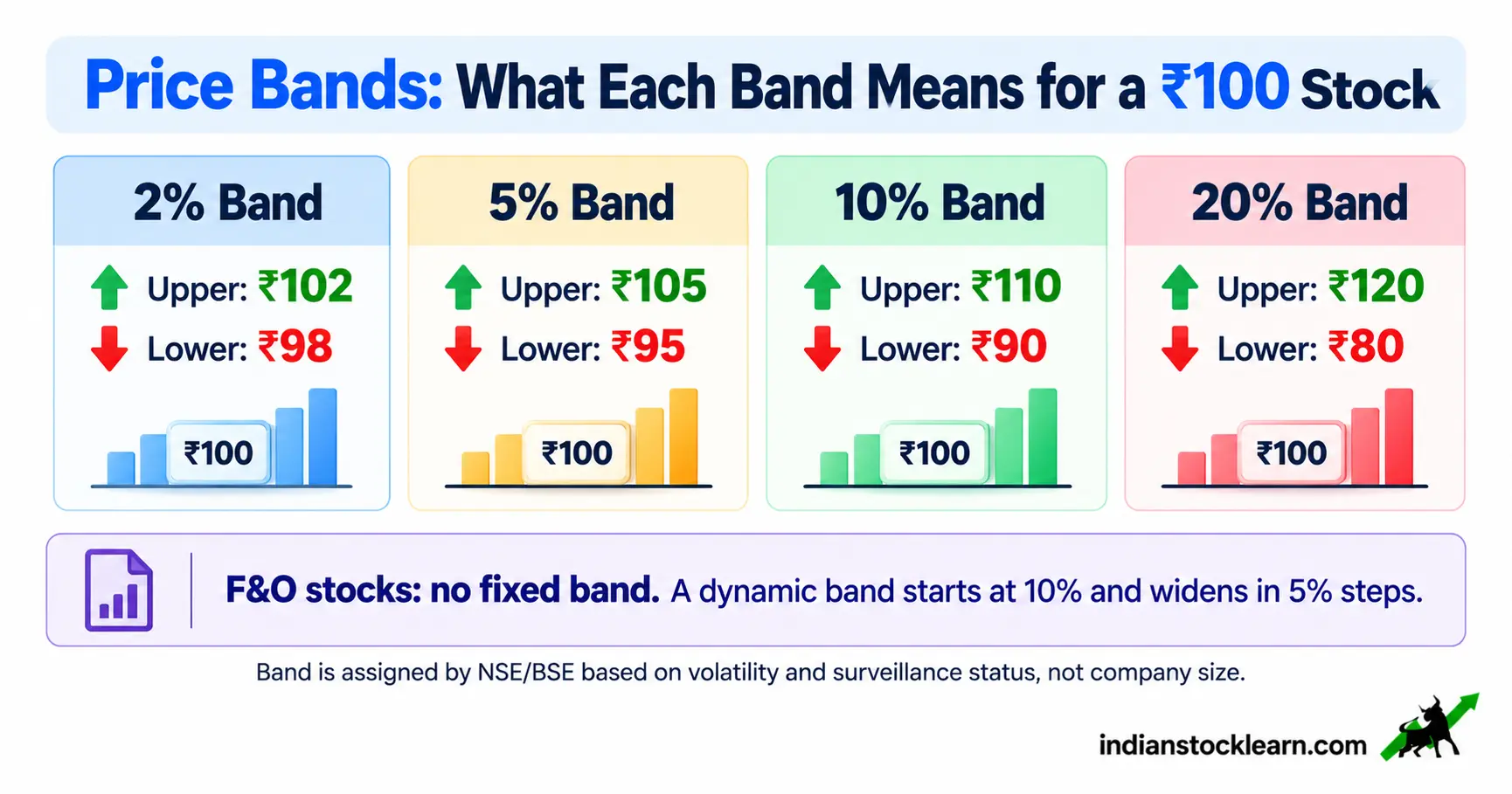
Stocks without F&O contracts get one of 4 bands: 2%, 5%, 10% or 20%. The exchange picks the band using the stock’s volatility, trading pattern and surveillance status. Company size doesn’t decide it, so a large company doesn’t automatically get a tight band. Here is what each band means for a stock that closed at ₹100:
| Band | Upper Circuit | Lower Circuit |
|---|---|---|
| 2% | ₹102 | ₹98 |
| 5% | ₹105 | ₹95 |
| 10% | ₹110 | ₹90 |
| 20% | ₹120 | ₹80 |
| No fixed band (F&O stocks) | A dynamic price band starts at 10% and widens in 5% steps, with a 15-minute cooling-off period each time the price reaches an edge | |
Formula & Calculation
Circuit Calculation Formula
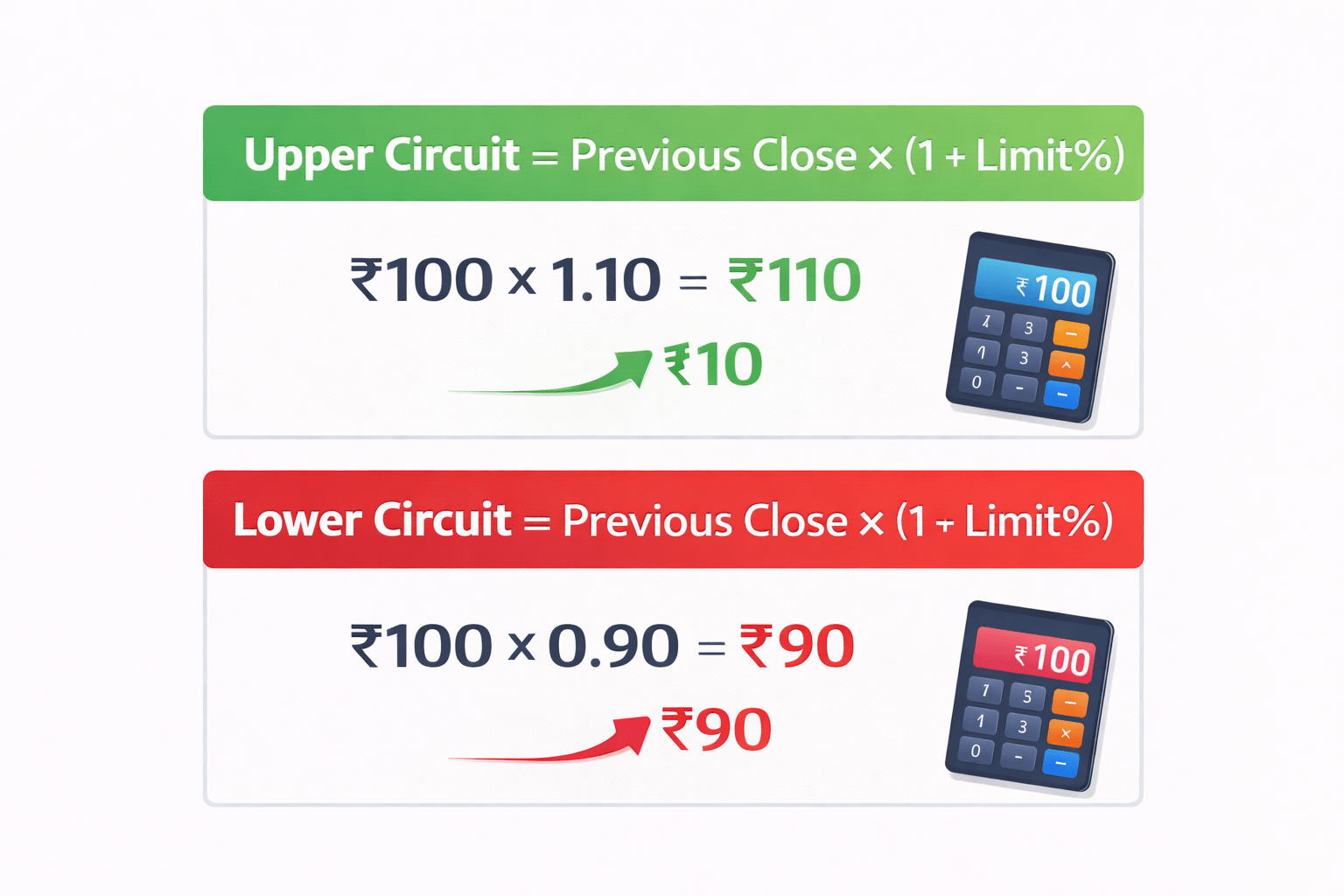
Upper Circuit = Previous Close × (1 + Limit%)
Lower Circuit = Previous Close × (1 − Limit%)
Once you know this, you can work out the ceiling and floor for any stock you’re watching before the market opens.
Worked Example
| Detail | Example 1 | Example 2 |
|---|---|---|
| Previous closing price | ₹100 | ₹250 |
| Applicable band | 10% | 5% |
| Upper circuit price | ₹110 (₹100 × 1.10) | ₹262.50 (₹250 × 1.05) |
| Lower circuit price | ₹90 (₹100 × 0.90) | ₹237.50 (₹250 × 0.95) |
Exchanges round the result to the nearest tick, so the limit on your screen can differ from your calculation by a few paise.
Why Circuit Limits Exist
Upper circuit and lower circuit limits were introduced to stop extreme price swings that could hurt everyday investors. They do 3 jobs: they make market manipulation harder, they give the market time to absorb news during panic buying or selling, and they keep trading stable enough for all participants.
How to Check Today’s Upper Circuit and Lower Circuit Stocks
You don’t need to calculate anything by hand to see which stocks hit their upper circuit and lower circuit today. The exchanges publish it:
- NSE: the daily price band report and market data pages on nseindia.com list every stock’s current band.
- BSE: the price band and circuit filter section under market data on bseindia.com.
- Broker apps: Zerodha, Groww and Upstox show the upper and lower circuit limit on each stock’s quote page.
Real Stock Market Examples (India)
Example 1 — Upper Circuit (Small-Cap Stock)
Take a small-cap company, XYZ Ltd, with a 20% band and a previous close of ₹50. It announces strong quarterly results, and buyers rush in. The price reaches ₹60, its upper circuit, within minutes. Buy orders now queue at ₹60 while almost nobody offers shares at that price. Existing holders see a 20% gain. New buyers wait for the next session, when the band resets from the new closing price.
Example 2 — Lower Circuit (Small-Cap Stock)
Now flip it. XYZ Ltd closes at ₹50, then reports a big loss and faces a regulatory notice. Sellers flood in and the price drops to ₹40, its lower circuit. Sell orders pile up, but buyers are scarce. Holders who want out may not find anyone to trade with that day, and the stock can stay locked at ₹40 until the close.
Example 3 — Market-Wide Circuit Breaker (COVID Crash, March 2020)
On 13 March 2020, the Nifty hit the 10% breaker in early trade, and trading halted for 45 minutes. It happened again on 23 March 2020, when the Sensex fell 10%. These halts are market-wide circuit breakers. They work differently from the upper circuit and lower circuit on a single stock.
| Nifty / Sensex move | Time of breach | Trading halt |
|---|---|---|
| 10% | Before 1:00 PM | 45 minutes |
| 1:00 PM to 2:30 PM | 15 minutes | |
| After 2:30 PM | No halt | |
| 15% | Before 1:00 PM | 1 hour 45 minutes |
| 1:00 PM to 2:00 PM | 45 minutes | |
| After 2:00 PM | Rest of the day | |
| 20% | Any time | Rest of the day |
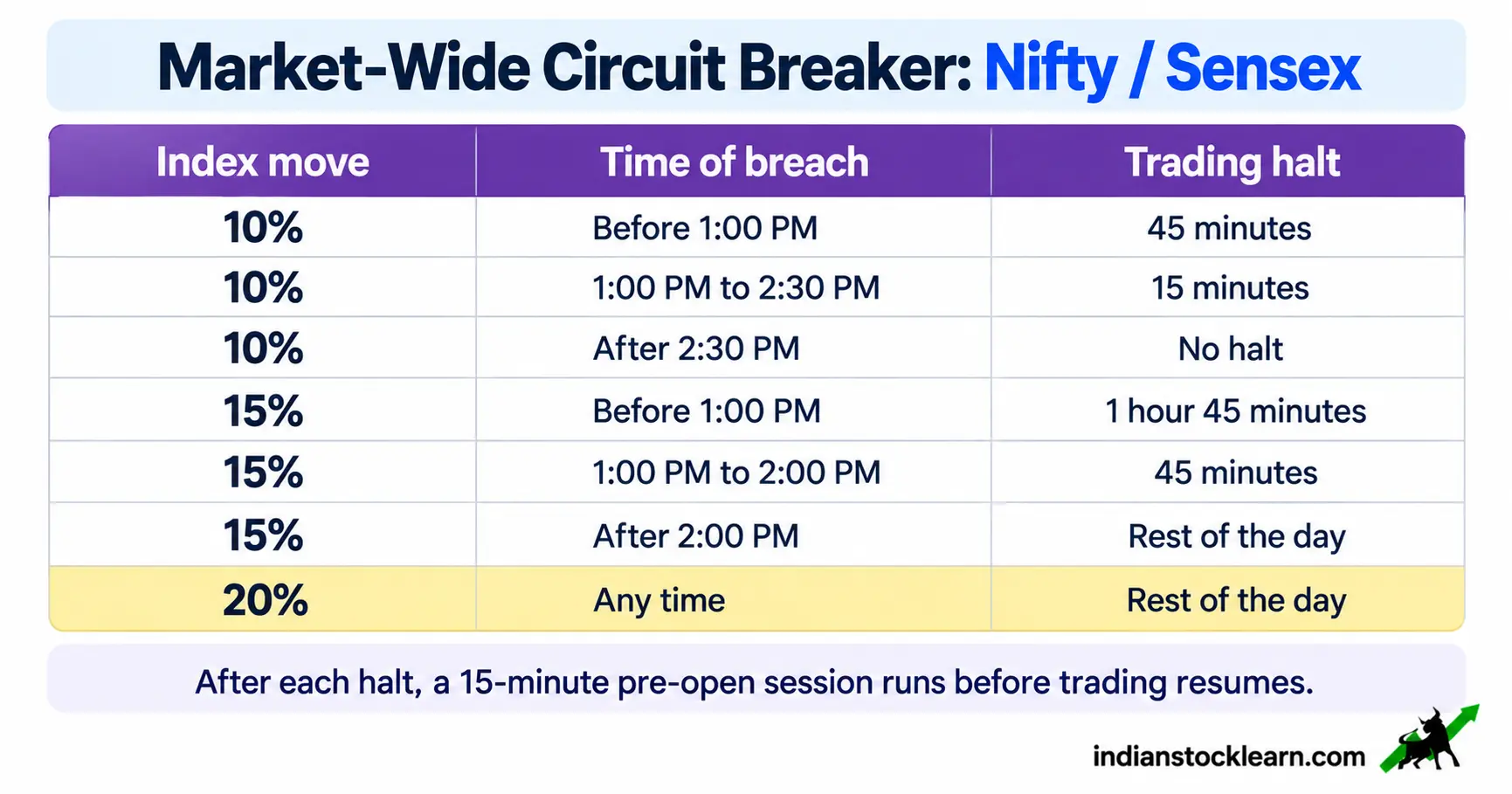
After each halt, the market reopens with a 15-minute pre-open session. You can read how that works in our guide to NSE pre-open session rules. The breaker levels are recalculated every day from the previous close of the index.
📌 Also read: What is Sensex and Nifty: Simple Guide for Beginners in India
Why Investors Use It
Knowing how upper circuit and lower circuit limits work lets you read a frozen stock calmly. You can check whether strong demand or panic selling is behind it, and avoid rushed decisions during volatile days. Circuit moves also show up in market mood, so it helps to read them alongside our guide to bull and bear markets.
Advantages
The upper circuit and lower circuit system gives investors 4 clear benefits.
1. Protects investors. Capping the daily move gives both new and experienced investors a buffer against sudden shocks.
2. Reduces panic selling. A lower circuit forces a pause. That breathing room can stop a fear-driven sell-off from turning a dip into a crash.
3. Makes manipulation harder. Limiting how far a price can move in one session makes it tougher for large players to engineer fake rallies or crashes.
4. Encourages discipline. With hype capped for the day, traders have more reason to look at company results instead of short-term noise.
Limitations
The upper circuit and lower circuit system also comes with trade-offs you should know about.
1. Trapped positions. If a stock is locked at its lower circuit, you may not be able to sell when you need cash, even at a loss.
2. Missed entries. At upper circuit, buyers often can’t get shares because nobody is selling at the capped price.
3. Delayed price discovery. While a stock sits at its limit, its true value may not show in the price, because supply and demand can’t fully play out.
4. F&O stocks work differently. Stocks with futures and options contracts have no fixed 2%, 5%, 10% or 20% band. NSE applies a dynamic price band that starts at 10% of the previous close and widens in 5% steps. Since many large companies are in the F&O list, their price can move well beyond 10% in a day. Learn more in our option chain analysis guide.
5. A circuit alone says little about quality. Upper circuit shows heavy buying on one day. Thinly traded stocks can hit circuits several days in a row and then reverse. Check the news or results behind the move before drawing any conclusion.
Key Takeaways
- Upper circuit and lower circuit are the maximum and minimum prices a stock can trade at in one session.
- Non-F&O stocks get a 2%, 5%, 10% or 20% band, assigned by the exchange from volatility and surveillance status, not company size.
- F&O stocks have no fixed band. A dynamic band starts at 10% and widens in 5% steps.
- The formula uses the previous day’s closing price as the starting point.
- At upper circuit, existing holders can still sell. New buyers struggle to find sellers.
- A market-wide circuit breaker triggers at 10%, 15% or 20% moves in Nifty or Sensex and halts every stock.
Frequently Asked Questions (FAQs)
What is upper circuit in simple words?
Can I buy a stock that is in upper circuit?
Can I sell my stock when it is in upper circuit?
Why do stocks hit lower circuit?
Who decides circuit limits in India?
How is the upper circuit price calculated?
What is the difference between upper circuit and a market-wide circuit breaker?
Do Futures and Options (F&O) stocks have circuit limits?
What is a circuit filter in the stock market?
When does a stock come out of upper circuit?
Conclusion
Upper circuit and lower circuit rules explain why a stock sometimes freezes on your screen. Now you can tell whether strong buying is behind it or heavy selling, and you know that F&O stocks and market-wide breakers follow different rules.
The limits are built to slow extreme moves so that prices can settle. They apply the same way whether you trade on Groww, Zerodha or any other platform. For the full picture of how orders reach the exchange, read how the stock market works in India.
its new Version
yes i updated