
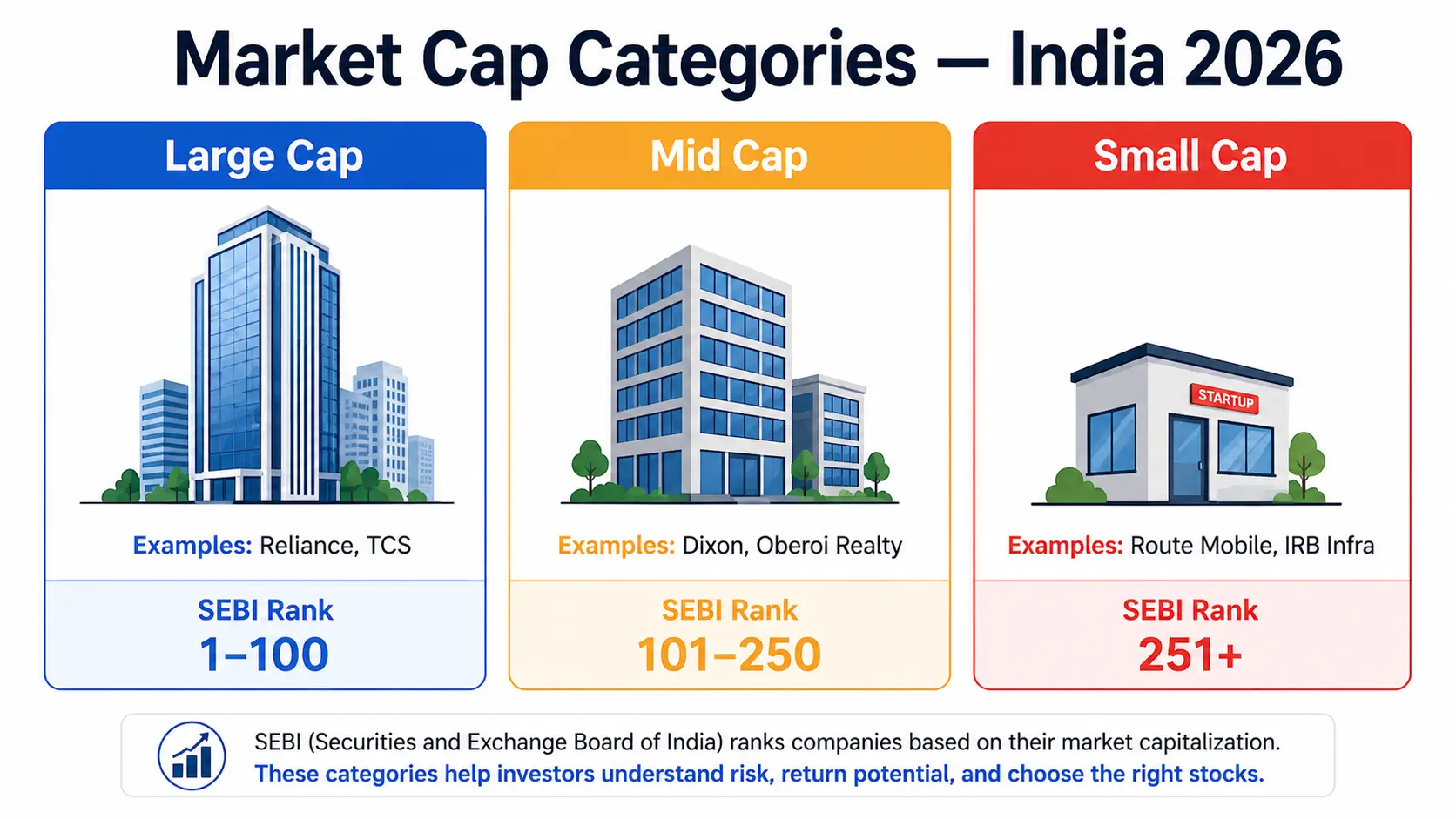
Last Updated: May 13, 2026
SEBI officially classifies only 100 companies as large cap in India. Everything else — thousands of stocks — falls into mid or small cap. That one rule changes how you should think about risk.
Which one is safe? Which gives the highest returns? Which is right for a beginner?
If this sounds familiar, you are not alone. Millions of new investors in India face the exact same confusion every day. The good news is that understanding large cap vs mid cap vs small cap stocks in India is simpler than it looks — and this guide will make it crystal clear.
“This complete guide on large cap vs mid cap vs small cap stocks India covers everything you need.”
By the end of this article, you will know how each category works, how SEBI classifies them, what the real risk differences are, and how to build a beginner-friendly SIP strategy using real examples like Reliance Industries and TCS.
📌 Quick Fact: According to SEBI’s classification rules, India’s stock market is divided into three clear categories — and every mutual fund or stock you invest in falls into one of them.
📑 Table of Contents
- What Is Market Cap in the Indian Stock Market?
- SEBI Classification: Large Cap, Mid Cap, Small Cap (India 2026)
- Large Cap vs Mid Cap vs Small Cap — Full Comparison
- How These Categories Work in Mutual Funds
- Which Is Best for SIP? A Beginner’s Roadmap
- Can a Small Cap Become a Large Cap?
- How to Identify Cap Categories on Zerodha or Groww
- Advantages and Limitations of Each Category
- Key Takeaways
- Frequently Asked Questions
1. What Is Market Cap in the Indian Stock Market?
Market capitalization (market cap) is simply the total value of a company as measured by the stock market. It tells you how big or small a company is — not by its revenue or number of employees, but purely by its market value.
The Formula Is Straightforward
📐 Market Cap Formula:
Market Cap = Current Share Price × Total Outstanding Shares
A Real Indian Example: Reliance Industries
Share Price ≈ ₹2,500
Total Outstanding Shares ≈ 676 crore
Market Cap = ₹2,500 × 676 crore = ₹16+ lakh crore
That massive number is exactly why Reliance Industries is a large cap stock in India — it is one of the most valuable companies listed on NSE and BSE.
Market cap is the most widely used way to classify stocks because it reflects what the entire market thinks a company is worth at any given moment.
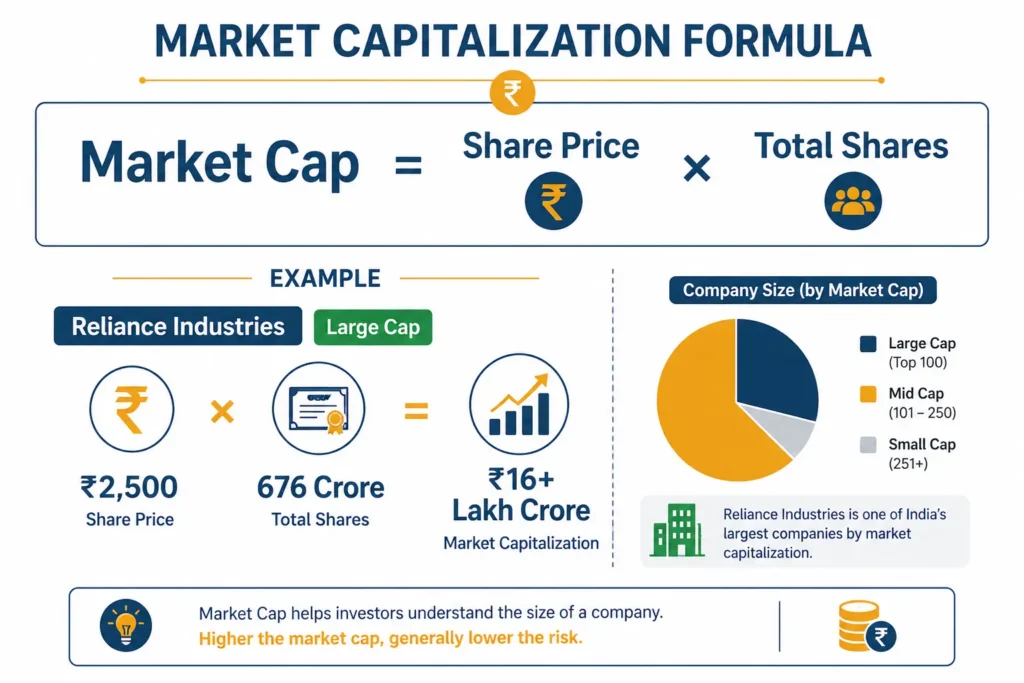
Market cap = Share Price × Total Shares. Reliance Industries is a classic large cap example in India.
2. SEBI Classification: Large Cap, Mid Cap, and Small Cap in India (2026)
The Securities and Exchange Board of India (SEBI) officially defines these three categories so there is no ambiguity for investors or fund managers. Here is the current classification:
Many beginners confuse small cap stocks with penny stocks. They are very different.
Small cap stocks are legitimate, SEBI-regulated companies with real businesses that are ranked 251st and beyond by market cap.
Penny stocks are extremely low-priced shares that often have no real business model and carry very high risk of fraud or loss.
Never mix the two up.
SEBI and AMFI review and update this classification list every six months. A company’s rank can move up or down depending on how its share price and market cap change over time.
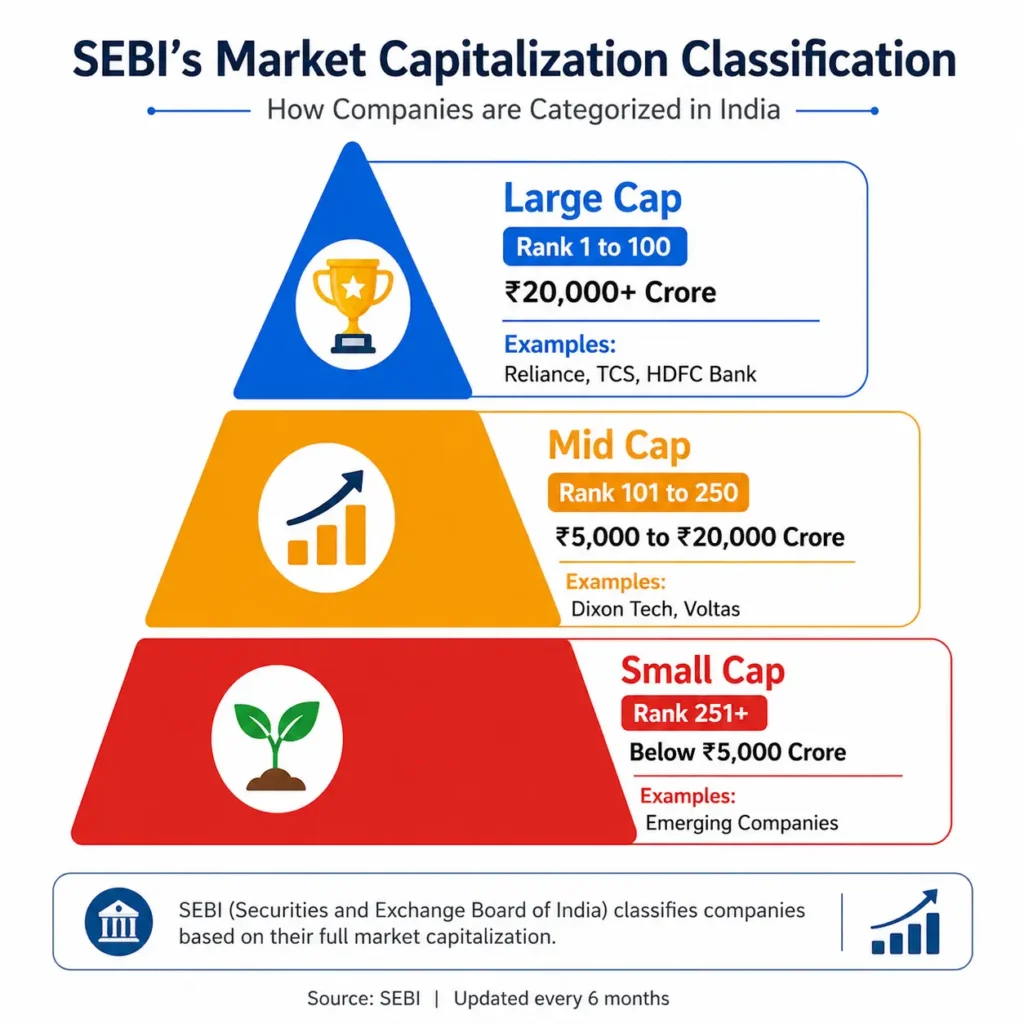
SEBI classifies Indian companies into three categories based on their market rank. This list is updated every 6 months.
3. Large Cap vs Mid Cap vs Small Cap — Full Comparison
Now that you understand the definitions, let’s compare all three categories across the factors that matter most to investors. When comparing large cap vs mid cap vs small cap stocks India, the biggest differences are risk and return. This is where the real decision-making begins.
💡 Simple Rule of Thumb: Higher potential return always comes with higher risk. There is no free lunch in the stock market. Large cap stocks sleep well; small cap stocks dream big — but the ride is bumpy.
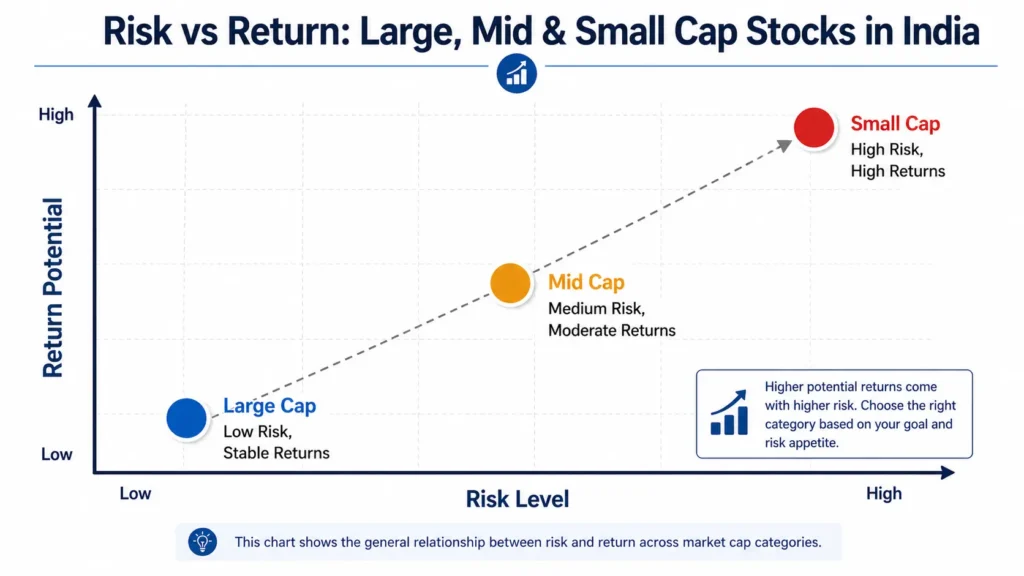
Higher potential returns in small cap come at the cost of higher risk. Balance your portfolio based on your risk appetite.
4. How These Categories Work in Mutual Funds
When you invest in a mutual fund on platforms like Groww or Zerodha, you are effectively investing in a basket of stocks. SEBI has set minimum allocation rules for each fund category:
These rules mean that when you pick a “mid cap fund,” you know exactly what kind of stocks the fund manager must hold. This clarity helps you align your investment choices with your personal risk tolerance.
5. Which Is Best for SIP in India? A Beginner’s Roadmap
There is no single “best” category for SIP — it depends entirely on your timeline and comfort with risk. That said, here is a proven beginner-friendly approach that many financial educators recommend:
Low risk, steady growth. Build confidence as a new investor. Horizon: 3–5 years.
Once you understand market cycles, diversify with a mid cap SIP for growth potential.
Only if you have a 10+ year horizon and can handle high volatility without panic-selling.
📌 Key Principle: Consistency matters more than which category you choose. A SIP that runs for 10 years in a large cap fund will outperform a small cap fund that gets stopped during a market crash.
6. Can a Small Cap Stock Become a Large Cap?
Yes — and this is one of the most exciting aspects of investing in mid and small cap stocks in India. Companies can and do move between categories as they grow.
A well-known example is Zomato, which started as a relatively smaller company before its IPO and gradually climbed into the mid cap and eventually large cap category as its market valuation grew. Similarly, many companies that were once small cap have grown into giants over a 10–15 year period.
This is why SEBI and AMFI update the classification list every six months — because the stock market is dynamic, and a company’s rank can change as its share price rises or falls.
For long-term investors, this “graduation” from small cap to large cap is where the biggest wealth creation has historically happened — though it comes with proportionally higher risk along the way.
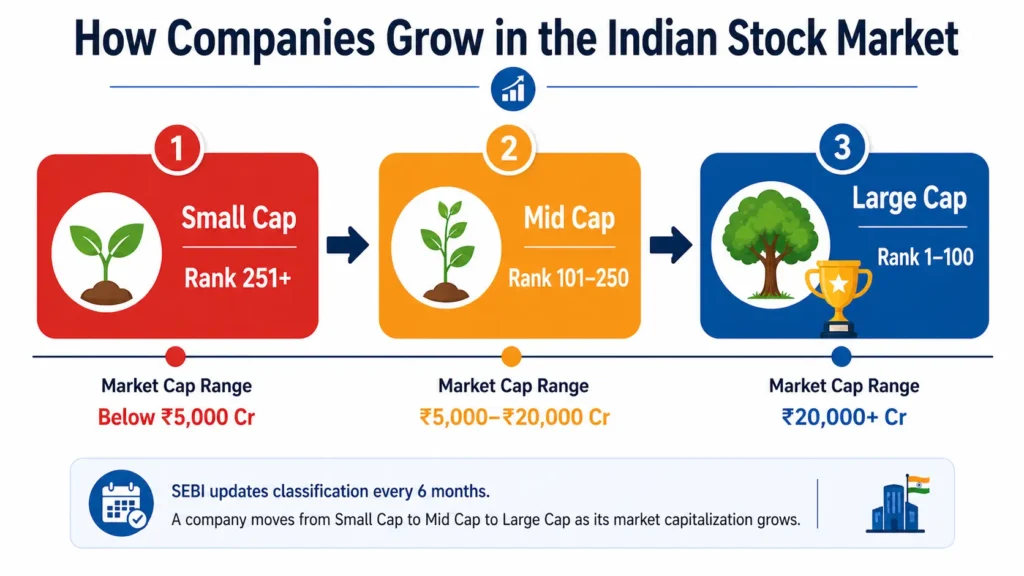
Companies can grow from small cap to large cap over time. SEBI updates this list every 6 months.
7. How to Identify Large, Mid, and Small Cap Stocks on Zerodha or Groww
You do not need to manually calculate market cap every time. Here is a simple way to check any stock’s category directly on the most popular Indian investing apps:
- Open the app (Zerodha, Groww, Paytm Money, or similar)
- Search for the stock by name or ticker symbol
- Look at the stock details page — the market cap is displayed prominently
- Compare with SEBI’s classification: ₹20,000 Cr+ = Large Cap, ₹5,000–₹20,000 Cr = Mid Cap, Below ₹5,000 Cr = Small Cap
- For mutual funds, the fund category (Large Cap / Mid Cap / Small Cap) is clearly labelled on the fund page
You can also visit the official NSE India website or Zerodha Varsity for a complete updated list of stocks in each category.
8. Advantages and Limitations of Each Category
9. Key Takeaways
- ✅ Market cap = Share Price × Total Shares. It defines how big a company is.
- ✅ SEBI classifies the top 100 companies as Large Cap, ranks 101–250 as Mid Cap, and 251+ as Small Cap.
- ✅ Large cap = low risk, stable returns — best for beginners and conservative investors.
- ✅ Mid cap = medium risk, better growth — suitable for investors with a 5–7 year horizon.
- ✅ Small cap = high risk, high reward — only suitable for long-term, patient, aggressive investors.
- ✅ Small cap ≠ penny stocks. Never confuse the two.
- ✅ Start simple: A large cap SIP is the most sensible first step for any new investor in India.
- ✅ Diversify gradually as your knowledge and risk tolerance grow.
10. Frequently Asked Questions
What is the difference between large cap, mid cap, and small cap stocks in India?
In India, SEBI defines large cap stocks as the top 100 companies by market cap (₹20,000 Crore+), mid cap as ranks 101–250 (₹5,000–₹20,000 Crore), and small cap as rank 251 and beyond (below ₹5,000 Crore). Large cap stocks carry low risk, mid cap stocks carry moderate risk, and small cap stocks carry high risk but offer the highest long-term return potential.
Which is better for beginners — large cap, mid cap, or small cap?
For beginners, large cap stocks and funds are the safest and most recommended starting point. They are less volatile, easier to understand, and provide stable returns over a 3–5 year horizon. Once you gain experience and confidence, you can gradually add mid cap and small cap exposure to your portfolio.
What is market cap in simple words?
Market cap is the total value of all the shares of a company that are available in the stock market. It is calculated by multiplying the current share price by the total number of shares. It is the simplest way to understand how big or small a company is.
Is mid cap riskier than large cap?
Yes, mid cap stocks are moderately riskier than large cap stocks. They can fall more sharply during market downturns and are more sensitive to economic changes. However, they also offer significantly better growth potential over the medium to long term, which is why many experienced investors include them in a balanced portfolio.
Can a small cap company become a large cap company in India?
Absolutely. Many well-known companies in India today started as small or mid cap stocks and grew over time. SEBI updates the classification list every six months, so a company that performs well and sees its market cap rise can move from small cap to mid cap and eventually to large cap.
What index tracks large cap, mid cap, and small cap stocks in India?
The Nifty 50 tracks large cap stocks, the Nifty Midcap 100 tracks mid cap stocks, and the Nifty Smallcap 250 tracks small cap stocks in India. These are the primary benchmark indices used by fund managers and investors.
Conclusion
Understanding the difference between large cap vs mid cap vs small cap stocks in India is one of the most important foundations of smart investing. It is not about picking the “best” category — it is about matching the right category to your financial goals, time horizon, and risk tolerance.
In the large cap vs mid cap vs small cap stocks India debate, there is no universal winner. Large cap stocks keep you safe and steady. Mid cap stocks help you grow. Small cap stocks can multiply your wealth — but only if you have the patience and discipline to stay invested through market cycles.
Start simple. Stay consistent. Let time and compounding do the heavy lifting. That is the real secret to building wealth through the Indian stock market.
🚀 What to Read Next:
→ What is Bonus Share in Stock Market India for Beginners
→ What is Dividend in Stock Market India? Simple & Clear Guide (2026)
→What is Bull and Bear Market in India? Simple & Clear Guide (2026)
→Share Market Holiday List 2026 India
→ What is Upper Circuit and Lower Circuit in Stock Market India? Simple Guide (2026)
Disclaimer: This article is published for educational and informational purposes only. It does not constitute financial advice, investment recommendations, or any form of professional guidance. Always conduct your own research and consult a qualified financial advisor before making any investment decisions.