
If you’ve already read our guide on trading account vs demat account and know the basic difference, this is the next layer. This is for readers who’ve placed a few trades, seen a settlement delay, or wondered why their broker suddenly asked for a DDPI signature.
This guide covers what actually happens between your order and your demat credit, why the standard “buy → shares appear” flow breaks down in certain trades, the authorisation layer that controls your account, margin pledging, and why some experienced investors deliberately avoid keeping everything with one broker. Every point here is built for demat and trading account for experienced investors who want the mechanics behind the basics.
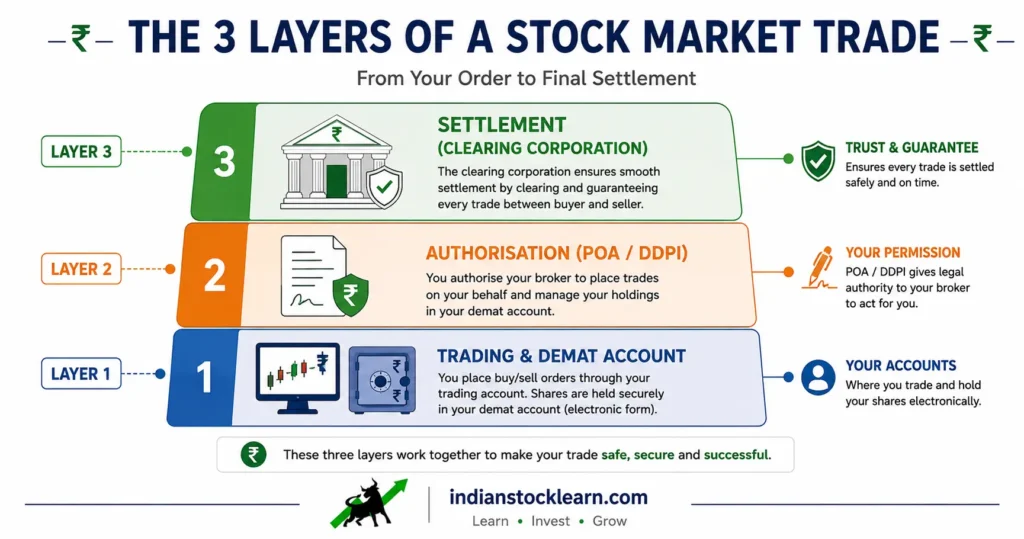
Who This Guide Is For
This isn’t the place to start if you haven’t opened a demat and trading account yet — begin with our guide on how a trading account and demat account work together first. This guide is for readers who already understand that basic flow and now want to know what happens underneath it — the settlement mechanics, the authorisation rules, and the account architecture that active investors deal with over time.
What Happens After You Click Buy
Most beginner explanations stop at “shares are credited to your demat account.” Here’s the fuller sequence for demat and trading account for experienced investors who want to know why that credit doesn’t happen instantly.

Your broker isn’t personally selling you the shares — the exchange, the clearing corporation, and the depository each play a defined role before ownership is final.
When the Standard Flow Breaks Down
The buy-then-credit sequence above is the default. A few common trade types don’t follow it in the same way.
| Trade Type | What Happens to the Shares |
|---|---|
| Delivery (standard buy and hold) | Standard T+1 flow — shares land in your demat account the next working day. |
| Intraday | Shares never enter your demat account — the position is squared off within the same session. |
| BTST (Buy Today, Sell Tomorrow) | You sell before the T+1 credit completes. If the original seller defaults, a short-delivery or auction situation can follow. |
| Margin Trading Facility (MTF) | Shares are credited to your demat account but instantly marked as pledged to the broker — you own them but can’t freely sell without releasing the pledge. |
| IPO Allotment | Funds are blocked via ASBA in your bank account, the trading account isn’t used to place the bid, and shares hit your demat account directly after allotment. |
Myth vs Reality: The Deeper Version
| Myth | Reality |
|---|---|
| Your trading account balance is your full purchasing power. | Purchasing power also depends on pledged-share margin and upfront margin rules, so it can shift within the same day. |
| A demat account is a passive digital vault that just sits there. | It actively interacts with NSDL/CDSL for corporate actions — if your KYC or nominee details aren’t synced with your trading account, dividends and bonus shares can get stuck. |
| Closing a demat account is as simple as opening one. | If it has holdings or pending corporate actions, you generally can’t close it in one click — expect forms and a transfer of shares first. |
| Multiple demat accounts always mean better diversification. | They also mean more consolidation friction, nomination mismatches, and reporting overhead — most people discover this only at the time of sale or inheritance. |
POA vs DDPI: The Control Layer Most Guides Skip
Every beginner explanation says “trading account places orders, demat account stores shares.” What it usually skips is the authorisation layer that actually lets your broker move shares out of your demat account when you sell.
The Old System: Power of Attorney
Some legacy broker setups still rely on a Power of Attorney (POA), a broad authorisation signed when the account was opened. It lets the broker debit shares from your demat account for settlement without asking you again each time.
The Current System: DDPI
SEBI’s Demat Debit and Pledge Instruction (DDPI) narrows that authorisation. It permits your broker to debit shares only for specific purposes — settlement of a sale, pledging for margin, mutual fund transactions — rather than a blanket authority.
e-DIS as the Alternative
If you haven’t signed a DDPI, some brokers ask for an e-DIS confirmation, usually a one-time password, each time you sell delivery shares. It adds a small extra step, but nothing moves out of your demat account without that confirmation.
DDPI or POA affects your daily selling workflow, not just paperwork. A DDPI-linked account sells faster with fewer prompts; an e-DIS-only account adds one confirmation step per sale but keeps a fresh authorisation check each time.
Margin Pledging: Turning Holdings Into Trading Capital
Instead of letting long-term shares sit idle in a demat account, some investors pledge them to their broker as collateral.
Dormant Accounts, AMC Traps and the IEPF Black Hole
Opening an account is a small part of the journey — maintaining it is where most of the quiet costs and risks build up.
- AMC keeps running: Annual Maintenance Charges apply to the demat account, not the trading account. Deactivating a trading app doesn’t stop this — unpaid AMC can quietly accumulate.
- KYC or PAN lapses freeze debits: If KYC lapses or PAN isn’t linked, NSDL/CDSL can freeze the account for debits. You can still receive shares, but your trading account can’t sell them.
- Nominee mismatches delay payouts: A missing or conflicting nominee between the trading and demat account can delay dividends or rights-issue execution.
- Unclaimed holdings move to IEPF: Dividends and shares left untouched for an extended period can be transferred to the Investor Education and Protection Fund. Reclaiming them later means filing an IEPF-5 form.
When “One Broker for Everything” Backfires
The common advice is to open your trading and demat account with the same broker for convenience. That’s reasonable for most beginners, but experienced investors sometimes deliberately split the two.
Single Broker
- Simple setup, one login
- Fewer forms and fewer relationships to manage
- Works well for most casual investors
Split Broker
- A backup route if one platform has an outage
- Separates active trading risk from long-term holdings
- Adds migration and tracking overhead
If a broker’s platform goes down during high volatility — which does happen in Indian markets — and your demat is tied to the same broker, you’re locked out of your own portfolio until it’s resolved. Investors who keep a separate “cold storage” demat account with a bank can use an off-market transfer, through a physical DIS or the CDSL Easiest platform, to move holdings and sell through a different route if needed.
Switching brokers entirely is possible too, though moving an existing demat account is a slower, largely offline process compared to simply opening a new trading account. Compare options in our Zerodha vs Groww vs Upstox breakdown before deciding.

- Settlement runs on a T+1 cycle — shares don’t land in your demat account the moment you buy.
- Intraday, BTST, MTF, and IPO trades don’t follow the standard buy-then-credit flow.
- DDPI has largely replaced old-style POA as the authorisation layer for your demat account.
- Pledged shares provide trading margin, reduced by an exchange-set haircut, with real liquidation risk on unpaid losses.
- Dormant accounts, AMC charges, and unclaimed shares in the IEPF are real, avoidable risks.
- Splitting trading and demat accounts across brokers is a deliberate risk-management choice for some active investors, not a requirement.
Frequently Asked Questions
Why did shares I sold still show in my demat account the next day?
What is DDPI and why does my broker keep asking me to sign it?
Can I sell shares before they’re credited to my demat account?
What exactly is a haircut in margin pledging?
What happens to unclaimed shares and dividends over time?
Is it worth having a demat account with a different broker than my trading account?
Conclusion
Once you’ve handled a few trades, the basic “trading account buys, demat account stores” explanation stops being enough. Understanding demat and trading account for experienced investors means knowing how T+1 settlement actually plays out, why BTST and MTF trades behave differently, what DDPI actually authorises, how margin pledging works, and why dormant accounts quietly cost money.
None of this changes the core relationship between the two accounts — it just fills in what happens underneath it. Check the latest settlement and margin rules directly on NSE and SEBI’s websites, since these frameworks do get updated from time to time.