
If you have just started exploring the stock market, you have probably come across the term SEBI more than once. But what exactly is SEBI, and why does it matter so much to new investors like you?
The story begins with one of India’s most significant financial events — the 1992 market scam that exposed serious gaps in the system and pushed the government to create a powerful watchdog. That watchdog is SEBI. In this guide, we will clearly understand what is SEBI in stock market and why it matters for every beginner.
Understanding what is SEBI in stock market is one of the smartest first steps you can take as a beginner. SEBI works behind the scenes every single day to keep the market fair and safe for ordinary investors. Whether you trade on popular platforms such as Zerodha or Groww, or plan to invest in shares of large companies like Reliance, TCS, or HDFC Bank, SEBI is quietly protecting your interests.
In simple terms, SEBI makes sure the stock market operates safely, transparently, and without unfair practices. Let us break everything down step by step so you can move forward with confidence.

Overview of how SEBI regulates and monitors the Indian stock market
Table of Contents
- SEBI Full Form and Meaning
- Why Was SEBI Formed?
- What is SEBI and Its Functions
- How SEBI Protects Investors
- SEBI vs RBI — Key Differences
- SEBI New Rules 2026
- How to File a Complaint (SCORES)
- Real Stock Market Examples
- Key Takeaways
- Frequently Asked Questions
- Conclusion
What is SEBI in Stock Market
SEBI Full Form and Meaning — What Does SEBI Stand For?
SEBI stands for Securities and Exchange Board of India.
It is the primary regulatory authority that oversees and monitors the Indian stock market. Established in 1988 and granted full statutory powers through the SEBI Act of 1992, it functions as an independent body under the Government of India.
Here is a quick summary:
- SEBI = India’s stock market regulator
- It ensures fair and transparent trading
- It exists primarily to protect investors
SEBI Explained Simply — Like a Referee in Cricket
Think of SEBI as the referee in a cricket match:
- Players = Traders and investors
- Referee = SEBI
- Rules of the game = Market regulations
If a player breaks the rules, the referee steps in immediately. That is exactly how SEBI works — when someone tries to cheat the system, SEBI investigates and takes action.
Why Was SEBI Formed? History and Background
Why Was SEBI Formed in India
In the late 1980s and early 1990s, the Indian stock market had very little regulation. Brokers could manipulate prices, companies could mislead investors, and there was no strong authority to hold anyone accountable.
A major market scam in 1992 brought these weaknesses to national attention. It exposed widespread price manipulation, fake transactions, and inadequate monitoring. The government acted swiftly.To fully understand what is SEBI in stock market, you must first look at its basic role in regulating the market.
The result was the SEBI Act of 1992, which gave SEBI the statutory powers it needed to truly regulate and protect the market.
The three core purposes behind SEBI’s creation were:
- To protect investors from fraud and misleading practices
- To regulate stock exchanges and financial intermediaries
- To prevent manipulation and ensure market integrity
💡 Did You Know? SEBI was originally set up in 1988 as a non-statutory body. It became a fully statutory authority only after the SEBI Act was passed in 1992.
What is SEBI and Its Functions in India
Functions of SEBI Explained with Examples
The concept of what is SEBI in stock market becomes clearer when you understand its real functions in the market. SEBI performs several critical roles that keep the Indian stock market running smoothly. Here are its six main functions:

Key functions of SEBI including regulation, protection, and transparency in the stock market
1. Protecting Investors
SEBI’s top priority is to safeguard the interests of retail investors. It monitors the market for fraudulent schemes, misleading advertisements, and unfair practices — and takes action when violations are found.
2. Regulating Stock Exchanges
SEBI oversees the operations of India’s stock exchanges — primarily NSE (National Stock Exchange) and BSE (Bombay Stock Exchange). It sets the rules they must follow and monitors their compliance.
3. Controlling Brokers and Intermediaries
Every stockbroker in India must be registered with SEBI before they can operate. Platforms like Zerodha, Groww, and Upstox all carry SEBI registration numbers. You can verify any broker’s registration directly on the SEBI website.
4. Preventing Insider Trading
SEBI prohibits the use of confidential, non-public information to trade stocks. Company executives and insiders must follow strict disclosure rules before buying or selling shares in their own company.
5. Promoting Fair Practices
SEBI works to create a level playing field so that all investors — large or small — have access to the same information and the same opportunities.
6. Educating Investors
Through its Investor Education and Protection Fund (IEPF) and awareness campaigns, SEBI actively educates the public about safe investing and financial literacy.
SEBI Powers — Legislative, Executive, and Judicial
One of the most unique aspects of SEBI is that it holds three types of powers — which is rare for a regulatory body:
| Power Type | What It Means | Example |
|---|---|---|
| Legislative | Creates rules and regulations | Setting F&O trading limits |
| Executive | Implements and enforces rules | Inspecting broker records |
| Judicial | Investigates and penalises violations | Imposing fines, banning entities |
This combination of powers allows SEBI to act swiftly — from creating a rule to enforcing it and penalising those who break it — all without depending on other government bodies for every step.
How SEBI Protects Investors in India
Real Examples of SEBI’s Investor Protection

Illustration showing how SEBI protects investors and ensures fair trading
SEBI’s protection is not just theoretical — it shows up in very practical ways:
- Every broker must prominently display their SEBI registration number, making it easy for investors to verify legitimacy before opening an account.
- Listed companies are required to disclose financial results, board decisions, and major business updates to the public at the same time — so no group of investors gets information ahead of others.
- All IPOs (Initial Public Offerings) must go through a rigorous SEBI approval process before shares are offered to the public.
This is where understanding what is SEBI in stock market becomes important for every beginner investor.
Before you invest through any platform, you can check its SEBI registration on the official SEBI website. This single step can protect you from a great deal of financial fraud.
📌 Also read: Difference Between NSE and BSE: Simple Guide for Beginners in India (2026)
SEBI Role in Indian Stock Market for Beginners
As a beginner, here is what SEBI’s presence means for you in practical terms:
- Your broker is accountable to a regulatory authority — they cannot simply disappear with your money.
- The companies you invest in must share honest financial information with the public.
- If you are cheated, you have an official channel to report it and seek resolution.
Without SEBI, the stock market would be far riskier for ordinary investors. With SEBI in place, the market has a strong foundation of trust.
SEBI vs RBI — What Is the Difference?
Many beginners confuse SEBI with the RBI (Reserve Bank of India). While both are powerful regulatory bodies, they serve very different purposes.
| Feature | SEBI | RBI |
|---|---|---|
| Full Form | Securities and Exchange Board of India | Reserve Bank of India |
| Primary Role | Regulates the stock market | Regulates banks and money supply |
| Controls | NSE, BSE, brokers, mutual funds | Commercial banks, NBFCs |
| Main Focus | Investor protection and fair trading | Monetary policy and inflation |
| Established | 1988 (Statutory powers: 1992) | 1935 |
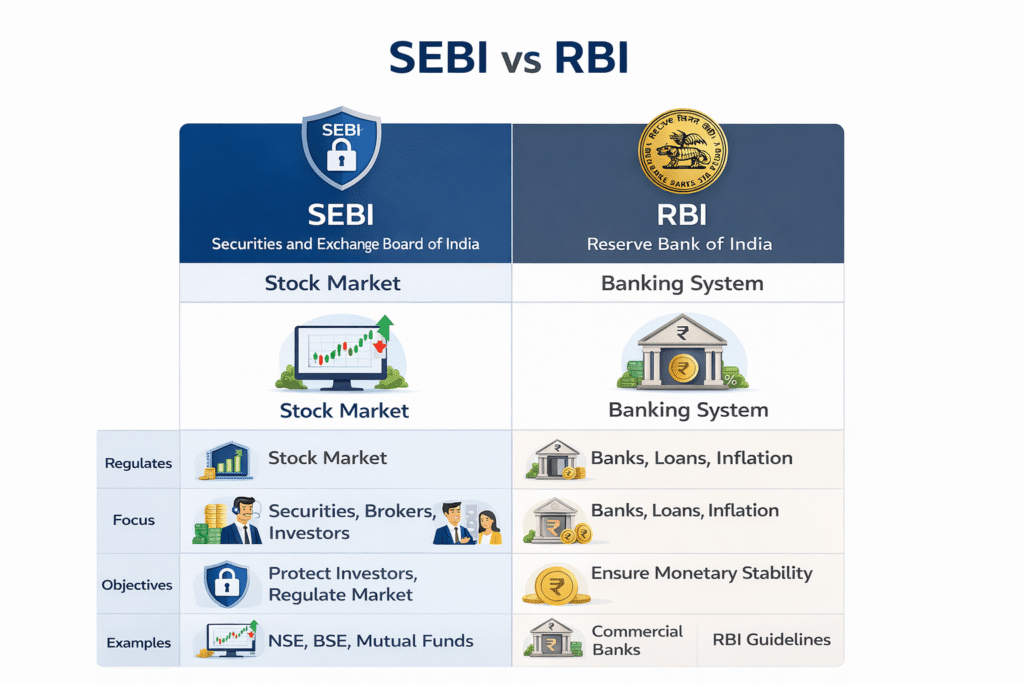
Comparison of SEBI and RBI roles in regulating financial systems in India
The simple way to remember it: SEBI = stock market, RBI = banking system. They work together to keep India’s overall financial system stable and trustworthy.
SEBI New Rules and Regulations for Investors India 2026
SEBI regularly updates its rules to keep pace with market changes and protect investors more effectively. Here are some key areas of focus in 2025–2026:
- F&O (Futures & Options) Regulations: SEBI introduced stricter rules for derivatives trading to reduce speculative risk for retail investors. These changes affected how platforms like Zerodha and Groww offer F&O products.
- Transparency and Disclosure Norms: Listed companies now face tighter timelines for disclosing material information to the public.
- Closing Auction Session (CAS): SEBI has planned the rollout of a closing auction mechanism for price discovery at market close — a significant structural update for Indian exchanges.
- Investor Protection Initiatives: SEBI continues to expand its investor awareness programs and strengthen the grievance redressal system.
These updates reflect SEBI’s ongoing commitment to making India’s stock market safer, more transparent, and better aligned with global standards.
How to File a Complaint with SEBI — SCORES Portal (Step-by-Step)
If you face an issue with your broker or any market participant, SEBI provides an official online platform called SCORES (SEBI Complaints Redress System) to register your complaint.
Here is how to use it:
- Visit the official SCORES portal at scores.gov.in
- Click on “Register” and create a new account using your PAN and basic details.
- Log in and select “Lodge a Complaint”.
- Fill in the details — choose the entity you are complaining against (broker, company, etc.) and describe the issue clearly.
- Submit and note your complaint registration number for future reference.
- Track your complaint status anytime by logging back into SCORES.
SCORES is designed to ensure that your complaint reaches the right authority and receives a timely response. It is free to use and accessible to all investors across India.
Real Stock Market Examples
SEBI’s regulations apply to every listed company in India. Here is how that plays out in practice:
- Reliance Industries must follow SEBI disclosure rules whenever it releases quarterly financial results or announces a major business update. Every investor — large or small — receives the same information at exactly the same time.
- TCS (Tata Consultancy Services) adheres to strict SEBI guidelines for corporate governance and shareholder communication, ensuring that important business decisions are always made public.
- HDFC Bank, as a listed entity, must meet SEBI’s standards for financial reporting, insider trading restrictions, and investor relations — ensuring that shareholders always have access to accurate and up-to-date information.
These rules ensure that no matter which company you invest in on NSE or BSE, there is a consistent standard of transparency and accountability that applies to all.
📌 Also read:Types of Shares in India for Beginners
Why Investors Rely on SEBI
Here is why SEBI’s presence matters to every investor, beginner or experienced:
- It creates a safe and regulated environment for investing
- It provides legal protection against fraud and malpractice
- It ensures market transparency through mandatory disclosures
- It builds long-term trust in the financial system
Advantages of SEBI
- Strong investor protection through active monitoring and enforcement
- Well-regulated market structure that follows global best practices
- Transparent trading environment backed by clear disclosure rules
- Reduced market manipulation through consistent oversight
Limitations of SEBI
While SEBI plays a crucial role, it is important to understand its limitations:
- SEBI cannot eliminate all investment risks — market volatility is a natural part of investing.
- Enforcement can be slow in complex fraud cases involving multiple parties.
- There remains a significant awareness gap among first-time investors in smaller cities and towns.
Key Takeaways
- ✅ SEBI = Securities and Exchange Board of India — India’s primary stock market regulator
- ✅ It was created following the 1992 market scam to bring accountability to the system
- ✅ SEBI protects investors, regulates brokers, and oversees stock exchanges
- ✅ It holds legislative, executive, and judicial powers — making it highly effective
- ✅ SEBI ≠ RBI — SEBI handles markets, RBI handles banking
- ✅ You can file investor complaints through the SCORES portal at scores.gov.in
- ✅ Every broker on Zerodha, Groww, or Upstox is mandatorily registered with SEBI
Frequently Asked Questions (FAQs)
1. What is SEBI in stock market?
SEBI, or the Securities and Exchange Board of India, is the official regulatory authority of India’s stock market. It oversees stock exchanges, registers brokers, and protects investors from fraud and malpractice.
2. Why was SEBI formed in India?
SEBI was formed to address the lack of effective regulation in India’s financial markets. A major market scam in 1992 highlighted serious gaps in oversight, prompting the government to pass the SEBI Act and give the body full statutory powers to regulate, protect, and develop the securities market.
3. What are the main functions of SEBI?
SEBI’s main functions include protecting investors, regulating stock exchanges (NSE and BSE), controlling brokers and financial intermediaries, preventing insider trading, promoting fair market practices, and educating the public about safe investing.
4. What is the difference between SEBI and RBI?
SEBI regulates the securities market — including stock exchanges, brokers, and listed companies. The RBI (Reserve Bank of India) regulates banks, monetary policy, and the overall money supply. Simply put: SEBI governs the stock market, while the RBI governs the banking system.
5. How can I file a complaint with SEBI?
You can file a complaint through SEBI’s official online platform called SCORES (SEBI Complaints Redress System) at scores.gov.in. Register with your PAN, submit your complaint details, and track its status online. The service is free for all investors.
6. Can SEBI punish brokers or companies?
Yes. SEBI has broad judicial powers that allow it to investigate violations, impose financial penalties, suspend trading licences, and even ban individuals or entities from participating in the securities market. It has used these powers in several high-profile enforcement actions.
7. Is SEBI a government or private body?
SEBI is a statutory body established by an Act of Parliament — the SEBI Act of 1992. It operates under the ownership of the Government of India but functions as an autonomous regulatory authority. It is neither a private company nor a standard government department.
8. Does SEBI regulate mutual funds and IPOs as well?
Yes. SEBI regulates mutual funds, IPOs, portfolio management services, and various other investment products in India. Any fund house or company looking to raise money from the public through the securities market must comply with SEBI’s guidelines and approvals.
Conclusion
Understanding what is SEBI in stock market is one of the most important building blocks for any beginner investor in India. SEBI is not just a regulatory body on paper — it is the institution that makes everyday investing safer, fairer, and more reliable for millions of people.
Without SEBI, the stock market would carry far greater risk. With it, you have a well-regulated system where brokers are accountable, companies must be transparent, and investors have a clear path to seek help when something goes wrong. By now, you should clearly understand what is SEBI in stock market and how it works in India.
As you continue your learning journey, you will encounter SEBI’s influence at almost every step — from opening your first demat account to reading a company’s quarterly results. Knowing its role gives you a stronger, more confident foundation as an investor.
If you found this guide helpful, explore more articles in our Stock Market Basics series:
- 📌 Also read: What is the Stock Market? A Simple Guide for Beginners
- 📌 Also read: How the Stock Market Works — A Complete Beginner’s Guide
Disclaimer:
This article is published for educational and informational purposes only. It does not constitute financial, investment, or legal advice. All investments in the stock market are subject to market risks. Readers are advised to consult a qualified financial advisor before making any investment decisions.