
Introduction
You and a few friends decide to open a small tea stall near your home. Each of you contributes some money, and in return, you all receive a fair “share” of the profits.
Now imagine that same simple idea applied to massive companies like Reliance or TCS. That is exactly How the stock market works.
This is why understanding types of shares in India for beginners matters so much. Not every share works the same way. Some give you voting rights and a real say in the company. Others offer more stable, fixed income. And a few behave in entirely different ways.
In this clear, step-by-step guide, you will discover:
- What a share really means
- How shares actually work
- The main types of shares in India
- A simple comparison between them
- Real Indian examples (Reliance, TCS, HDFC Bank)
- Why this knowledge is essential for new investors

Simple example: A company divided into shares just like pizza slices
Table of Contents
Reading time: 12–15 min
- What is a Share?
- How Shares Work
- Types of Shares in India for Beginners
- Simple Comparison
- Real Indian Examples
- Why It Matters
- Key Takeaways
- FAQs
- Conclusion
What is a Share?
A share is simply a small unit of ownership in a company. When you buy a share, you become a part-owner of that business. You may benefit from a rising share price or receive dividends when the company earns profits.
Think of it like slicing a pizza. The whole company is the pizza, and each slice you own is one share.
Share vs Stock
- Share = one single unit of ownership
- Stock = a collection of shares you hold
Who Does This Apply to in India?
In India, shares are bought and sold on two major exchanges:
To get started, you only need three things:
- A Demat account (your digital locker for shares)
- A trading app such as Zerodha or Groww
- Oversight by SEBI, India’s market regulator
💡 Quick Tip: Most beginners in India choose Groww or Zerodha because both apps are simple, mobile-friendly, and allow you to start investing with very small amounts.
How Shares Work
Let’s keep this straightforward.
- A company needs money to grow, so it issues shares to the public.
- You buy those shares through your Demat account.
- The share price moves up or down based on supply and demand.
- You earn money when the price rises or when the company pays dividends.
👉 Example:
You buy one Reliance share at ₹2,500.
If the price later rises to ₹3,000, you make a profit.

Example: Buying shares using a Demat account in India
Here is the important part — not every share behaves the same way. This is exactly where the different types of shares come into play.
Types of Shares in India for Beginners
1. Equity Shares (Most Common)
These are the shares most people buy. They give you part ownership in the company along with voting rights at shareholder meetings.
Example: Reliance and TCS equity shares.
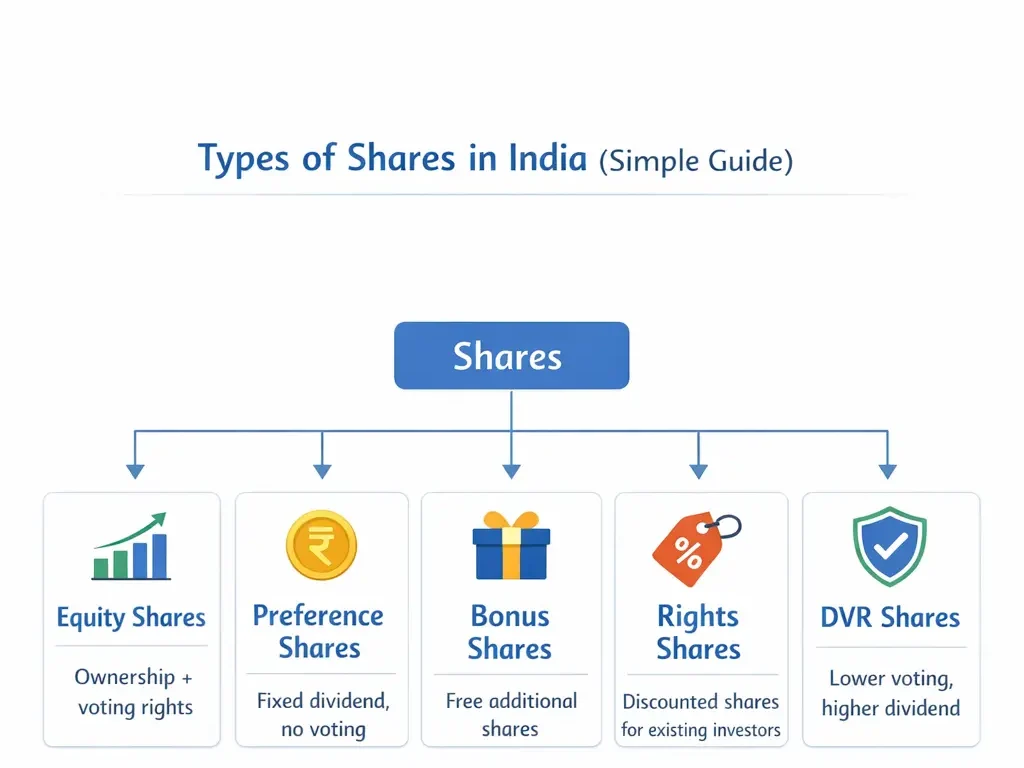
Overview of all major share types in Indian stock market
✔ Pros:
- Potential for high returns
- Voting rights
❌ Cons:
- Higher risk
- Price can fluctuate sharply
2. Preference Shares (Fixed Income Type)
These shares offer a fixed dividend each year but generally carry no voting rights. Preference shareholders are paid before equity shareholders if the company runs into financial trouble.
Example: Banks like HDFC sometimes issue preference shares.
✔ Pros:
- More stable income
- Priority payment
❌ Cons:
- No voting rights
- Limited upside potential
💡 Quick Tip: Think of preference shares like a fixed deposit — you receive regular income with less volatility.
3. Bonus Shares (Free Shares)
Companies sometimes issue extra shares to existing shareholders at no cost.
Example: Infosys has issued bonus shares several times.
✔ Pros:
- You receive free shares
- Your total holding increases
❌ Cons:
- The share price adjusts downward accordingly
- No immediate gain in overall wealth
4. Rights Shares (Discounted Shares)
Existing shareholders are given the opportunity to buy additional shares at a discounted price before the offer is opened to others.
Example: Tata group companies have offered rights issues in the past.
✔ Pros:
- Buy at a discount
- Priority access
❌ Cons:
- Requires additional capital
- Risk increases if the company is struggling
5. DVR Shares (Differential Voting Rights)
These shares carry lower voting power but often come with higher dividends.
Example: Tata Motors DVR shares.
✔ Pros:
- Higher dividend in some cases
- Usually available at a lower price
❌ Cons:
- Reduced voting rights
- Less commonly traded
India vs Global Comparison
In India, equity shares account for the vast majority of trading activity. Most companies keep their share structure straightforward, which works well for everyday investors.
In the United States, companies like Google (Alphabet) often issue multiple classes of shares with varying voting powers. The Indian approach is generally simpler, making it easier for beginners to get started.
Simple Comparison
| Parameter | Equity Shares | Preference Shares |
|---|---|---|
| Ownership | Yes | Limited |
| Voting Rights | Yes | No |
| Dividend | Variable | Fixed |
| Risk | High | Low |
| Return | High potential | Moderate |
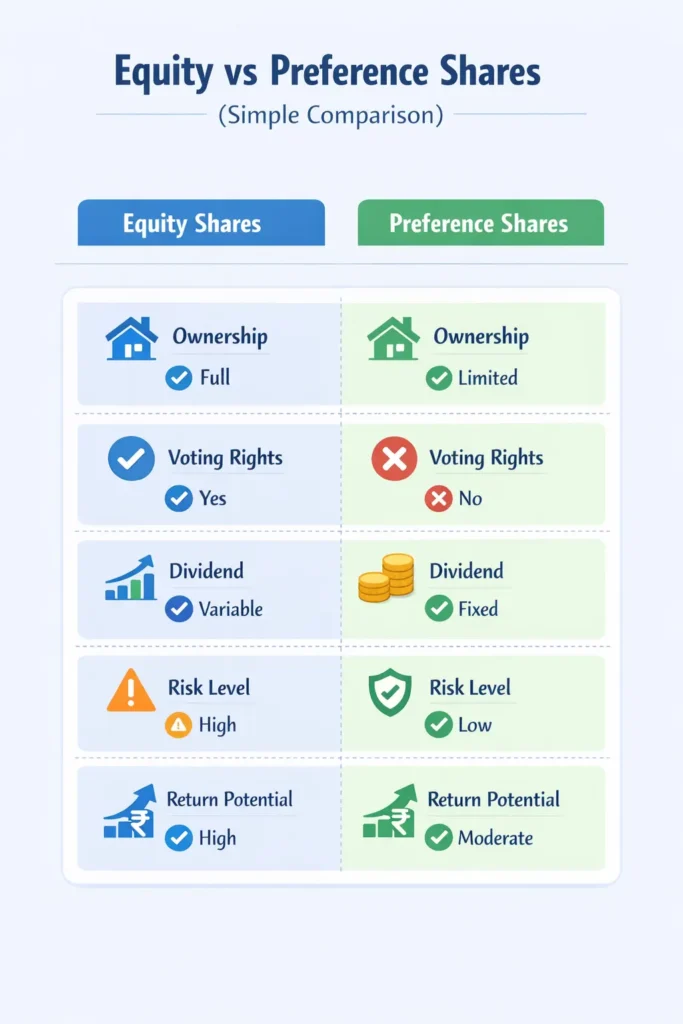
Quick comparison between equity and preference shares in India
👉 In simple words: Equity shares are suited for growth and carry higher risk. Preference shares are better for stability and fixed income.
Real Indian Examples
Let’s bring this to life with companies you already know.
👉 Reliance Industries
Its equity shares have delivered strong long-term growth. Patient investors have benefited from both rising prices and regular dividends over the years.
👉 TCS
A well-known dividend-paying company. Its equity shares have consistently rewarded shareholders with steady income and reliable performance.
👉 Infosys
Has issued bonus shares multiple times, allowing existing investors to grow their holdings without spending additional money.
👉 HDFC Bank
Has used preference shares in specific situations to raise capital while offering fixed returns to those shareholders.
🌍 Global example: Apple shares follow a pure equity growth model. The same ownership principles apply whether you invest in Reliance in India or Apple in the United States.
Why It Matters for Beginners
Without a clear understanding of the different types of shares, it is easy to make avoidable mistakes. You might expect fixed income from equity shares, or miss out on more stable options like preference shares.
Many new investors in India begin with mutual funds or SIPs because they feel more comfortable. Opening a Demat account is the natural next step when you are ready to buy shares directly. Knowing these share types helps you make smarter choices from day one.
Key Takeaways
- The main types of shares in India for beginners are equity, preference, bonus, rights, and DVR.
- Equity shares offer ownership and higher potential returns, but come with greater risk.
- Preference shares provide fixed income and greater stability.
- Bonus shares increase your holdings at no cost but cause the share price to adjust downward.
- Rights shares allow you to buy at a discount but require additional capital.
- Understanding these types helps you avoid common beginner mistakes.
Frequently Asked Questions
What is a share in the stock market?
A share represents ownership in a company. When you buy a share, you become a partial owner and may earn returns through price appreciation or dividends.
How many types of shares are there?
The main types are equity shares and preference shares. There are also bonus shares, rights shares, and DVR shares.
What is the difference between equity shares and preference shares?
Equity shares give you ownership and voting rights, while preference shares provide fixed dividends but generally no voting rights.
Why do companies issue shares?
Companies issue shares to raise funds for growth, expansion, or debt repayment without taking on loans.
Can I buy preference shares in India?
Yes, but they are less commonly traded than equity shares and are typically issued in specific circumstances.
Conclusion
Understanding the types of shares in India for beginners is one of the most important foundations in stock market investing.
Once you grasp the difference between equity and preference shares — and become familiar with the other share types — everything else becomes much clearer.
Keep these key ideas in mind:
- Ownership versus fixed income
- Risk versus stability
- Real-world examples from companies you know
Whether you are looking at Reliance in India or Apple on global markets, the same core principles apply.
Disclaimer: This article is for educational purposes only and does not constitute financial advice. Please consult a SEBI-registered financial advisor before making any investment decisions.