

Sensex and Nifty are the two most-watched stock market indexes in India, listed on BSE and NSE respectively.
If you are just starting your journey in the stock market, one of the first questions you will likely ask is: what exactly is NSE and BSE for beginners, and what is the real difference between them?
Understanding the difference between NSE and BSE is important because these are the two main stock exchanges in India. Almost every time you buy or sell shares of companies like Reliance, TCS, or HDFC Bank, your trade happens on one of these platforms.
📌 Also read: What is Sensex and Nifty: Simple Guide for Beginners in India
In simple terms, NSE and BSE are marketplaces that connect buyers and sellers of stocks. However, they are not exactly the same — they differ in technology, history, and how they operate. In this guide, we will break everything down step by step in the simplest way possible. By the end, you will feel much more confident about how these exchanges work. Let us get started!
📋 Table of Contents
- What is NSE and BSE in Simple Words
- Difference Between NSE and BSE
- NSE vs BSE: Which is Better for Beginners
- How Stock Exchanges Work in India
- Example of NSE vs BSE
- Why Investors Use It
- Advantages
- Limitations
- Key Takeaways
- Frequently Asked Questions (FAQs)
- Conclusion
- Disclaimer
What is NSE and BSE in Simple Words
The NSE (National Stock Exchange) and BSE (Bombay Stock Exchange) are platforms where shares of companies are bought and sold in India.
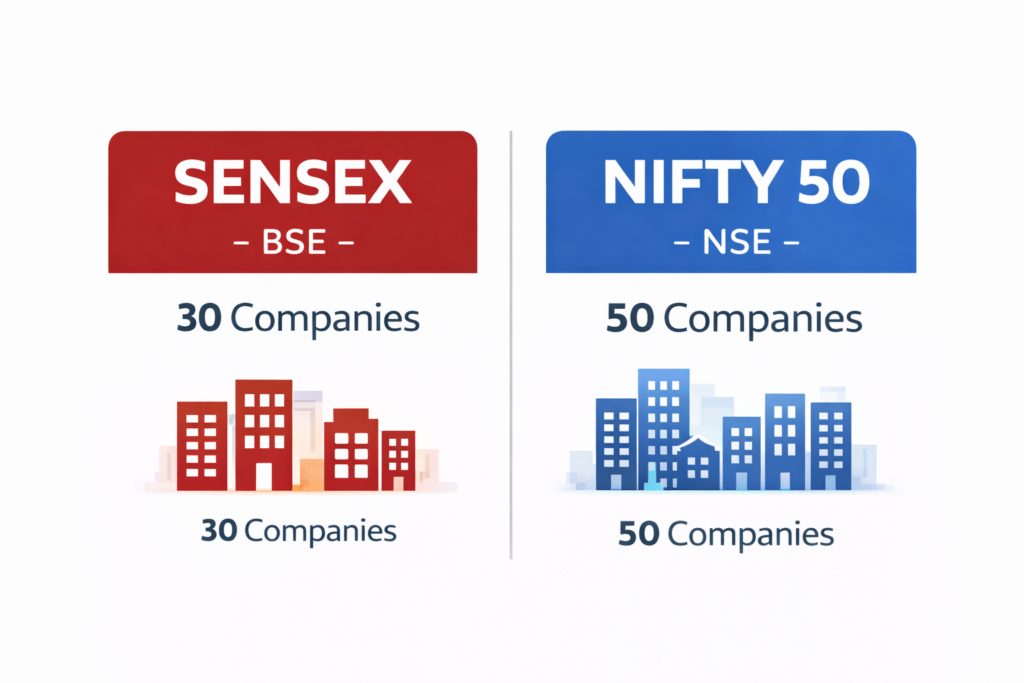
Sensex tracks 30 companies on BSE, while Nifty 50 covers 50 companies on NSE — both are reliable indicators of market performance.
BSE:
- Established in 1875 (Asia’s oldest stock exchange)
- Index: Sensex (tracks 30 companies)
- Known for its long history and legacy
NSE:
- Established in 1992
- Index: Nifty 50 (tracks 50 companies)
- Known for advanced technology and high trading volume
Simple way to remember:
- BSE = Older exchange
- NSE = More modern and widely used
So when someone asks, “what is NSE and BSE in simple words?” — the answer is: they are regulated marketplaces where stocks are traded in India.
Now that you have a clear picture of what NSE and BSE are, let us look at how they compare.
Difference Between NSE and BSE
| Full Form | National Stock Exchange | Bombay Stock Exchange |
| Founded | 1992 | 1875 |
| Index | Nifty 50 | Sensex |
| Listed Companies | ~1,600+ | ~5,000+ |
| Trading Volume | Higher | Lower |
| Technology | Advanced | Moderate |
| Popularity | More popular among active traders | More traditional investor base |
Key difference at a glance:
- NSE = High liquidity, fast trade execution
- BSE = More listed companies, strong legacy presence
This is the core of the difference between NSE and BSE in India with examples.
NSE vs BSE: Which is Better for Beginners
For beginners, both exchanges are accessible through the same broker or trading app. In most cases, you do not need to choose between them manually.
Here is a quick comparison:
NSE:
- Better liquidity
- Faster trade execution
- More commonly used by traders
BSE:
- More listed companies
- Some stocks are exclusively available here
Simple answer: There is no single “better” exchange — both serve the same fundamental purpose. However, beginners tend to see more trading activity on NSE.
With this in mind, let us understand the bigger picture of how these exchanges actually operate in India.
How Stock Exchanges Work in India
Understanding how stock exchanges work in India is an important step for every beginner. Here is the process, broken down simply:
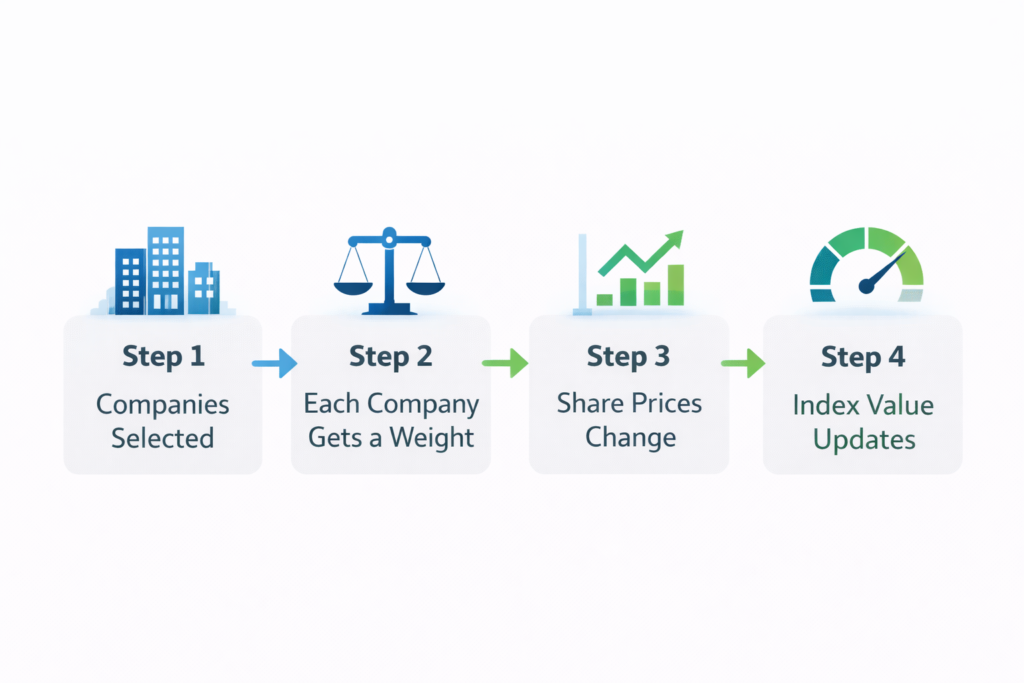
The index value updates continuously based on changes in the share prices of its component companies.
- A company lists its shares through an IPO
- The shares become available on NSE and BSE
- Investors place buy or sell orders through their broker
- The exchange matches buyers with sellers
- The trade is completed and settled
Core idea: The stock exchange acts as a middleman. It ensures that every trade is fair, transparent, and properly recorded.
Demand and Supply — The Price Driver
Stock prices are driven by one simple concept:
- More buyers → price goes up
- More sellers → price goes down
📌 Also read: How Stock Market Works
Index Calculation
Both Nifty (NSE) and Sensex (BSE) are calculated using free-float market capitalization. This means larger companies have a greater influence on the index movement.
Example of NSE vs BSE
Let us look at some real-world examples to understand the difference between NSE and BSE in India.
Reliance Industries
- Listed on both NSE and BSE
- NSE price: ₹2,500 | BSE price: ₹2,502
- The small difference is caused by demand, supply, and liquidity variations
TCS
- Traded on both exchanges
- Trading volume is generally higher on NSE
HDFC Bank
- Listed on both exchanges
- Trades tend to be smoother and faster on NSE
Key insight: For most large companies, the price difference between NSE and BSE is very small and generally not significant for everyday investors.
Why Investors Use NSE and BSE
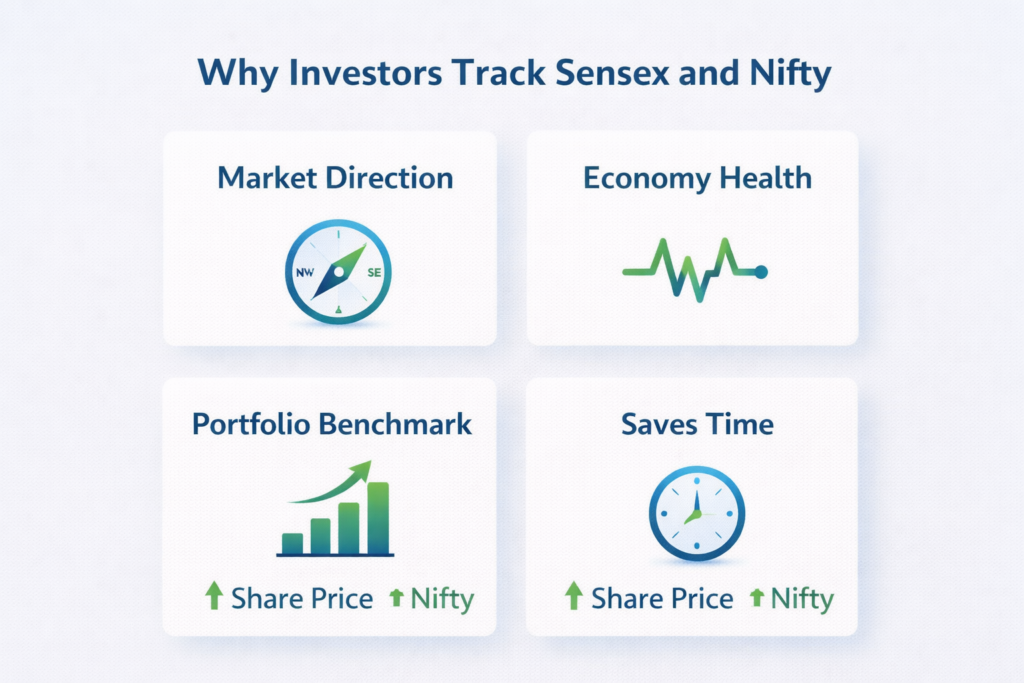
Tracking Sensex and Nifty helps investors quickly assess market direction, benchmark performance, and make informed decisions without monitoring individual stocks.
- To buy and sell shares of Indian companies
- To track overall market performance
- To invest in companies like Reliance, TCS, and Infosys
- To participate in India’s long-term economic growth
Advantages
- Easy access to the stock market for retail investors
- Transparent and real-time pricing
- High liquidity, especially on NSE
- Regulated and monitored by SEBI
- Real-time trade execution
Limitations
- Markets can be volatile, especially in the short term
- Returns are never guaranteed
- Beginners need time to understand how trading works
- Small price differences between NSE and BSE may confuse new investors
Key Takeaways
- NSE and BSE are India’s two main stock exchanges
- NSE is modern, technology-driven, and high in volume
- BSE is older and has more listed companies
- Both allow investors to buy and sell shares
- Prices on both exchanges are nearly identical for most stocks
Frequently Asked Questions (FAQs)
Q1. What is NSE and BSE for beginners?
NSE and BSE are regulated platforms where stocks of Indian companies are bought and sold.
Q2. NSE vs BSE — which is better for beginners?
Both are equally accessible. However, NSE is more commonly used due to its higher trading activity.
Q3. Can I trade on both NSE and BSE?
Yes. Most brokers in India allow you to trade on both exchanges from a single account.
Q4. Why does the price differ between NSE and BSE?
Minor price differences occur due to variations in demand, supply, and liquidity on each exchange.
Q5. How do stock exchanges work in India?
They act as intermediaries that match buyers and sellers, ensuring trades are executed fairly and transparently.
Conclusion
Understanding the difference between NSE and BSE is an important first step for any beginner in India. Both exchanges serve the same core purpose — enabling investors to buy and sell shares — but they differ in terms of technology, trading volume, and the number of listed companies.
📌 Also read: Types of Shares in India for Beginners
Once you understand how NSE vs BSE works, small price differences will no longer confuse you. Instead, you can focus on the bigger picture — how stock exchanges connect you to real companies and help you grow your wealth over time.
For beginners, the goal is not to choose between NSE and BSE, but to understand how stock exchanges work in India and how you can use them to start your investment journey.
Disclaimer
This article is for educational purposes only. It does not constitute financial advice or investment recommendations. Stock market investments are subject to market risks. Please conduct your own research before making any financial decisions.