
Introduction
If you have ever wondered how stock market works, you are not alone. Many beginners feel overwhelmed the first time they encounter words like shares, NSE, or Sensex. The good news is that once someone explains it clearly, it is far simpler than it appears.
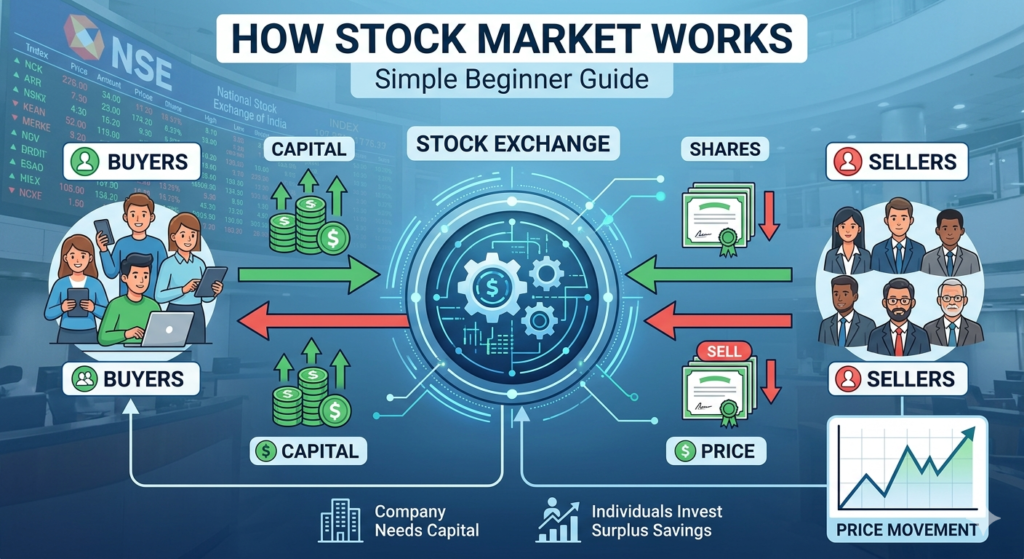
This image shows how buyers and sellers interact in the stock market, making it easier for beginners to understand the basics.
Think of the stock market as a bustling marketplace where ordinary people can buy and sell small ownership stakes in large companies. In this guide, you will learn how stock market works step by step — from the very basics through to real examples from the Indian share market. By the end, even a complete beginner will feel confident and ready to take the next step.
Table of Contents
- What is Stock Market?
- Stock Market Basics
- How Stock Market Works — Step by Step
- Stock Market for Beginners
- How Stock Market Works in India
- India vs Global Markets
- How to Buy Shares Online
- Common Mistakes Beginners Make
- Key Takeaways
- Frequently Asked Questions
- Conclusion
What is Stock Market?
The stock market — also called the share market — is simply a platform where people buy and sell ownership stakes in companies.
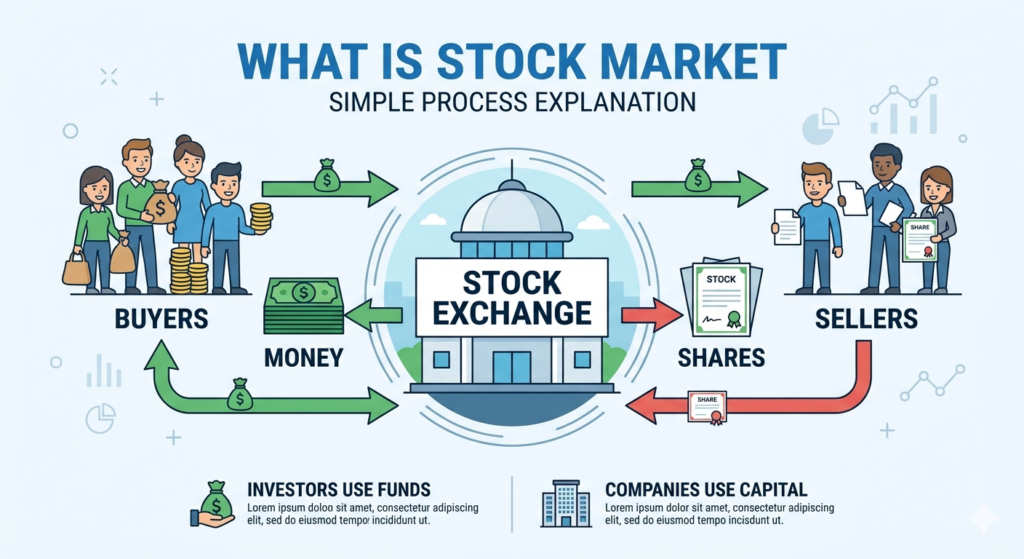
This diagram explains how the stock market connects buyers and sellers through an exchange system.
A helpful analogy: think of it like a vegetable market.
- Sellers = Companies offering shares to the public
- Buyers = Investors purchasing those shares
- Price = Determined by how many people want to buy or sell at any given moment
When someone asks what is stock market or what is share market, the simplest answer is: it is a marketplace where shares of publicly listed companies are traded every day.
For example, when you buy a share of Reliance Industries, you become a part-owner of that company — however small. If Reliance grows and earns greater profits, the value of your share can increase. The same principle applies to TCS, HDFC Bank, or any other listed company. You are purchasing a small stake in a real business.
Stock Market Basics
Before going deeper, it helps to understand the core stock market basics that every beginner needs. These concepts form the foundation of everything else.
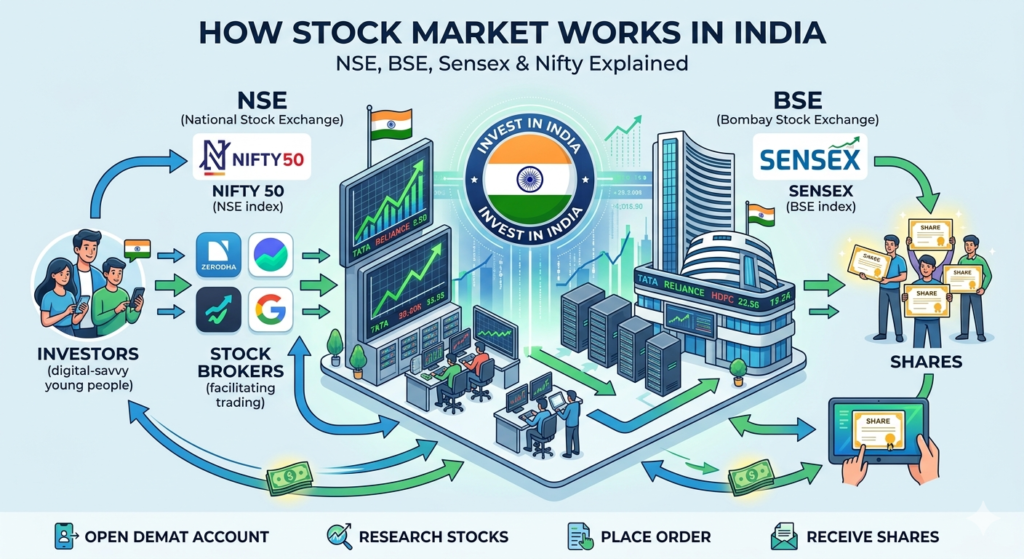
This infographic explains how the Indian stock market operates with NSE, BSE, Sensex, and Nifty.
Shares
A share is simply a small unit of ownership in a company.
Buyers and Sellers
Buyers want to purchase shares. Sellers want to offload them. Both sides meet on a stock exchange.
Demand and Supply
When many people want to buy (high demand), the price tends to rise. When many people want to sell (high supply), the price tends to fall.
Price Movement
Share prices change continuously throughout the trading day, driven by this constant buying and selling activity.
Bull Market vs Bear Market
- 🐂 Bull Market — Prices are generally rising and investor confidence is high
- 🐻 Bear Market — Prices are generally falling and sentiment is cautious
These five ideas give you the foundation of stock market basics. With this in place, everything that follows will make much more sense.
How Stock Market Works — Step by Step
Now let us look at how stock market works in a clear, sequential way.
Step 1: A Company Raises Capital
A company decides to raise money by offering shares to the public for the first time. This process is called an Initial Public Offering, or IPO.
Step 2: Shares Are Listed
Once the IPO is complete, the shares are listed on a stock exchange, making them available for anyone to buy or sell.
Step 3: Investors Buy and Sell
Investors — individuals like you or large institutions — start buying and selling shares through a registered broker.
Step 4: Orders Are Matched
The exchange automatically matches buy orders with sell orders in real time.
Step 5: Price Is Discovered
The final transaction price is set by supply and demand. This process is known as price discovery.
This entire cycle runs every weekday during market hours. That, in essence, is how does the stock market work behind the scenes — continuously, transparently, and at remarkable speed.
Stock Market for Beginners
If you are new to investing, the stock market can feel daunting at first. But here is an important truth: it is not gambling, and it is not reserved for financial experts.
Many beginners worry about losing money or finding the subject too technical. Once you understand how stock market works, however, many of those concerns diminish significantly.
Why Should Beginners Pay Attention?
- It can help your savings grow meaningfully over time
- Returns often outpace inflation in the long run
- It is one of the most accessible ways to build long-term wealth
The key is to start small, learn steadily, and stay patient. A solid grasp of the basics is the best foundation any new investor can build.
Want a deeper explanation? Read this before moving ahead.
How Stock Market Works in India 🇮🇳
Understanding how stock market works in India is particularly valuable, as millions of investors — including many Non-Resident Indians (NRIs) — actively participate in it every day.
NSE and BSE
- NSE stands for National Stock Exchange — India’s largest exchange by trading volume
- BSE stands for Bombay Stock Exchange — Asia’s oldest stock exchange
- Both platforms facilitate the daily buying and selling of shares
Sensex and Nifty 50
- Sensex tracks the top 30 companies listed on the BSE
- Nifty 50 tracks the top 50 companies listed on the NSE
- Both indices serve as barometers of the overall market’s health
SEBI
SEBI — the Securities and Exchange Board of India — is the regulatory body that oversees the stock market. Its role is to maintain fairness, transparency, and investor protection across all market activity.
Demat Account
In India, shares are held electronically in a Demat (Dematerialised) account. There are no physical certificates. When you buy shares, they are credited to your Demat account; when you sell, they are debited.
Brokers and Trading Platforms
User-friendly platforms such as Zerodha and Groww have made investing significantly more accessible for beginners, allowing anyone with a smartphone to start trading within minutes.
Real-world example: You decide to buy shares of TCS using Zerodha. Your order is routed to the NSE, matched with a seller, and the trade is completed in seconds. The shares then appear in your Demat account. That is how the share market in India works in practice.
India vs Global Markets
The fundamental mechanics of how stock market works are consistent worldwide. However, each country operates its own exchanges, indices, and regulatory framework.
| Aspect | India | Global Markets |
|---|---|---|
| Main Exchanges | NSE, BSE | NYSE, NASDAQ |
| Key Indices | Nifty 50, Sensex | Dow Jones, S&P 500 |
| Regulator | SEBI | SEC (USA) |
Many global investors closely watch the Indian market due to its strong economic growth potential and large consumer base.
How to Buy Shares Online
Buying shares today is straightforward. Here is a simple step-by-step process for Indian beginners:
- Open a Demat and trading account with a registered broker
- Choose a reliable platform — Zerodha and Groww are popular choices in India
- Complete your KYC (Know Your Customer) verification
- Transfer funds into your trading account
- Search for a company you would like to invest in (for example, Reliance or HDFC Bank)
- Place a buy order and confirm the transaction
That is the complete process for how to buy shares online. Global platforms such as Interactive Brokers or Charles Schwab follow a similar flow for international investors.
Common Mistakes Beginners Make
What to Avoid
- Investing without understanding the basics first
- Acting on unverified tips from social media or messaging groups
- Expecting overnight or unrealistic returns
- Panic-selling when prices fall temporarily
- Putting all savings into a single stock or sector
Helpful Tips
- Always learn before you invest — knowledge reduces risk
- Think long-term and remain patient during market fluctuations
- Begin with a small amount you can afford to keep invested
- Focus on understanding the fundamentals of any company before buying
Key Takeaways
- The stock market is a platform to buy and sell shares of publicly listed companies
- Share prices are driven by demand and supply
- NSE and BSE are India’s two primary stock exchanges
- Sensex and Nifty 50 are the key indices used to measure market performance
- SEBI regulates the Indian market to protect investor interests
- Understanding the basics significantly reduces investment risk
Frequently Asked Questions
What is stock market in simple words?
It is a regulated marketplace where people buy and sell shares of publicly listed companies.
How stock market works for beginners?
Companies list their shares on an exchange. Buyers and sellers trade those shares through brokers. Prices move based on demand and supply.
Is the stock market the same as gambling?
No. While all investments carry some risk, investing in the stock market is based on research, fundamentals, and long-term thinking — unlike gambling, which is based purely on chance.
How to buy shares online in India?
Open a Demat account with a registered broker such as Zerodha or Groww, complete your KYC, add funds, and place a buy order through the app or website.
What is Nifty 50?
Nifty 50 is an index that tracks the performance of the top 50 companies listed on the National Stock Exchange (NSE) of India.
How does the stock market work daily?
Every weekday during market hours, buyers and sellers place orders through brokers. The exchange matches these orders and executes trades continuously, with prices updating in real time.
What is the difference between NSE and BSE?
Both are Indian stock exchanges. NSE (National Stock Exchange) is the larger by trading volume, while BSE (Bombay Stock Exchange) is Asia’s oldest exchange. Most major companies are listed on both.
Conclusion
You now have a clear understanding of how stock market works — from foundational concepts to real-world examples from the Indian share market. At its core, the market is a system where buyers and sellers trade shares, and prices are determined by supply and demand.
Whether you are interested in Reliance, TCS, or tracking the Sensex and Nifty 50, the same principles apply. The more you learn, the more confident you will become.
Disclaimer: This article is intended for educational and informational purposes only. It does not constitute financial advice, investment recommendations, or an endorsement of any specific investment product or service. All investing involves risk. Please consult a qualified financial advisor before making any investment decisions.