
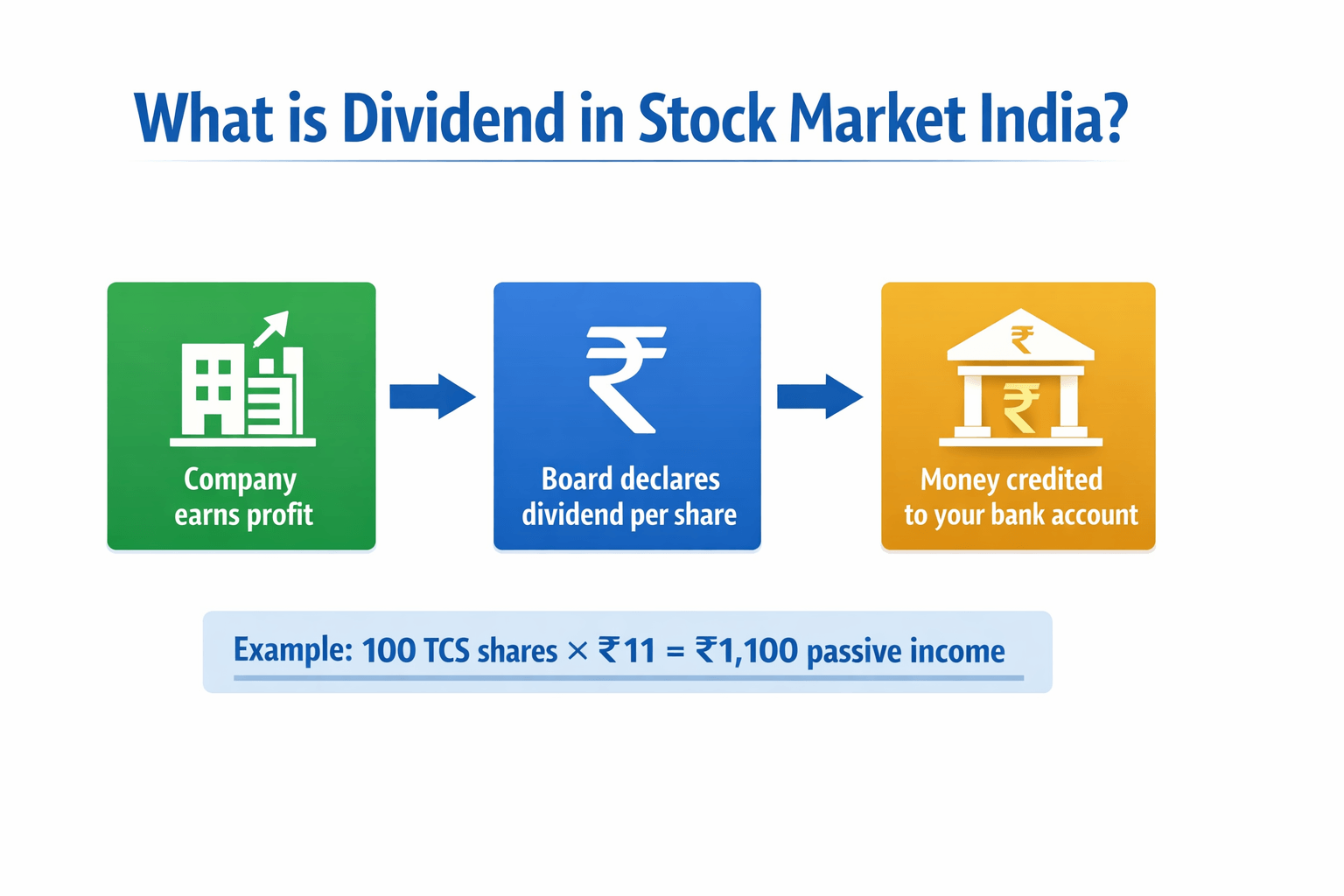
Picture this: You own 100 shares of TCS, one of India’s most trusted IT companies. A few months later, money appears directly in your bank account — and you never had to sell a single share. No trading stress, no phone calls, just extra cash arriving quietly.
That is exactly what dividends are.
Understanding what is dividend in stock market India is one of the most important concepts for any beginner who wants to build genuine passive income from stocks. Many new investors focus only on chasing price gains, but dividends can create a steady income stream that keeps working year after year — even when the market feels unpredictable.
In this guide, you will find a plain-language breakdown of everything: what dividend means, how the process works, real examples from Indian stocks, the dividend yield formula, and the tax rules that apply in 2026.
📋 Table of Contents
- What is Dividend in Stock Market India
- How Dividend Works in India (2026)
- Dividend Yield Formula Explained
- Real Stock Market Examples (India)
- Why Investors Use Dividends
- Advantages
- Limitations
- Key Takeaways
- Frequently Asked Questions
- Conclusion
What is Dividend in Stock Market India
A dividend is a portion of a company’s profit that is distributed to its shareholders. When a company earns more money than it needs for running and growing its business, the board of directors may choose to share part of that surplus with the people who own shares.
In simple words: Dividend = company profit shared with investors, paid directly to your bank account — without you having to sell a single share.
What is Dividend in Stock Market India for Beginners — Simple Example
Here is the clearest way to understand it:
- You own 100 shares of TCS
- TCS declares a dividend of ₹11 per share
- You receive: 100 × ₹11 = ₹1,100 directly in your bank account
No selling. No trading. Just income — this is why dividends are widely described as passive income from stocks. The moment that amount lands in your account without any action on your part, the concept clicks in a way no textbook can quite replicate.
Does Every Stock Pay Dividend?
No. Not every company pays dividends. There are broadly two types:
| Company Type | What They Do with Profit | Examples (India) |
|---|---|---|
| Dividend-paying companies | Share a portion with shareholders | TCS, Reliance, HDFC Bank, ITC, Coal India |
| Growth companies | Reinvest all profit for expansion | Many newer tech startups, early-stage companies |
Growth companies are not necessarily a worse investment — they simply prioritise expanding the business over paying out cash. Understanding this distinction helps you choose stocks that match your goal, whether that is regular income or long-term capital growth.
How Dividend Works in Indian Stock Market (2026)
The dividend process follows a clear, step-by-step sequence. Once you understand each stage, the whole system becomes much easier to track — especially when you are watching for an upcoming payout.
| Step | What Happens | Who Does It |
|---|---|---|
| 1. Announcement | Company declares dividend amount per share | Board of Directors |
| 2. Ex-Dividend Date | Cut-off date — you must own shares before this day | Stock Exchange (NSE / BSE) |
| 3. Record Date | Company checks its shareholder records | Company + Depository (CDSL / NSDL) |
| 4. Payment | Dividend credited to eligible shareholders’ bank accounts | Company (within 30–45 days of record date) |
📌 Also read: What is SEBI in stock market? Complete Beginner-Friendly Guide (2026)
Ex-Dividend Date Meaning India — Explained
The ex-dividend date is the single most important date in the dividend process, and it trips up many beginners.
- If you buy shares before the ex-dividend date → you receive the dividend
- If you buy shares on or after the ex-dividend date → the previous owner gets the dividend, not you
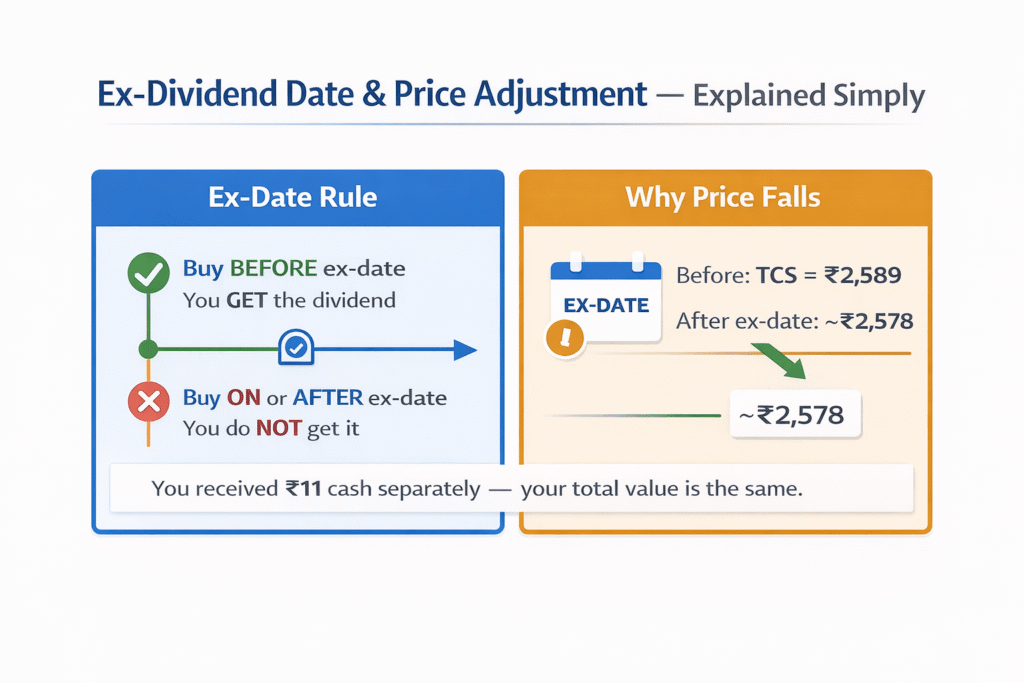
The price adjustment on ex-date does not mean a loss — you receive that amount separately as dividend cash.
2026 Update — T+1 Settlement: India now operates on a T+1 settlement cycle. This means the ex-dividend date and the record date are practically the same day. If you plan to receive a dividend, ensure you purchase the shares at least one full trading day before the ex-date.
Why Does Stock Price Fall After Dividend?
This is one of the most common sources of confusion for new investors — and it is completely understandable.
Example:
TCS share price = ₹2,589 | Dividend declared = ₹11 per share
On ex-dividend date → TCS price adjusts to approximately ₹2,578
✅ You did NOT lose money. You received ₹11 per share as cash separately. The price adjustment simply reflects that the company has paid out that amount. Your total position value remains balanced.
How to Check Dividend in Zerodha or Groww
Both platforms make dividend tracking straightforward. Once the payment is processed, you can find it in:
- Groww: Portfolio → Dividends section
- Zerodha Kite: Console → Portfolio → Dividends
- Bank statement: The credit appears with the company name and the payout amount
Dividends are typically credited within 30 to 45 days of the record date — sometimes sooner for large companies.
Dividend Yield Formula — Concept Explained
Once you understand what a dividend is, the next step is learning how to compare dividends across different stocks. That is what the dividend yield does.Once you understand what is dividend in stock market India, calculating dividend yield becomes much easier.
Dividend Yield Formula
Dividend Yield = (Annual Dividend Per Share ÷ Share Price) × 100
Example using TCS:
- TCS approximate annual dividend = ₹100 per share (across multiple payouts)
- TCS share price = ₹2,589
- Dividend Yield = (100 ÷ 2,589) × 100 = ~3.86%
This means for every ₹100 you invest in TCS, you earn approximately ₹3.86 annually as dividend income — independent of any movement in the share price itself.
Dividend Payout Ratio
Another concept worth knowing alongside dividend yield is the payout ratio:
Payout Ratio = (Dividend Per Share ÷ Earnings Per Share) × 100
- High payout ratio → company is returning more Profit to shareholders
- Low payout ratio → company is reinvesting more for Future growth
Neither is automatically better. A sustainable payout ratio — typically between 30% and 60% — suggests the company can comfortably maintain or increase dividends over time without straining its finances.
Real Stock Market Examples — India (2026)
Looking at actual companies makes dividend concepts far more tangible. Here are three widely held Indian stocks that beginners frequently ask about:
| Stock | Sector | Recent Dividend | Payout Style |
|---|---|---|---|
| TCS | IT Services | ₹11 per share (interim) | Regular interim + occasional special |
| Reliance | Energy & Retail | ₹5.50 per share (final) | Annual final dividend |
| HDFC Bank | Private Banking | ₹22 per share (final) | Annual final dividend |
💰 Passive Income Calculation:
If you hold 1,000 TCS shares and TCS pays ₹11 per payout:
1,000 × ₹11 = ₹11,000 per payout — without selling a single share.
With multiple payouts across the year, this can build into a meaningful and growing income stream.
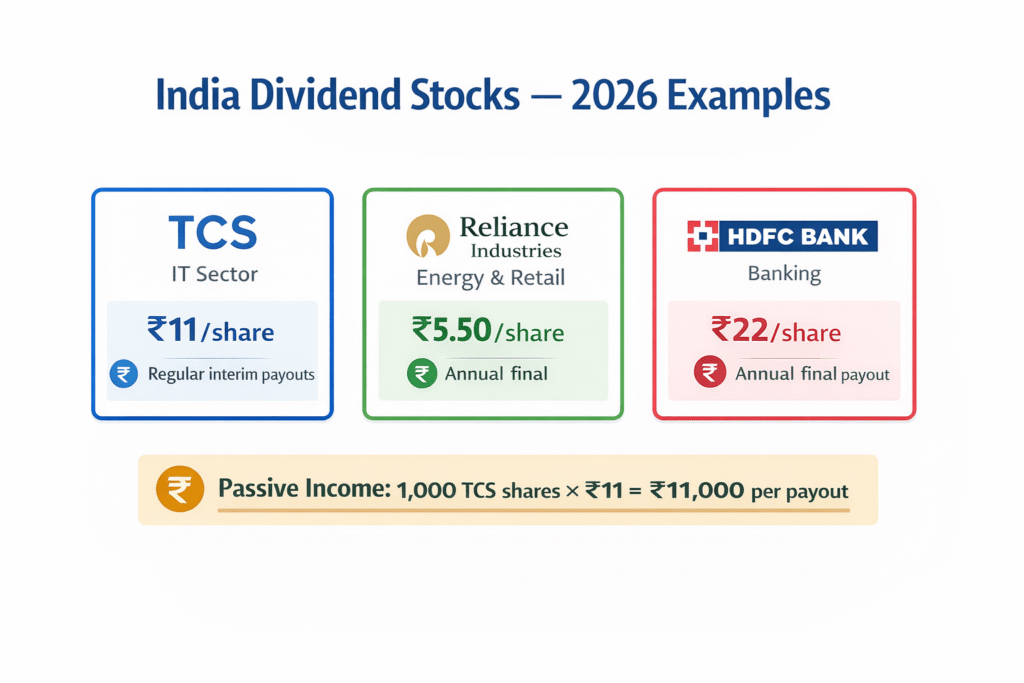
TCS, Reliance, and HDFC Bank are among India’s most consistently tracked dividend-paying stocks in 2026.
Why Investors Use Dividends
Dividend investing appeals to a wide range of investors for several practical reasons that go well beyond just the numbers.
- Passive income: Earn money without selling your holdings — your shares continue to work for you in the background
- Regular cash flow: Even in a flat or sideways market, dividend payments arrive on a predictable schedule
- Stability during volatility: When market prices move unpredictably, receiving actual cash gives many investors the confidence to stay invested rather than react emotionally
- Compounding potential: Reinvesting dividends to buy more shares accelerates long-term wealth growth through the power of compounding
This steady, reliable dimension of dividend investing is precisely why it is often the first strategy beginners explore when they move beyond simply watching their portfolio value fluctuate.
📌 Also read: What is Sensex and Nifty: Simple Guide for Beginners in India
Advantages of Dividend Investing
- Passive income: Your holdings generate returns without any active trading on your part — the money simply arrives
- Stability: Dividend-paying companies are typically well-established, profitable businesses with a track record of consistent cash flows
- Compounding: Reinvesting dividend payouts to buy additional shares accelerates long-term portfolio growth significantly
- Reduced emotional pressure: When you are already receiving income from dividends, the daily movement of stock prices feels considerably less stressful
These advantages make dividend investing particularly well-suited to beginners who want to build their first portfolio around real, tangible returns rather than speculation.This is why learning what is dividend in stock market India is important for beginners who want passive income.
Limitations to Be Aware Of
- Not all companies pay dividends: Growth-focused companies reinvest profits rather than distributing them — both approaches are valid, depending on the business stage
- Dividends can change: A company may reduce or pause dividends if its profits fall, its business strategy shifts, or it faces broader economic pressure
- Tax applies: Dividend income in India is taxable at your income slab rate — always factor this into your net return calculation
- Slower capital growth: Companies that pay high dividends may grow their share price more slowly, since they distribute cash rather than reinvesting it entirely into expansion
Knowing these limitations helps you build a balanced portfolio — combining dividend stocks for income with growth stocks for capital appreciation, based on your own financial goals and timeline.
Key Takeaways
- ✅ Dividend = a portion of company profit paid to shareholders
- ✅ You earn income without selling your shares
- ✅ The ex-dividend date is the critical cut-off — buy before it to receive the payout
- ✅ Under T+1 settlement (2026), the ex-date and record date are effectively the same
- ✅ A price drop on ex-date is a normal adjustment — your overall value remains the same
- ✅ Dividend yield = (Annual Dividend ÷ Share Price) × 100
- ✅ Dividend income in India is taxable at your income slab rate — TDS applies above ₹10,000
- ✅ Understanding what is dividend in stock market India is the first step towards building real passive income from your investments
Frequently Asked Questions (FAQs)
1. What is dividend in stock market in simple words?
A dividend is money paid by a company to its shareholders from the profits it earns. Instead of keeping all profits within the business, the company distributes a portion to the people who own its shares — directly into their bank accounts, with no selling required.
2. How is dividend paid in India?
Dividends are credited directly to the bank account linked to your demat account. The payment typically arrives within 30 to 45 days of the record date. You can track incoming dividends in the dividends section of apps like Groww or Zerodha Console.
3. Is dividend income taxable in India 2026?
Yes. In India, dividend income is added to your total income and taxed at your applicable income slab rate. TDS (Tax Deducted at Source) is applied by the company if the total dividend paid to you in a financial year exceeds ₹10,000 — this threshold was updated for FY 2025-26. Always account for tax when calculating your net dividend returns.
4. What is the ex-dividend date in India?
The ex-dividend date is the cut-off date that determines which shareholders qualify to receive the upcoming dividend. If you own shares before this date, you will receive the payout. If you buy on or after this date, the dividend goes to the previous holder. Under India’s T+1 settlement system in 2026, the ex-dividend date and the record date are effectively the same.
5. Does every stock pay dividend in India?
No. Only companies that generate consistent profits and choose to distribute them to shareholders pay dividends. Many growth-stage companies and newer startups reinvest all earnings back into the business instead. Well-known dividend-paying companies in India include TCS, Reliance Industries, HDFC Bank, ITC, and Coal India.
Conclusion
Understanding what is dividend in stock market India can genuinely change how you think about investing. Rather than watching stock prices move up and down and hoping to sell at the right moment, dividends allow you to earn consistent, real income from companies you believe in — year after year, without selling a single share.
Companies like TCS, Reliance Industries, and HDFC Bank have long track records of rewarding their shareholders with regular payouts. As you build your portfolio over time, combining dividend income with long-term holding creates a compounding effect that can quietly but meaningfully grow your wealth.
Start small, stay consistent, keep track of your ex-dates, and let the power of dividends work steadily in your favour.
Continue building your stock market knowledge with these related guides:
Disclaimer: This article is published for educational and informational purposes only. It does not constitute financial or investment advice. All investments in the stock market are subject to market risks. Tax rules mentioned are based on publicly available information for FY 2025-26 and may change. Please consult a qualified financial or tax advisor before making any investment decisions.