
Last Updated: May 13, 2026
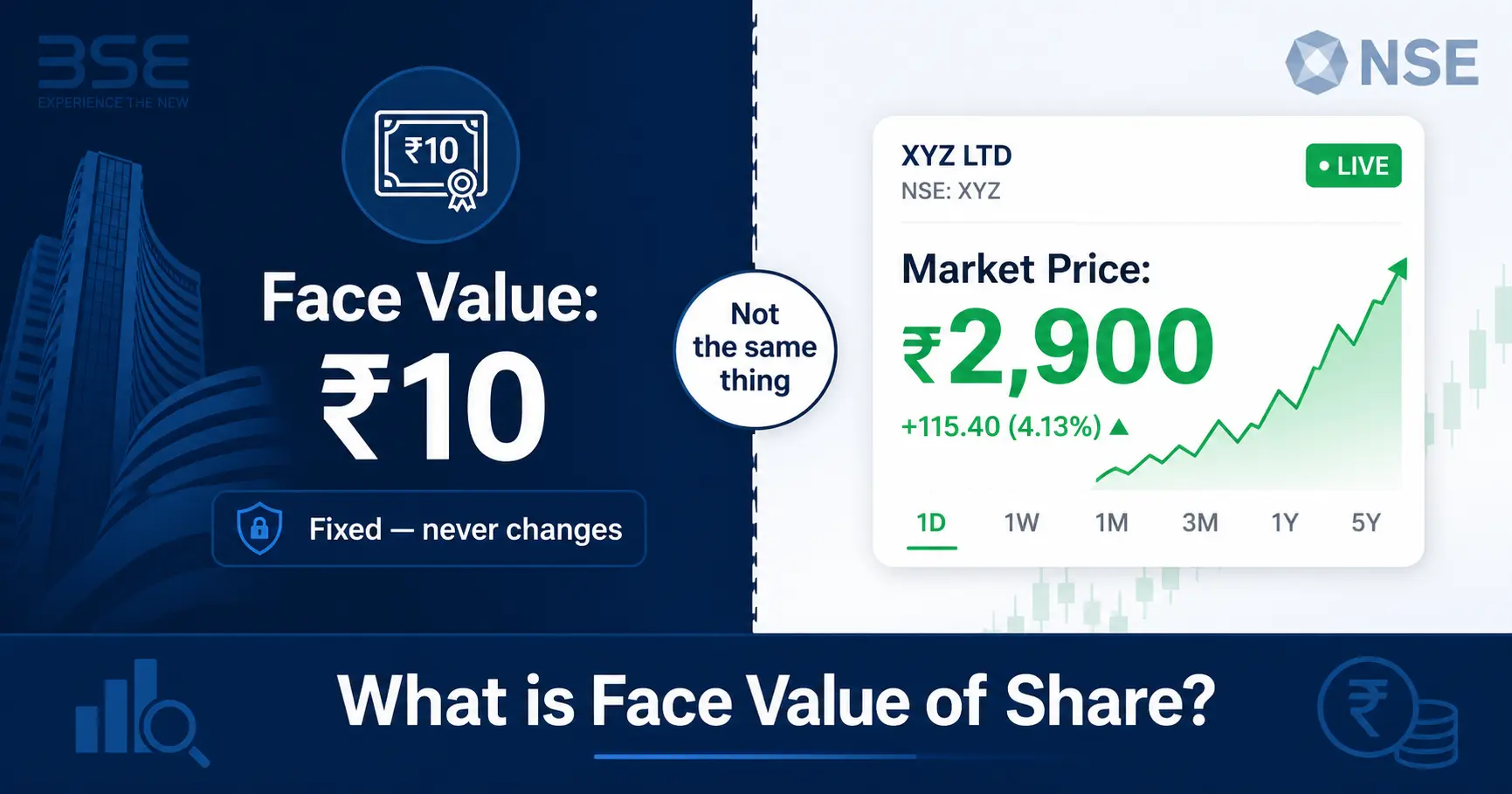
Every share has two prices — the one you see on Zerodha, and one hidden in the company’s records. Most beginners never notice the second one. It’s called face value, and it shows up in dividends, bonus shares, and stock splits..
The face value of a share is one of the most misunderstood concepts in the Indian stock market — and yet, it affects everything from how your dividends are calculated to how a stock split changes your portfolio.
If you are new to the stock market, understanding face value is one of the first important concepts.
In this guide, you will learn the face value of share meaning in plain language, with real NSE and BSE examples — no jargon, no textbook language. By the end, you will know exactly why a company shows ₹1 face value on TCS but ₹10 on Reliance, and why that difference matters when you invest.
📋 Table of Contents
- What is Face Value of Share?
- Face Value vs Market Value vs Book Value
- Why Face Value Matters for Investors
- How to Find Face Value on Zerodha, Groww & Angel One
- Advantages of Understanding Face Value
- Common Mistakes New Investors Make
- Key Takeaways
- Frequently Asked Questions (FAQ)
- Conclusion
What is Face Value of Share Meaning?
The face value of a share (also called nominal value or par value) is the original, fixed value assigned to a share when a company first creates it. It is decided by the company at incorporation and is printed on the share certificate.
Think of it like an MRP label on a product. No matter what the market charges — higher or lower — the number printed on the label does not change. Face value works exactly the same way for shares.
When you look at a stock on NSE or BSE, the face value appears as a static data point in the stock’s profile. It never fluctuates with daily market movements.
Face Value Formula & Calculation
There is no complex formula to memorise, but here is how face value connects to a company’s balance sheet:
Example: A company has Equity Share Capital of ₹100 crore and has issued 10 crore shares.
This number appears on the company’s balance sheet under Equity Share Capital. It does not appear anywhere on your trading screen as a moving number — because it simply does not move.
Why Do Some Indian Stocks Have ₹1 Face Value and Others ₹10?
This is the question every new investor on Zerodha and Groww eventually asks — and it is the one gap that even the biggest finance sites fail to answer clearly.
You will notice that major Indian companies have very different face values:
- TCS, HDFC Bank, ITC, Wipro → Face Value: ₹1
- Infosys → Face Value: ₹5
- Reliance Industries, MRF → Face Value: ₹10
- Tata Motors → Face Value: ₹2
Here is why — and it comes down to two reasons:
1. Stock splits over time. Many large Indian IT and banking companies started with a ₹10 face value. As their share prices climbed into the thousands, companies split their shares to make them accessible to retail investors. In a 10:1 split, one ₹10 share becomes ten ₹1 shares. The face value drops accordingly. That is why TCS, HDFC Bank, and Wipro all show ₹1 today.
2. Deliberate choice at incorporation. Newer companies sometimes choose ₹1 or ₹2 face value from the beginning to keep their share count high and simplify per-share calculations.
A ₹1 face value does not mean the stock is cheap. TCS has a ₹1 face value and trades above ₹3,800. MRF has a ₹10 face value and trades above ₹1,28,000. Face value and stock price are completely independent numbers.
Face Value vs Market Value vs Book Value — Key Differences
These three numbers all describe some kind of “value” of a share — but they measure completely different things. Here is a clear side-by-side comparison that every beginner needs to bookmark:
| Type of Value | What It Measures | Does It Change? | Example (Infosys) | Where You See It |
|---|---|---|---|---|
| Face Value | Original printed value on share certificate | Only on stock split | ₹5 | Balance sheet, stock profile |
| Market Value (LTP) | Current price buyers are paying on the exchange | Every second (trading hours) | ₹1,600 | Zerodha, Groww, NSE live feed |
| Book Value | Net assets of company per share | Every quarter | ₹260 | Annual reports, screener.in |
| Intrinsic Value | Estimated fair value based on fundamentals | Changes with analysis | Varies by analyst | Research reports, valuations |
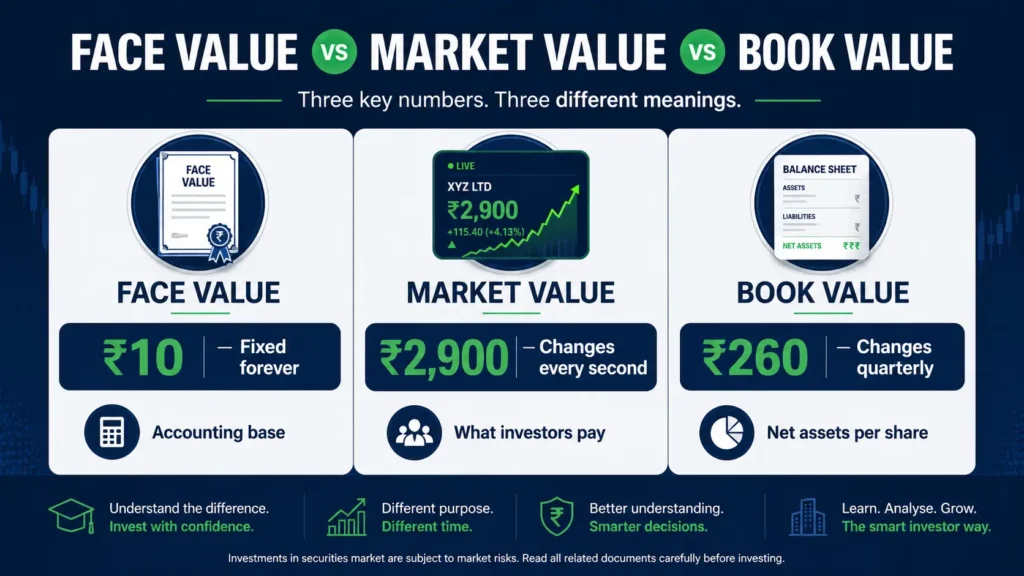
The three most important ‘value’ types every stock market beginner in India must understand — they measure completely different things.
Real Indian Stock Examples from NSE and BSE
Here is something no other finance article shows you — a live reference table of popular Indian stocks with their actual face values alongside their market prices:
| Company | NSE Symbol | Face Value (₹) | Approx. Market Price (₹) | FV as % of Market Price |
|---|---|---|---|---|
| Reliance Industries | RELIANCE | ₹10 | ₹2,900 | 0.34% |
| Tata Consultancy Services | TCS | ₹1 | ₹3,800 | 0.03% |
| Infosys | INFY | ₹5 | ₹1,600 | 0.31% |
| HDFC Bank | HDFCBANK | ₹1 | ₹1,700 | 0.06% |
| ITC | ITC | ₹1 | ₹460 | 0.22% |
| Tata Motors | TATAMOTORS | ₹2 | ₹950 | 0.21% |
| MRF | MRF | ₹10 | ₹1,28,000 | 0.008% |
For every company in this list, face value is a tiny fraction of the market price. This proves that face value and market price have no relationship to each other. A ₹1 face value company (TCS at ₹3,800) is far more valuable than most ₹10 face value companies.
Why Face Value of Share Matters for Investors
Face value is not just a textbook definition — it directly affects three real-world situations that impact your portfolio: dividend payouts, IPO applications, and corporate actions like stock splits and bonus shares.
1. Dividend Calculation — The Most Important Use
This is where most beginners make a costly mistake. When a company announces a dividend, it expresses it as a percentage of face value — not of the market price. Before calculating returns, it’s useful to understand how dividend in the stock market works.
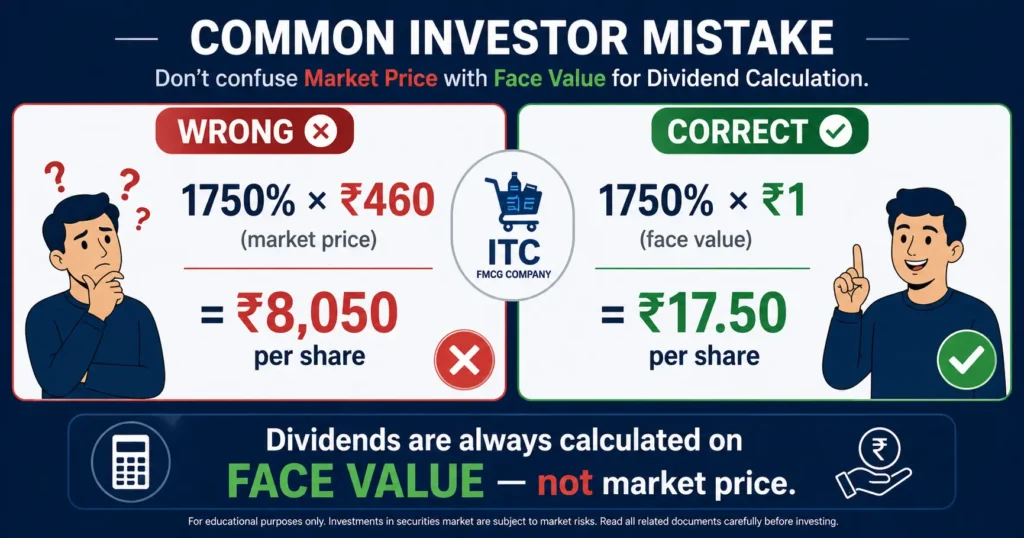
Dividends in India are always calculated as a percentage of face value — never the market price. This is one of the most misunderstood concepts for new investors.
Many beginners assume 1750% of ₹460 (market price) = ₹8,050 per share. That is completely wrong. Dividends are always calculated on face value — never on market price.
Quick formula to remember:
Similarly, if Reliance Industries (face value ₹10) announces a 200% dividend, each shareholder receives ₹20 per share — not 200% of the ₹2,900 market price. This is why always calculating your dividend income against face value — not the current stock price — is essential.
2. Face Value in Indian IPOs — What It Means When You Apply
When a company launches an IPO in India, it presents two separate numbers in the prospectus and the ASBA application form:
| Term | What It Means | Example (LIC IPO) |
|---|---|---|
| Face Value | Original accounting value of the share | ₹10 |
| Issue Price (IPO Price) | Price you actually pay to buy shares in the IPO | ₹949 |
| Share Premium | Difference = extra money the company collects as capital | ₹939 |
When you fill out an IPO application on Zerodha, Groww, or your bank’s ASBA portal, you apply at the issue price — not the face value. The face value is shown only for reference and does not affect how many shares you are allotted.
To understand this clearly, you should first know what an IPO in the Indian stock market is.
3. Stock Splits and Bonus Shares — How Face Value Changes
This is where most investors confuse two different corporate actions. The distinction is important — and no major competitor article explains it clearly enough. To understand this better, see how bonus shares work in India.
| Corporate Action | Does Face Value Change? | Number of Shares? | Your Total Value? | Real Example |
|---|---|---|---|---|
| Stock Split | Yes — reduces | Increases | Stays same | TCS 1:10 split: FV ₹10 → ₹1 |
| Bonus Issue | No — stays same | Increases | Stays same | Infosys 1:1 bonus: FV stays ₹5 |
| Rights Issue | No — stays same | Increases (if you subscribe) | Changes based on your decision | Reliance rights 1:15 |
Only a stock split or reverse stock split changes face value. A bonus issue, rights issue, or dividend payment does not change the face value of a share.
How to Find Face Value on Zerodha, Groww & Angel One
Finding the face value of any Indian stock takes under 30 seconds on any major trading app. Here is exactly where to look — step by step:
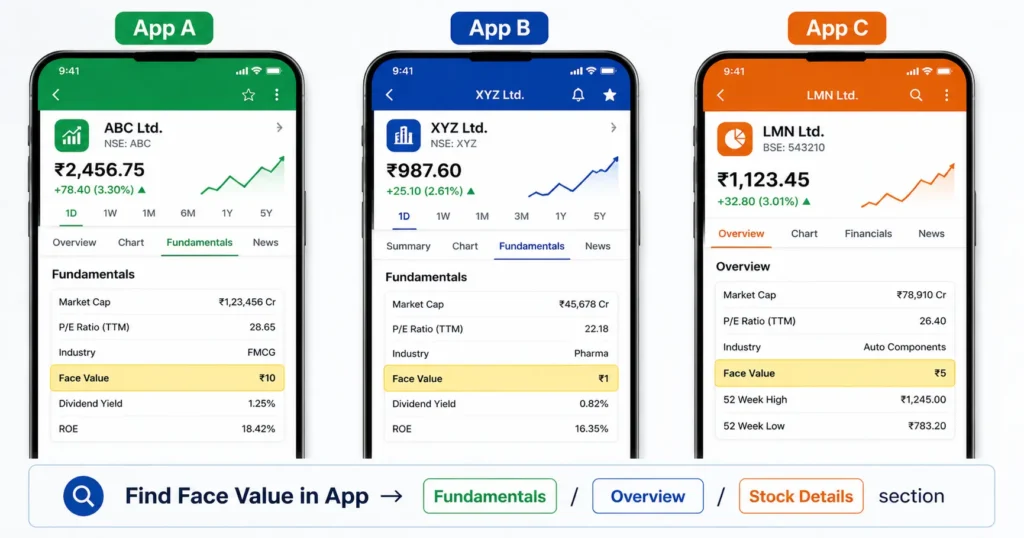
Face value of any NSE or BSE listed stock can be found in the Fundamentals section of Zerodha Kite, Groww, and Angel One within seconds.
🟢 Zerodha Kite
- Open the Kite app and search for any stock (e.g., type “RELIANCE”)
- Tap the stock name to open its market page
- Scroll down to the Fundamentals section
- You will see “Face Value” listed — typically ₹1, ₹2, ₹5, or ₹10
🔵 Groww
- Search for any stock from the home screen
- Tap the stock to open its detail page
- Scroll down to Stock Details or the About section
- Face value is listed alongside market cap, P/E ratio, and 52-week high/low
🟠 Angel One
- Open the app and go to any stock’s profile page
- Navigate to the Overview or Fundamentals tab
- Face value appears alongside EPS, P/E ratio, and market cap data
🔴 Official Exchange Websites (Most Reliable)
- BSE India: Go to bseindia.com → Search company name → Company Info → Master Data
- NSE India: Go to nseindia.com → Search symbol → Market Data → Face value shown in equity data
The face value shown across Zerodha, Groww, Angel One, NSE, and BSE will always be the same number — they all pull from the same official exchange data. If you ever see a discrepancy, always trust NSE or BSE directly.
Advantages of Understanding Face Value of a Share
| Advantage | How It Helps You as an Investor |
|---|---|
| Accurate dividend income calculation | You will never overestimate or underestimate your dividend payout again — because you know it is based on face value, not market price. |
| Reading company balance sheets | The “Equity Share Capital” line in any annual report becomes instantly clear when you know face value and total shares issued. |
| Understanding stock splits correctly | When a company announces a stock split, you will understand exactly how your face value changes — and why your wealth stays the same. |
| Smarter IPO applications | You will clearly understand the difference between face value and issue price, and know that the share premium is additional capital the company is raising. |
| Not being misled by face value differences | You will never assume a ₹1 face value stock is cheap, or that a ₹10 face value stock is expensive — because you know face value has nothing to do with market price. |
Common Mistakes New Investors Make About Face Value
These are the errors that trip up lakhs of new investors in India every year — and that no other article in this niche covers in enough detail.
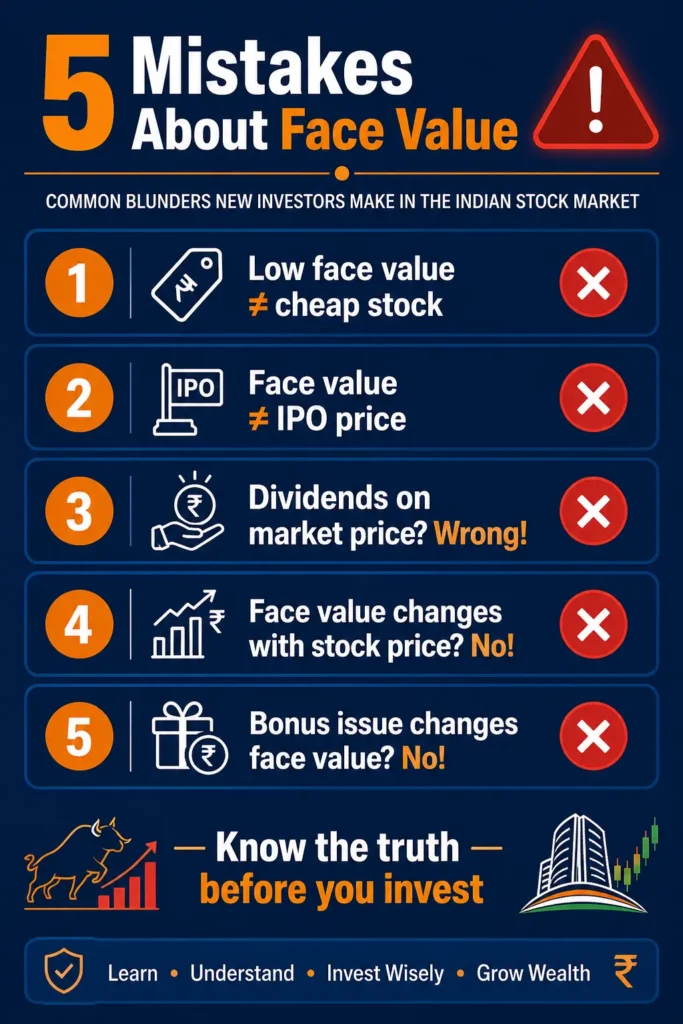
These five misunderstandings about face value trip up millions of new stock market investors in India every year.
Key Takeaways
📌 Face value of a share is the original fixed value set when a company is incorporated — also called nominal value or par value.
📌 Face value never changes with market movements — only a stock split or reverse stock split can alter it.
📌 Dividends in India are always declared as a percentage of face value — not market price. Always apply the formula: Dividend per share = (Dividend % × Face Value) ÷ 100.
📌 In a stock split, face value reduces proportionally. In a bonus issue, face value stays exactly the same.
📌 A low face value (₹1) does not mean the stock is cheap. TCS (₹1 FV) trades at ₹3,800+. Always evaluate stocks using PE ratio, EPS, and fundamentals — not face value.
📌 You can find face value of any stock on Zerodha Kite, Groww, Angel One, or directly on NSE/BSE websites under stock fundamentals.
Frequently Asked Questions (FAQ)
Conclusion
Understanding the face value of share meaning is a small step that makes a big difference in how you read stock data, calculate dividends, and interpret corporate actions like splits and bonus issues.
To recap what you have learned: the face value of a share is fixed from the day a company is formed. It lives in the company’s balance sheet. It is the base for dividend calculations. It changes only during stock splits. And it has absolutely nothing to do with what price you pay for that share on Zerodha or Groww.
The next time your trading app shows you “Face Value: ₹1” next to a ₹3,800 stock price, you will know exactly what it means — and you will not confuse it with the investment value ever again. That clarity is what separates informed investors from the ones making expensive assumptions.
Keep this guide bookmarked. The more you read company reports and follow corporate announcements, the more often face value will show up — and now you are ready for it. After understanding face value, the next step is learning how the stock market works.
⚠️ Disclaimer: This article is for educational and informational purposes only. It does not constitute financial advice, investment recommendations, or guidance of any kind. All stock prices and examples mentioned are approximate and for illustrative purposes only. Always conduct your own research and consult a SEBI-registered financial advisor before making investment decisions.