

Last Updated: May 13, 2026
When Wipro announced a 1:5 stock split in 2023, thousands of retail investors panicked — thinking their portfolio had lost value overnight. It hadn’t. Here’s exactly what a stock split does and doesn’t do.
A stock split increases the number of your shares while reducing the price per share proportionally. Your total investment value stays exactly the same. If you had 10 shares worth ₹2,000 each, after a 1:2 split you now have 20 shares worth ₹1,000 each — same total, more shares.
Relax. What you just witnessed is a stock split — one of the most common corporate actions in the Indian stock market, and one of the most misunderstood. This complete guide covers stock split explained for beginners India — what it means, how it works, real examples from companies like Infosys and TCS, and exactly what it means for your portfolio on Zerodha or Groww.
No jargon. No complicated theory. Just clear, honest explanation — the way it should have been taught from the start.
Table of Contents
- What is Stock Split?
- How Stock Split Works in India
- Stock Split Formula Explained
- Real Indian Stock Examples
- Why Companies Do Stock Split
- Stock Split vs Bonus Shares India
- Advantages and Limitations
- Key Takeaways
- Frequently Asked Questions
What is Stock Split?
A stock split is when a company divides each of its existing shares into multiple smaller units. The total number of shares in the market increases — but the overall value of the company stays exactly the same.
The Pizza Analogy
Imagine you have one whole pizza. Now you slice it into 4 pieces instead of 2. You still have the same pizza — just more, smaller slices. A stock split works exactly the same way. The company’s total value is unchanged; the shares are simply divided into more affordable pieces.
How Stock Split Works in India
When a company listed on NSE or BSE announces a stock split, here is the exact sequence of events — and what it means for you as a retail investor on Zerodha or Groww:
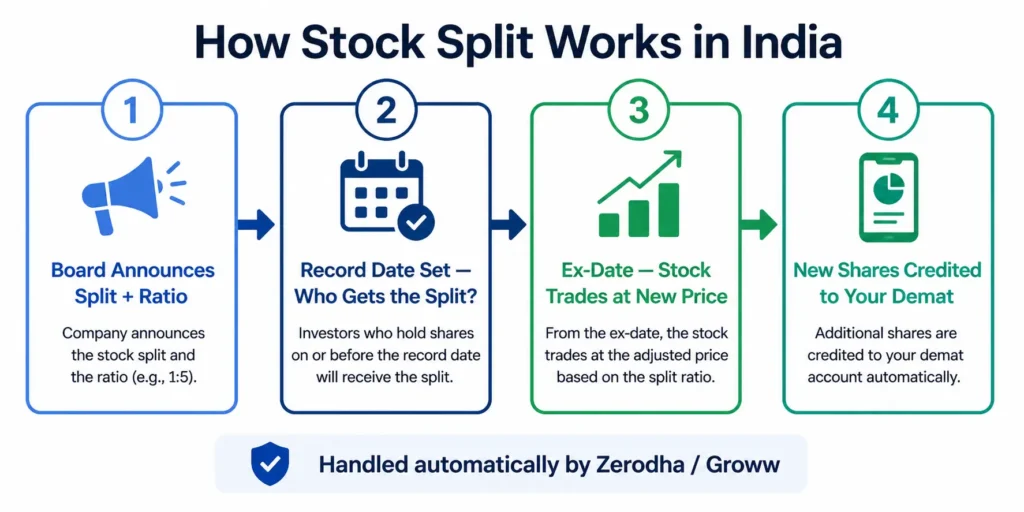
Four simple steps: announcement → record date → ex-date → new shares credited in your demat account.
The company’s board of directors approves a split ratio — such as 1:2, 1:5, or 1:10 — and announces it publicly on NSE and BSE.
The company sets a record date. You must hold the shares in your demat account on or before this date to be eligible for the split. If you buy after this date, you miss the split entitlement.
On the ex-date, the stock begins trading at the new adjusted price on NSE and BSE. The exchange handles this automatically — no action needed from your side.
Your broker — whether Zerodha, Groww, or any other SEBI-registered platform — automatically credits the additional shares to your demat account. You will see the updated share count in your portfolio within a few working days.
Stock Split Ratios — 1:2, 1:5, 1:10 Explained
| Split Ratio | Shares you had | Shares you get | Old price (example) | New price |
|---|---|---|---|---|
| 1:2 | 10 | 20 | ₹2,000 | ₹1,000 |
| 1:5 | 10 | 50 | ₹2,000 | ₹400 |
| 1:10 | 10 | 100 | ₹2,000 | ₹200 |
Stock Split Formula Explained
There is no complicated formula. The math is straightforward — everything stays proportional.
New price = Old price ÷ Split ratio
Step-by-Step Calculation Example
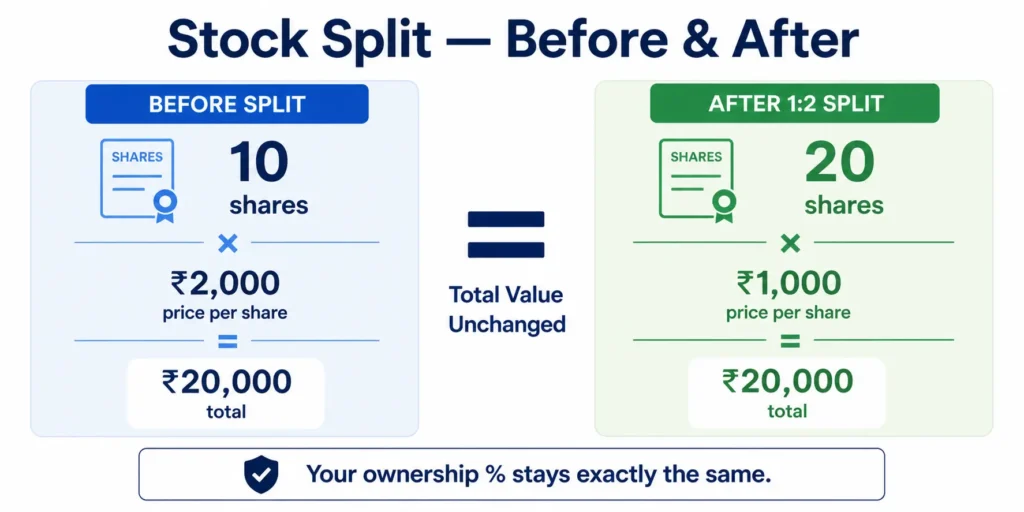
Before: 10 shares at ₹2,000. After a 1:2 split: 20 shares at ₹1,000. Total value unchanged.
| Detail | Before Split | After 1:2 Split |
|---|---|---|
| Number of shares | 10 | 20 |
| Price per share | ₹2,000 | ₹1,000 |
| Total value | ₹20,000 | ₹20,000 |
| Your ownership % | Unchanged | Unchanged |
Real Indian Stock Examples
Example 1: TCS (Tata Consultancy Services)
TCS, India’s largest IT company by market capitalization, has used stock splits to maintain retail accessibility. When share prices climb to levels that seem out of reach for smaller investors, a split brings the per-share price to a more approachable level — without changing the company’s fundamental value.
| Detail | Value | What it means |
|---|---|---|
| Hypothetical share price | ₹4,000 | High price limits retail participation |
| Shares you hold | 5 | Total value: ₹20,000 |
| After 1:2 split — price | ₹2,000 | More affordable entry point |
| After 1:2 split — shares | 10 | Total value still: ₹20,000 |
Example 2: Reliance Industries
Reliance Industries — India’s largest company by market cap — has historically used stock splits to maintain broad retail investor participation. As the share price rises over time, periodic splits ensure that millions of investors using apps like Groww and Zerodha can continue buying and trading the stock without needing large amounts of capital per transaction.
The MRF Story — Why Most Companies Choose to Split
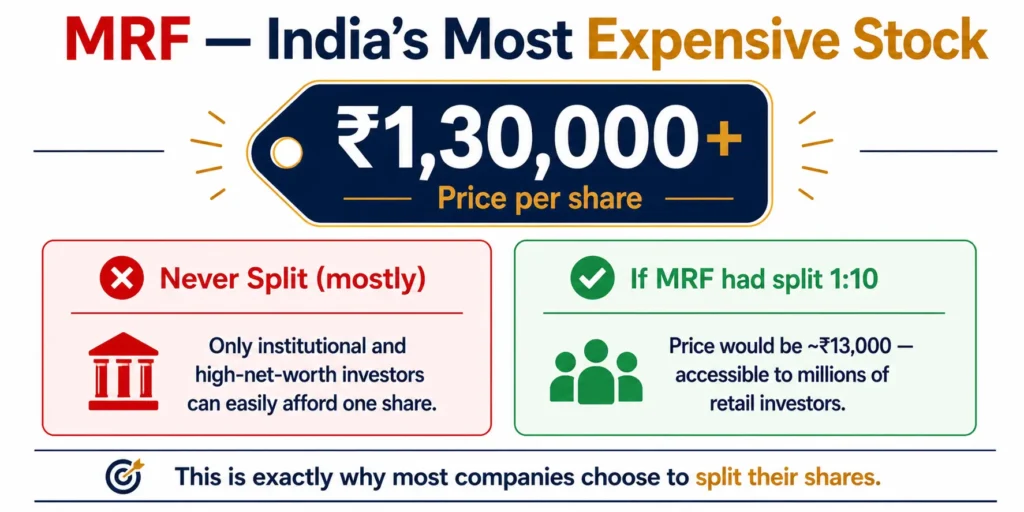
MRF — India’s most expensive stock — has largely avoided splits, limiting retail participation.
Consider MRF, India’s leading tyre manufacturer. Its shares trade above ₹1,30,000 per share — making it the most expensive stock on NSE. Because MRF has largely avoided stock splits, it effectively limits direct retail participation. Most everyday investors simply cannot afford to buy even one share. This is precisely the problem that stock splits are designed to solve for other companies.
Why Companies Do Stock Split
Companies announce stock splits for strategic business reasons — not because they are required to. Here are the primary motivations behind this decision:
| Reason | What it means for investors |
|---|---|
| Make shares more affordable | Lower price per share allows more retail investors (especially new Groww/Zerodha users) to participate |
| Increase trading liquidity | More shares at lower prices means higher daily trading volumes and tighter bid-ask spreads |
| Signal confidence | A company splitting its shares signals it expects the price to continue growing — otherwise a split makes less sense |
| Broaden the shareholder base | More affordable shares attract a wider range of investors, including Tier-2 and Tier-3 city investors |
| Improve index inclusion eligibility | Some index inclusion criteria consider liquidity — higher volume from splits can improve a company’s chances |
Understanding why companies take corporate actions like splits also requires knowing how shares are classified. Read our guide: Types of Shares in India for Beginners.
Stock Split vs Bonus Shares India
This is the most common point of confusion for beginners. Stock splits and bonus shares both increase your share count — but they work very differently under the hood.
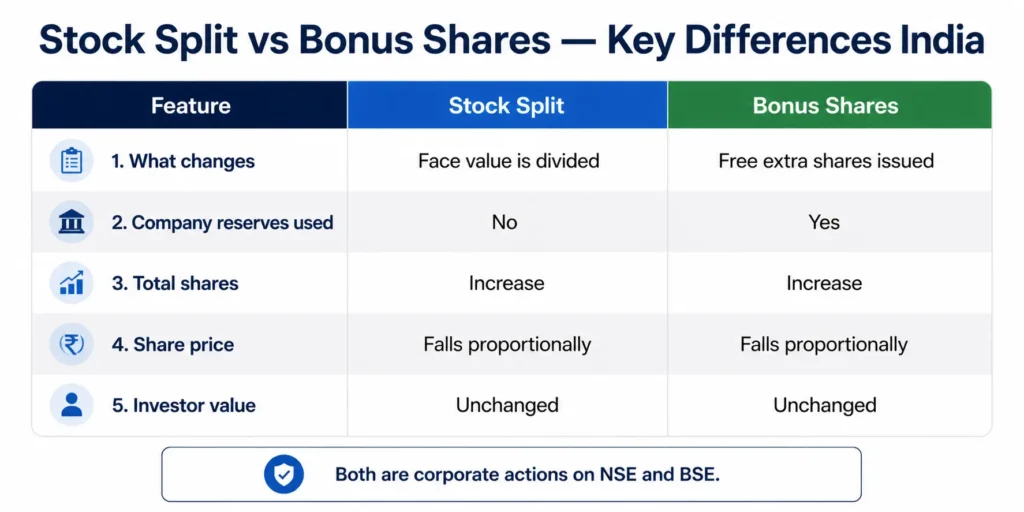
Stock split and bonus shares look similar but work differently — here’s the key difference.
| Detail | Stock Split | Bonus Shares |
|---|---|---|
| What changes | Face value of each share is divided | Free extra shares are issued to shareholders |
| Company reserves used? | No | Yes — from retained earnings or reserves |
| Face value | Reduces proportionally | Stays the same |
| Share price after | Falls proportionally to the split ratio | Falls approximately in line with bonus ratio |
| Total shareholder value | Unchanged immediately | Unchanged immediately |
| Tax treatment | No tax event on the split itself | No tax event on issue — tax applies on sale |
Want to understand bonus shares in detail? What is Bonus Share in Stock Market India — complete beginner guide.
Advantages and Limitations of Stock Split
Why stock splits are useful
- Makes shares more affordable for retail investors
- Increases trading volumes and liquidity on NSE/BSE
- Signals company confidence in future growth
- Broadens shareholder base — especially in Tier-2 and Tier-3 cities
- Creates positive media coverage and investor interest
Where stock splits can mislead
- No real change in company value or your wealth
- Short-term FOMO can inflate price temporarily — then correct
- Many beginners mistake a split for instant profit
- Small-cap splits can attract speculative trading and volatility
- Buying purely on split announcement is not a strategy
To understand how to evaluate stocks beyond just corporate actions, read: Face Value of Share Meaning — Simple Guide with Real Indian Examples.
Key Takeaways
- A stock split increases shares and reduces price per share proportionally — your total investment value stays exactly the same.
- The record date is critical — you must hold shares on or before this date to receive the split benefit.
- Zerodha and Groww handle everything automatically — no action required from your side.
- Stock split ≠ bonus shares — they look similar but work very differently. Face value changes in a split; it does not in a bonus issue.
- MRF is the perfect example of what happens when a company never splits — extremely high price per share, very limited retail accessibility.
- Never buy purely on a split announcement — base all decisions on company fundamentals, not corporate action hype.
Frequently Asked Questions
Conclusion
Understanding stock split explained for beginners India gives you a real edge the next time a split announcement appears in your Zerodha or Groww notifications. Instead of confusion or panic, you will know exactly what is happening — and why.
Your money has not magically increased or disappeared. The company has simply restructured its shares to stay accessible to a growing community of retail investors like you. When combined with strong fundamentals and sound investing habits, this kind of corporate action contributes to a more liquid, more inclusive stock market for everyone in India.
Stay informed, keep learning, and always look beyond the headline before making any investment decision.
Disclaimer: This article is for educational purposes only. It does not constitute financial advice, investment recommendations, or any solicitation to buy or sell securities. Stock market investments are subject to market risk. Always conduct independent research or consult a SEBI-registered financial advisor before making investment decisions. Data and examples are illustrative only and may not reflect current market values.