

Last Updated: May 13, 2026
Reliance is trading at ₹2,900. Infosys at ₹1,450. Which one is expensive? The price alone tells you nothing. PE Ratio answers this in one number — and once you understand it, you read stocks completely differently.
You are not alone. Most beginners in India see this number every day but skip it because nobody explained it in simple words. The truth is — PE ratio is one of the most powerful tools for understanding whether a stock is expensive or cheap. And once you understand it, you will never look at a stock the same way again.
In this guide, we will break down PE ratio explained for beginners India — what it means, how to calculate it, and how to actually use it while investing in Indian stocks like Reliance, TCS, and HDFC Bank.
No jargon. No complicated finance theory. Just clear, simple explanation with real Indian examples.
PE ratio = Share Price ÷ EPS. It tells you how expensive or cheap a stock is compared to its earnings. A PE of 25 means you pay ₹25 for every ₹1 the company earns. Read on to understand exactly what that means for your Zerodha or Groww investments.
📌 Also read:
What is Stock Market for Beginners
What is PE Ratio? (Simple Meaning in Plain English)
Imagine you are thinking about buying a small chai shop from your friend. The shop earns ₹1,00,000 every year. Your friend is asking ₹10,00,000 for it. Would you buy it?
To decide, you would naturally ask: how many years will it take to earn back what I am paying? The answer: 10 years. That number — 10 — is essentially the PE ratio.
In the stock market, it works the same way. The PE ratio (Price to Earnings ratio) shows how expensive or cheap a stock is relative to the profit the company makes. It is one of the most widely used tools in fundamental analysis — and understanding it is one of the first real skills you develop as a stock market beginner in India.
How PE Ratio Works in the Stock Market
When you open Zerodha, Groww, or NSE India and see a stock listed with a PE of 25 or 35, it is telling you something very specific: for every rupee this company earns, investors are currently paying that many rupees.
Investors pay ₹10 for every ₹1 earned.
Could be undervalued — or the company may be slow-growing or risky.
Common in: PSU banks, commodity stocks, cyclical companies.
Investors pay ₹40 for every ₹1 earned.
Could be overvalued — or the company has strong future growth expected.
Common in: IT companies, quality FMCG brands, premium consumer companies.
PE Ratio Formula — Step by Step
The Formula
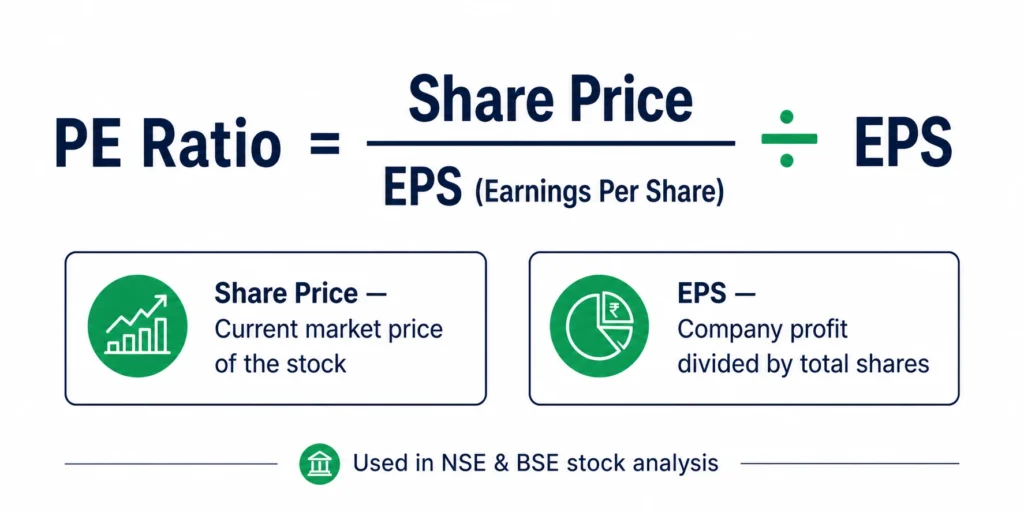
PE Ratio = Share Price ÷ EPS — the simplest stock valuation formula.
What Each Part Means
| Term | What it means | Where to find it |
|---|---|---|
| Share Price | The current price of one share on the stock exchange | NSE, BSE, Zerodha, Groww (live market price) |
| EPS (Earnings Per Share) | Company’s net profit divided by the total number of shares | Company quarterly results, Screener.in, Tickertape |
| PE Ratio | Share Price ÷ EPS — the valuation multiple | Directly visible on Zerodha, Groww, NSE website |
Trailing PE vs Forward PE
When you see a PE ratio on your broker app, it is usually the Trailing PE — calculated using actual earnings from the last 12 months.
Forward PE, on the other hand, uses analyst estimates of future earnings. It is more speculative but useful for fast-growing companies.
| Type | Based on | Best for |
|---|---|---|
| Trailing PE | Actual past 12-month earnings | Stable, established companies (HDFC, HUL) |
| Forward PE | Estimated future 12-month earnings | High-growth companies where future earnings may be much higher |
Real Indian Stock Examples — PE Ratio in Action
Example 1: Reliance Industries
| Data Point | Value | What it tells you |
|---|---|---|
| Share Price | ₹2,500 | Current market price per share |
| EPS | ₹100 | Profit per share in the last 12 months |
| PE Ratio | 25 | You pay ₹25 for every ₹1 Reliance earns |
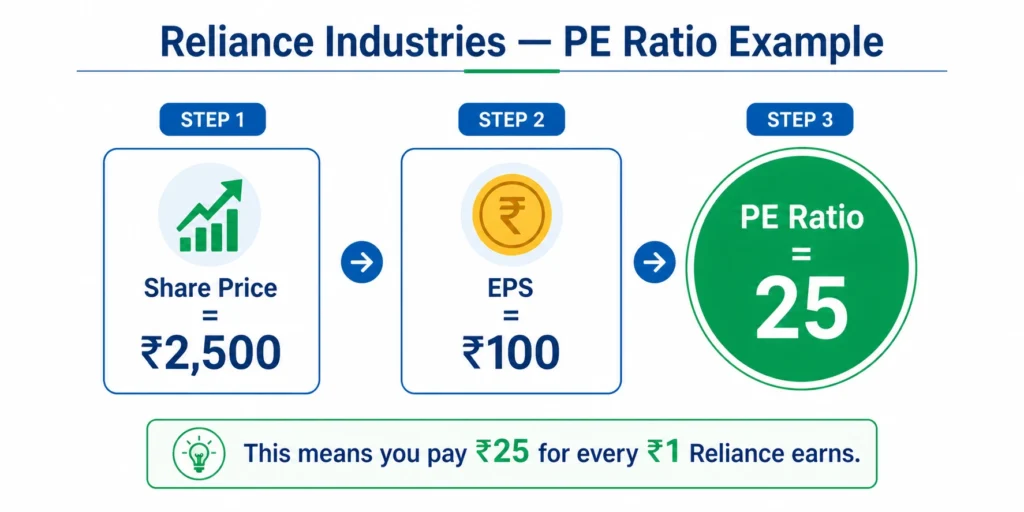
Reliance Industries PE ratio calculation: ₹2,500 share price ÷ ₹100 EPS = PE 25.
Example 2: Tata Consultancy Services (TCS)
TCS typically trades at a PE of 30–35 — higher than many other companies. This is not because the stock is necessarily overpriced. It reflects the market’s expectation of consistent, high-quality earnings growth from India’s largest IT exporter. Investors are willing to pay a premium for that stability and global revenue base.
Example 3: A PSU Bank (Comparison)
Many government-owned banks trade at PE ratios of 6–12. This does not automatically make them great buys. It often reflects lower growth expectations, higher non-performing assets (NPA), or structural challenges in the public sector.
What is a Good PE Ratio for Indian Stocks? (Sector-Wise Guide)
There is no single “correct” PE ratio for all stocks. Every sector in India has its own typical PE range, shaped by growth rates, business cycles, and investor expectations. Here is a practical reference table for beginners.
| Sector | Typical PE Range | Zone | Why? |
|---|---|---|---|
| Banking & Finance (Private) | 15 – 25 | Medium | Steady growth, interest rate sensitive |
| PSU Banks & Government Finance | 6 – 15 | Low | Lower growth expectations, higher risk |
| IT & Technology | 25 – 40 | High | Global revenue, consistent earnings, high quality |
| FMCG & Consumer Goods | 40 – 65 | Very High | Brand power, pricing advantage, recession-proof demand |
| Auto & Manufacturing | 12 – 25 | Medium | Cyclical sector, tied to economic growth cycles |
| Pharma & Healthcare | 25 – 45 | High | R&D-heavy, long product cycles, global markets |
| Real Estate (REITs / Developers) | 20 – 40 | Medium | Asset-backed, but lumpy earnings can distort PE |
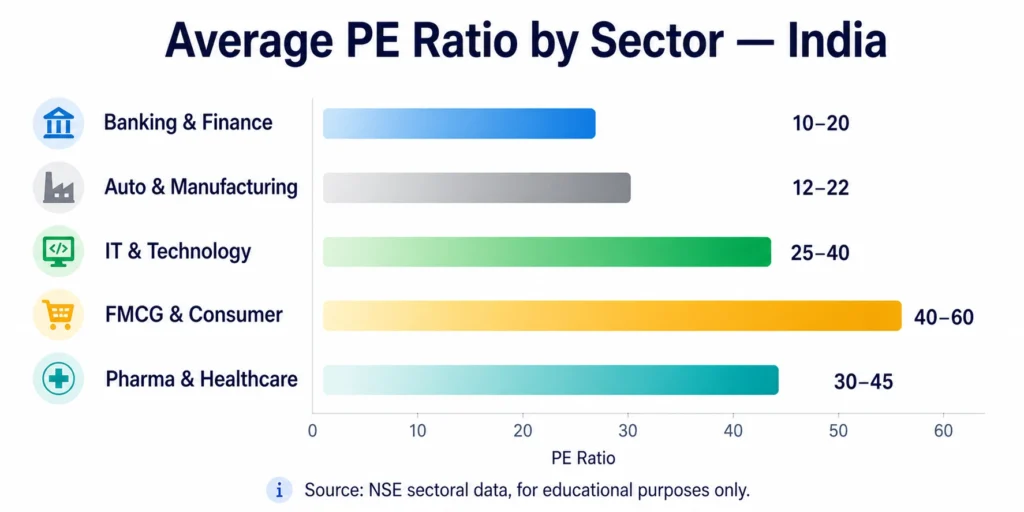
Different sectors in India trade at very different PE ratios — always compare within the same sector.
Nifty 50 PE Ratio — What It Tells You About the Indian Market
The Nifty 50 PE ratio is the combined PE of all 50 companies in the Nifty index. It acts as a market-wide thermometer — telling you whether the Indian stock market, overall, is expensive or cheap.
Here is a simple historical guide:
| Period | Nifty 50 PE (approx.) | Market Situation |
|---|---|---|
| 2008 (Global Financial Crisis) | ~10–12 | Deep undervaluation — strong long-term buy zone in hindsight |
| 2020 (COVID-19 crash) | ~18–20 (briefly) | Short-lived dip before a sharp recovery |
| 2021 (Post-COVID bull run) | ~38–42 | Extreme overvaluation — frothy markets, retail FOMO |
| 2024–2025 (current range) | ~20–24 | Moderately valued — reasonable but not cheap |
📌 Also read:
What is Sensex and Nifty
How to Find PE Ratio on Zerodha Kite and Groww (Step-by-Step)
Knowing the theory is one thing. Being able to look it up in your actual trading app is what makes it useful. Here is exactly how to find PE ratio on the two most popular platforms in India.
On Zerodha Kite
Log in and go to the market watchlist or search for any stock.
This opens the stock detail page. On mobile, tap the stock. On desktop, click it.
Scroll down on the stock page. You will see a section labeled Fundamentals with P/E listed clearly.
On Groww
Use the search bar at the top. Type any stock name like “Infosys” or “HDFC Bank.”
Tap on the stock. You will land on a page showing the chart and key data.
Groww shows “PE Ratio” clearly under key statistics section.
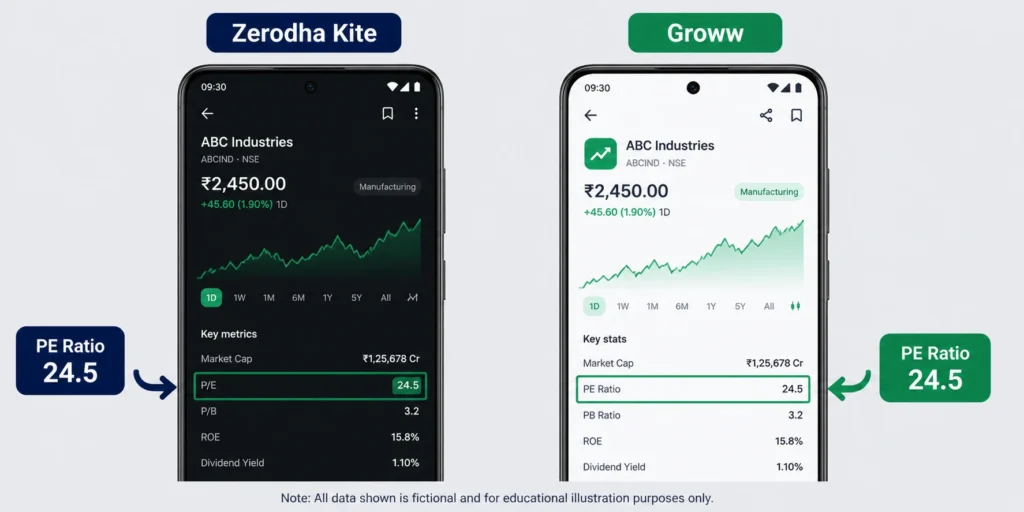
Both Zerodha Kite and Groww display PE ratio under the stock’s fundamentals section.
High PE vs Low PE Stocks — Real-World Indian Examples
Let us make this practical with real comparisons you might actually encounter while using Groww or Zerodha.
| Stock Type | Example | Typical PE | What it usually signals | Beginner watch-out |
|---|---|---|---|---|
| High-quality IT | TCS, Infosys | 28 – 35 | Premium for consistent, dollar-earning growth | Not a bubble — check PE vs sector average |
| FMCG brand | HUL, Nestle India | 50 – 80 | Pricing power, near-monopoly brand value | High PE + slow EPS growth = risky entry point |
| Private bank | HDFC Bank, Kotak | 18 – 28 | Growth + asset quality trust premium | Check NPA levels alongside PE |
| Cyclical / commodity | Steel, Cement, Coal | 5 – 15 | Earnings can spike in upcycles, crash in downcycles | Low PE in a commodity upcycle = dangerous trap |
| Small-cap growth | Various NSE SME stocks | 30 – 100+ | High growth expected, high speculation | Always verify EPS — small caps can manipulate earnings |
Advantages and Limitations of PE Ratio
Why PE ratio is useful
- Simple, one-number stock valuation check
- Available instantly on Zerodha, Groww, NSE
- Easy to compare stocks within the same sector
- Widely used by retail and institutional investors
- Works as a quick screen before deeper research
Where PE ratio can mislead you
- No PE available for loss-making companies
- Earnings (EPS) can be manipulated or inflated
- Ignores debt, cash flows, and business quality
- Sector comparison is meaningless (IT vs Banking)
- Misleading for cyclical stocks at earnings peaks
📌 Also read: Large Cap vs Mid Cap vs Small Cap
Key Takeaways — What to Remember
- PE ratio = Share Price ÷ EPS. It shows how much investors pay for each rupee of earnings.
- High PE ≠ bad. Low PE ≠ good. Context — sector, growth, and quality — determines meaning.
- Always compare within the same sector. IT vs Banking comparison is not meaningful.
- Check the Nifty 50 PE to understand whether the overall market is cheap or expensive.
- Find PE instantly on Zerodha Kite or Groww under the stock’s fundamentals section.
- Never rely on PE alone. Use it as a starting filter, then dig deeper.
- Small-cap stocks with suspiciously low PE deserve extra scrutiny — earnings may not be reliable.
Frequently Asked Questions (FAQ)
There is no single correct number — it depends entirely on the sector. As a starting guide: Banking stocks (15–25), IT stocks (25–40), FMCG stocks (40–65). Compare with sector average.
High PE can mean growth expectations or overvaluation. Always compare growth vs valuation.
Groww → Key Stats. Zerodha → Fundamentals panel. Screener.in for deep analysis.
It shows how much investors pay per ₹1 earnings. Helps compare valuation.
Generally, if PE is 50% above historical average, it signals overvaluation.
No — but very high PE indicates risk. Combine with other indicators.
Disclaimer: This article is for educational purposes only and does not constitute financial advice, investment recommendations, or any form of solicitation. Stock market investments are subject to market risks. Always conduct your own research or consult a SEBI-registered financial advisor before making any investment decisions. Data and examples used are for illustration only and may not reflect current market values.