
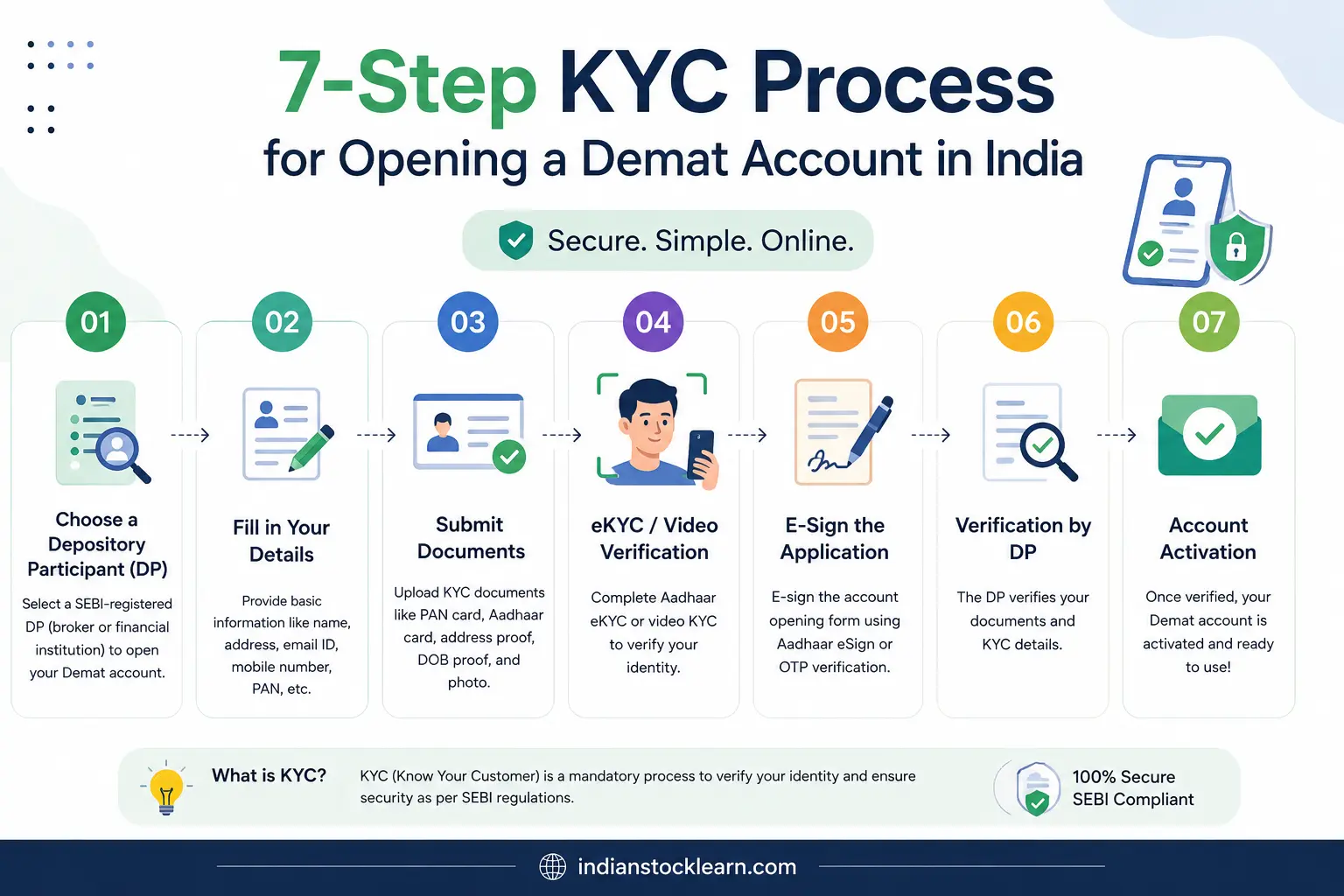
If you’ve tried opening a Demat account with Groww, Zerodha, Upstox, or Angel One, you’ve seen the mandatory KYC step. Before you can buy a single share, your identity must be verified. That’s how KYC works in stock market India — and this guide breaks down every part of it.
You’ll learn what KYC is, why it’s mandatory, how the step-by-step process works, the difference between eKYC, Video KYC, and Physical KYC, what KRA and CKYC mean, and how to check your KYC status using your PAN card.
- What is KYC in Stock Market India?
- Why is KYC Mandatory?
- How Does KYC Work in Stock Market India?
- Step-by-Step KYC Process
- What Happens After You Click Submit?
- eKYC vs Physical KYC vs Video KYC
- KYC Edge Cases: NRI, Minor, Name Change
- What is KRA in the Indian Stock Market?
- What is CKYC?
- KYC Status Explained
- KYC Myths vs Reality
- How to Check KYC Status Using PAN
- Real Stock Market Example
- Why KYC Protects Investors
- Frequently Asked Questions
What is KYC in Stock Market India?
KYC stands for Know Your Customer. It’s the identity verification process used by stock brokers, mutual fund companies, and banks to confirm you are who you say you are before allowing you to invest.
Think of it like airport security. You show your identity proof before boarding — no exceptions. KYC works the same way. Before buying shares of Reliance Industries, TCS, or any Nifty 50 ETF, your identity needs to be on record with a SEBI (Securities and Exchange Board of India)-registered broker.
KYC verifies your:
- Full name and PAN card details
- Aadhaar details (where applicable)
- Date of birth
- Current address
- Mobile number and email ID
- Photograph and signature
- Bank account details
Is KYC Mandatory?
Yes — without exception. You cannot buy shares, sell shares, apply for IPOs, invest in ETFs, or open a Demat account without completing KYC first. Brokers are legally prohibited from activating your trading account until verification is done.
Who Regulates KYC Rules?
SEBI sets the rules. Stock brokers like Groww, Zerodha, Upstox, and Angel One collect your documents and run the verification. A third party called the KYC Registration Agency (KRA) stores your verified records centrally — you’ll learn more about KRA below.
How Does KYC Work in Stock Market India?
Most beginners think KYC means uploading a PAN card. There are actually several checks happening behind the scenes. Here’s the complete picture.
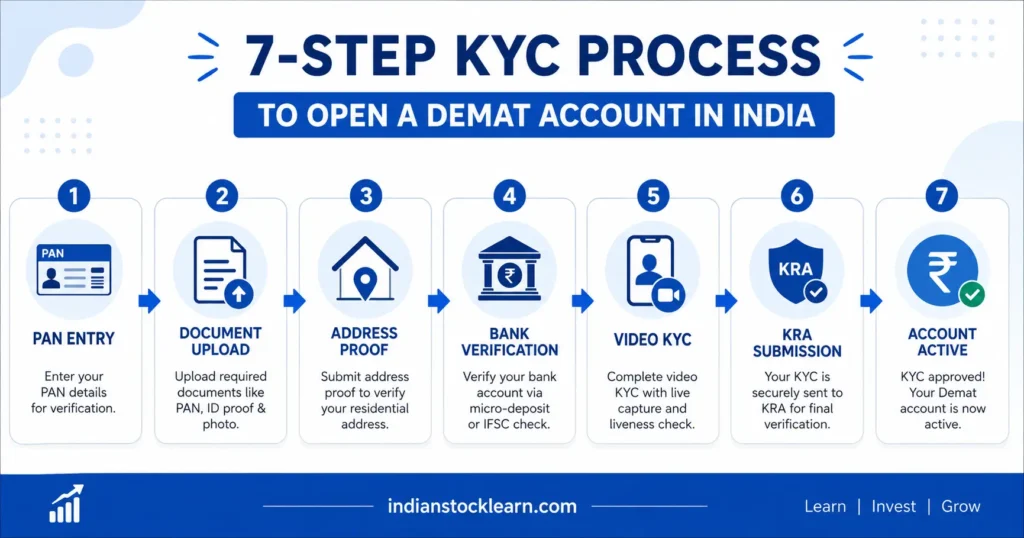
Step-by-Step KYC Process for a Demat Account
Here’s the same process as a quick reference table:
| Step | What Happens |
|---|---|
| 1 | Register with a stock broker |
| 2 | Enter PAN details |
| 3 | Upload identity documents |
| 4 | Verify address |
| 5 | Verify bank account |
| 6 | Complete eKYC or Video KYC |
| 7 | Broker submits details to KRA |
| 8 | Verification completed |
| 9 | Trading and Demat account activated ✅ |
What Actually Happens After You Click “Submit”?
Most guides stop at “upload your documents.” But submitting your KYC is only the beginning. Here’s what happens inside the system — steps that most investors never see.
Most KYC delays aren’t caused by your documents being wrong. They’re caused by backend queues, batch processing windows, and manual review triggers. Once you know this, you stop panicking and simply wait for the right window.
eKYC vs Physical KYC vs Video KYC
Not every investor completes KYC the same way. 3 methods are in common use today.
1. eKYC — Fastest Option
Everything happens online. You verify your PAN, authenticate via Aadhaar OTP (where applicable), and upload documents digitally. No branch visit, no paperwork. This is what most first-time investors use with online brokers like Groww, Zerodha, and Upstox.
2. Physical KYC — Traditional Method
You submit paper copies and signed forms at a branch office or through a broker representative. Verification takes longer, but some investors prefer this route — especially those with limited internet access or who want in-person support.
3. Video KYC — Now Standard with Modern Brokers
During a live or recorded session, you show your PAN card, display your face clearly, speak a verification code, and confirm your identity on camera. It keeps the process fully online while significantly reducing fraud.
| Feature | eKYC | Physical KYC | Video KYC |
|---|---|---|---|
| Online Process | Yes | No | Yes |
| Paper Documents | Minimal | Required | Minimal |
| Branch Visit | No | Usually Yes | No |
| Processing Speed | Fast | Slower | Fast |
| Popular with Online Brokers | Yes | Less Common | Yes |
Most beginners today choose eKYC combined with Video KYC. Whether you open an account with Groww, Zerodha, Angel One, or ICICI Direct, the core verification checks are the same — only the app interface differs.
KYC Edge Cases: When Standard Advice Fails
The standard KYC guide assumes a simple scenario — a resident Indian adult with a linked Aadhaar, a clean PAN, and a standard bank account. But real life is rarely this tidy. Here are the most common situations where standard KYC advice breaks down, and what to do instead.
What is KRA in the Indian Stock Market?
After your broker finishes verifying your documents, where do those records go? To a KYC Registration Agency (KRA).
A KRA acts as a central record keeper for investor KYC data. Instead of every broker maintaining its own separate records, KRAs hold a verified database that financial institutions can access when needed.
Here’s why that matters. Say you opened a Demat account with Groww in 2024. Two years later you want to open another with Zerodha. Without a central system, you’d submit everything from scratch. Because your records are already at a KRA, much of the verification can be skipped or fast-tracked.
What Does a KRA Store?
A KRA stores your PAN, name, date of birth, address, mobile number, email, photograph, signature, and KYC status. It does not store your stock holdings, trading history, or portfolio — those remain with your Demat account and Depository Participant (DP).
Popular KRAs in India
- CVL KRA
- CAMS KRA
- NDML KRA
- Karvy KRA
- NSE KRA
All operate under the same regulatory framework. For investors, the experience is identical regardless of which KRA your broker uses.
What is CKYC?
KYC and CKYC are related but not the same thing.
CKYC stands for Central Know Your Customer. It was introduced to create one common customer identification system across different financial sectors — banks, mutual funds, insurance, and stock brokers.
After successful CKYC registration, some investors receive a 14-digit CKYC Identification Number. Financial institutions can use this number to retrieve your verified data without asking you to re-submit documents each time you open a new financial account.
KYC is broker-specific verification, stored at a KRA. CKYC is a cross-sector system — it spans banks, mutual funds, and insurance too. You may have done both without knowing it.
KYC Status Explained
Log into your broker account and you might see: Registered, Validated, or On Hold. Here’s what each means.
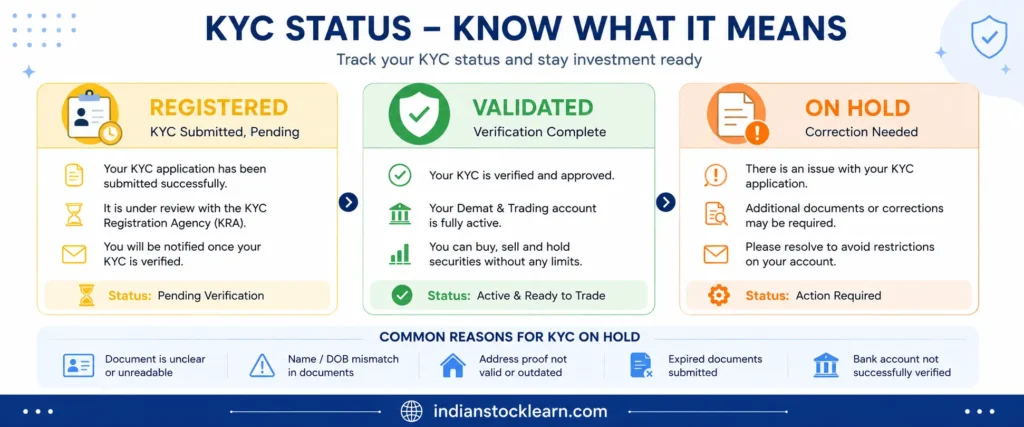
| Status | What It Means | Action Required? |
|---|---|---|
| Registered | Documents submitted. Some verification still pending. | Wait — usually resolves automatically. |
| Validated | All checks complete. KYC record accepted. | None — you’re ready to trade. |
| On Hold | Correction required before verification can continue. | Fix the flagged document or mismatch. |
Common Reasons for “On Hold” or Rejection
KYC Myths vs Reality — What Investors Get Wrong
Most KYC guides tell you the rules. Almost none explain what investors wrongly believe about those rules. These misconceptions are exactly what causes delays, frozen accounts, and missed IPO windows.
| ❌ Myth | ✅ Reality |
|---|---|
| MythKYC is a one-time process — done forever. | RealityYour KYC can go “On Hold” years later. Address changes, mobile number updates, account dormancy (12+ months without trading), and periodic SEBI compliance drives all trigger re-verification requirements. |
| MythOne broker’s KYC works everywhere automatically. | RealityThe KRA stores your verified record centrally, but some brokers still run their own additional checks — especially when their internal risk systems flag something. You may need to upload documents again even with an existing KRA record. |
| MythVideo KYC is always instant. | RealityPoor network during Video KYC can cause a recorded session to be rejected later during compliance review — even if it seemed successful in the app. Weekend and holiday submissions go into a manual queue that is processed only on business days. |
| MythMy name must match 100% across all documents. | RealityMinor variations — initials vs full name — are often auto-approved through fuzzy matching. But specific combinations (middle name vs. no middle name, maiden name vs. married name) still trigger manual review at certain KRAs. Check rather than assume. |
| MythKYC approval means my account is fully active. | RealityKYC approval and account activation are two separate events. Some brokers activate trading within minutes of KYC clearance; others take one additional business day for internal account setup. If you want to trade F&O, a separate financial KYC (income proof via ITR or bank statements) is required on top of standard KYC. |
| MythKYC protects me from all stock market fraud. | RealityKYC verifies identity at account opening. It significantly reduces fraud but cannot prevent mis-selling, unauthorized trading, or phishing attacks after your account is active. Stay alert even after KYC is complete. |
How to Check KYC Status Using Your PAN Card
Checking your status takes under 2 minutes.
- Visit the official KRA status-check portal (CVL KRA, CAMS KRA, or NSE KRA — all are available online).
- Enter your PAN number.
- Complete the security verification if prompted.
- Submit the request.
- Your current KYC status displays — Registered, Validated, On Hold, or Rejected.
If the status shows “On Hold,” your broker usually sends an email or app notification detailing exactly which document needs correction.
Real Stock Market Example
Rahul wants to invest in Reliance Industries because he believes in the company’s long-term potential.
He downloads Groww, enters his PAN, uploads his Aadhaar and photograph, links his bank account, and completes a 60-second Video KYC on his phone. The broker verifies everything and submits the records to the KRA.
The next morning, Rahul’s account is active. He can now:
- Buy Reliance Industries, TCS, or Infosys shares on NSE India
- Invest in Nifty 50 ETFs
- Apply for IPOs through his broker
- Purchase upcoming IPOs the moment they open
Notice something: before buying his first share, Rahul didn’t need to understand charts or read financial statements. The very first step was proving he is who he says he is. That’s the role KYC plays in the Indian stock market.
Why KYC Protects Investors
KYC isn’t just a regulatory checkbox — it has real benefits for you as an investor.
| Benefit | What It Means for You |
|---|---|
| Prevents Identity Fraud | Nobody can open a trading account in your name without your documents. |
| Reduces Money Laundering | Financial institutions verify where funds are coming from — protecting the entire market. |
| Faster Future Account Opening | Once your KYC record is at a KRA, new accounts with other institutions go quicker. |
| Safer Online Investing | Verified investor records make the ecosystem more trustworthy for everyone. |
| SEBI Compliance | Brokers follow the same rules — no broker can skip or shortcut the process. |
Limitations to Keep in Mind
- Initial documentation: First-time investors need to collect and upload multiple documents.
- Verification delays: A single mismatch can add days to your account opening.
- Doesn’t eliminate every fraud: KYC reduces fraud significantly but no system catches everything.
- Periodic re-verification: Brokers may request updated documents if your address or mobile number changes.
- KYC (Know Your Customer) is mandatory before opening a Demat or trading account in India.
- The process verifies your identity, address, and bank account through your broker.
- Most beginners complete KYC online using eKYC and Video KYC — no branch visit needed.
- A KYC Registration Agency (KRA) stores your verified records centrally.
- CKYC is a cross-sector system — one record works across banks, mutual funds, and brokers.
- Your KYC status will show Registered, Validated, or On Hold.
- Most delays happen because of a name mismatch or a blurred document upload.
- Once approved, you can invest in shares, ETFs, and IPOs through your broker.
Frequently Asked Questions
Is KYC mandatory for investing in the Indian stock market?
Can I buy shares without completing KYC?
How long does KYC approval take?
What documents are required for KYC?
What does “KYC On Hold” mean?
Do I need to complete KYC again if I open an account with another broker?
Does KYC expire?
How Does KYC Work in Stock Market India — Final Word
KYC is the foundation of every Demat account in India. Before you can buy shares of Reliance Industries, TCS, or Infosys — or invest in a Nifty 50 ETF — your identity must be verified through this process. That’s how KYC works in stock market India at its core.
The process protects you as much as it protects the market. It stops fraudulent accounts, keeps investments traceable, and ensures brokers follow SEBI‘s rules consistently. And with eKYC and Video KYC, most investors today complete the whole thing from their phone in under 15 minutes.
One last tip: check every document before uploading. Make sure the name on your PAN matches your Aadhaar exactly — including middle names and initials. That single detail is the most common reason accounts go “On Hold.”
1 thought on “How Does KYC Work in Stock Market India? Complete Beginner’s Guide (2026)”