
Direct Question
Every broker asks you to open a trading account and a demat account together — but if you ask most beginners what each one actually does, you’ll get a blank stare.
Author’s Note — Kalpesh Patil
The first time I opened an account with a broker, I assumed the demat account alone would let me buy shares — it took a confused call to support to learn that the order actually goes through the trading account first.
Trading Account vs Demat Account: A Simple Guide for Beginners
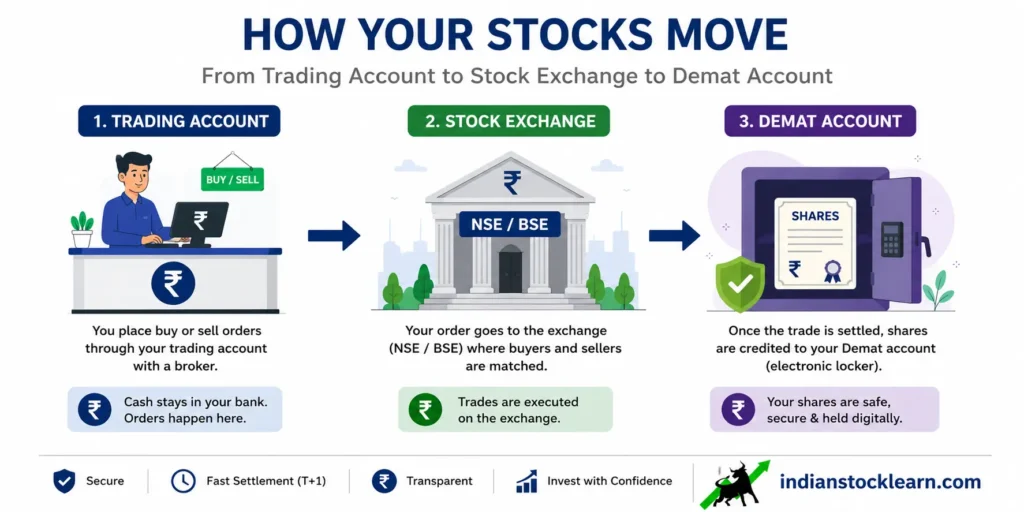
If you’re planning to invest in the Indian stock market, you’ve probably come across both terms in the same sentence. Many beginners assume they’re the same thing. They aren’t. Understanding trading account vs demat account is one of the first things to get clear before you buy or sell a single share.
A demat account stores your shares. A trading account places the buy or sell order on the exchange. Both work together, but each does a different job — whether you’re buying Reliance Industries, TCS, Infosys, or a Nifty 50 ETF.
This guide covers the trading account meaning, how both accounts work, where they differ, their advantages and limits, and when each one comes into play — in plain English, with real Indian examples.
60-Second Summary
A trading account buys and sells securities on NSE or BSE. A demat account stores the securities you already own, in electronic form through NSDL or CDSL. You need both to invest — one without the other can’t complete a transaction.
Table of Contents
- What Is a Trading Account?
- What Is a Demat Account?
- Trading Account vs Demat Account
- How Both Accounts Work Together
- Concept Explained With an Example
- A Real Indian Market Example
- Common Mistakes Beginners Make
- Myth vs Reality
- Why Investors Use Both Accounts
- Advantages of Each Account
- Limitations of Each Account
- Quick Summary Table
- FAQs
What Is a Trading Account?
A trading account lets you buy and sell financial securities, including:
- Shares
- Exchange Traded Funds (ETFs)
- Bonds
- Government securities
- Rights issues
- IPOs, through supported brokers
Every time you place a buy or sell order on the National Stock Exchange (NSE) or Bombay Stock Exchange (BSE), it travels through your trading account first. Think of it as the bridge between you and the exchange — without it, you can’t place an order at all.
What Is a Demat Account?
A demat account, short for dematerialised account, holds your securities in electronic form. Before this system existed, investors held paper share certificates that could be lost, damaged, stolen, forged, or delayed in transfer. India moved to a fully electronic system to fix that.
Today, when you buy shares, they land directly in your demat account instead of arriving as a paper certificate — a digital locker for your investments. A demat account can hold equity shares, mutual fund units (on some platforms), ETFs, bonds, government securities, Sovereign Gold Bonds, REITs, and InvITs.
Trading Account
- Places buy and sell orders
- Connects to NSE / BSE
- Works like a shopping counter
Demat Account
- Stores shares electronically
- Linked to NSDL / CDSL
- Works like a digital locker
Not Always Required
If you only invest in regular mutual funds through an AMC or a platform like Groww or Zerodha Coin, you generally don’t need a demat account at all — units are tracked in a separate statement. A demat account becomes necessary once you want to buy shares, ETFs, or hold everything in one place.
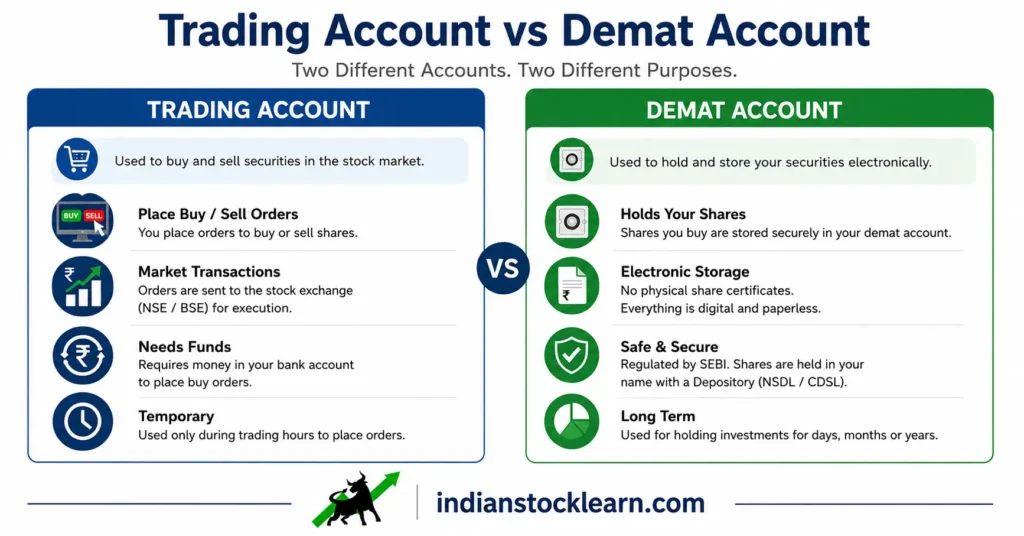
Trading Account vs Demat Account: Detailed Comparison
| Feature | Trading Account | Demat Account |
|---|---|---|
| Main purpose | Buy and sell securities | Store securities electronically |
| Used for | Trading transactions | Holding investments |
| Connected with | NSE and BSE | Depositories (NSDL or CDSL) |
| Stores shares? | No | Yes |
| Places orders? | Yes | No |
| Similar to | Shopping counter | Digital locker |
One-Line Difference
A trading account helps you trade. A demat account helps you own and store shares — the simplest way to remember the difference between trading and demat account.
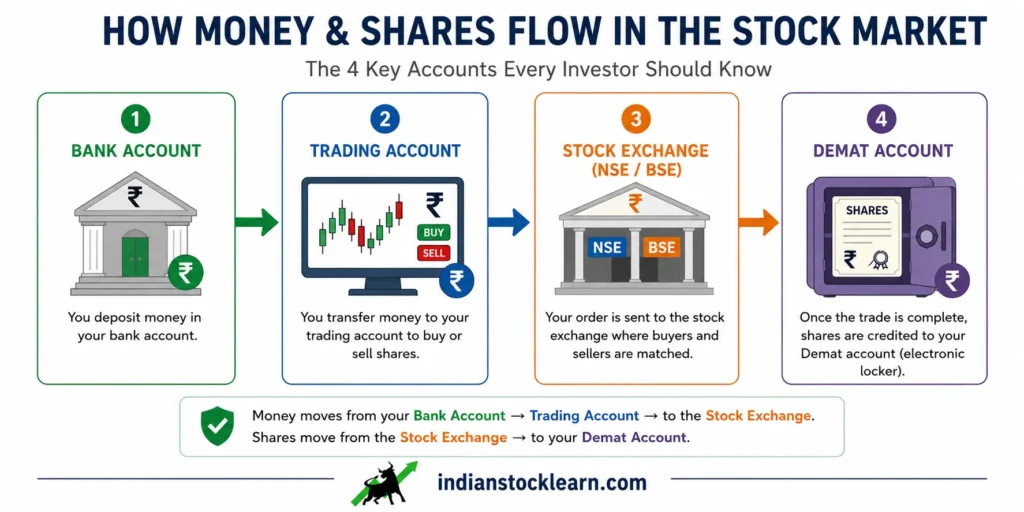
How Both Accounts Work Together
Buying shares of a company like Tata Consultancy Services (TCS) involves three accounts working in sequence:
1
Bank Account
Your savings account is linked to your broker and funds the purchase.
2
Trading Account
You enter the company name, quantity, and order type. The order goes to NSE or BSE.
3
Stock Exchange
The exchange matches your order with a seller at the market price.
4
Demat Account
After settlement, the shares are credited here as proof of ownership.
Selling works in reverse: you select the shares in your demat account, your trading account places the sell order, the exchange finds a buyer, and after settlement the shares leave your demat account while the sale proceeds land in your trading account and then your bank account.
ADD IMAGE: trading-demat-account-flow-india-2026
Concept Explained With an Example
Rahul wants to buy 10 shares of Reliance Industries. Here’s the sequence:
- He transfers ₹30,000 from his savings account to his broker.
- He places a buy order for 10 shares at market price.
- The exchange matches his order with a seller.
- After settlement, the shares move into his demat account and the seller gets paid.
Six months later, when Rahul sells all 10 shares, his trading account places the sell order, the exchange finds a buyer, the shares leave his demat account after settlement, and the money reaches his linked bank account.
A Real Indian Market Example
Priya wants to invest in TCS. Before the purchase, her bank balance is ₹25,000, her trading account is active, and her demat account is empty. She places a buy order for 5 TCS shares through her trading account. The order reaches the NSE, a seller agrees to sell, and the trade completes.
After settlement, the money is deducted and 5 TCS shares are credited to her demat account — she’s now a shareholder. The same process applies if she buys a Nifty 50 ETF instead: the trading account places the order, the exchange processes it, and the units land in her demat account.
Good to Know
Whether you invest in Reliance, Infosys, HDFC Bank, or a Nifty 50 ETF, the roles of the trading account and demat account stay the same.
Common Mistakes Beginners Make
01
Thinking a demat account alone is enough
You still need a trading account to place the order.
02
Assuming the trading account stores shares
It only routes orders — the demat account holds them.
03
Expecting instant delivery
Shares are credited only after the settlement cycle completes.
04
Mixing up the two balances
Trading account funds and demat holdings value are not the same number.
Myth vs Reality: Trading and Demat Accounts
| Myth | Reality |
|---|---|
| If my broker shuts down, I lose my shares. | Your shares sit with NSDL or CDSL, not the broker. If a broker exits the business, your holdings stay on record and can be moved to another broker. |
| Shares show up in my demat account the moment I buy them. | They land only after the exchange’s settlement cycle completes, usually the next working day. |
| Idle cash in my trading account earns interest, like a savings account. | It doesn’t. Funds sitting in a trading account earn zero interest. |
Why Investors Use Both Trading and Demat Accounts
A trading account buys and sells securities. A demat account safely stores what you own. Together, they keep investing organised:
To Buy Shares Listed on NSE and BSE
You can’t buy shares of Reliance, TCS, Infosys, HDFC Bank, or ICICI Bank directly from the company — you buy them through the exchange using your trading account, and they land in your demat account afterward.
To Sell Existing Investments
Say you bought 20 shares of Infosys two years ago. To sell today, the shares come out of your demat account, your trading account places the sell order, and once settled, the money reaches your linked bank account.
Safe Electronic Storage
Before dematerialisation, certificates could be lost, torn, stolen, or forged. Electronic storage removes most of that risk and cuts down on paperwork.
Easier Portfolio Management
Your demat account keeps every holding in one place — company name, quantity, purchase date, and corporate actions like bonus shares or splits — viewable from your broker’s app.
Read the full documents required for a demat account and how KYC works in the stock market before you open one.
Advantages of a Trading Account
- Single-platform access to NSE and BSE for buy and sell orders
- Real-time prices, market depth, charts, and order status
- Online order placement from mobile, desktop, or browser
- Multiple order types — market, limit, stop-loss, and GTT orders
- A running record of every order and executed trade
Advantages of a Demat Account
- Electronic storage cuts the risk of theft, damage, loss, or forgery
- Shares are credited or debited automatically after settlement
- Far less paperwork than the certificate-based system
- Corporate actions like bonus shares or a stock split reflect automatically, subject to eligibility
- One account holds many types of securities together
Watch Out
“Zero brokerage” doesn’t always mean zero cost. Check for Annual Maintenance Charges (AMC) on the demat side and per-transaction Depository Participant (DP) charges before you assume an account is free to run.
Limitations of Each Account
Trading Account
- Doesn’t store shares — that’s the demat account’s job
- Orders generally execute during market hours, with a few order types placeable outside those hours for later execution
- Brokerage, exchange charges, GST, SEBI charges, and stamp duty vary by broker
- Needs a stable internet connection for most modern platforms
Demat Account
- Can’t place buy or sell orders on its own
- Some Depository Participants charge an Annual Maintenance Charge, though a few brokers waive it under certain plans
- Holdings don’t earn interest — their value depends on market prices
- Opened through a Depository Participant (a bank or broker) linked to NSDL or CDSL
Common Trap
A demat account balance is not your available trading fund, and a trading account balance doesn’t reflect your total holdings value. Check both separately.
ADD IMAGE: trading-vs-demat-account-comparison-india-2026
Quick Summary Table
| Feature | Trading Account | Demat Account |
|---|---|---|
| Purpose | Buy and sell securities | Store securities |
| Places orders | Yes | No |
| Holds investments | No | Yes |
| Connected with | NSE and BSE | NSDL / CDSL |
| Used during trading | Yes | Yes |
Key Takeaways
- A trading account buys and sells securities on the exchange.
- A demat account stores your securities electronically.
- Both work together in every stock market transaction.
- A trading account can’t hold shares; a demat account can’t place orders.
- Most Indian brokers open both together when you sign up.
- Whether it’s Reliance, TCS, Infosys, or a Nifty 50 ETF, the same process applies.
Frequently Asked Questions
Can I open a demat account without a trading account?
Yes, it’s possible to open a demat account alone. But to buy or sell shares on the exchange, you’ll generally need a trading account too — a demat account by itself is mainly for holding securities.
Can I have multiple demat accounts?
Yes. You can open demat accounts with different Depository Participants, as long as each one completes the required KYC and follows applicable rules.
Is a trading account compulsory for investing in shares?
If you want to buy or sell shares directly on the exchange, yes — a trading account is generally required to place the order. The shares then move to your demat account after settlement.
Can I keep shares in my demat account for many years?
Yes, shares can stay in your demat account for as long as you hold them and keep the account active, as per your Depository Participant’s terms.
Which is more important: trading account or demat account?
Neither. A trading account helps you buy and sell; a demat account stores what you own. In practice, understanding this trading account vs demat account split matters more than ranking one above the other.
What’s the difference between a trading account and a bank account?
A bank account holds your money for everyday transactions. A trading account exists only to place buy and sell orders in the stock market — it’s the bridge between your bank account and the exchange.
Can I use one trading account for both NSE and BSE?
Yes. Most Indian brokers give you access to both the NSE and BSE through a single trading account, depending on what the broker offers. For a deeper look, see how to buy your first stock in India.
Conclusion
The trading account vs demat account distinction is one of the first things every new investor should get straight. A trading account places your buy and sell orders on NSE or BSE. A demat account holds the shares and eligible securities you own, in electronic form.
Remember it this way: trading account for buying and selling, demat account for holding and storing. Buy shares of Reliance, TCS, or any listed company, and your trading account places the order while your demat account receives the shares after settlement.
Once this trading account meaning is clear, concepts like IPOs, ETFs, and long-term investing get a lot easier to follow. If you haven’t opened either account yet, start with how to start investing in the stock market or compare brokers with our Zerodha vs Groww vs Upstox breakdown.
Next Step
Before you open an account, check the documents required for a demat account so your application doesn’t get held up over a mismatch.
Disclaimer: This article is for educational purposes only and does not provide financial, investment, tax, or legal advice. Stock market investments carry risk, and values can rise or fall with market conditions. Consider your own financial situation and consult a qualified advisor before investing. Always check the latest rules from SEBI, NSE, BSE, and your registered broker.