
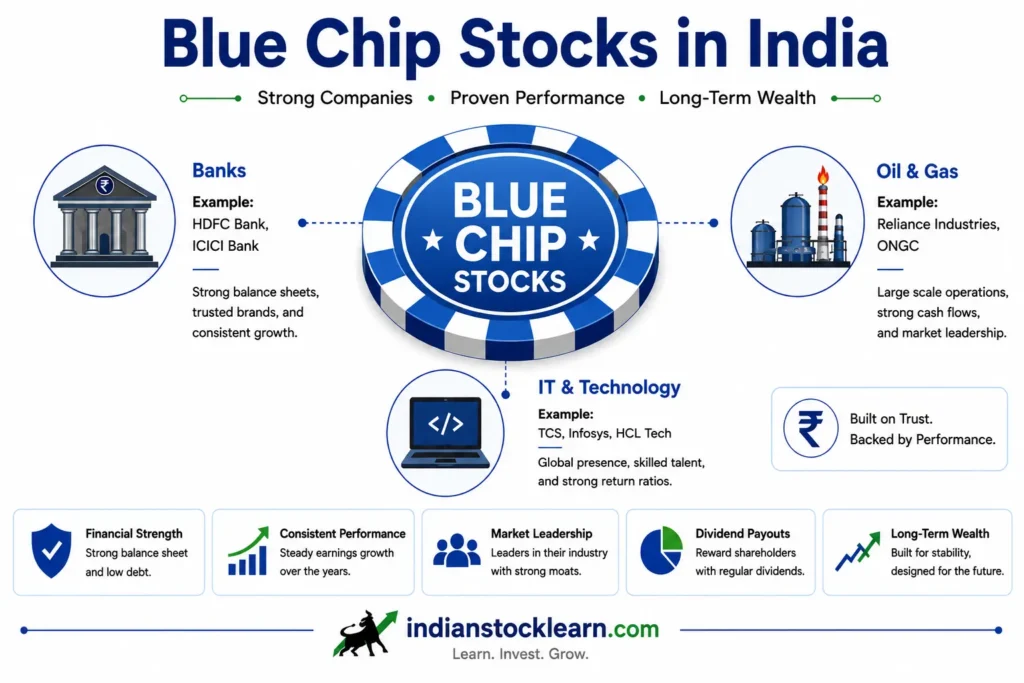
Blue chip stocks are shares of large, financially strong companies with a long history of steady performance. In India, names like Reliance Industries, Tata Consultancy Services, and HDFC Bank fall into this group. They tend to lead their industries and often pay regular dividends to shareholders.
This guide breaks down what blue chip stocks mean in the Indian market, how they actually work, and where beginners get the idea of “safe” wrong. By the end, you’ll know exactly what to check before calling any stock a blue chip.
What Is a Blue Chip Stock
A blue chip stock is a share in a very large, well-established company with strong finances and a proven record. These companies usually rank among the top by market value and are often part of major indices like the Nifty 50. In India, blue chip companies tend to lead their sectors — banking, energy, IT, or consumer goods — and are known for stability.
Many blue chips have market capitalisations running into lakhs of crores, and most pay dividends to shareholders. There’s no official regulatory definition of “blue chip.” SEBI’s mutual fund circular defines large-cap stocks as the top 100 companies by market value, and that group largely overlaps with what investors informally call blue chips.
Blue chip stocks are generally the biggest, most reliable companies on the exchange. Their size and long operating history make them lower-risk than smaller or newer stocks, though “lower risk” doesn’t mean “no risk.”
Myth vs Reality: What “Blue Chip” Actually Tells You
Most articles stop at “large company, stable business, dividend = safe.” That’s too neat, and it’s the assumption that trips up most beginners. Before you go further, here’s what the label really does and doesn’t promise.
| Myth | Reality |
|---|---|
| “Blue chip means risk-free.” | Blue chips can fall sharply during market-wide or company-specific trouble. The label describes company quality, not price safety. |
| “Every Nifty 50 stock is a blue chip.” | Nifty 50 membership is an index rule; “blue chip” is an informal market term. The two overlap heavily but aren’t identical. |
| “Every blue chip pays a high dividend.” | Dividend policy varies widely by sector. Growth-focused names like Reliance and TCS often yield under 1.5%, since profits go back into the business instead. |
| “A large market cap means strong financial health.” | Size alone says nothing about debt levels, cash flow, or earnings quality. Check the fundamentals, not just the market cap. |
| “Blue chips always recover quickly after a crash.” | Recovery speed depends on the type of shock and how strong the underlying business really is — not on the blue chip label itself. |
None of this means blue chips are a bad choice — it means the label is a starting point for research, not a substitute for it.
How It Works
Blue chip stocks trade on exchanges like the NSE or BSE, and their prices move with market conditions just like any other stock. What sets them apart is scale and stability. Large institutional investors and mutual funds often build core positions in these stocks because of their track record.
Many large-cap mutual funds — sometimes marketed as “bluechip funds” — focus almost entirely on these leading companies. You can buy blue chips directly through a broker, or indirectly through index funds and ETFs that track major indices.
Blue chip stocks are usually highly liquid, meaning high trading volume. You can typically buy or sell a large position without moving the price much. This is also why the Nifty 50 — made almost entirely of blue chip companies — works as India’s benchmark for large-cap performance.
Formula or Concept Explanation
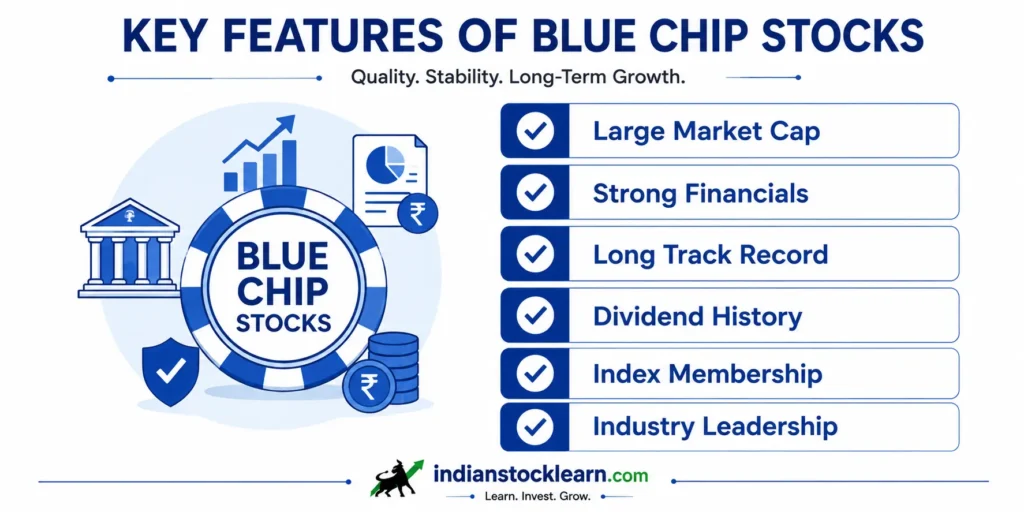
There’s no fixed formula for blue chip status, but six factors come up again and again:
| Criteria | What It Means |
|---|---|
| Large Market Cap | Usually ranks in the top 100 companies by market value (SEBI’s large-cap definition) |
| Strong Financials | Healthy balance sheet, stable revenue, low bankruptcy risk |
| Long Track Record | Years of operating history through multiple market cycles |
| Dividend History | Regular, often growing, dividend payouts |
| Index Membership | Typically part of Nifty 50 or Sensex |
| Industry Leadership | Dominates or leads its sector — banking, IT, energy, FMCG |
A company that checks most of these boxes is usually treated as a blue chip. None of these factors alone is enough — a small company can pay a dividend, but that doesn’t make it a blue chip.
Real Stock Market Example
Reliance Industries is a textbook blue chip — energy, petrochemicals, and telecom under one roof, with one of the highest market capitalisations on the NSE. In 2026, the company reported a 10% year-over-year rise in revenue and a 13.5% jump in EBITDA, a sign of steady growth rather than a sudden spike.
Tata Consultancy Services (TCS), India’s largest IT services company, has delivered consistent revenue and profit growth for decades. Other names widely treated as blue chips include HDFC Bank, ICICI Bank, Infosys, Hindustan Unilever, and ITC.
These companies share a pattern: broad customer bases, resilient business models, and enough market influence to move an index by themselves. When the broader market drops, blue chips often recover faster than smaller companies, backed by stronger cash flows.
Why Investors Use It
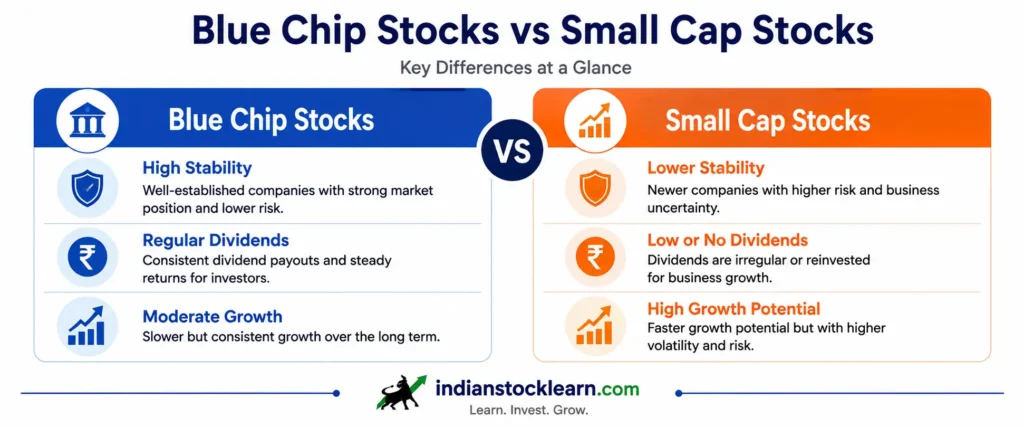
Investors hold blue chip stocks for a mix of stability and steady growth. Because these companies are large and established, their share prices swing less than smaller companies, which helps reduce overall portfolio risk. Many also pay reliable dividends, giving investors income on top of any price gains — a reason retirees and conservative investors often favour them.
Blue chips also work as a market benchmark. Buying an index fund that tracks the Nifty 50 means you’re effectively holding a basket of blue chip companies. They still carry market risk — even the strongest companies fell during global downturns — but their long-term record of recovery is why many investors use them as a core holding around which they build the rest of a diversified portfolio.
Advantages
What Blue Chips Offer
- Lower price swings than smaller companies
- Decades of consistent performance
- Regular dividend income, often reinvestable
- High liquidity — easy to buy or sell
- Automatic exposure via index funds and ETFs
What They Don’t Offer
- Fast, “multibagger” style growth
- Immunity from market crashes
- Guaranteed high dividend yields
- Permanent blue chip status
- Cheap valuations — they’re often priced high
Limitations
Blue chips are already large, so they rarely grow as fast as newer, smaller companies. Don’t expect outsized returns — gains here are usually steady rather than explosive.
They can still fall hard in a downturn. In 2008, several well-known blue chips lost significant value along with the rest of the market. Because they’re popular, blue chips can also get expensive, trading at high price-to-earnings ratios that leave less room for the stock to climb further — check the PE ratio before buying into the hype.
Blue Chip Status Isn’t Permanent
A company doesn’t wake up one morning and officially stop being a blue chip. The slide is usually gradual, and by the time it’s obvious, the price has already moved.
Yes Bank was a Nifty 50 constituent trading above ₹300 in 2018. Governance concerns, rising bad loans, and a stretched exposure to troubled promoters brought the stock down to single digits within about two years — a fall very few holders saw coming while they were still calling it “a large private bank, it’ll bounce back.” DHFL and Jet Airways followed a similar pattern: established, widely held names that investors treated as safe right up until they weren’t.
None of this means every blue chip is one bad quarter from collapse. It means a handful of things are worth checking periodically rather than assuming they’ll stay fine forever:
Owning 10 Blue Chips Doesn’t Automatically Mean You’re Diversified
Buy HDFC Bank, ICICI Bank, SBI, Kotak Mahindra, and Bajaj Finance, and you might feel diversified because you hold five different company names. In practice, you’re holding one large bet on Indian banking and credit conditions — when RBI policy or credit stress hits the sector, all five tend to move together.
This isn’t a small quirk. Financial services alone make up roughly a third of the Nifty 50’s total weight, with IT adding another 10–14%. An index fund and a handful of individual blue chips from the same two sectors can leave you far more concentrated than “10 stocks” suggests.
A quick gut check before buying another blue chip: which sector is it in, and how many of your existing holdings are already in that same sector? Spreading across banking, IT, energy, and consumer goods does more for real diversification than simply adding more company names.
- Blue chip stocks are shares of large, financially strong companies, usually part of the Nifty 50 or Sensex.
- Indian examples include Reliance Industries, TCS, HDFC Bank, ICICI Bank, Bharti Airtel, and ITC.
- They tend to be less volatile than smaller stocks and often pay regular dividends.
- They’re not risk-free and rarely deliver fast growth — diversification beyond blue chips still matters.
- Blue chip status can fade over time (Yes Bank, DHFL, Jet Airways) — it’s a reputation, not a permanent certificate.
- Owning several blue chips from the same sector (banks, especially) isn’t real diversification.
- You can buy blue chips directly through a broker, or via mutual funds and index funds.
Frequently Asked Questions
What qualifies a stock as a blue chip?
Are blue chip stocks risk-free?
Can beginners invest in blue chip stocks?
What are some examples of blue chip stocks in India?
Is a blue chip the same as a large-cap stock?
How do I buy blue chip stocks?
Do blue chip stocks pay dividends?
Conclusion
Blue chip stocks are the powerhouse companies of the Indian market — big, financially sound, and tested across market cycles. They can form a reliable core for a beginner’s portfolio, offering steadier returns and dividend income, but they’re not a guaranteed win. Check the six criteria before you label any stock a blue chip, and size your position with the same care you’d use for any other investment.