
If you’ve started reading about mutual funds, you’ve probably run into the term index fund. Names like “Nifty 50 Index Fund” show up everywhere, and the natural question is: what is an index fund, and how is it different from a regular mutual fund?
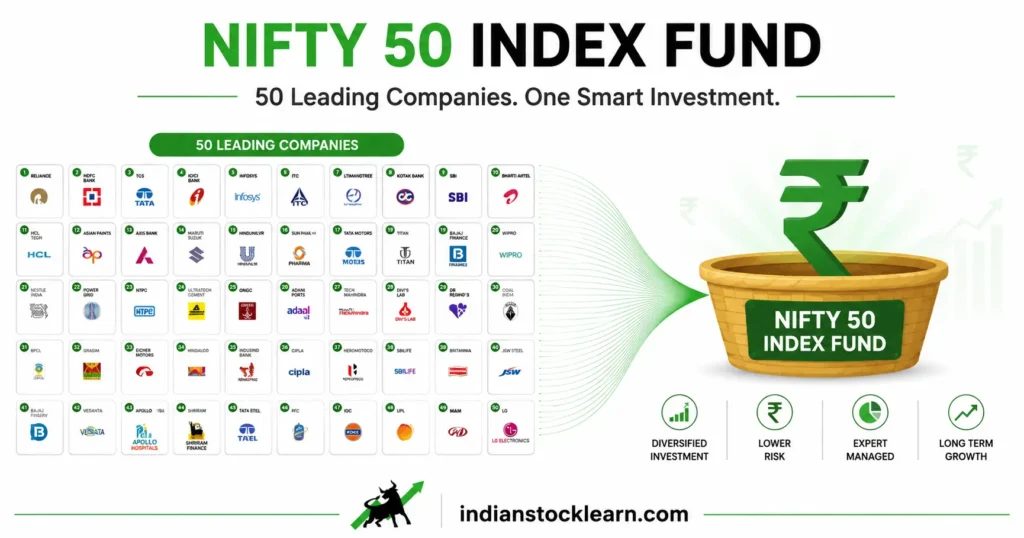
In short, an index fund is a mutual fund built to follow a specific market index rather than pick individual winners. A Nifty 50 index fund tries to mirror the Nifty 50, which represents 50 large Indian companies across multiple sectors, including names like Reliance Industries, TCS, HDFC Bank, Infosys and ICICI Bank.
This guide covers how index funds work, how their returns are calculated, what tracking error means, and how an index fund compares with an ETF.
- What Is an Index Fund?
- What Is a Nifty 50 Index Fund?
- Myth vs Reality: Is Nifty 50 Really Diversified?
- How Does an Index Fund Work?
- NAV Timing: Why the Price You See Isn’t Your Buy Price
- Index Fund Returns and Tracking Error
- Why Your Fund Looks Like It’s Underperforming the News
- The Rebalancing Effect: How the Index Changes Twice a Year
- Index Fund vs ETF
- Why Investors Use Index Funds
- Advantages and Limitations
- Key Takeaways
- FAQs
- Conclusion
What Is an Index Fund?
An index fund is a mutual fund that attempts to replicate the performance of a specific market index. Unlike an actively managed fund, where a fund manager regularly decides which stocks to buy or sell, an index fund simply follows a predefined index.
Take a Nifty 50 index fund as an example. Its one job is to follow the Nifty 50 Index, which covers 50 large companies listed on the NSE across 13 sectors of the Indian economy.
So instead of buying Reliance, TCS, HDFC Bank, Infosys, ICICI Bank and the other Nifty 50 companies one by one, an investor can buy units of a single Nifty 50 index fund, which holds a basket of securities designed to mirror the index.
Index Fund in Simple Words
Think of the Nifty 50 as a ready-made basket of large Indian companies. An index fund gives you exposure to that basket through a single mutual fund unit, instead of you picking items from the basket yourself.
The fund isn’t trying to guess which Nifty 50 stock will be the next big winner. Its only objective is to track the index as closely as possible. This is why index funds are called passive funds – a term Zerodha Varsity uses to describe funds that track a benchmark rather than trying to beat it.
What Is a Nifty 50 Index Fund?
A Nifty 50 index fund is an index mutual fund that seeks to track the Nifty 50 Index, which NSE Indices maintains using a free-float market-capitalisation method.
The relationship works like this: Nifty 50 Index → 50 companies → index fund tries to replicate those companies in similar proportions.
The weights aren’t equal. A company with a larger share of the index – Reliance, for instance – typically gets a correspondingly larger allocation inside the fund. And the index itself isn’t fixed forever: companies get added or removed as the index rules require, so a Nifty 50 index fund’s holdings shift gradually over time. The index rules decide the portfolio, not a fund manager’s personal judgment.
Myth vs Reality: Is Nifty 50 Really Diversified?
A common assumption is that buying a Nifty 50 index fund spreads your money evenly across 50 companies. Because the index is weighted by free-float market capitalisation, not by an equal split, that isn’t how it actually works.
| Myth | Reality |
|---|---|
| “50 stocks means my money is split roughly equally, so no single company matters much.” | The financial services sector alone has carried the largest single weight in the Nifty 50 for years, and the top 10 stocks together typically account for around half or more of the index. A handful of companies can drive most of the index’s daily movement. |
| “If the Nifty 50 is up, most of the 50 companies must be doing well.” | The index can rise even when a large share of its constituent stocks are flat or falling, simply because a few heavyweight stocks moved up. |
| “Nifty 50 index fund = exposure to the whole Indian economy.” | Nifty 50 represents large, already-listed companies in specific sectors. It leaves out mid-caps, small-caps and unlisted businesses, and it’s skewed toward whichever sectors currently carry the most market cap – historically financials, IT and energy. |
This doesn’t make a Nifty 50 index fund a bad choice – it just means “diversified” should be read as “spread across many companies,” not “equally exposed to each one.” Investors who want less concentration sometimes pair a Nifty 50 fund with mid-cap or small-cap exposure, though that’s a personal portfolio decision based on individual goals and risk appetite.
How Does an Index Fund Work?
A simple four-step example makes the mechanics easier to follow.
Say you put ₹5,000 into a Nifty 50 index fund. You’re not buying ₹5,000 of Reliance and ₹5,000 of TCS separately – you’re buying mutual fund units.
The fund pools money from all investors and builds a portfolio designed to stay close to the Nifty 50.
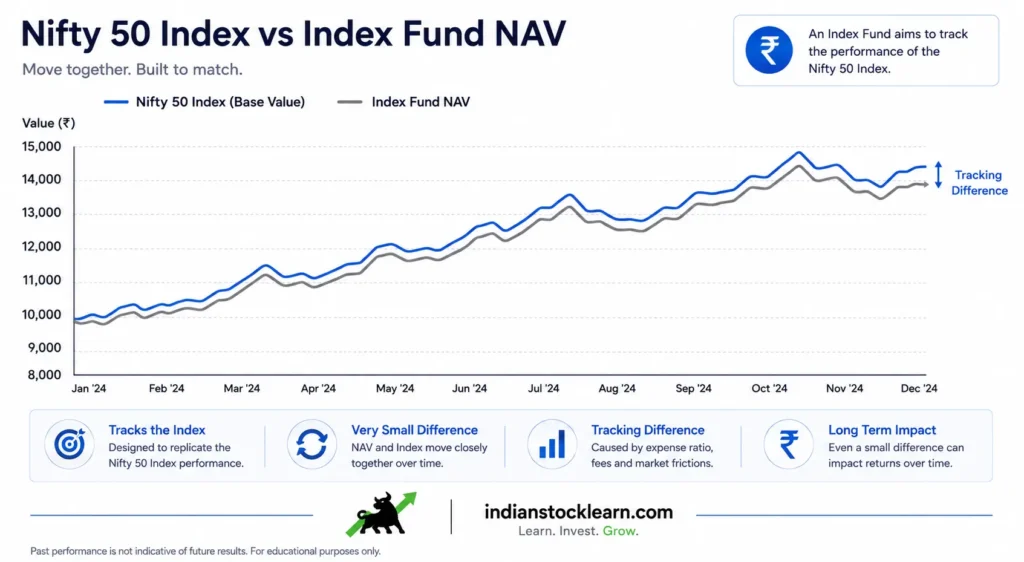
If the Nifty 50 rises 8%, the fund generally moves the same way – though costs and small tracking gaps can make the exact number slightly different.
A rising index generally pushes the fund’s NAV up. A falling index can pull it down. There’s no guarantee of a positive return in any given year.
NAV Timing: Why the Price You See Isn’t Your Buy Price
This is where the author’s note above comes from. A mutual fund unit, including a Nifty 50 index fund, isn’t priced the way a stock or an ETF is. You can’t watch a live price and know exactly what you’ll pay.
How the Order Timeline Actually Works
The NAV shown on your app is typically the previous day’s closing NAV – not a live, real-time price like a stock quote.
You submit a buy request for a certain amount, along with the payment.
For equity mutual fund schemes, SEBI rules apply a same-day cut-off (commonly 3:00 PM). Your order and funds need to reach the AMC before that cut-off to get that day’s NAV.
If you were on time, you get that day’s closing NAV, calculated after markets shut. If your payment cleared even a few minutes after the cut-off, you get the next business day’s NAV instead.
The bigger takeaway: an index mutual fund can’t be timed the way a stock or ETF can be during market hours. If intraday price watching and instant execution matter to you, that’s one of the practical differences worth weighing against an ETF, covered later in this guide.
Index Fund Returns and Tracking Error
There’s no complex formula here. At a high level:
Index Fund Return ≈ Index Return − Fund Costs − Tracking Difference
For example, if the Nifty 50 returns 10% and the fund’s costs and tracking differences add up to 0.30%, the fund’s return might land around 9.70%. This is only an illustration, not a prediction for any real scheme.
Tracking Error vs Tracking Difference – They’re Not the Same
Both terms describe how a fund behaves relative to its benchmark, but beginner articles (and sometimes even factsheets) use them loosely. They measure different things.
Tracking Difference
- The actual gap in returns over a period
- Example: index returned 10%, fund returned 9.5% → tracking difference is 0.5%
- Driven mainly by expenses and cash drag
- Tells you how much return you gave up
Tracking Error
- How much the daily gap itself varies, i.e. its volatility
- A fund can lag by a consistent 0.5% every single day – a small tracking error, but a real cost
- Driven by rebalancing timing, corporate actions and portfolio implementation
- Tells you how consistent that gap is, not how large it is
Why Your Fund Looks Like It’s Underperforming the News
A common source of confusion: a business channel or app shows “Nifty 50 up 12% this year,” but your Nifty 50 index fund’s factsheet shows a slightly different, and often lower, benchmark number for the same period. The fund isn’t necessarily doing badly – it’s likely being compared against a different version of the index.
Price Return Index (PRI)
- Tracks only price movement of the 50 stocks
- Ignores dividends paid by those companies
- This is usually what news headlines quote
Total Return Index (TRI)
- Includes price movement plus dividends, assumed reinvested
- SEBI has required mutual fund schemes to benchmark performance against TRI since a 2018 circular
- This is the number your index fund is actually compared against
Because TRI factors in reinvested dividends on top of price movement, it’s typically a bit higher than the PRI number quoted in the news. So when your fund is measured against TRI rather than PRI, the bar it has to clear is already higher than the headline figure suggests – a fund tracking the index closely can still look like it’s “behind” the number you saw on the news.
The Rebalancing Effect: How the Index Changes Twice a Year
The Nifty 50 isn’t a fixed list. NSE reviews the index composition twice a year, and companies can be added or removed based on eligibility rules like free-float market capitalisation and trading frequency. When that happens, every Nifty 50 index fund has to adjust its portfolio to match.
| Stage | What Happens |
|---|---|
| Announcement | NSE announces upcoming index changes some weeks ahead of the effective date. |
| Between announcement and effective date | The stock being added often sees increased buying interest as market participants anticipate index funds needing to buy it. |
| Effective date | Every Nifty 50 index fund must buy the new constituent and sell the removed one, at whatever price the market offers on that date, to keep tracking the index correctly. |
| After the change | The fund’s holdings now reflect the updated Nifty 50 – this transition can add a small, temporary contribution to tracking difference. |
Index Fund vs ETF
One of the most common beginner questions is index fund vs ETF – what’s actually different? Both can track the same index, such as the Nifty 50, but the two products work differently.
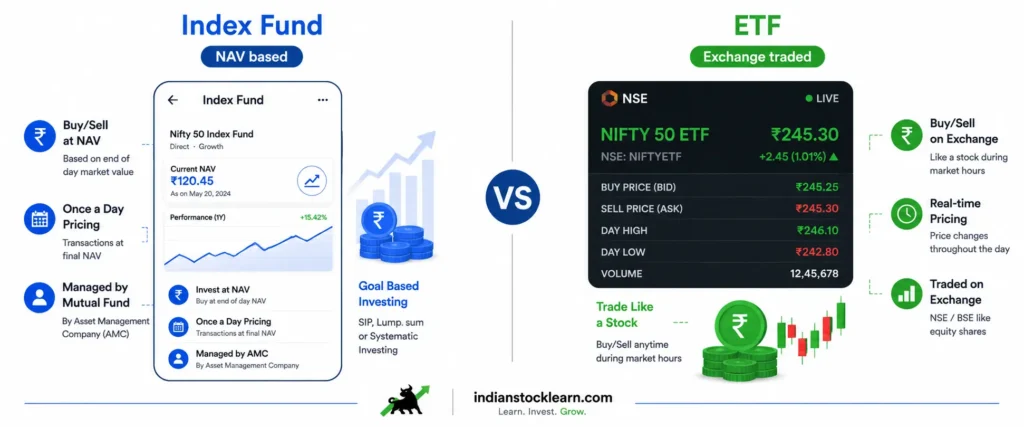
An index fund is a mutual fund, bought and redeemed at the applicable NAV. An ETF (Exchange Traded Fund) trades on a stock exchange during market hours, similar to a share, and its price can move slightly above or below its underlying value depending on buyers and sellers in the market.
| Feature | Index Fund | ETF |
|---|---|---|
| Structure | Mutual fund | Exchange-traded fund |
| Pricing | Based on NAV | Market price during trading hours |
| Intraday buying/selling | No | Yes |
| Demat account needed | Usually not | Yes |
| SIP option | Commonly available | Depends on platform |
| Price vs value gap | Not applicable – uses NAV | Market price can differ from NAV |
You may notice an ETF advertising a lower expense ratio than an index fund – say 0.07% versus 0.30%. That number alone doesn’t tell the full story. With an ETF, you also need to weigh the bid-ask spread, liquidity, brokerage and tracking difference. A cheaper expense ratio on paper doesn’t always mean a cheaper experience in practice.
IMAGE: index-fund-vs-etf-comparison-india-2026
Why Investors Use Index Funds
Investors turn to index funds for a mix of reasons: broad exposure to multiple large companies in one purchase, a simpler alternative to researching dozens of stocks individually, a passive approach that doesn’t depend on a fund manager guessing the next winner, and a transparent benchmark that’s easy to compare performance against.
Many Nifty 50 index funds also support SIP investing, letting an investor build exposure gradually rather than in one lump sum – though the exact minimum amount and dates depend on the scheme and platform.
Advantages and Limitations of Index Funds
Advantages
- Diversification across sectors instead of one stock
- Simple structure: track the benchmark, nothing more
- No constant stock-picking decisions required
- Easy to compare fund performance with its benchmark
- Often lower costs than actively managed funds
Limitations
- Does not protect against a falling market
- Not designed to beat the index – only to follow it
- Tracking difference means returns aren’t identical to the index
- Nifty 50 is large-cap only, not the entire market
- Comparing with ETFs takes more than the expense ratio
- An index fund is a mutual fund built to track a market index, such as the Nifty 50.
- It’s a passive product – the goal is to follow the benchmark, not beat it.
- Fund returns can differ slightly from the index because of costs and tracking error.
- Index fund vs ETF mainly comes down to how you buy and hold it – NAV-based mutual fund units versus exchange-traded units.
- Index funds still carry full market risk; a falling Nifty 50 means a falling fund.
- “Diversified across 50 stocks” doesn’t mean equal exposure – a handful of top-weighted companies can drive most of the index’s movement.
- Your order needs to clear before the SEBI cut-off time (commonly 3 PM) to get that day’s NAV – the price you see earlier isn’t guaranteed to be your price.
- Your fund is benchmarked against the Total Return Index (TRI), which includes dividends – that’s usually a slightly higher bar than the Price Return Index (PRI) figures quoted in the news.
Frequently Asked Questions
What is an index fund in simple words?
What is a Nifty 50 index fund?
Are index funds safe investments?
Is an index fund the same as an ETF?
How is an index fund different from an actively managed fund?
Can I invest in a Nifty 50 index fund through SIP?
Why does an index fund’s return differ from the Nifty 50’s return?
What’s the difference between tracking error and tracking difference?
Why does my index fund’s return look lower than the Nifty 50 figure I see in the news?
If I place a buy order before the market crashes, do I get that day’s lower NAV?
Conclusion
Understanding what is an index fund gets much easier once you stop treating it like just another investment product and see it instead as a way of following a market index. A Nifty 50 index fund gives investors a mutual-fund route into the Nifty 50, without asking a fund manager to guess which stock will outperform next.
The index fund vs ETF comparison comes down to structure: an index fund uses NAV-based mutual fund transactions, while an ETF trades on the exchange throughout the day. For a beginner, the useful habit is checking what the fund tracks, how closely it tracks it, what it costs, and what risk comes with the underlying market. Once that’s clear, terms like NAV, expense ratio and tracking error stop being confusing.