
Last Updated: September 27, 2026
If you’ve already read the beginner guide to defence sector stocks, you know an order book shows future work, not booked profit. That’s true, but it’s step one. Learning how to read a defence order book properly means going one layer deeper – into how the order was won, which procurement category it falls under, and whether the profit it eventually reports actually shows up as cash.
None of this tells you what to buy. It tells you which questions to ask before trusting a headline order-book number – the same order-book size can hide two completely different risk profiles once you look past the total.
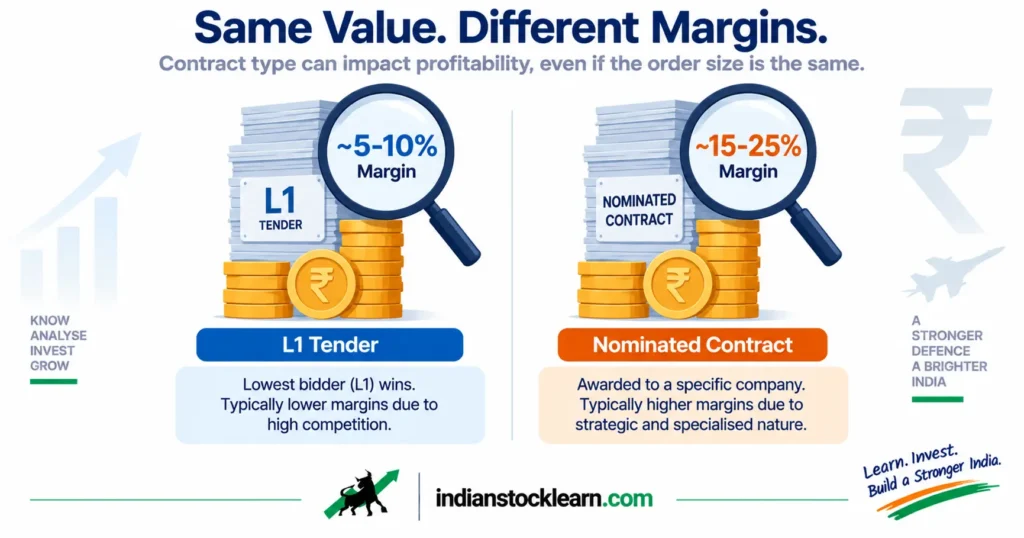
L1 vs Nominated Contracts: Not All Orders Are Won the Same Way
Most Indian defence procurement runs on the L1 system – the lowest technically qualified bidder wins the contract. It’s the backbone of the Defence Acquisition Procedure (DAP), and even India’s former Army Chief has publicly criticised it for rewarding the cheapest bid over the best value. To win a competitive L1 tender, companies sometimes quote aggressively, which can leave thin margins for the years of execution that follow.
This single distinction is often the first thing missing from a beginner’s checklist, and it’s the starting point for how to read a defence order book with any real precision – the same rupee value of orders behaves completely differently depending on which route won them.
Nominated (sole-source) contracts work differently. These are awarded directly, often to PSUs like HAL or BEL, without a competitive price war. Margins on nominated work tend to be steadier and more predictable, since there’s no bidding-war pressure pushing the price down before the contract is even signed.
Neither route is universally safer for an investor. A nominated contract removes pricing competition but often comes with government-set formulae that can also cap upside. A competitive L1 tender pushes margins down at the bidding stage, but a well-run company with genuine cost discipline can still execute an L1-won contract profitably – the win itself isn’t the problem, an aggressive quote from a company that then struggles to control costs is.
A Rs 1,000 crore nominated contract and a Rs 3,000 crore L1 tender can carry a similar earnings outcome – the size of the order doesn’t tell you how it was priced. Annual reports and investor presentations sometimes use phrases like “orders on nomination” or “cost-based contracts” – worth watching for when comparing two companies’ order books.
The Procurement Category That Shapes the Margin
Under DAP 2020, capital acquisitions fall into ranked categories, and the category matters as much as the order value:
- Buy (Indian-IDDM): Indigenously Designed, Developed and Manufactured, with a minimum 50% Indian content. Highest procurement preference. The company owns the design and IP, which generally supports stronger margins.
- Buy (Indian): Manufactured in India with a minimum indigenous-content threshold, but not necessarily indigenously designed.
- Buy (Global) / Transfer of Technology (ToT): The company licenses or assembles foreign technology rather than owning the IP outright. Lowest procurement preference, and typically thinner margins since royalties or licence costs eat into the economics.
Offsets add another layer. India’s defence offset policy requires foreign vendors to invest a share of the contract value back into Indian industry – historically 30% for Buy (Global) and ToT category deals above Rs 300 crore. Since DAP 2020, though, this offset requirement doesn’t apply to inter-government agreements, government-to-government deals, or single-vendor purchases – only to competitive foreign procurement. That’s a meaningful exception worth checking before assuming every large foreign deal automatically creates offset-linked work for Indian suppliers.
This category structure also explains why a large PSU like HAL and a much smaller private component supplier can both be called “defence companies” while sitting in completely different parts of the value chain. HAL rarely manufactures every single part of a platform itself – a wide base of private suppliers, spanning large cap, mid cap and small cap companies, feeds specialised components, castings and sub-systems into the same programmes. The procurement category of the prime contract doesn’t automatically apply to every supplier underneath it – a Tier 2 supplier’s own contract with the prime can carry entirely different pricing terms.
The Order Book Quality Checklist
Order-book size alone is one number. Reading it properly means running it through a few checks – this is the practical core of how to read a defence order book instead of just quoting its total against annual revenue.
Indian armed forces, an overseas government, or a private/distributor customer – each carries a different payment and execution profile.
Is production already underway, or is the order still awaiting approvals and prototypes? A ready-to-execute order isn’t the same as one sitting early in the pipeline.
Rs 10,000 crore delivered over 2 years behaves very differently, financially, than the same value spread across 7 years.
A low-margin manufacturing contract and a higher-margin electronics or software-linked contract of equal size produce very different profit.
A fifth check worth adding: repeatability. A one-off large programme tells you less about future business than a repeat order on an existing platform, since repeat orders usually mean the customer relationship and execution track record are already proven.
None of these five checks require anything beyond what’s already in a company’s public disclosures – annual reports, investor presentations and exchange filings usually give enough detail to answer most of them, even when the exact contract terms stay confidential.
When Profit Grows but Cash Doesn’t
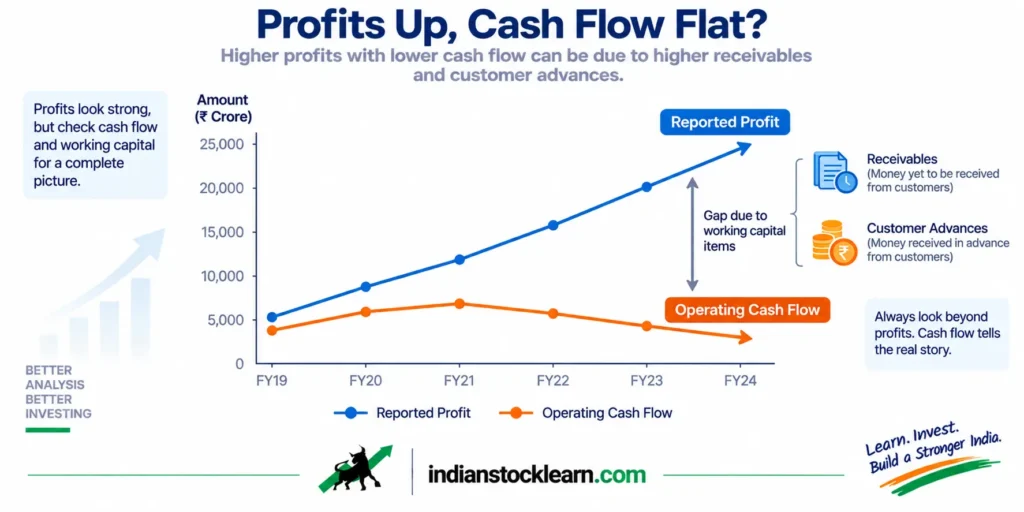
A company can report rising revenue and rising profit while its operating cash flow tells a completely different story. This isn’t unusual in defence manufacturing, where government payment terms and long project cycles create a real gap between when profit is booked and when the cash actually lands.
- Receivables: If trade receivables grow faster than revenue, cash is getting tied up rather than collected – the company is, in effect, financing its customer’s payment schedule.
- Inventory and work-in-progress: Long-gestation programmes like shipbuilding or aircraft manufacturing require materials and unfinished production sitting on the balance sheet well before final delivery.
- Customer advances: Not every effect runs one direction – some contracts include advance payments that actually help fund production, which is a genuinely positive sign, not a warning one.
A simple three-step check covers most of this: look at reported profit, then operating cash flow, then receivables and inventory movement, to see whether the gap has an obvious explanation or not.
The pattern is common enough in this sector that it deserves a name: a company can look financially healthy on the income statement – growing revenue, growing profit, a growing order book – while its cash conversion tells a slower, more cautious story. That’s not automatically a failure. It’s a reminder that in a government-procurement-driven business, the income statement and the cash flow statement can genuinely disagree for reasons that have nothing to do with mismanagement.
This is the piece most beginner checklists skip entirely, and it’s just as central to how to read a defence order book as the contract-type distinction covered earlier – a healthy-looking order book means little if the cash behind it never actually arrives on schedule.
| Myth | Reality |
|---|---|
| “A large order book means locked-in profit.” | It means future revenue over an uncertain timeline – conversion depends on execution, contract type and margin. |
| “A defence budget hike automatically lifts every defence stock.” | It depends on which company, which programme, and whether that specific project is actually on the approved procurement list. |
| “Winning an order proves the company is doing well.” | Winning an L1 tender at a thin margin can hurt as much as help – execution and pricing matter more than the win itself. |
| “Government ownership means guaranteed downside protection for PSU stocks.” | PSU pricing formulas, dividend policy and capital-allocation decisions aren’t always shareholder-first, even with sovereign backing. |
| “Rising defence exports mean every defence company benefits equally.” | Export capability, and the share of revenue it actually represents, varies enormously company to company. |
- An L1-won order and a nominated order of equal value can carry very different margin risk – check how the order was won, not just its size.
- Procurement category (IDDM, Buy Indian, or Buy Global/ToT) shapes both IP ownership and margin potential.
- Offsets apply to competitive Buy (Global)/ToT deals above Rs 300 crore – not to G2G, IGA or single-vendor purchases.
- Order book quality depends on customer type, contract maturity, execution period, margin profile and repeatability – not size alone.
- Rising profit with weak operating cash flow needs an explanation, not an automatic red-flag verdict – check receivables, inventory and advances first.
Frequently Asked Questions
Is a nominated contract always better than an L1 tender win?
How can a beginner tell if an order was won through L1 or nomination?
Does understanding how to read a defence order book change what I should buy?
Why does the offset policy matter if I’m not investing in the foreign vendor?
Is negative operating cash flow always a warning sign for a defence company?
Is this level of detail necessary for a beginner investor?
Does a bigger order book always mean a bigger company opportunity?
What’s the single fastest check to run when a company announces a big new order?
Conclusion
How to read a defence order book properly comes down to more than checking one number against annual revenue. How the order was won – L1 or nominated – shapes the margin. The procurement category shapes IP ownership and pricing power. Offsets apply selectively, not universally. And profit growth only means something once you’ve checked whether the cash is actually following it. None of this replaces basic homework like PE ratio or revenue growth – it adds the layer underneath that decides whether those basic numbers can be trusted.
The next time an order announcement pushes a defence stock higher, the headline value is only the starting question. How it was won, what category it falls under, and whether it converts to cash on schedule are the ones that actually decide the outcome.