
When Reliance Industries announced a ₹53,125 crore rights issue in India in 2020, thousands of first-time investors saw “RE” shares appear in their demat accounts overnight — and had no idea what to do. Some panicked. Some ignored it. A few let it expire worthless without realising they had lost money.
That confusion is common. A rights issue is one of the most misunderstood events in the Indian stock market — especially for beginners who are new to platforms like Zerodha or Groww.
This guide explains exactly what a rights issue in India is, how the application process works, what happens to your share price, and what to do when RE shares appear in your demat account.
What you’ll learn: RE shares, TERP calculation, ASBA application, and when to subscribe or sell.
What is a Rights Issue?
A rights issue in India is a method companies use to raise fresh capital by offering additional shares to their existing shareholders at a discounted price — before anyone else gets the chance.
Instead of borrowing from banks or launching a new IPO, the company turns to people who already own its shares. They get first preference to buy extra shares at a price lower than the current market rate
Quick definition: A rights issue gives current shareholders the right — not the obligation — to buy more shares at a discount.
Simple Example
Say you own 100 shares of a company. The company announces a rights issue with a 1:5 ratio.
That means for every 5 shares you hold, you can buy 1 additional share. If the market price is ₹500 and the rights issue price is ₹350, you get to buy at that ₹150 discount — before the general public even knows about it.
This is different from an IPO, where any investor can apply. Here, only existing shareholders get the offer first.
How Rights Issue Works
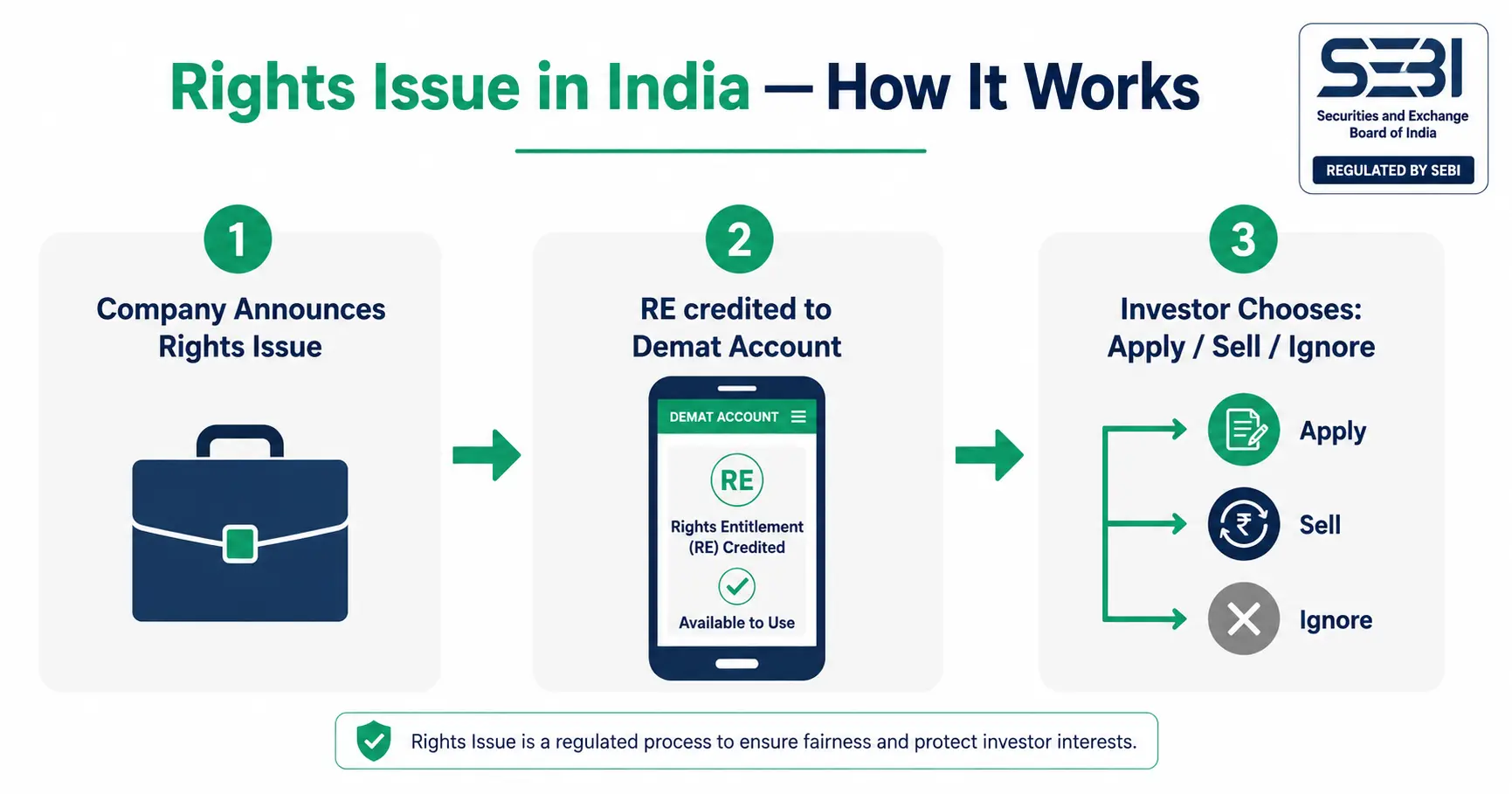
The rights issue process in India follows clear steps regulated by SEBI. Here’s how it unfolds from announcement to allotment.
Important: If you ignore RE shares and don’t act before the expiry date, they become worthless.
Step 1: Company Announces the Rights Issue
The company publicly discloses the rights ratio, issue price, record date, and opening and closing dates of the issue.
Step 2: Record Date Is Fixed
Only shareholders who hold shares on or before the record date are eligible. If you buy shares after this date, you don’t receive rights entitlements for this issue.
Step 3: Rights Entitlement (RE) Is Credited to Your Demat
Eligible shareholders receive temporary RE shares in their demat account. These appear with a suffix — for example, RELIANCE-RE or ABC-RE. Many new investors see this and think it’s a free bonus. It’s not. Each RE represents the right to buy one new share at the discounted price. You must act on it.
Step 4: You Choose What to Do
Three options are open to you:
- Apply and pay — buy the rights shares at the discounted price
- Sell your RE shares — trade them in the market during the RE trading window
- Do nothing — the RE expires worthless after the issue closes, and you lose value
Step 5: New Shares Are Allotted
Once the process closes and payments are verified, the new rights shares are credited to your demat account. The RE shares are removed automatically.
2025 SEBI Update: SEBI simplified the rights issue disclosure process, making timelines faster and easier.
Rights Issue Formula and Concept
When a company issues new shares, the total share count rises. This affects the price per share — a concept called dilution. The Theoretical Ex-Rights Price (TERP) estimates where the share price will settle after the issue.
Rights Issue Ratio Formula
Rights Ratio = New Shares Offered ÷ Existing Shares Held
A 1:4 ratio means you can buy 1 new share for every 4 shares you hold.
TERP Formula
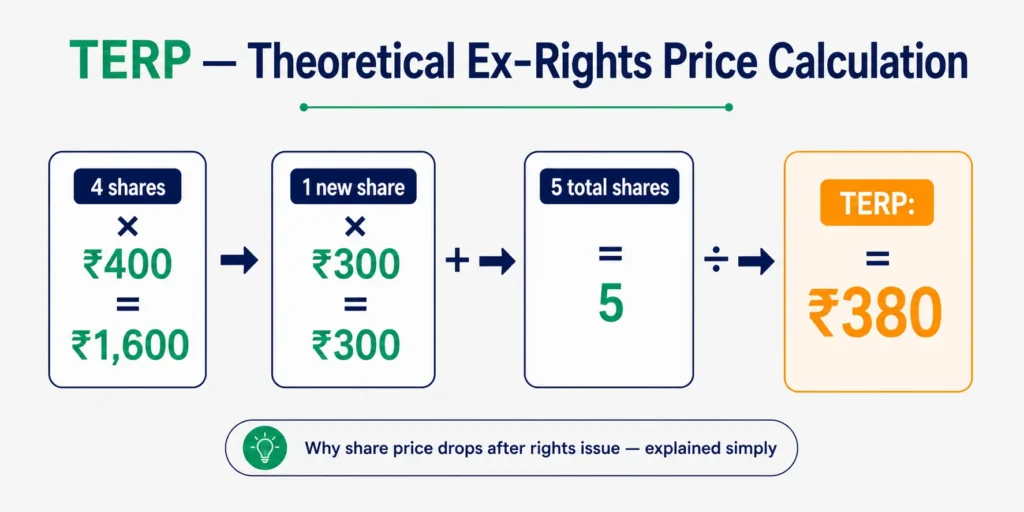
TERP = (Old Shares × Old Price + New Shares × Issue Price) ÷ Total Shares After Issue
TERP Worked Example
TERP (Theoretical Ex-Rights Price) is the estimated fair share price after a rights issue adjusts for dilution.
| Input | Value |
|---|---|
| Current share price | ₹400 |
| Rights issue price | ₹300 |
| Rights ratio | 1:4 |
| Value of 4 old shares (4 × ₹400) | ₹1,600 |
| Value of 1 new share (₹300) | ₹300 |
| Total value | ₹1,900 |
| Total shares after issue | 5 |
| TERP | ₹380 |
The share price drops from ₹400 to approximately ₹380. This is expected — not a sign that the company is in trouble. It’s simply the math of issuing new shares at a discount.
Real Indian Stock Market Example
The most talked-about rights issue in India in recent memory was by Reliance Industries in 2020.
Reliance Rights Issue 2020
This was the largest rights issue India had ever seen. Millions of retail investors — many on Zerodha and Groww — saw “RELIANCE-RE” appear in their demat accounts for the first time. It became a crash course in rights issues for an entire generation of new investors.
Other large Indian companies — including TCS and HDFC Bank — have also used rights issues at different points in their growth journeys. It’s a well-established fundraising tool across sectors.
Why Investors Use Rights Issues
Why Companies Use Rights Issues
Companies typically raise money through a rights issue in India for these reasons:
- Repaying high-cost debt
- Funding expansion and new projects
- Financing acquisitions
- Meeting working capital needs
Rights issues are often cheaper than bank loans. No interest payments. No third-party lenders. The capital comes directly from investors who already believe in the business.
Why Investors Participate
Existing shareholders benefit in three ways:
- They buy shares at a discount to market price
- They maintain their ownership percentage in the company
- They get priority over new investors
That said, always check the company’s fundamentals, debt levels, and promoter participation before deciding whether to apply. A discount price doesn’t always mean a good deal.
Advantages of Rights Issues
Limitations and Risks
See also: What is SEBI and how it protects investors — SEBI’s oversight makes the rights issue process in India one of the most regulated in Asia.
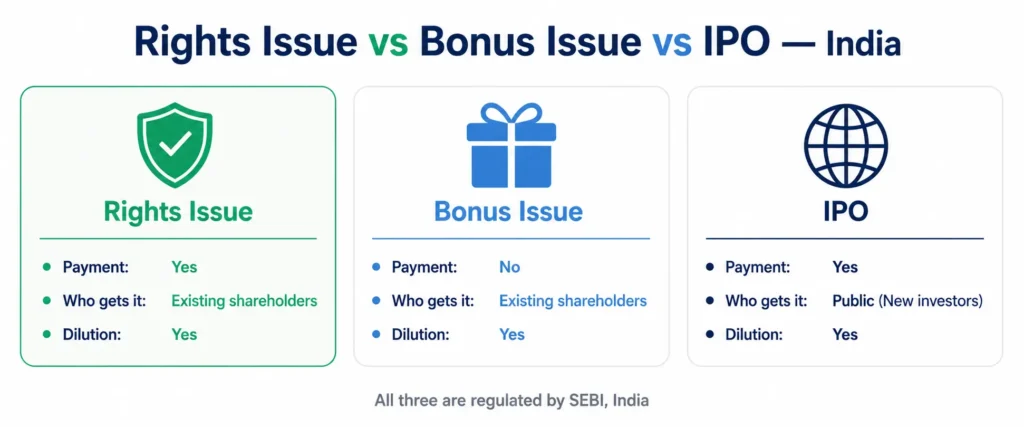
Rights Issue vs Bonus Issue vs IPO
Key Takeaways
- A rights issue in India lets companies raise capital from existing shareholders at a discounted price.
- Eligible shareholders receive Rights Entitlement (RE) shares in their demat account — these are temporary and must be acted on.
- You have three choices: apply for new shares, sell the RE in the market, or let them expire (which costs you money).
- The TERP formula explains why share prices adjust downward after an issue — it’s not a red flag, it’s math.
- Reliance’s 2020 rights issue (₹53,125 crore) is India’s best-known example and a useful reference point.
- Check SEBI guidelines, company fundamentals, and promoter participation before deciding to subscribe.
Frequently Asked Questions
Rights Entitlement (RE) is a temporary security credited to your demat account during a rights issue in India. It gives you the right to buy additional company shares at the discounted issue price. RE shares are listed on NSE and BSE and can be traded within the RE trading window. After the rights issue closes, they are automatically removed from your account.
If you don’t apply and don’t sell your RE shares before the issue closes, the RE expires worthless. You don’t receive the discounted shares and you lose the value embedded in your RE. Your ownership percentage in the company also gets diluted as other shareholders pick up those shares. Acting on time — either by applying or selling the RE — is always better than ignoring it.
Yes. RE shares can be traded on NSE and BSE during the RE trading window. If you don’t want to invest more capital in the company, selling your RE shares lets you pocket the value of your entitlement without paying for new shares. On platforms like Zerodha or Groww, RE shares appear with a “-RE” suffix and can be sold like any other stock during trading hours.
The price adjusts because new shares are being issued at a discount, which increases total share supply. The market reprices the stock at TERP (Theoretical Ex-Rights Price) — a weighted average of the old and new share prices. This is normal and expected, not a warning sign. Whether the price recovers depends on why the company raised the funds and whether the business performs well.
There’s no single answer. A rights issue is positive when the company raises capital for growth — expansion, acquisitions, or reducing expensive debt. It can be a concern when the company is raising money to cover losses or stay solvent. Check three things: why the company needs the money, whether promoters are subscribing to their own rights, and the company’s debt-to-equity ratio. If all three look healthy, applying is usually worth considering.
Not directly. The rights issue is initially open only to shareholders on the record date. However, RE shares can be traded on NSE and BSE, so you can buy RE shares from the market during the trading window and then apply for the rights shares. This is called “buying renounced rights” and gives non-shareholders a way to participate.
Conclusion
A rights issue in India is something every investor will encounter sooner or later — whether you hold large-cap stocks like Reliance and TCS or invest in smaller mid-cap companies on NSE and BSE.
The core idea is straightforward: existing shareholders get the first chance to buy more shares at a discount. But the process — RE shares, TERP, ASBA application, expiry dates — requires some understanding before you can act with confidence.
The most important thing to remember: never ignore RE shares in your demat account. Either apply for the new shares or sell the RE before it expires. Letting it lapse is the one option that guarantees a loss.
Want to go deeper? Read our guides on What is an IPO, What are Bonus Shares, and How SEBI Protects Indian Investors.
Disclaimer: This article is for educational purposes only and does not constitute financial or investment advice. Stock market investments are subject to market risks. Always conduct your own research or consult a qualified financial advisor before making investment decisions.