
Introduction
If you have recently started learning about the stock market, you have probably come across the words “Sensex” and “Nifty” — on news channels, YouTube videos, or inside your trading app. But what exactly do they mean?
Understanding what is Sensex and Nifty is one of the smartest first steps for any beginner in India. These are not individual stocks you can buy. Instead, they act like a “thermometer” for the entire Indian stock market. When they rise, it generally means most large companies are performing well. When they fall, it signals that the market is under some pressure.
This guide breaks everything down in the simplest way possible. By the end, you will feel confident reading market headlines and understanding what is really happening behind the numbers. Let’s dive in!
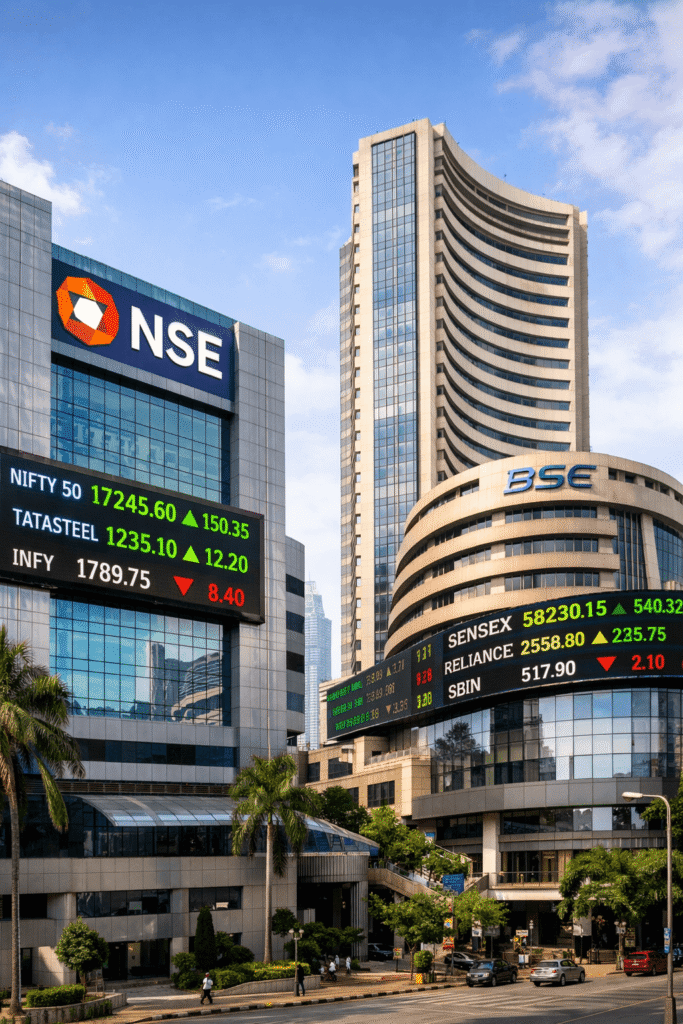
What is Sensex and Nifty India overview NSE BSE stock market
Table of Contents
- What is Sensex and Nifty
- How Sensex and Nifty Works in India
- Formula or Concept Explanation
- Real Stock Market Example
- Difference Between Sensex and Nifty
- Why Investors Use It
- Advantages
- Limitations
- Key Takeaways
- FAQs
- Conclusion
- Disclaimer
What is Sensex and Nifty
What is Sensex and Nifty in simple words
The Sensex and Nifty are stock market indexes in India.
Sensex:
- Represents the top 30 companies listed on the BSE
- Examples: Reliance, TCS, HDFC Bank
Nifty 50:
- Represents the top 50 companies listed on the NSE
- Covers multiple sectors including IT, banking, and FMCG
So when someone asks:
“What is Nifty 50 and Sensex India for beginners?”
The simple answer is:
They are groups of top companies used to measure how the overall market is performing.
What is Nifty and Sensex for beginners in India
Think of it this way:
- Sensex = A snapshot of the top 30 companies
- Nifty 50 = A snapshot of the top 50 companies
If most companies are growing → the index goes up
If most companies are falling → the index goes down
📌 Also read: What is Stock Market for Beginners
How Sensex and Nifty Works in India
How Sensex and Nifty works in India
Sensex and Nifty do not move randomly. Their movement depends on the performance of the companies that make them up.
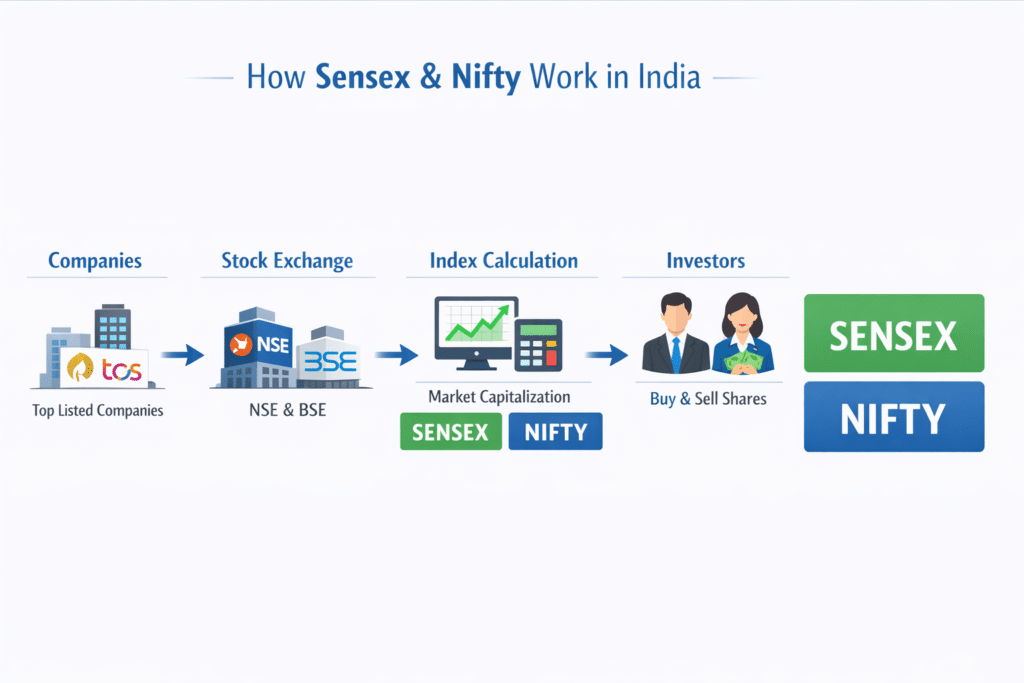
Simple visual explaining how Sensex and Nifty work in India based on company performance and index calculation
Here is a simple step-by-step breakdown:
- Each index contains a selected group of companies
- Every company carries a weight based on its size
- Changes in share prices affect the index value
- Larger companies have a greater impact on the index
Example:
- If Reliance shares rise → Nifty/Sensex may go up
- If HDFC Bank shares fall → the index may drop
This is why the Sensex goes up and down — it reflects company performance and overall investor sentiment.
📌 Also read: How Stock Market Works
Formula or Concept Explanation
How Sensex is calculated — simple explanation India
You do not need to memorise any complicated formula, but understanding the core concept helps a lot.
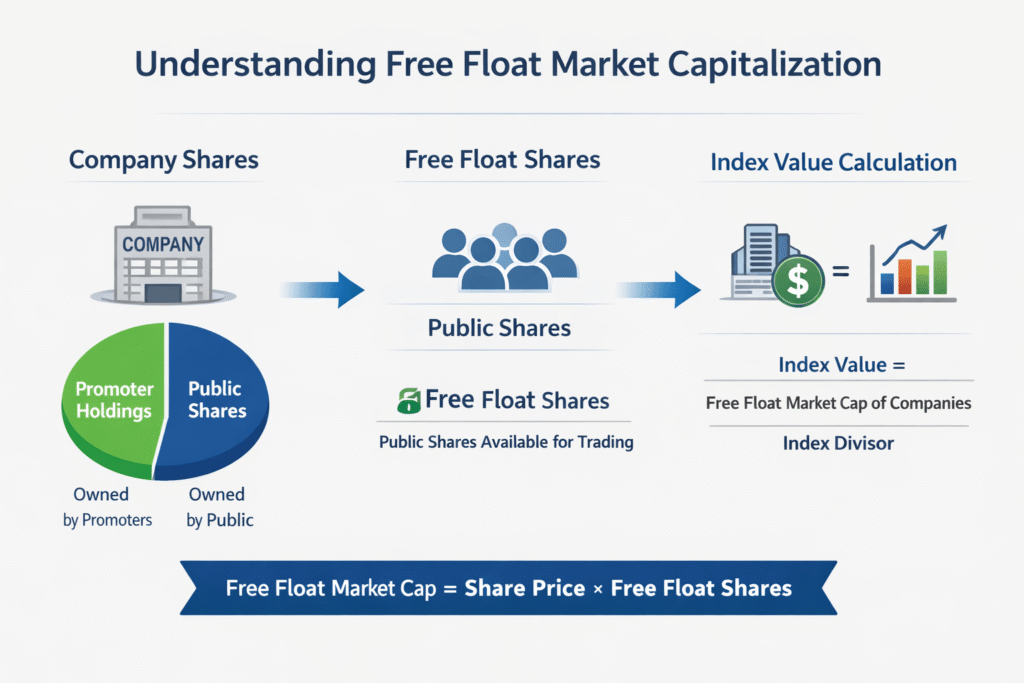
Diagram showing how Sensex is calculated using free float market capitalization in the Indian stock market
Core concept: Free-float market capitalisation
Formula (simplified):
Index Value = Total Free-Float Market Cap ÷ Base Value
What is Free Float?
- It refers to only those shares that are available for public trading
- Promoter holdings are excluded from this count
Simple idea:
- Bigger company → bigger impact on the index
- More publicly traded shares → more influence on the index
That is why large companies like Reliance or TCS affect the index far more than smaller ones.
Real Stock Market Example
Let’s understand this using real companies.
- Reliance Industries: When Reliance reports strong growth → Nifty rises
- TCS (IT Sector): IT sector growth pushes Nifty up
- Banking Stocks: HDFC Bank, ICICI Bank strongly influence indexes
Instead of tracking thousands of individual stocks, you can simply follow Sensex or Nifty.
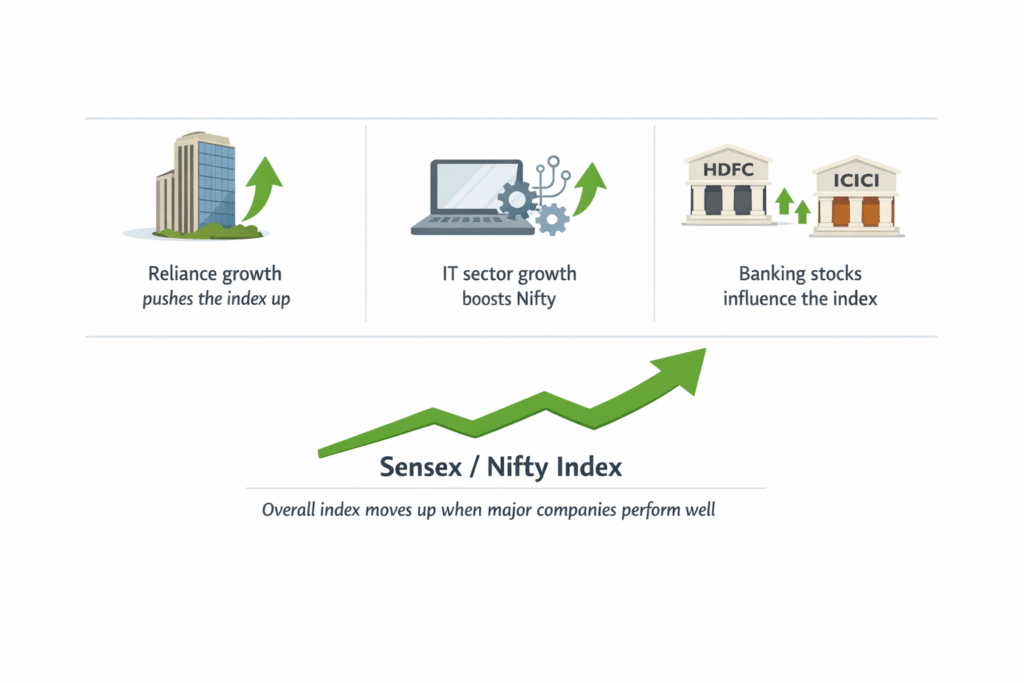
Example of stock price movement showing how companies like Reliance and TCS influence Sensex and Nifty trends
Difference Between Sensex and Nifty
Sensex vs Nifty difference explained India
| Feature | Sensex | Nifty 50 |
|---|---|---|
| Exchange | BSE | NSE |
| Companies | 30 | 50 |
| Coverage | Limited | Broader |
| Popularity | Older index | More widely used today |
Why Investors Use It
- To understand the overall direction of the market
- To track the health of the broader economy
- To compare portfolio performance against a benchmark
- To avoid tracking hundreds of stocks
Advantages
- Simple and easy-to-understand market indicator
- Saves time
- Widely accepted benchmark
- Easy to track
- Reflects economic trends
Limitations
- Does not represent all stocks
- Large-cap companies dominate
- Short-term movements can mislead
- Not all stocks move equally
Key Takeaways
- Sensex and Nifty are market indicators
- Sensex = 30 companies, Nifty = 50 companies
- Based on free-float market capitalisation
- Used to track market direction
Frequently Asked Questions (FAQs)
1. What is Sensex and Nifty in simple words?
They are indexes showing performance of top companies.
2. Which is better?
Nifty gives a broader view.
3. Can I invest directly?
Only through index funds or ETFs.
4. Why do they go up and down?
Due to stock price changes and demand.
5. How is Sensex calculated?
Using free-float market capitalisation.
Conclusion
Understanding what is Sensex and Nifty is essential for beginners. These indexes reflect the performance of India’s top companies and overall market direction.
Tracking them makes learning the stock market much easier.
Disclaimer
This article is for educational purposes only. It does not provide financial advice. Investments are subject to market risks.