
Have you ever come across a news headline about a major company launching an IPO in India and wondered what it really means? Perhaps it was Swiggy making waves, or Tata Technologies drawing huge crowds of investors. If you are new to the stock market, these stories can feel both exciting and confusing.
Understanding what is IPO in stock market India is one of the smartest first steps for anyone who wants to start investing. At its core, an IPO — or Initial Public Offering — is the moment a private company opens its doors to everyday investors. It sells shares to the public for the very first time, giving ordinary people a chance to own a small piece of a growing business.

Simple overview of IPO in the Indian stock market for beginners
India has seen a significant surge in IPO activity in recent years. Names like LIC, Zomato, and Tata Technologies have captured attention across the country and among global investors alike. Yet many beginners still feel lost when it comes to the details — how the process works, how to apply safely, and what happens once the shares start trading.
That is exactly why this guide exists. We will walk you through everything step by step in the simplest possible language, with clear explanations, real Indian market examples, and practical tips that make sense even if you have never invested before. By the end, you will feel far more confident about IPOs — whether you are a local investor, an NRI, or an international reader following the Indian stock market. This guide will help you clearly understand what is IPO in stock market India and how beginners can approach it with confidence.
📌 Also read: What is Stock Market for Beginners
📋 Table of Contents
- What is IPO in Stock Market India
- How IPO Works in India
- Formula or Concept Explanation
- Real Stock Market Example
- Why Investors Use IPO
- Advantages
- Limitations
- Key Takeaways
- Frequently Asked Questions (FAQs)
- Conclusion
- Disclaimer
What is IPO in Stock Market India
IPO Full Form and Meaning
IPO stands for Initial Public Offering.
👉 Simple meaning: An IPO is when a company sells its shares to the public for the very first time.
This process allows a privately held company to raise capital by offering ownership stakes to a wide range of investors. It marks a significant milestone in the life of any business — the transition from being funded by a limited group of private backers to becoming part of the open stock market. To fully understand what is IPO in stock market India, it is important to look at how companies raise money from the public.
IPO Explained Simply (Beginner Friendly)
Think of a company as a private business that has been running quietly for years. Before the IPO, it usually belongs to its founders, early investors, or a small circle of stakeholders. After the IPO, the company opens up ownership — anyone with a demat account can buy shares and become a part-owner.
This shift from private to public is what makes an IPO such a significant event in the Indian stock market. It creates opportunities for everyday people to participate in the growth of companies they believe in. For beginners, the important thing to understand is that this is a regulated and structured way for companies to raise funds from the public.
What is IPO and How to Invest in IPO India Beginners
When a company launches an IPO, the opportunity is open to regular investors like you. Here is what the journey looks like:
- You apply through apps like Zerodha or Groww directly from your phone.
- If you receive an allotment, you get shares at the IPO offer price.
- Once the shares are listed, you can buy or sell them on the NSE or BSE just like any other stock.
The entire process is designed to be accessible, even for complete beginners. Many people start their investing journey with IPOs because the process is straightforward and well-supported by modern technology.
How IPO Works in India
Understanding what is IPO in stock market India becomes easier when you follow the step by step process. Now that you understand the basic idea, let us look at the actual journey an IPO takes in the Indian market. The process is carefully structured to ensure fairness and transparency for all participants.
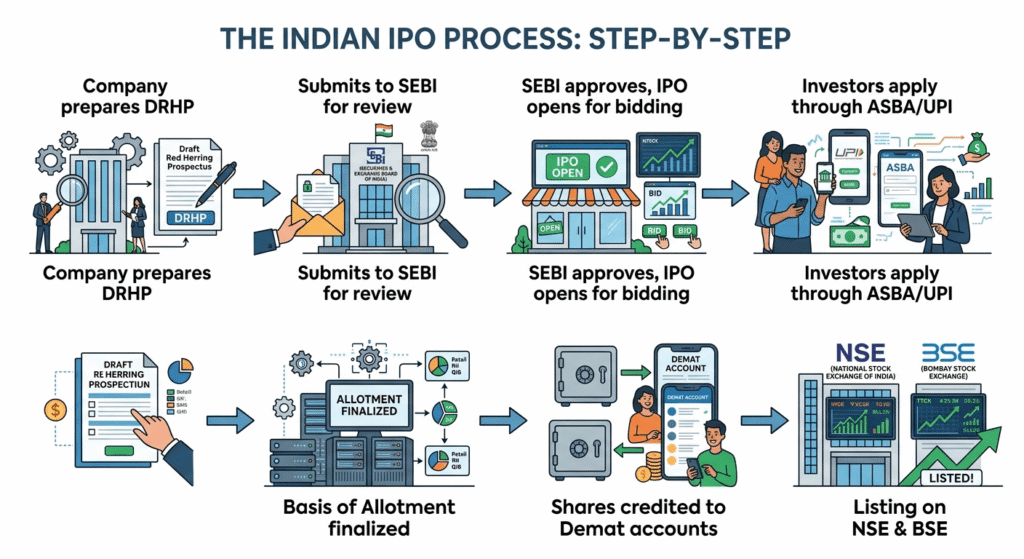
Step by step process of how IPO works in India
How Does IPO Work in India Step by Step
- The company decides to go public and raise money from everyday investors. This decision typically comes after years of private funding and sustained business growth.
- It files a Draft Red Herring Prospectus (DRHP) with SEBI. This document contains all important information about the company, its finances, and future plans.
- SEBI reviews and approves the filing. The regulator ensures that investors receive accurate and complete details before any shares are offered.
- The company sets a price band — a range within which shares will be offered. This helps investors decide at what value they wish to participate.
- Investors place their applications during the open subscription period. This is your window to decide how many shares you want to apply for.
- Allotment of shares is decided based on demand. The company and its bankers evaluate the overall response from different categories of investors.
- Shares get listed on the stock exchanges and trading begins. This is when the share price starts reflecting real market sentiment.
Each step is regulated to protect retail investors. Understanding this flow removes much of the mystery around IPOs and helps you follow market news with far greater clarity.
📌 Also read: How Stock Market Works
IPO Allotment Process — How Shares Are Distributed
When demand for an IPO is very high, shares are distributed through a lottery system. If demand is lower than supply, you may receive the full number of shares you applied for.
👉 This is why many beginners ask: “Why didn’t I get IPO allotment?”
The system is designed to be fair. In India, retail investors have a reserved portion — usually 35 percent of the total issue — which gives new participants a dedicated chance. A computerized lottery ensures there is no bias, making the process transparent for everyone involved.
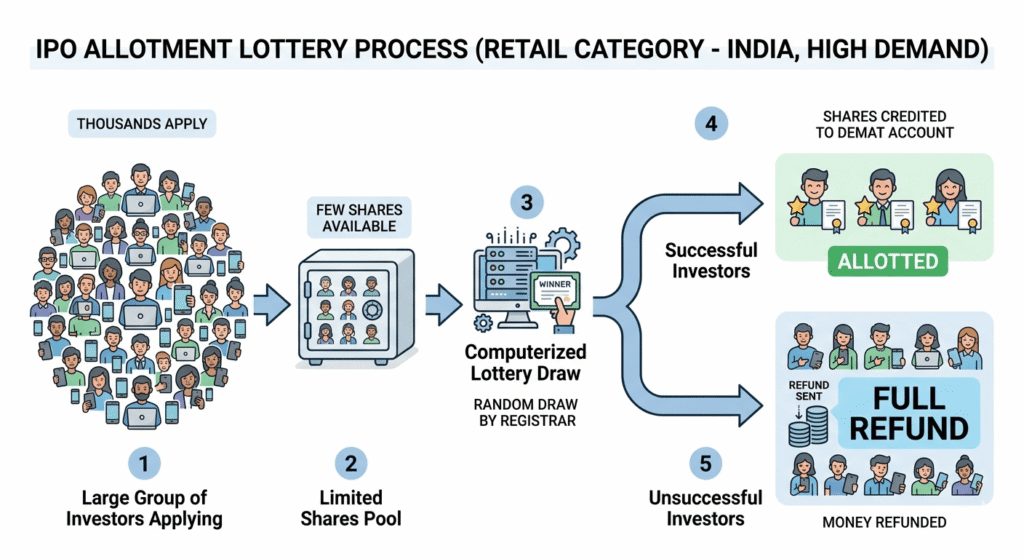
How IPO shares are allotted to investors in India
IPO Subscription Status Meaning
You will often see numbers like 1x, 5x, or 10x next to an IPO listing. Here is what they mean:
- 1x — The issue is exactly fully subscribed.
- 5x — Demand is five times the available shares.
- 10x — Very high investor interest.
👉 Higher subscription generally signals strong market confidence, but it also makes allotment tougher for retail participants. Tracking these numbers on financial apps gives you a useful sense of how popular an IPO is before you apply.
Formula or Concept Explanation
Demand and Supply in IPO
IPO performance is driven by two fundamental forces: investor demand and the company’s valuation.
👉 Simple logic:
- High demand often leads to strong listing gains on the first day of trading.
- Low demand can result in a weaker or flat listing price.
Demand comes from different investor types — retail, institutional, and non-institutional. Supply is limited to the shares being offered. When more people want in than there are shares available, the price can rise sharply after listing. This dynamic is what creates the excitement around popular IPOs in India. This concept helps beginners better understand what is IPO in stock market India in practical terms.
IPO Pricing Concept
Companies do not set a single fixed price. Instead, they establish a price band — a range within which investors can place bids.
👉 Example: ₹100 – ₹110
You bid within this range when you apply. The final issue price is determined after the subscription period closes, based on the bids received. This approach allows the market to help find the right value. For beginners, it is worth knowing that the final price tends to land at the upper end of the band when demand is strong.
Real Stock Market Example
To make these concepts more concrete, let us look at actual cases from the Indian market. These examples illustrate both the opportunities and the realities of IPO investing — including lessons from major names like Reliance, TCS, and HDFC Bank. These examples make it easier to understand what is IPO in stock market India in real market situations.

Example of IPO performance in India using real company data
Tata Technologies IPO
Tata Technologies saw strong demand when it came to market. The issue received high subscription and listed with a healthy premium. Many retail investors who received an allotment benefited from early listing gains. This IPO highlighted how a well-established name backed by the Tata Group can attract widespread interest from domestic and international investors. It also showed that researching a company’s background before applying is always worthwhile.
LIC IPO
The Life Insurance Corporation of India IPO was one of the largest ever in India. It drew massive participation from across the country. However, the stock showed mixed performance after listing. This example is an important reminder that even big, well-known names do not always deliver instant success. The LIC IPO taught many first-time investors about patience and the importance of looking beyond the listing day.
Reliance Example (Future IPO)
Reliance Industries remains a dominant force in the Indian economy. Any future IPO from key units — such as Jio — would likely generate enormous interest from retail investors and global participants alike. Similar enthusiasm surrounded landmark IPOs from TCS in 2004, which listed at a significant premium and delivered strong long-term returns, and HDFC Bank, which built its reputation for consistency after its early public offering. These historical cases, alongside potential Reliance developments, illustrate how IPOs from trusted brands can become generational wealth opportunities when aligned with strong market conditions.
👉 Key insight: IPO success depends on demand, valuation, and overall market conditions at the time of listing. Studying real examples helps beginners evaluate future opportunities with greater confidence.
Why Investors Use IPO
- IPOs offer a chance to invest early in promising companies that were previously unavailable to the public.
- There is potential for listing gains on the first day of trading.
- Investors can participate directly in a company’s future growth story.
- IPOs help diversify a portfolio beyond regular market stocks.
This early access can sometimes lead to higher returns compared to buying shares later on the open market, though it comes with its own considerations. For many investors, participating in an IPO feels like being part of a company’s most exciting chapter.
Advantages
- Early investment opportunity — You can invest in companies that were previously closed to the public, potentially growing alongside the business from its debut.
- Potential listing gains — Many IPOs in India have seen positive first-day movements, rewarding successful applicants.
- Transparent and regulated process — SEBI’s strict oversight ensures companies disclose all necessary information upfront, protecting retail investors.
- Easy and convenient application — Through apps like Groww and Zerodha, anyone with a smartphone and a demat account can apply without visiting a broker’s office.
Limitations
- Allotment is not guaranteed — In popular IPOs, you may apply and still not receive any shares due to high oversubscription.
- Risk of loss after listing — Not every IPO performs well in the long run. Share prices can fall below the issue price.
- Market volatility — External factors such as economic news or global events can quickly affect share prices after listing.
- Information overload for beginners — The volume of details in a company prospectus can feel overwhelming at first.
Recognizing these limitations helps you approach IPOs with a balanced mindset and avoid common first-time mistakes.
Key Takeaways
- IPO means the first public sale of shares by a company.
- The process requires SEBI approval and follows clear, regulated rules.
- Allotment often works like a lottery when an IPO is oversubscribed.
- The listing price can rise or fall depending on market reaction and sentiment.
- Taking time to understand the basics is essential before you invest.
Frequently Asked Questions (FAQs)
1. What is IPO in stock market India?
An IPO is when a company offers its shares to the public for the first time, allowing everyday investors to buy ownership stakes through the stock exchange.
2. How to apply for IPO in India?
You can apply through a registered broker or app like Zerodha or Groww using the UPI mandate or ASBA process linked to your bank account.
3. What happens if IPO is not allotted?
If you do not receive an allotment, the full application amount is refunded directly to your bank account, usually within a few working days.
4. What is the minimum investment in IPO?
It depends on the lot size set by the company. Most retail IPOs in India require a minimum investment of approximately ₹10,000 to ₹15,000.
5. Can I sell IPO shares on listing day?
Yes. Once shares are listed and credited to your demat account, you can sell them on the exchange from the first day of trading.
Conclusion
Understanding what is IPO in stock market India is an essential step for every beginner who wants to explore investing. IPOs offer a real opportunity to become part of a company’s growth story right from the beginning.
That said, it is important to understand the process, the risks, and what to expect before you apply. With the right knowledge, IPOs can become a powerful and rewarding part of your investing journey.
📌 Also read: Types of Shares in India for Beginners
Disclaimer
This article is for educational purposes only. It does not constitute financial advice or investment recommendations. Stock market investments are subject to market risks. Please conduct your own research before making any financial decisions.