
Last Updated: May 13, 2026
When Bajaj Finance announced a 4:1 bonus issue in 2024, investors holding 100 shares found 400 shares in their demat account. No payment, no action required. Here’s exactly how that happens.
Understanding what is bonus share in stock market India is an important concept for any beginner. Companies like Reliance Industries, Infosys, and Bajaj Finance have all used bonus shares to reward their shareholders. Yet many new investors are confused — Is it really free money? Why does the share price drop after a bonus issue? And should you buy before the record date?
In this guide, you will get clear answers to all of these questions, along with real Indian examples, a simple ratio calculation table, and everything you need to understand bonus shares with confidence.
📋 Table of Contents
- What is Bonus Share in Stock Market India
- How Bonus Shares Work — Step-by-Step
- Bonus Share Formula and Ratio Explained
- Real Stock Market Examples (India)
- Why Investors Track Bonus Shares
- Advantages of Bonus Shares
- Limitations to Be Aware Of
- Key Takeaways
- Frequently Asked Questions
- Conclusion
What is Bonus Share in Stock Market India
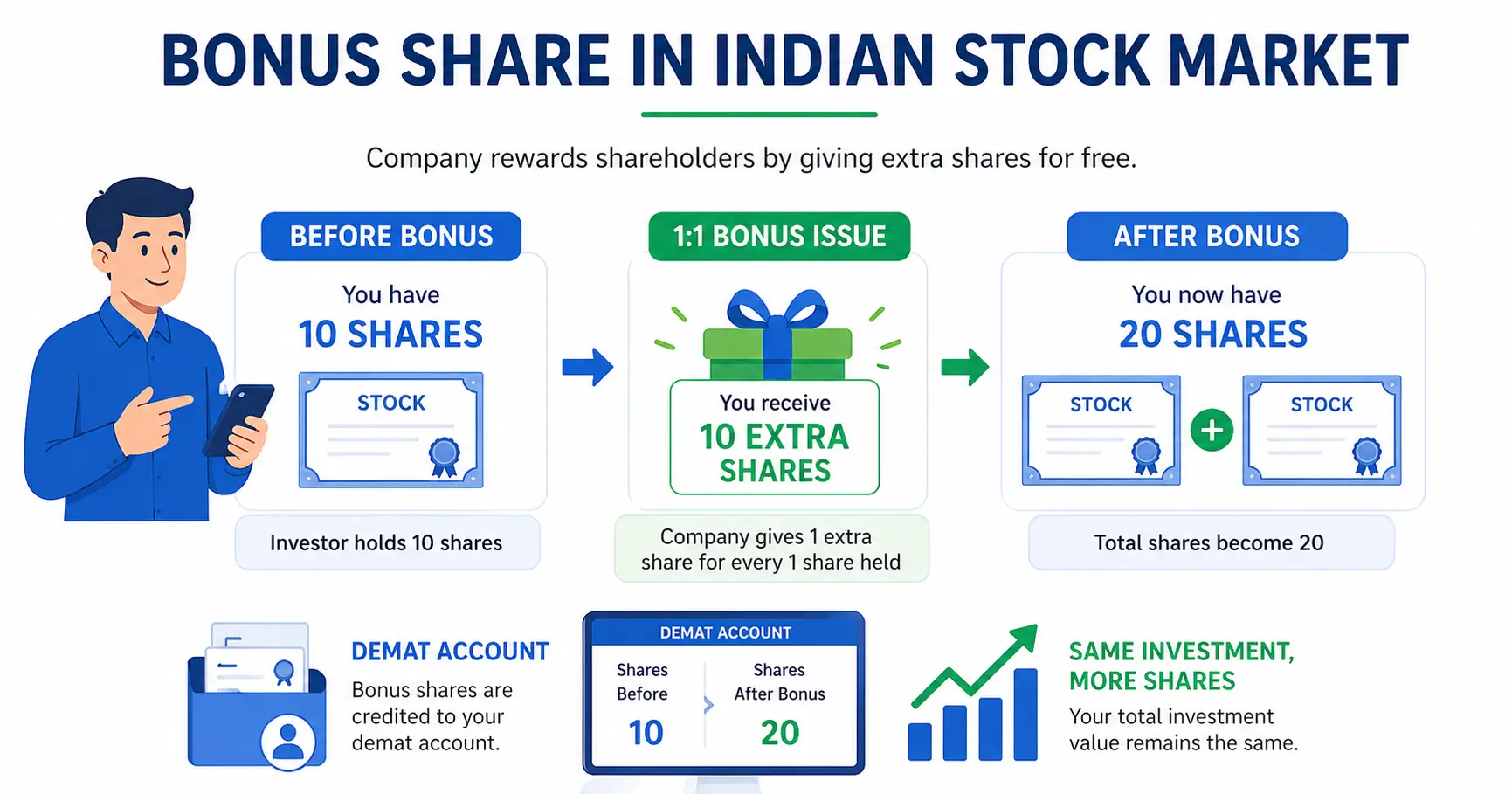
A bonus share is an additional share given by a company to its existing shareholders at absolutely no cost. Instead of distributing profits as cash dividends, the company converts its accumulated profits or reserves into new shares and distributes them proportionally to all existing shareholders.
In simple words: Bonus shares are free extra shares issued from a company’s accumulated profits — no payment required, no action needed. They are credited directly to your demat account.
Here is a straightforward example to make the concept clear:
- You own 100 shares of a company
- The company announces a 1:1 bonus issue
- You receive 100 bonus shares at no cost
- Your total holding becomes 200 shares
- Your total investment value stays exactly the same
The key point to understand from the start is that while you end up with more shares, the share price adjusts proportionally — which means your overall portfolio value does not change on the day of the bonus. Over the long term, however, holding more shares in a growing company can compound into significant wealth.
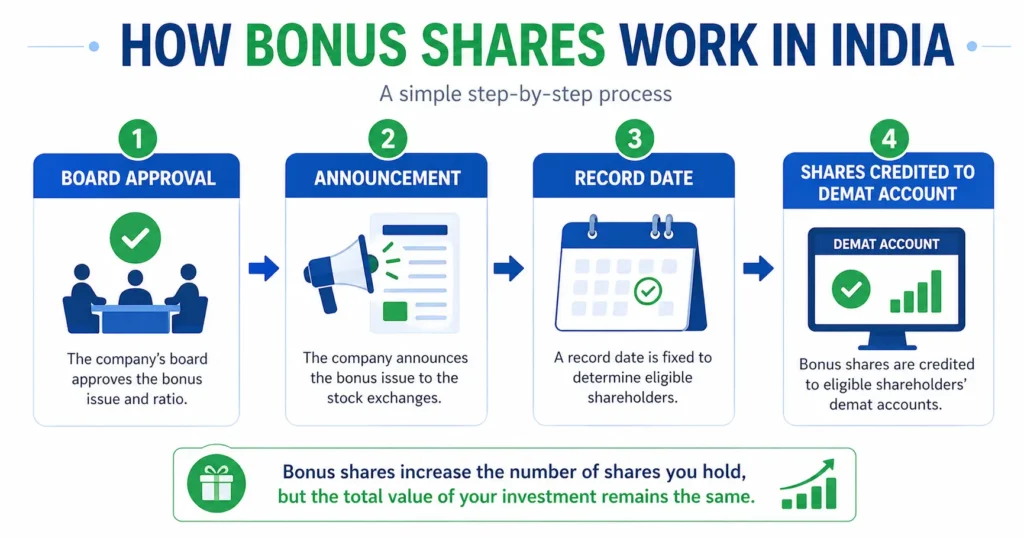
Step-by-step process of bonus share issue
How Bonus Shares Work — Step-by-Step
Bonus shares in India follow a clear, regulated process set by SEBI and the stock exchanges. Here is how it unfolds from announcement to credit:
⚠️ Important Rule Most Beginners Miss: You cannot sell bonus shares the moment they appear in your account. Bonus shares are typically credited about 15 days after the ex-date. Attempting to sell them before they are officially credited can result in a short-delivery penalty or auction settlement. Always wait for the credit confirmation before placing any sell order.
Bonus Share Formula and Ratio Explained
Bonus shares are always announced in a ratio format. This ratio tells you exactly how many free shares you receive for every share you already own.
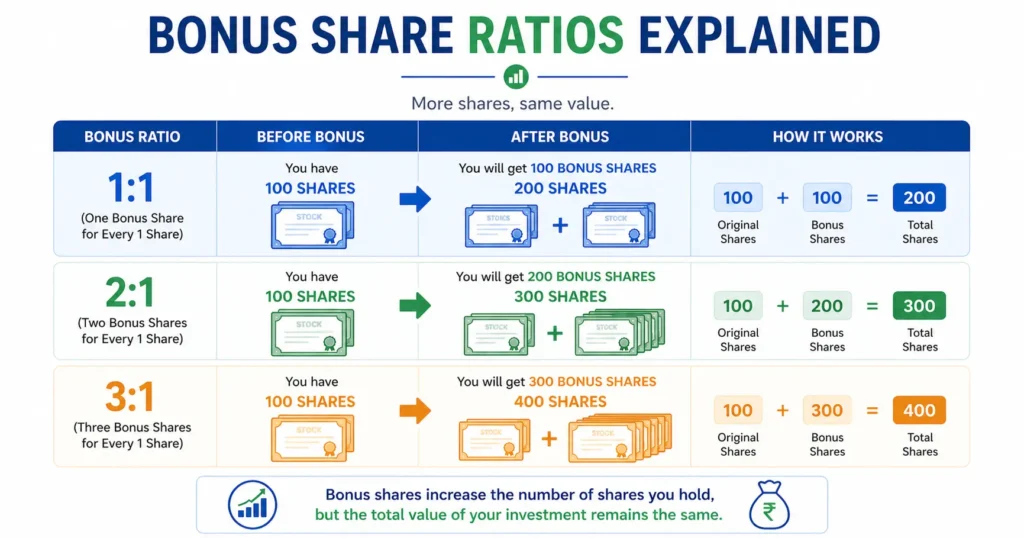
Understanding bonus share ratios
Key Concept — Why Your Total Value Stays the Same
This is the single most important idea that trips up beginners, and it is worth spelling out clearly with numbers.
Before 1:1 Bonus: 100 shares × ₹1,000 = ₹1,00,000 total value
After 1:1 Bonus: 200 shares × ₹500 = ₹1,00,000 total value
The share price adjusts to reflect the increased number of shares. Your total investment value on the day of the bonus remains exactly the same — no profit, no loss at the point of issue.
Think of it like cutting a chocolate bar into two equal pieces. You now have two pieces instead of one, but the total amount of chocolate has not changed. Bonus shares work on exactly the same principle.
Real Stock Market Examples — India (2024–2026)
Looking at actual companies makes the concept far more tangible. Here are three well-known Indian examples that beginners often ask about.
Bajaj Finance — 4:1 Bonus Issue (June 2025)
One of the most talked-about bonus issues in recent years came from Bajaj Finance, India’s leading NBFC. In June 2025, the company announced a 4:1 bonus ratio. This meant that for every one share held, shareholders received four additional shares at no cost.
- If you held 100 shares before the record date
- You received 400 bonus shares
- Your total holding became 500 shares
The share price adjusted proportionally, but investors who held long-term benefited significantly as Bajaj Finance continued to grow.
Reliance Industries — 1:1 Bonus Issue (September 2024)
Reliance Industries announced a 1:1 bonus issue in September 2024 — its first bonus issue since 2017. Every shareholder received one additional share for each share they already held, effectively doubling their holding overnight.
Wipro — India’s Most Frequent Bonus Company (13 Issues!)
💡 Did you know? Wipro has issued bonus shares 13 times — more than any other company in the Nifty 50. This consistent track record of rewarding shareholders over decades is one of the reasons long-term Wipro investors have built significant wealth, even during periods of flat share price movement.
Why Investors Track Bonus Shares
Bonus share announcements attract considerable attention from retail investors for several practical reasons.
- Positive signal about company health: A bonus issue signals that the company has built up strong reserves — which typically means consistent profitability over time.
- Improved stock liquidity: More shares in circulation means easier buying and selling in the market, which benefits all participants.
- Psychological benefit: Receiving additional shares without any payment feels rewarding and tends to strengthen investor loyalty.
- Long-term wealth building: Investors who hold fundamentally strong companies through multiple bonus cycles often see compounding effects on their holdings over the years.
Advantages of Bonus Shares
- No additional investment required: Shareholders receive extra shares without spending any money
- Increases the number of shares held: More shares means a larger stake in the company’s future growth
- Improves stock liquidity: A higher share count makes the stock more accessible to a wider range of investors
- Signals company confidence: Companies with healthy reserves can afford to issue bonus shares, which reflects management’s confidence in future performance
- Tax-efficient reward: Unlike dividends, bonus shares are not taxable at the time of receipt — only capital gains tax applies when you eventually sell
Limitations to Be Aware Of
- Not an immediate financial gain: Total portfolio value does not increase on the day of the bonus — the share price adjusts proportionally
- Share price adjusts downward: The market price per share falls in line with the bonus ratio, which can confuse beginners who see a lower price and worry
- No immediate cash income: Unlike dividends, bonus shares do not provide cash flow — they are purely a redistribution of equity
- Cannot sell immediately: Bonus shares take approximately 15 days to be credited — selling before this can lead to auction penalties
- Long-term benefit depends on company performance: If the company does not grow after the bonus issue, holding more shares at a lower price provides no additional real advantage
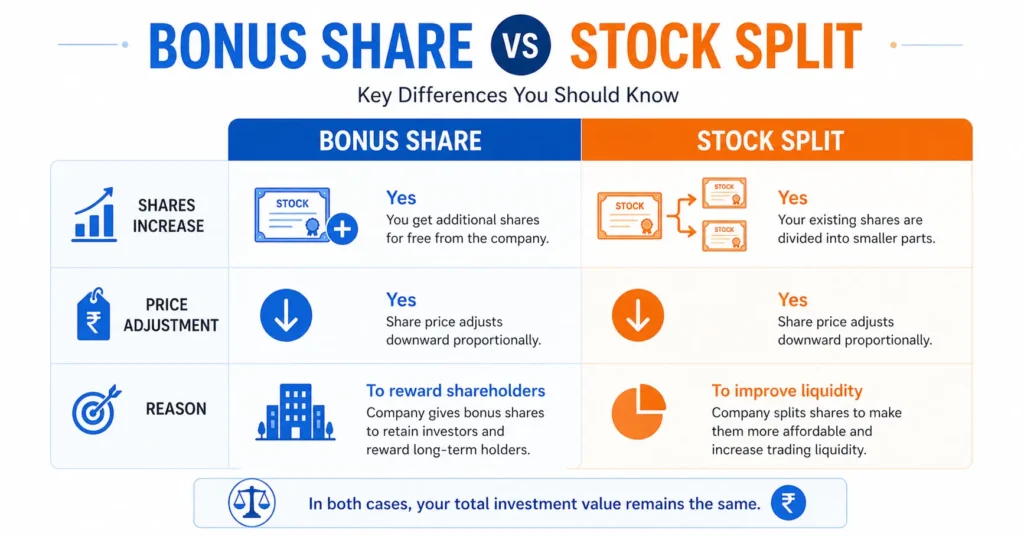
Difference between bonus shares and stock split
Key Takeaways
- ✅ Bonus shares are free extra shares issued from a company’s accumulated profits
- ✅ You do not pay anything — shares are credited directly to your demat account
- ✅ The total investment value stays the same on the day of issue — price adjusts proportionally
- ✅ You must hold shares before the record date to qualify for the bonus
- ✅ Do not sell before bonus shares are officially credited (~15 days) — auction penalty risk!
- ✅ Bonus shares are not taxable at receipt — capital gains tax applies only when you sell
- ✅ Companies like Bajaj Finance (4:1), Reliance (1:1), and Wipro (13 issues) have strong bonus track records
- ✅ Understanding what is bonus share in stock market India helps you make better long-term investment decisions
Frequently Asked Questions (FAQs)
1. What is bonus share in simple words?
A bonus share is a free additional share given by a company to its existing shareholders. The company uses its accumulated profits or reserves to issue these shares — you receive them without paying anything, and they are credited directly to your demat account.
2. Is bonus share really free money?
Not exactly. Bonus shares are free in the sense that you do not pay for them. However, your total portfolio value does not increase on the day of issue — the share price adjusts downward in proportion to the bonus ratio. Think of it as cutting a chocolate bar into more pieces: you have more pieces, but the total chocolate is the same. Long-term wealth building depends on whether the underlying business continues to grow.
3. Why do companies give bonus shares instead of dividends?
Companies issue bonus shares for several reasons: to reward shareholders without distributing cash, to improve stock liquidity by increasing the share count, to signal financial strength and healthy reserves, and to make shares more affordable for new retail investors by bringing down the per-share price.
4. Are bonus shares taxable in India 2026?
Bonus shares are not taxable at the time of receipt. You do not pay any tax when the shares are credited to your account. However, when you eventually sell bonus shares, capital gains tax applies. Since the cost of acquisition for bonus shares is considered zero, your entire sale proceeds are treated as capital gains and taxed accordingly.
5. What is the difference between bonus share and dividend?
A bonus share rewards you with additional shares — no cash changes hands, and your total holding increases in number while the per-share price adjusts. A dividend pays you a portion of the company’s profits in cash, credited directly to your bank account. Dividends provide immediate income; bonus shares offer long-term compounding potential through a larger shareholding.
Conclusion
Understanding what is bonus share in stock market India goes well beyond the idea of getting free shares. While a bonus issue does not make you richer on day one, it is a meaningful signal that a company is profitable, well-managed, and confident in its future. For long-term investors who hold quality companies, bonus shares can quietly compound into significant additional wealth over time.
The key discipline is simple: hold strong companies, own shares before the record date, and do not attempt to sell before the bonus is officially credited to your demat account.
Build on this foundation with these related guides from our Stock Market Basics series:
- 📖 What is Dividend in Stock Market India? Simple Beginner Guide (2026)
- 📖 Types of Shares in India for Beginners (2026 Guide)
- 📖 What is IPO in Stock Market India? Beginner Guide (2026)
- 📖 What is SEBI in Stock Market? Complete Beginner Guide (2026)
- 📖 What is Bull and Bear Market in India? Simple Guide (2026)
Disclaimer: This article is published for educational and informational purposes only. It does not constitute financial or investment advice. All investments in the stock market are subject to market risks. Please conduct your own research or consult a qualified financial advisor before making any investment decisions.