

Last Updated: June 22, 2026
She closes the app. The ₹2,000 sits there for another month.
This guide is for Priya. And for anyone who has been in that exact moment.
Buying your first stock can feel exciting and confusing at the same time. You have a Demat account, some savings, and a trading app — but the actual process of placing that first order is something most guides never explain clearly.
In this complete guide on how to buy your first stock in India, you will learn the exact step-by-step process, understand the key order types that confuse most beginners, see what actually happens after you click Buy, and avoid the mistakes that cost new investors the most money.
- What Is Buying a Stock?
- How Buying Your First Stock Works
- Before You Buy: 3 Things to Check
- How to Buy Shares in India Online
- Market Order vs Limit Order
- CNC vs MIS Explained
- Stock Ownership Formula
- Real Indian Example
- What Happens After You Buy?
- T+1 Settlement Explained
- Money Deducted, Trade Failed? (UPI Fix)
- Real Cost of Your First Trade
- Why Investors Buy Stocks
- The Dividend Trap — Myth vs Reality
- Advantages of Stock Investing
- Limitations and Risks
- 8 Mistakes First-Time Buyers Make
- Key Takeaways
- Frequently Asked Questions
- Conclusion
What Is Buying a Stock?
When you buy a stock, you are purchasing a small ownership stake in a company. Companies are divided into millions of tiny pieces called shares. Buy one share, and you legally own a tiny fraction of that business.
Three quick examples:
- One share of Reliance = one tiny piece of Reliance Industries
- One share of TCS = partial ownership of Tata Consultancy Services
- One share of HDFC Bank = a fractional stake in one of India’s largest banks
Owning one share does not give you any control over the company. But if the company grows and its value increases, the price of your share may increase too. Some companies also pay dividends — a share of profits paid directly to shareholders.
This is the core idea behind learning how to buy your first stock in India — you are not gambling on a price chart. You are buying a piece of a real business. To understand what the stock market is and how ownership works, start there.
How Buying Your First Stock Works
Understanding how the stock market works will make the buying process much clearer. Here is the complete sequence from zero to shareholder:
Choose a SEBI-registered broker — Groww, Zerodha, Upstox, or Angel One. Your Demat account stores shares electronically. Without it, you cannot hold stocks in India.
You need PAN card, Aadhaar card, mobile number, bank account details, and a signature. The entire process is online and takes 10–15 minutes.
Transfer ₹500, ₹1,000, or any amount from your bank account to your trading account using UPI — instant and free.
Type the company name in your app — “Reliance,” “TCS,” “Infosys,” “ITC.” You see the live stock price, charts, and fundamentals.
Select quantity, order type (CNC for delivery), and price. Review carefully. Tap Buy. Your order reaches NSE or BSE in milliseconds.
After T+1 settlement (next trading day), shares are credited to your Demat account. You are now officially a shareholder.
Before You Buy: 3 Things to Check
Most beginners rush straight to clicking Buy. Do these three checks first — they take 2 minutes and prevent a lot of frustration.
1. Is Your Demat Account Fully Active?
Many people complete the signup form but miss the final activation step. Check: account status, KYC completion status, and whether your bank account is linked. A pending KYC means your order can fail at the last moment.
2. Is Your Bank Account Properly Linked?
Without a linked bank account, fund transfers fail, orders get rejected, and withdrawals are blocked. Check the Funds section in your app to confirm your bank is active.
3. Are You Buying During Market Hours?
How to Buy Shares in India Online
Here is the exact screen-by-screen process on most Indian broker apps (Groww, Zerodha, Upstox):
| Step | What You Do | What You See |
|---|---|---|
| 1 | Open your broker app | Home screen with market overview |
| 2 | Search for the company (e.g., “TCS”) | Live price, day change, charts |
| 3 | Tap the stock | Detailed view — PE ratio, market cap, 52-week high/low |
| 4 | Tap “Buy” | Order screen opens |
| 5 | Select order type (CNC) and quantity | Estimated total amount shown |
| 6 | Choose Market Order or Limit Order | Price field appears for Limit Order |
| 7 | Review: quantity, price, estimated total | Order summary screen |
| 8 | Tap Confirm / Place Order | Order confirmation + order ID |
Understanding the Nifty 50 index before buying helps you gauge whether the overall market is up or down on the day you place your first order.
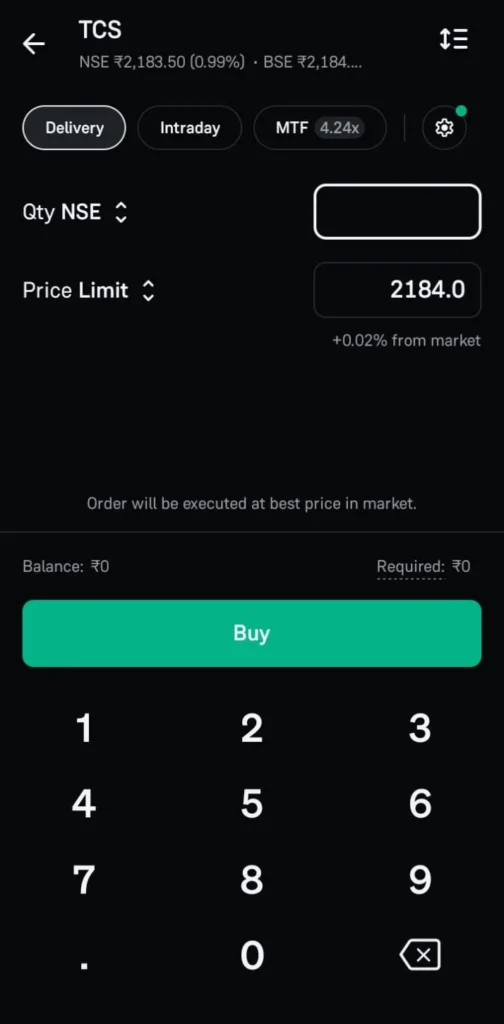
Example screenshot from a personal Groww account. Similar buying steps apply across major Indian brokers including Zerodha, Upstox, and Angel One.Market Order vs Limit Order
This is the most important decision you make when placing your first buy order. Get this wrong and you either pay more than expected or your order never executes.
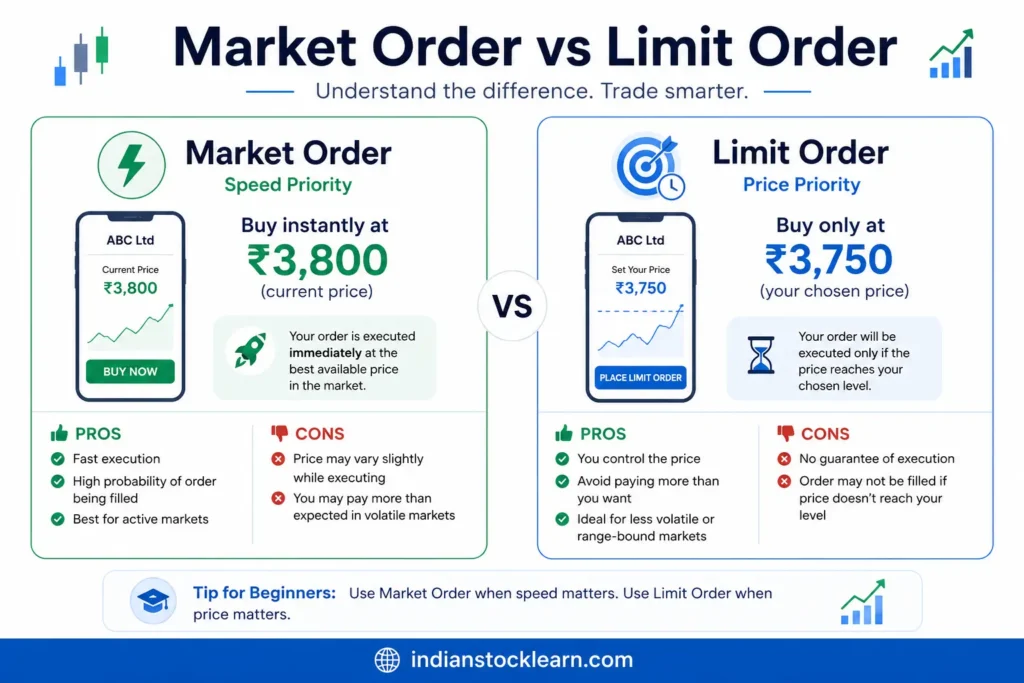
Buy Now at Market Price
Executes immediately at the best available price. If TCS is at ₹3,800, your order fills at or near ₹3,800.
- ✅ Fast execution — within seconds
- ✅ Simpler — no price to set
- ✅ Best for liquid large-cap stocks
- ⚠️ Final price may vary slightly
Buy Only at Your Price
You set a maximum price. If TCS is at ₹3,800 but you want to buy at ₹3,750, the order only executes when price falls there.
- ✅ Price control — no surprises
- ✅ Useful during volatile sessions
- ⚠️ May never execute if price doesn’t reach your level
- ⚠️ Slightly more complex to set up
CNC vs MIS Explained
This is the single most common mistake Indian beginners make when buying their first stock. Most guides mention it briefly. We are going to explain it clearly.
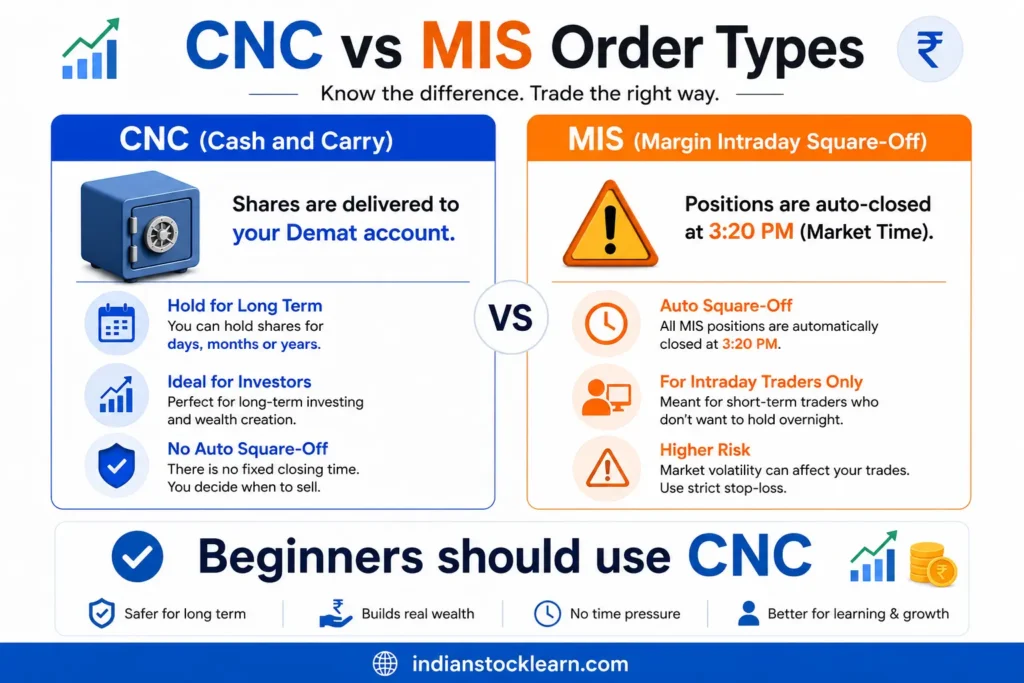
For Long-Term Investors
Shares are delivered to your Demat account after T+1 settlement. You can hold them for days, months, or years.
- ✅ Shares credited to your Demat account
- ✅ Hold as long as you want
- ✅ Correct choice for 99% of beginners
- ✅ No auto-closing — your position stays open
For Intraday Traders Only
Position must be closed on the same day. If you forget, the broker auto-closes it at 3:20 PM — sometimes at a loss.
- ⚠️ Auto-closes at 3:20 PM same day
- ⚠️ Not for holding — shares never go to Demat
- ❌ Wrong choice for long-term investing
- ❌ Has accidentally confused thousands of Indian beginners
Why “Buy and Forget” Is a Dangerous Myth
Most guides tell you that once shares are in CNC, you can hold them forever and never look back. That advice is incomplete — and can quietly cost you money or shares.
- Delisting and bankruptcy: If a company gets delisted from the exchange or goes bankrupt, your money can be permanently stuck — review your holdings periodically.
- Mergers and demergers: When companies merge (such as HDFC Limited merging into HDFC Bank), your old shares may be cancelled and replaced with new ones. You may need to take action.
- Rights issues: If a company offers a rights issue and you ignore the notification email, your existing shareholding value can get diluted.
- CDSL/NSDL email alerts: Never mark these as spam. Corporate action notices arrive through these emails, and missing them has real financial consequences.
The takeaway: long-term investing does not mean zero attention. A quick portfolio review 3–4 times a year is enough to stay safe.
Stock Ownership Formula
Many beginners ask: “How much of the company do I actually own if I buy one share?” The calculation is straightforward:
The percentage is tiny, but the ownership is real and legal. This is why stock investing is fundamentally about owning businesses — not just watching price charts. The PE ratio of a stock helps you evaluate whether you are paying a fair price for that ownership stake.
Real Indian Example
Let us follow Rahul’s exact journey — from funding his account to becoming a shareholder.
| Step | What Rahul Does | Result |
|---|---|---|
| 1 | Adds ₹2,000 to his Groww account via UPI | Trading account funded instantly |
| 2 | Searches “ITC” (current price: ₹420/share) | Sees price, PE ratio, 52-week range, dividend history |
| 3 | Selects: Quantity = 2, Order Type = CNC, Market Order | Estimated total: ~₹840 + small charges |
| 4 | Taps Confirm | Order sent to NSE, matched with a seller |
| 5 | Checks portfolio next morning (T+1) | 2 shares of ITC appear in Demat holdings |
| 6 | Monitors quarterly results and dividend announcements | Rahul is now a shareholder of ITC Limited |
Rahul started with ₹2,000. He chose ITC because he uses ITC products daily — cigarettes, notebooks, FMCG goods — he understood the business. This is exactly the Peter Lynch principle: invest in what you know and use.
What Happens After You Buy Your First Stock in India?
Most guides stop at “place the order.” Here is what actually happens next — step by step.
| Event | When | Where to See It |
|---|---|---|
| Order confirmation | Instantly | App notification + Orders tab |
| Money deducted | Same day | Funds tab — available balance reduces |
| Trade settlement begins | Same day | Behind the scenes — NSE/CDSL clearing |
| Shares credited to Demat | T+1 (next trading day) | Holdings tab — shares appear |
| P&L display activates | After settlement | Portfolio shows unrealised gain/loss |
T+1 Settlement Explained — When Do Shares Actually Appear?
One of the most confusing moments for first-time buyers: you placed the order, the app confirmed it, money was debited — but your Holdings tab shows nothing. Why?
India operates on T+1 settlement:
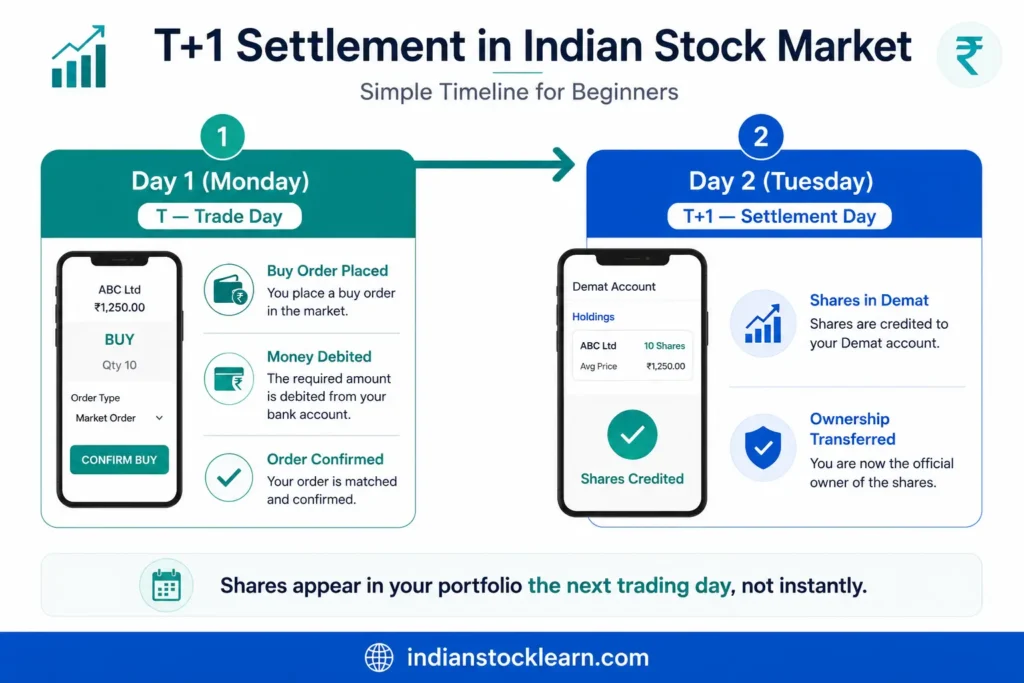
Order executes. Money is debited from your account. Order appears in your portfolio as “pending settlement.” Shares not visible yet.
→Ownership officially transfers. Shares show in Holdings tab. P&L tracking begins. You are now an official shareholder.
This process involves your broker, the stock exchange (NSE), the depository (CDSL or NSDL), and the clearing corporation working together. The Securities and Exchange Board of India (SEBI) mandates this process to protect both buyers and sellers.
Money Deducted, Trade Failed? (UPI Fix)
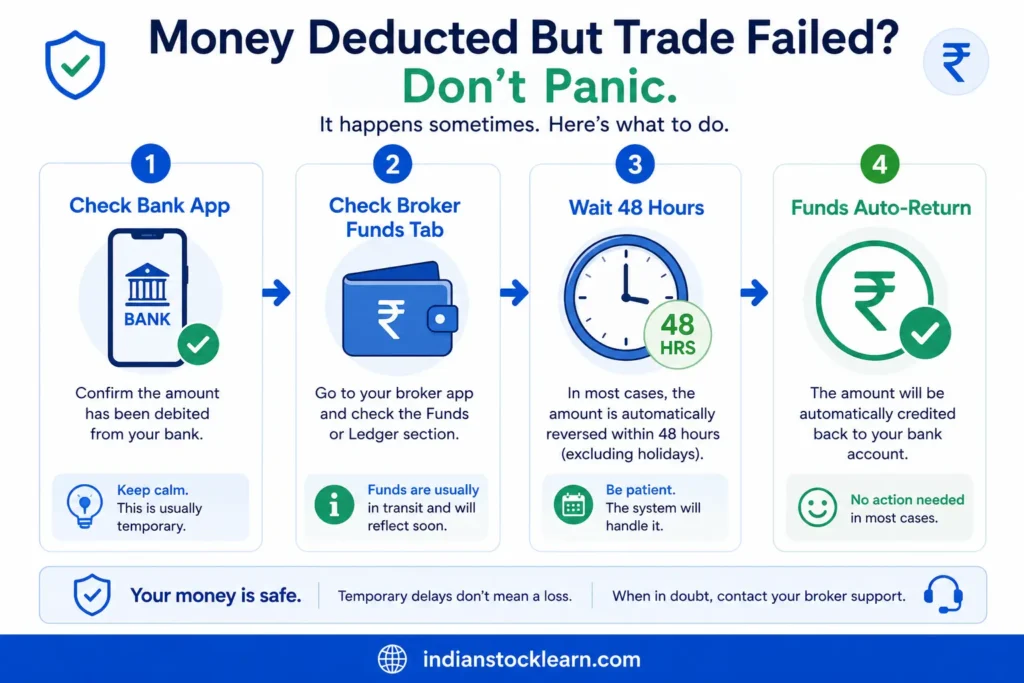
This happens to thousands of first-time buyers: you place an order, money leaves your bank account, but the trade shows as failed or the shares never appear. Do not panic. Here is exactly what is happening and what to do.
| Step | What to Check | What It Tells You |
|---|---|---|
| 1 | Check your bank app’s transaction history | If money shows “debited” but order failed, funds are likely stuck at the banking gateway (NPCI), not lost with the broker |
| 2 | Check your broker app’s Funds/Ledger section | If funds haven’t reflected, the issue is on the bank-to-broker transfer leg |
| 3 | Wait 48 working hours before raising a complaint | Failed UPI transactions are auto-reversed to your original bank account within this window in almost all cases |
| 4 | For amounts above ₹1 lakh, use NEFT/RTGS instead of UPI | Large transfers are more likely to hit UPI limits or gateway congestion — bank transfer is more reliable for big amounts |
Real Cost of Your First Trade — What ₹10,000 Actually Costs You
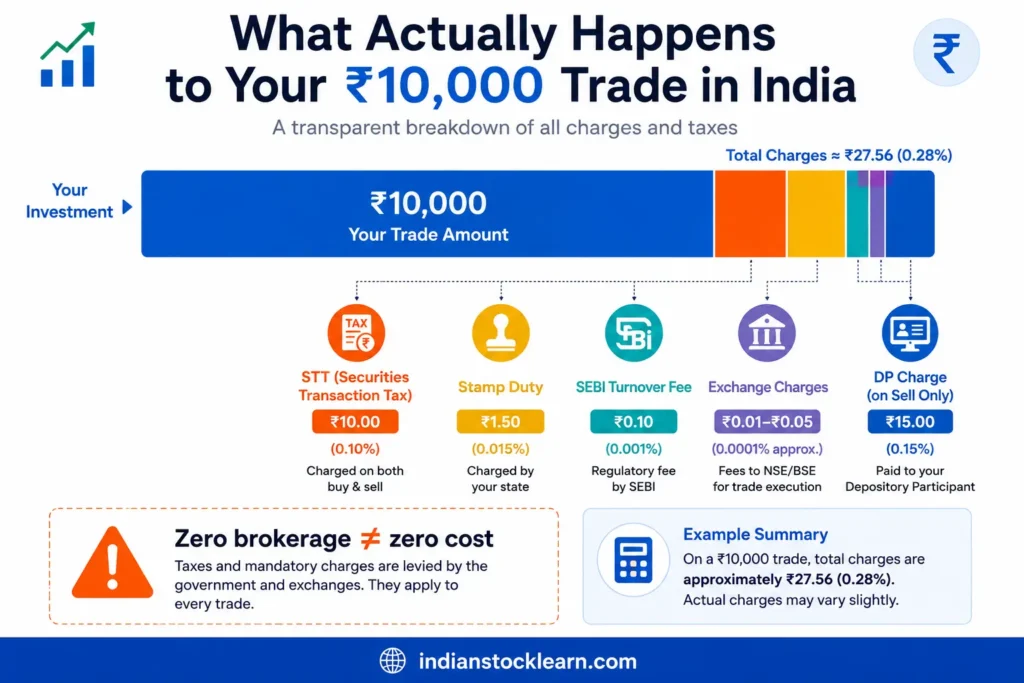
Your broker says “zero brokerage on delivery.” That is true — but it is not the full picture. Every trade has government-mandated charges that reduce your actual return. Here is the exact breakdown for a ₹10,000 delivery trade:
| Charge | What It Is | On ₹10,000 Trade | When Applied |
|---|---|---|---|
| STT (Securities Transaction Tax) | Government tax on every buy transaction | ~₹10 | On buy |
| Stamp Duty | State government charge on share purchases | ~₹1.50 | On buy |
| Exchange Transaction Charges | NSE/BSE fee for using the exchange | ~₹3–₹5 | On buy + sell |
| SEBI Turnover Fee | Regulatory fee — very small | ~₹0.10 | On buy + sell |
| GST | 18% on brokerage + exchange charges | Minimal on delivery | On buy + sell |
| DP Charge (CDSL/NSDL) | Flat fee per stock line item sold — regardless of trade size | ₹13–₹20 flat | On SELL only |
Why Investors Buy Stocks in India
People invest in stocks for reasons that go beyond “making quick money.” Understanding the real motivations helps you set realistic expectations.
| Reason | What It Means Practically |
|---|---|
| Wealth creation | Equities have historically outperformed fixed deposits over any 10-year period in India |
| Business ownership | You participate in the growth of companies like Reliance, TCS, HDFC Bank, and Infosys |
| Dividend income | Some companies share profits — ITC, HDFC Bank, and Coal India have strong dividend histories |
| Inflation protection | Savings account returns (3.5%) lose to inflation (5–6%). Equities have historically beaten inflation |
| India’s growth story | India is the fastest-growing major economy. Stock ownership lets you participate in that growth |
Understanding IPOs is also part of the investing journey — companies raising fresh capital give early investors a chance to participate from the very beginning.
The Dividend Trap — “Free Money” Myth vs Reality
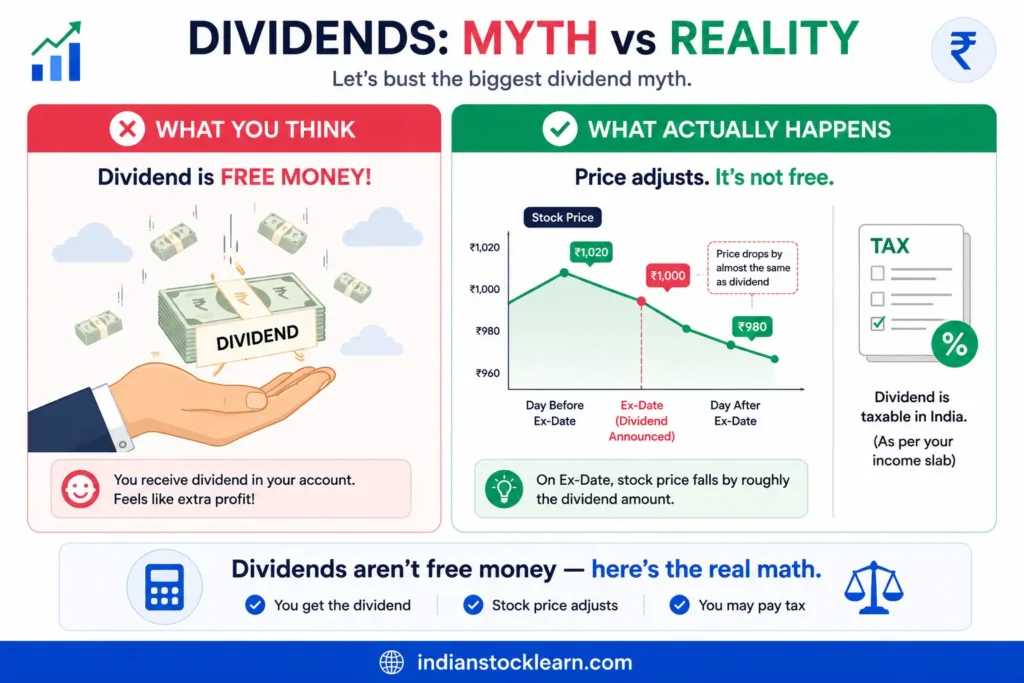
Dividends look like free money. They are not. Most beginner guides stop at “some companies share profits with shareholders” and skip the part that actually matters — what happens to your share price and your tax bill on the day you receive that dividend.
| What Beginners Think (Myth) | What Actually Happens (Reality) |
|---|---|
| “Dividend is bonus money on top of my investment” | On the Ex-Date, the share price drops by approximately the dividend amount. A ₹1,000 stock paying ₹50 dividend opens near ₹950 the next day. |
| “Dividends are tax-free since the company already pays tax” | Dividends are added to your total annual income and taxed at your personal income tax slab — 20% or 30% for many salaried investors. |
| “I should rush to buy before the Record Date to grab the dividend” | Buying just for a dividend you’ll lose roughly the same amount in price drop, plus tax — and you risk buying a stock you didn’t actually research. |
| “High dividend yield = good investment” | Companies that reinvest profits into growth (instead of paying dividends) often create more long-term wealth than high-dividend companies that aren’t growing. |
Advantages of Stock Investing
| Advantage | What This Means for a Beginner |
|---|---|
| Easy accessibility | Open Demat account in 10 minutes. Start with ₹200–₹500. No branch visit needed. |
| Liquidity | Sell any listed stock on any trading day. Far more liquid than gold, real estate, or FDs with lock-in. |
| Long-term growth potential | Companies that grow revenue and profits over years typically create long-term shareholder value. |
| Dividend opportunities | Select companies pay regular cash dividends — passive income on top of price appreciation. |
| Transparency | Listed companies must publish quarterly results, annual reports, and major announcements on NSE/BSE. |
| Wide choice | 5,000+ listed companies across banking, IT, FMCG, pharma, infrastructure, energy, and more. |
Limitations and Risks of Stock Market Investing
| Risk | What It Means | How to Reduce It |
|---|---|---|
| Market volatility | Even the best companies in the Nifty 50 can drop 20–30% during corrections | Long-term holding. Diversification. |
| Company-specific risk | Bad management, falling profits, or debt can crash a stock regardless of the market | Research before buying. Avoid concentration in one stock. |
| Emotional decisions | Panic selling at the bottom and FOMO buying at the top are the two most expensive mistakes | Written investment plan. Do not check portfolio hourly. |
| No guaranteed returns | Unlike FDs, stock returns are not guaranteed. Capital can decrease in value. | Only invest money you can leave untouched for 3–5 years. |
| Information noise | Telegram tips, YouTube stock picks, and social media hype create dangerous short-term thinking | Filter news. Stick to fundamentals. Ignore unverified tips. |
8 Mistakes First-Time Stock Buyers Make in India
| # | Mistake | Why It Happens | What to Do Instead |
|---|---|---|---|
| 1 | Selecting MIS instead of CNC | Rushing through the order screen without reading options | Always double-check order type before tapping Confirm |
| 2 | Buying based on WhatsApp or Telegram tips | Fear of missing out — everyone seems to know a “sure thing” | Never act on unverified tips. Research the business yourself. |
| 3 | Chasing penny stocks | Low price looks “cheap.” ₹2 share feels more affordable than ₹3,800. | Share price means nothing in isolation. Focus on business quality. |
| 4 | Investing emergency funds | Eagerness to start. Nobody warns about this explicitly. | Build a 3–6 month emergency fund before investing a single rupee. |
| 5 | Panic-selling during a market fall | Watching portfolio go red feels physically uncomfortable — and causes bad decisions. | Corrections are normal. The Nifty 50 has recovered from every correction in its history. |
| 6 | Placing orders before 9:15 AM | App is open early. Feels like markets are already running. | Pre-market orders (9:00–9:15 AM) execute at volatile discovery prices. Wait for regular session. |
| 7 | Ignoring transaction costs on small trades | Brokers advertise “zero brokerage” and beginners assume no costs apply. | STT + DP charges eat micro-profits. Trade meaningful amounts to offset fixed fees. |
| 8 | Panicking when money is deducted but trade fails | UPI server congestion during 2:00–3:30 PM causes delayed or failed transactions. | Wait 48 working hours — funds auto-reverse. Never retry payment immediately out of panic. |
Key Takeaways
- A stock represents real ownership in a real company — not just a price number.
- A Demat account is mandatory to hold shares in India. Choose a SEBI-registered broker.
- Always select CNC (not MIS) for delivery-based investing.
- Market orders execute instantly. Limit orders give price control but may not execute.
- T+1 settlement means shares appear in your Demat the next trading day — not immediately.
- Zero brokerage is not zero cost. STT, DP charges, and stamp duty apply to every trade.
- Your first order does not need to be perfect. Start small, learn the mechanics, then scale.
- Check the PE ratio before buying to understand whether a stock is cheap or expensive relative to earnings.
Frequently Asked Questions
What is the minimum amount needed to buy stocks in India?
Can I buy only one share of a company in India?
Which app is best for buying your first stock in India?
What happens after I buy a stock in India?
What is the difference between CNC and MIS in stock trading?
Do I pay tax if I buy and sell a stock the same day in India?
Is stock market investing safe for beginners in India?
When do shares appear in my Demat account after buying?
Conclusion
Buying your first stock in India is simpler than most people expect — once you know exactly what each step involves. That moment of hesitation Priya felt, staring at the Buy button, disappears the second you understand what CNC means, why T+1 exists, and what those charges on your contract note actually are.
Here is the complete picture for how to buy your first stock in India:
- Open a Demat account on Groww, Zerodha, or Upstox.
- Fund it with an amount you can afford to keep invested for 3+ years
- Choose a company whose business you understand — something you use daily.
- Select CNC order type. Choose Market Order for your first trade.
- Place the order after 9:15 AM on a trading day.
- Wait for T+1 settlement — check your Holdings tab the next day.
Your first stock purchase is not just a financial transaction. It is the moment you stop being a spectator in India's growth story and start being a participant. Every experienced investor started exactly where you are — one click away.