
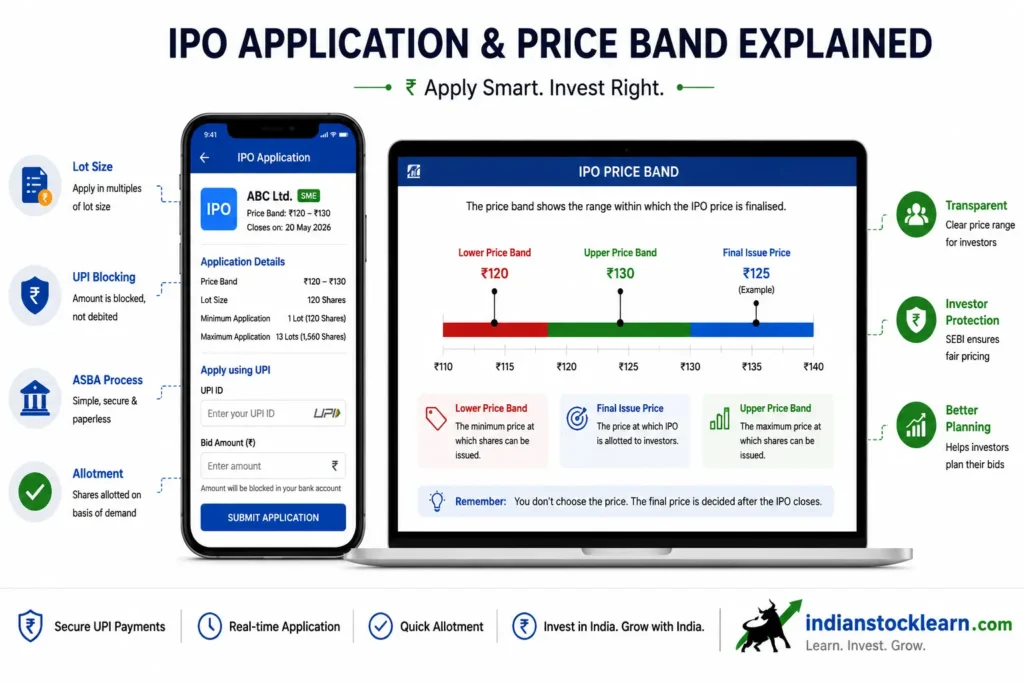
Applying for an IPO is one of the more direct ways to buy shares straight from a company, before the stock starts trading on the exchange. If you’re looking up how to apply for IPO in India, the actual process usually takes under 10 minutes once your PAN, Demat account, and KYC are in order.
This guide covers eligibility, the documents you’ll need, the exact steps on broker apps, UPI, and ASBA, and what happens after you submit — including allotment and listing day.
Whether you use Zerodha, Groww, Upstox, Angel One, or your bank’s net banking, the core steps stay nearly identical across platforms.
- You need a PAN card, active Demat account, bank account, and completed KYC before you apply for an IPO.
- Apply through a broker app (UPI) or your bank’s net banking (ASBA) — both work the same way underneath.
- Your funds are blocked, not deducted, until the allotment result is out.
- Allotment depends on how many times the issue gets subscribed, not on how fast you clicked submit.
- Check your allotment status on the registrar’s website a few days after the issue closes.
What Is an IPO, and Why Do Companies Launch One?
An Initial Public Offering (IPO) is how a private company sells shares to the public for the first time. Once the IPO is done and the stock lists, anyone can buy or sell those shares on the NSE or BSE.
Say ABC Technologies wants to raise ₹2,000 crore to expand. Instead of taking on more debt, it sells part of its ownership to the public through an IPO. Investors who apply and receive an allotment become shareholders in that company.
Companies go public for reasons beyond visibility — expanding operations, paying down debt, funding research, or giving early investors an exit. Investors, meanwhile, apply for listing gains, long-term wealth building, or simply to diversify a portfolio with a company they believe in early. Read the fuller IPO breakdown here if you want the mechanics behind price bands and issue sizes.
Who Can Apply for an IPO in India?
Most resident investors who meet a few basic requirements can apply for an IPO in India. You’ll need a PAN card, a Demat account, a trading account, a bank account, and a UPI ID or ASBA-enabled account.
| Requirement | Required? | Why It Matters |
|---|---|---|
| PAN Card | Yes | Mandatory for KYC and tax ID |
| Demat Account | Yes | Shares are credited electronically |
| Bank Account | Yes | Funds are blocked and refunds processed here |
| Valid KYC | Yes | Required under SEBI rules |
| UPI ID or ASBA facility | Depends on method | Used to authorize payment |
Can Students Apply?
Yes. Students above 18 with a PAN, bank account, Demat account, and completed KYC can apply on their own. If the student is a minor, investments generally go through a guardian-operated account, as permitted by the account provider.
Can NRIs Apply?
Many NRIs can apply for Indian IPOs too, subject to their bank account type — such as NRE or NRO — and the specific IPO’s eligibility conditions. The process differs slightly from a resident investor’s.
Can Multiple Family Members Apply?
Yes, as long as each person applies with their own unique PAN, Demat account, and payment details. Duplicate applications under the same applicant can get rejected under IPO rules.
Documents You Need Before You Apply for an IPO
Keep these ready before the IPO window opens, so you’re not scrambling on the last day.
| Document | Purpose |
|---|---|
| PAN Card | Identity verification |
| Aadhaar | Supports KYC updates |
| Demat Account | Receives allotted shares |
| Trading Account | Apply through broker platforms |
| Bank Account | Fund blocking |
| UPI ID | Payment approval (UPI method) |
| Registered Mobile Number | OTP and alerts |
| Email ID | IPO communication |
Get your Demat account documents sorted and confirm your KYC status well before the IPO opens. Fixing a PAN-Aadhaar mismatch or a pending KYC after you’ve already applied can cost you the window entirely.
IPO Investor Categories Explained
Not every applicant sits in the same bucket. IPOs split share allocation across a few investor categories.
- Retail Individual Investor (RII) — individuals applying within the retail limit; most first-time investors fall here.
- Non-Institutional Investor (NII/HNI) — applications above the retail limit, often split into small and big HNI.
- Qualified Institutional Buyers (QIB) — mutual funds, insurers, banks, and foreign portfolio investors.
- Employee category — reserved for eligible staff of the issuing company.
- Shareholder category — reserved for existing shareholders of a specified company, where applicable.
How to Apply for IPO Using a Broker App
This is the route most retail investors take. Log in to your broker app — Zerodha Kite, Groww, Upstox, Angel One, or similar — and head to the dedicated IPO section, where current, upcoming, and closed issues are listed.
A quick example: if the lot size is 60 shares at ₹250 each, one lot costs ₹15,000. Apply for 2 lots, and ₹30,000 gets blocked — not deducted — against your bid.
| Lot Size | Number of Lots | Total Shares |
|---|---|---|
| 40 | 1 | 40 |
| 40 | 2 | 80 |
| 40 | 3 | 120 |
Most retail investors select the cut-off price option. You agree to pay whatever the final issue price turns out to be within the band, which lowers the risk of your bid falling below that final price.
How to Apply for IPO Using UPI
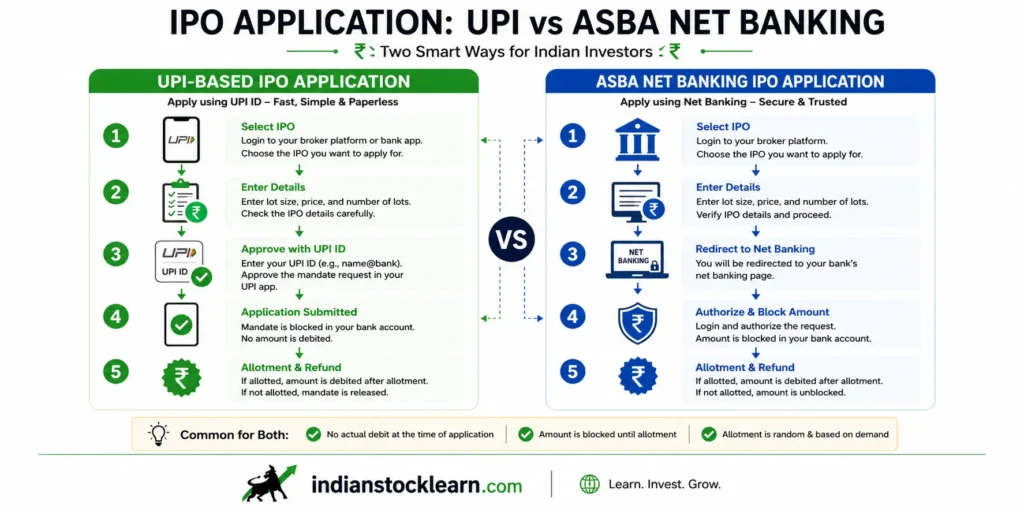
UPI is the most common payment method for retail applications today. Submit your application, enter your UPI ID correctly, and a mandate request lands in your UPI app. Verify the amount and approve it before the deadline — the amount then gets blocked, not deducted.
Your bank sets aside the required amount; it doesn’t deduct it. If your balance is ₹50,000 and the IPO amount is ₹15,000, your available balance drops to around ₹35,000. If you don’t get an allotment, the ₹15,000 goes back to you.
How to Apply for IPO Through ASBA (Net Banking)
ASBA stands for Application Supported by Blocked Amount, and it’s available through most major banks. Log in to your bank’s net banking portal, go to the IPO/ASBA section, select the issue, enter your Demat details, choose your lot count, and submit.
UPI Method
- Faster setup through broker apps
- Needs a separate mandate approval
- Preferred by most first-time retail investors
ASBA Method
- Applied directly through your bank
- Funds stay in your account until allotment
- No separate mandate step for many banks
Applying for an IPO Offline
Offline applications are less common now, but eligible bank branches still process them under ASBA. Collect the physical form, fill in your PAN and Demat details accurately, specify your lots and bid, and submit it at the branch. Your bank handles the fund block from there.
Common Mistakes That Get IPO Applications Rejected
Most rejected applications aren’t the result of bad luck — they’re small, avoidable errors.
Apply a day or two before the issue closes rather than in the final hours, double-check your PAN and bank details, and read the company’s business model and risk factors instead of going by social media chatter alone.
How IPO Allotment Works
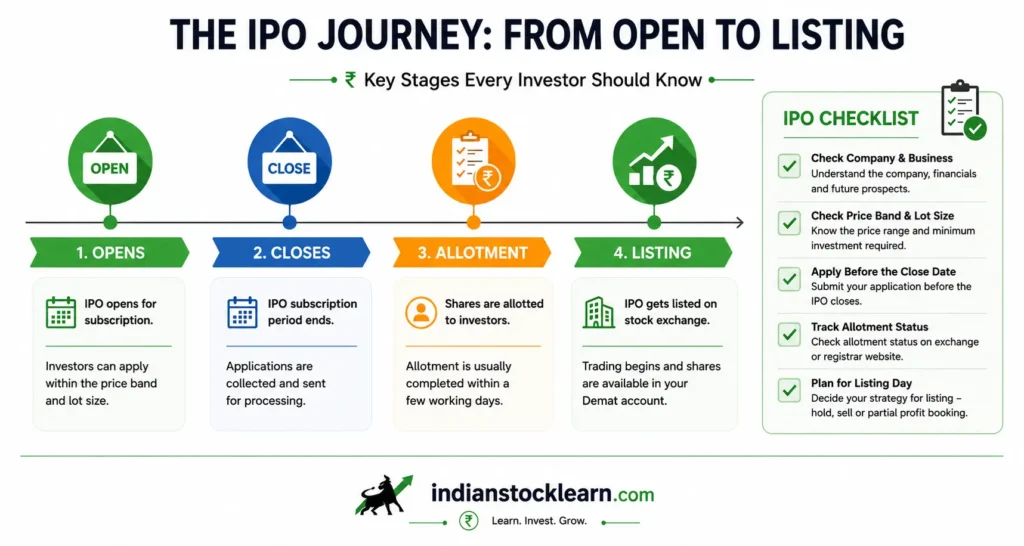
Once the subscription window closes, no new applications get accepted. The registrar verifies every application, removes invalid or duplicate ones, sorts the rest by category, and finalizes what’s called the Basis of Allotment — the official method for distributing available shares among valid applicants.
| Day | Activity |
|---|---|
| Day 1 | IPO opens |
| Day 3 | IPO closes |
| Day 4–5 | Application verification, basis of allotment |
| Day 5–6 | Shares credited or funds unblocked |
| Day 6–7 | Listing on NSE/BSE |
The subscription level decides most of the outcome. If a company offers 10 lakh shares and gets applications for 6 lakh, it’s undersubscribed and most applicants get what they applied for. If applications reach 100 lakh shares against the same 10 lakh on offer, the IPO is oversubscribed 10 times, and only a portion of applicants receive an allotment.
Why You Might Not Get IPO Allotment
Not receiving shares in a popular IPO usually comes down to one thing: demand outstripping supply. Other reasons include an invalid or duplicate application, an unapproved UPI mandate, insufficient funds for blocking, or a mismatched PAN or Demat detail.
If you don’t get an allotment, no shares are credited and your blocked funds are released back to your account on the bank’s usual schedule. You can use that money for the next IPO or any other investment.
What Happens on Listing Day
On the listing date, the company starts trading on the exchange, and anyone who received shares can hold or sell them at the market price. If the issue price was ₹300 and the stock opens at ₹390, that’s a potential listing gain of ₹90 per share before taxes and charges — though a listing below the issue price is just as possible.
You can check your stock portfolio once shares are credited, and confirm the exact market timing on share market timings before you place your first sell order.
Common Myths About IPO Allotment
| Myth | Reality |
|---|---|
| Every applicant gets shares | Oversubscription can leave many applicants with nothing. |
| A bigger application guarantees allotment | Allocation follows the rules for your investor category, not application size. |
| High subscription guarantees listing gains | Listing performance depends on market conditions and sentiment too. |
| Money is permanently deducted after applying | Funds are blocked and released if no shares are allotted. |
IPO Application Checklist
| Stage | Check |
|---|---|
| Before it opens | PAN, KYC, Demat, and bank balance all in order |
| Before submitting | Correct category, lot size, and UPI ID reviewed once more |
| After applying | Mandate approved, funds blocked, status confirmed in the app |
- Applying for an IPO in India needs a PAN, active Demat account, bank account, and completed KYC.
- UPI and ASBA are the two main ways to apply — both block funds instead of deducting them.
- Allotment depends on subscription level and your investor category, not on how quickly you applied.
- Unallotted funds are released back to your account after the process completes.
- Listing gains are possible but never guaranteed — check the offer document, not just the buzz.
Frequently Asked Questions
Can I apply for an IPO without a Demat account?
Is a trading account compulsory to apply for IPO in India?
Can I cancel my IPO application?
What happens if I don’t get allotment?
Can I apply for every IPO that opens?
Does higher subscription always mean better listing gains?
How long does the full IPO process take, start to finish?
Can I sell my IPO shares on listing day?
Conclusion
Knowing how to apply for IPO in India comes down to four things: your documents are ready, you pick the right application method, you approve your mandate on time, and you understand that allotment is about subscription levels — not speed. Get the paperwork sorted early, and the actual application takes minutes.
Before your next IPO, check your KYC status and see whether your broker or bank supports UPI, ASBA, or both — this beginner investing guide is a good next stop if you’re still setting up your accounts.