
IPO allotment status is usually the first thing investors search for once an IPO closes. You submit an application, approve the UPI mandate or block the money through ASBA, and then wait to find out if you got the shares or the blocked amount comes back.
The process can look confusing at first — subscription numbers, investor categories, application numbers, registrars, and the Basis of Allotment all come into play. It follows a defined system, and once you separate the stages, it’s easy to follow.
This guide covers how IPO allotment works, why oversubscription matters, how the allotment ratio is understood, how to check your result, and what happens to your money when you don’t receive shares. The examples use simple ₹ amounts to keep things clear.
- What Is the IPO Allotment Process?
- How It Works
- Formula or Concept Explanation
- Real Stock Market Example
- Investor Categories & Shareholder Quota
- Why Investors Use It
- Reading a Basis of Allotment
- Fund Unblocking Timeline
- Advantages
- Limitations
- Myth vs Reality
- Key Takeaways
- Frequently Asked Questions
- Conclusion
What Is the IPO Allotment Process?
The IPO allotment process is the procedure used to decide which valid investors receive shares once an IPO closes.
While the IPO is open, investors submit bids under a category — Retail Individual Investor (RII), Non-Institutional Investor (NII), or Qualified Institutional Buyer (QIB). Once bidding ends, applications are checked and the available shares are distributed according to the rules for that category. If you haven’t gone through the application step yet, our guide on how to apply for an IPO in India covers it in full.
The registrar to the issue works with the issuer and the stock exchange to complete the allotment. A formal Basis of Allotment document sets out how the available shares get distributed among valid applicants.
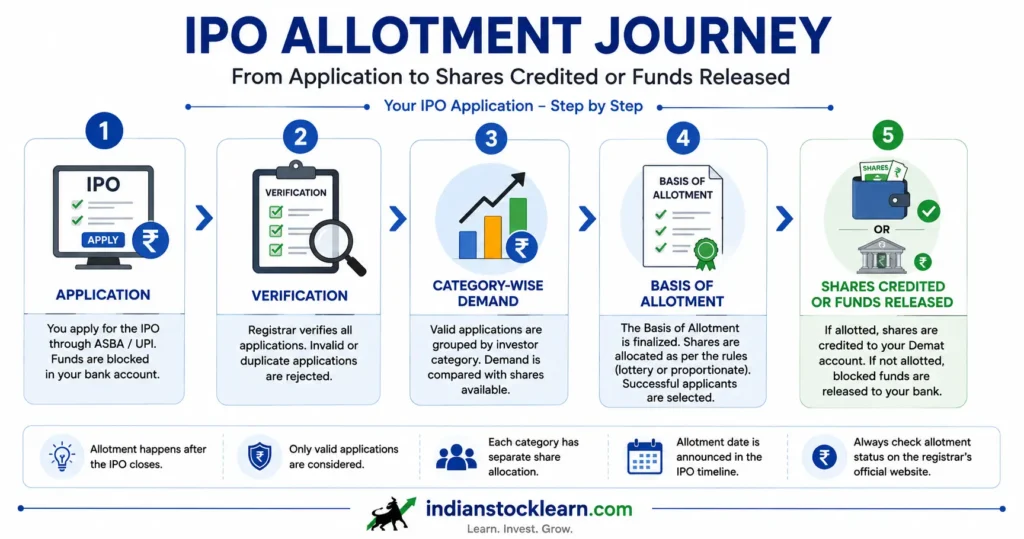
Here’s the journey in short: the IPO closes, applications get checked, category-wise demand is calculated, the Basis of Allotment is finalised, shares are credited or funds are released, and the IPO lists on NSE or BSE. Applying for an IPO doesn’t mean shares automatically land in your demat account — allotment is a separate step.
What Is IPO Allotment Status?
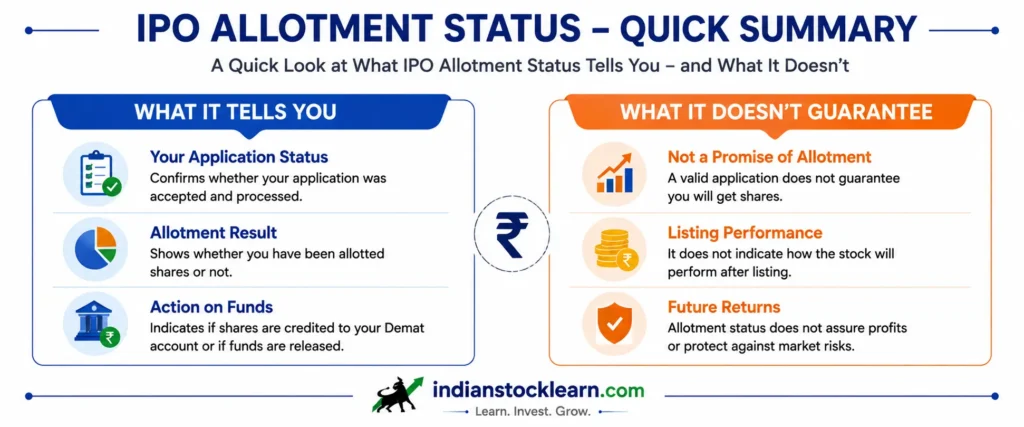
IPO allotment status tells you the final outcome of your application. Depending on the result, you may find that:
- You received the full number of shares you applied for.
- You received only part of the shares, where the rules allow it.
- You didn’t receive any shares.
- Your application was rejected because it was invalid.
NSE runs an IPO bid and allotment verification facility where you can check bid details using your PAN or application number, while the allotment result itself comes from the registrar.
How It Works
The easiest way to understand how IPO allotment works is to follow the process from the day the IPO closes.
Formula or Concept Explanation
There’s no single formula that tells an individual retail investor exactly whether they’ll get an IPO allotment. One simple concept, though, explains why allotment gets harder during heavy demand.
Basic Subscription Formula
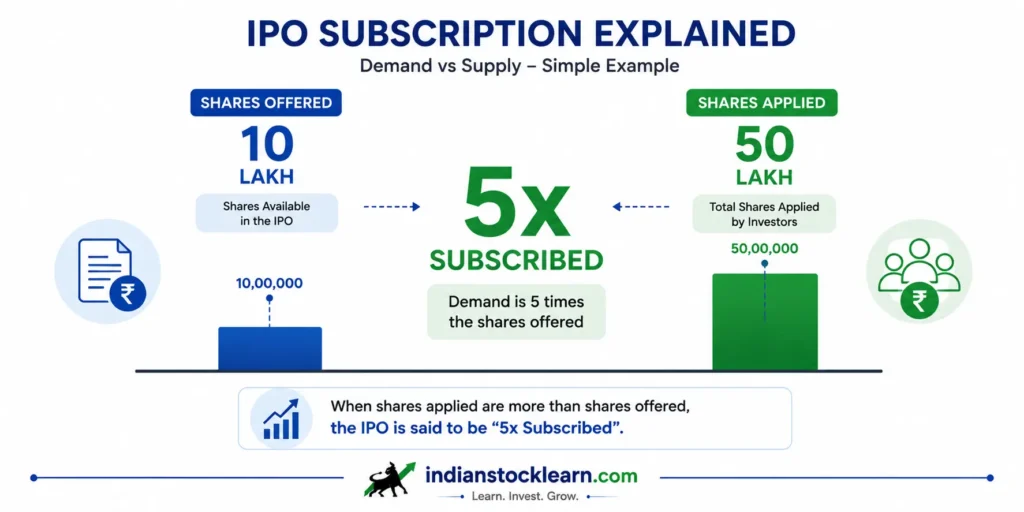
Subscription Multiple = Total Shares Applied ÷ Shares Offered
If 10 lakh shares are offered and 50 lakh shares’ worth of applications come in, that’s 50 lakh ÷ 10 lakh = 5 times subscribed. Useful for gauging demand — not a personal allotment probability calculator.
Simple Allotment Ratio Example
| Item | Value |
|---|---|
| Shares available | 1,00,000 |
| Valid retail applications | 2,00,000 |
| Minimum lot | 20 shares |
| Investors who can get 1 lot | 1,00,000 ÷ 20 = 5,000 |
Against 5,000 possible minimum lots, there are 2,00,000 valid applications. Only a fraction of applicants get the lot, and where lottery-based allotment applies, the registrar picks successful applicants under the finalised Basis of Allotment.
Why Applying for More Lots Does Not Always Solve the Problem
Say Investor A applies for 1 lot and Investor B applies for 5. In a heavily oversubscribed retail category, Investor B doesn’t automatically get five times the chance of allotment under the retail rules. The actual result depends on the category, valid applications, available shares, minimum lot, and the finalised Basis of Allotment — applying for more shares isn’t a reliable way to improve your odds.
Real Stock Market Example
Take an imaginary company, ABC Technologies, launching an IPO at ₹300 per share with a lot size of 50 shares. Minimum application value: 50 × ₹300 = ₹15,000.
Suppose 2,00,000 valid retail applicants bid, while the retail category has shares for only 20,000 minimum lots. That’s a mismatch of 2,00,000 applicants against 20,000 possible lots. Only a limited number can get the minimum lot — this is where “Allotted” or “Not Allotted” on your IPO allotment status becomes meaningful.
A Real Indian IPO Context: Swiggy
Swiggy’s 2024 IPO is a useful real-world reference. NSE records show the issue ran from November 6 to November 8, 2024, priced ₹371–₹390, with a lot size of 38 shares and Link Intime India Private Limited as registrar.
The post-issue Basis of Allotment document recorded category-wise allotment numbers, successful applicants, and the credit and unblocking process that followed. The final result came from the issue’s official process — not from social media claims about who was “sure to get” shares.
Where Do Reliance, TCS and Nifty 50 Fit In?
Reliance Industries and TCS are already-listed companies trading in the secondary market. The Nifty 50 is an index, not an IPO. A company first goes through the primary market via an IPO; after listing, its shares trade on the exchange, and it may later qualify for index inclusion.
Three ideas worth separating: an IPO is the primary market, listed shares trade in the secondary market, and Nifty 50 is a stock market index.
Investor Categories: Why Reservation Percentages Change
Not every IPO splits shares the same way. The category structure decides how much of the issue your bucket — retail, NII, or QIB — actually competes for.
| Category | Standard IPO (Profitable Company) | QIB Route IPO (Loss-Making Company) |
|---|---|---|
| Retail (RII) | 35% | 10% |
| NII (HNI) | 15% | 15% |
| QIB | 50% | 75% |
Under SEBI’s ICDR Regulation 6(2), companies that don’t meet the standard profitability track record — several new-age tech and internet businesses among them — can still list by allocating at least 75% of the issue to QIBs. Retail reservation drops to 10% in that structure. Checking which route the company used in the RHP tells you how crowded your category is likely to be.
The Shareholder Quota: A Separate, Second Pool
If the IPO belongs to a company with a listed parent — a subsidiary of a company already trading on NSE or BSE, for instance — it may reserve a shareholder quota. Eligibility is fixed on the date the company files its Red Herring Prospectus (RHP), not the date the IPO opens. You need at least one share of the parent company in your demat account on or before that date.
Why Investors Use It
Checking IPO allotment status answers a practical question: what happened to my application? Investors check it to confirm whether shares were allotted, see how many, understand a rejection, check whether funds should be released, and confirm the process before listing day.
How to Check IPO Allotment Status
You normally check the result on the registrar’s official platform, or another official route made available for the issue. Depending on the IPO, you may need your PAN, application number, DP ID or Client ID.
NSE’s IPO verification facility lets you check bid information using your PAN or application number, and also carries allotment information supplied by the registrar.
How to Read a Basis of Allotment Document
The registrar publishes the Basis of Allotment (BoA) on the NSE and BSE IPO pages as a PDF, at the same time the allotment status goes live. It’s the source document behind the result — worth a look if you want to understand your own outcome rather than just see “Not Allotted.”
| Field in the BoA | What It Tells You |
|---|---|
| No. of Valid Applications | How many applications survived verification in that category. |
| No. of Shares Applied | Total demand — not the same as the number of applicants. |
| Shares Reserved for Category | Supply available for that category before any spillover. |
| No. of Successful Applicants | How many applicants actually received a lot. |
| Ratio of Allotment | e.g. “1:25” — one successful applicant for every 25 valid ones in the draw. |
Two numbers matter most for a beginner: valid applications and successful applicants. Dividing the second by the first gives a rough sense of how tight that category’s draw was — closer to your actual result than the overall subscription headline, which blends every category together.
How Long Fund Unblocking Actually Takes
IPOs in India run on SEBI’s T+3 listing cycle — shares list on the third working day after the issue closes. Fund unblocking for non-allotted applications follows the same clock.
| Day | What Happens |
|---|---|
| T (Issue Closes) | Final valid bids move to the registrar for processing. |
| T+1 | Basis of Allotment is finalised and published on NSE/BSE. |
| T+2 | Registrar sends unblock instructions to banks; shares are credited to allottees’ demat accounts. |
| T+3 | Shares list and start trading; most non-allottees see funds unblocked by this point. |
SEBI requires unblocking within four working days of the issue closing — if a company misses that window, it owes 15% annual interest on the delayed amount. If your funds are still blocked past that, contact your bank’s IPO nodal officer or the registrar’s investor grievance desk before escalating to SEBI SCORES.
Advantages
Clear Result After the IPO Closes
The allotment process gives a definite outcome — allotted, partially allotted where applicable, rejected, or not allotted.
Helps Explain Blocked Funds
Once you know the result, it’s clear whether the blocked amount is going toward allotted shares or being released back to you.
Category-Based Process
Shares aren’t distributed randomly across every applicant. Category rules and the Basis of Allotment govern how shares get split up.
Official Records Are Available
For most IPOs, you can cross-check bid and allotment information through the exchange or registrar systems, including NSE’s dedicated facility.
Limitations
Subscription Numbers Do Not Give an Exact Personal Result
A 10x subscription figure doesn’t mean every investor has a flat 10% chance. The outcome depends on category, valid applications, lot size, shares available, and the final allotment rules.
Oversubscription Can Lead to No Allotment
A fully valid application can still receive zero shares when demand far outpaces supply.
Rules Can Differ by Investor Category
Retail, NII, and QIB allotment mechanisms aren’t identical. Don’t apply a retail example to another category without checking the issue-specific rules.
IPO Allotment Is Not the Same as Listing Performance
Getting shares says nothing about what the market price does after listing. A stock can list above, near, or below its issue price — subscription and allotment are separate from trading performance.
Timelines Can Vary
Allotment, credit, and listing dates are specified per issue. A generic “Day 4” or “Day 5” estimate shouldn’t replace the official IPO timetable
Myth vs Reality: IPO Allotment
| Myth | Reality |
|---|---|
| Applying on Day 1 improves your allotment chances | The lottery runs only after the issue closes. Day 1 and Day 3 bids carry the same odds, as long as both are valid. |
| Applying for more lots in retail multiplies your chances | In a heavily oversubscribed retail category, the draw is for the minimum lot. Extra lots add little once the category is oversubscribed many times over. |
| NII allotment is purely proportionate — bigger bids win more | Since April 2022, NII allotment also runs a lottery for the minimum lot first; only the leftover shares get divided proportionately. |
| A high subscription number means guaranteed listing gains | Allotment and listing performance are separate outcomes — a heavily subscribed IPO can still list below its issue price. |
| Not getting allotment means something went wrong with your application | A fully valid application can still get zero shares whenever demand exceeds the shares available in that category. |
- Which category you applied in (Retail, sNII, bNII, QIB, Shareholder)
- How many valid applications competed in that category
- The minimum lot size for that issue
- Whether the company used the standard or QIB listing route
- IPO allotment status tells you whether your application received shares.
- Allotment begins once the issue closes and applications are verified.
- Invalid or duplicate applications get rejected before final allocation.
- Subscription shows demand relative to shares available — not your personal odds.
- Oversubscribed retail issues may use lottery-based selection for the minimum lot.
- Applying for more lots doesn’t guarantee a better result.
- UPI and ASBA block the required funds rather than debiting them immediately.
- If you get no allotment, the blocked amount is released through the banking process.
- The registrar prepares and publishes the final allotment information.
- Allotment and listing performance are two separate events.
- Retail reservation can drop to 10% for loss-making companies listed via the QIB route.
- The Shareholder Quota runs as a separate pool — eligibility is fixed on the RHP filing date.
- Non-allotted funds are usually unblocked within the T+3 listing cycle, well inside SEBI’s 4-working-day limit.
Frequently Asked Questions
What is IPO allotment status?
How is IPO allotment decided?
Does applying early improve IPO allotment chances?
Why did I not receive IPO shares even though my application was valid?
How can I check my IPO allotment status?
What happens to my money if I do not get allotment?
Can IPO allotment be checked before the official allotment date?
Conclusion
The IPO allotment process gets easier to follow once you separate the stages: application, verification, category-wise demand, Basis of Allotment, share credit or fund release, and listing.
The most useful thing to understand about IPO allotment status is what it actually represents — the final outcome of your valid application, not a prediction based on subscription numbers or how fast you applied.
Once an IPO closes, the registrar processes valid applications under the applicable rules. In an oversubscribed retail issue, plenty of valid applicants may get no shares simply because there aren’t enough to go around.
Read the official offer documents for any IPO you’re considering, follow the published timetable, and check your result through the official registrar or exchange-linked source. If you’re still setting up your demat account documents or want to know what an IPO actually is before your first application, those guides cover the basics. It also helps to know the share market timings and how SEBI regulates the process.