

When people hear “defence sector stocks in India,” names like Hindustan Aeronautics, Bharat Electronics, Bharat Dynamics, Mazagon Dock and Cochin Shipyard usually come up first. But what actually makes a company a defence stock, and how different is this from buying a well-known name like Reliance or TCS, or an index like Nifty 50?
India’s defence industry has changed a lot over the past decade. Domestic production has hit record levels, exports have grown, and government policy keeps pushing local manufacturing over imports. For a beginner, the useful part isn’t memorising company names – it’s understanding how the business works, where the revenue comes from, why the order book matters, and what can go wrong.
What Are Defence Sector Stocks in India?
Defence sector stocks are shares of listed companies that earn a meaningful part of their business from defence-related products or services. That single line hides how different these businesses actually are – one company builds aircraft, another manufactures missiles, another supplies radar and electronic systems, and another constructs naval ships.
Major areas within the defence sector
The Indian defence ecosystem includes businesses working across:
- Aircraft and helicopters
- Missiles and weapon systems
- Radar and communication equipment
- Electronic warfare systems
- Naval ships and submarines
- Defence electronics
- Aerospace components
- Ammunition and specialised materials
- Military vehicles
- Maintenance, repair and support services
Well-known listed names tied to Indian defence include Hindustan Aeronautics Limited (HAL), Bharat Electronics Limited (BEL), Bharat Dynamics Limited (BDL), Mazagon Dock Shipbuilders, Cochin Shipyard and Garden Reach Shipbuilders & Engineers. Market platforms track a much wider group under the defence theme – Zerodha’s defence-stock list, for instance, runs to 24 listed companies across aerospace, electronics, shipbuilding and related areas.
How the Defence Sector Works
The simplest way to understand this sector is to follow the journey from government requirement to company revenue. Say the armed forces need a new radar system: a requirement gets identified, the government runs a procurement process involving specifications, approvals, bidding and testing, and only then does a company receive the order. Delivery can then take years of design, manufacturing and testing.
That’s a real difference from a consumer business. An FMCG company sells thousands of units every single day. A defence company can win one large contract and recognise revenue gradually as the project moves forward over several years.
Government orders matter a lot
The government remains a major customer for most defence businesses, so these companies are exposed to defence budgets, procurement policy, approvals, tender timelines, delivery schedules, testing standards, geopolitical developments and import-sourcing rules.
At the same time, the private sector’s role keeps growing. India recorded defence production of Rs 1.78 lakh crore in FY 2025-26, per the Ministry of Defence. The private sector accounted for roughly 24% of that, with public-sector defence companies and other PSUs making up the remaining 76%. Defence exports reached Rs 38,424 crore in the same year.
That matters because this sector isn’t only about traditional government-owned companies anymore. A growing number of private businesses now supply specialised parts, electronics, components and systems into the same supply chain.
Defence is an ecosystem, not one business
Picture an aircraft programme. One company builds the airframe. Another supplies the radar. Another provides electronics. Another manufactures specialised components or materials. Studying defence sector stocks in India benefits from looking past the headline names to see where each company actually sits in that supply chain.
Understanding Defence Stock Valuation and Key Formulas
There’s no single formula that captures a defence stock. A handful of simple concepts cover most of what a beginner needs to start.
Revenue growth
Revenue growth shows how quickly a company’s business is expanding:
Revenue Growth = (Current Revenue – Previous Revenue) / Previous Revenue x 100
If revenue rises from Rs 1,000 crore to Rs 1,200 crore: Rs 200 crore / Rs 1,000 crore x 100 = 20%. On its own, this doesn’t say whether a company is attractive – only how fast it’s growing.
Profit margin
Net Profit Margin = Net Profit / Revenue x 100
A manufacturer earning Rs 2,000 crore in revenue with Rs 300 crore in net profit has a margin of Rs 300 crore / Rs 2,000 crore x 100 = 15%. Margins shift with product mix, raw-material costs and how well a project is executed.
Price-to-Earnings ratio
The PE ratio compares share price with earnings per share: PE Ratio = Share Price / Earnings Per Share. A stock trading at Rs 500 with an EPS of Rs 20 has a PE of Rs 500 / Rs 20 = 25. A PE number means little in isolation – different industries carry different growth expectations, so comparing within the same sector matters more than comparing across sectors.
Order book
The order book is especially useful for defence companies – it’s the value of orders already won but not yet executed. A company with Rs 2,000 crore in revenue and a Rs 10,000 crore order book has an order book worth five times current annual revenue. That gives visibility into future work, but it isn’t guaranteed future profit – projects can get delayed, modified, or stretched across several years.
Order book-to-revenue ratio
Order Book Coverage = Order Book / Annual Revenue
An order book of Rs 8,000 crore against annual revenue of Rs 2,000 crore gives Rs 8,000 / Rs 2,000 = 4 times coverage. This is worth reading alongside delivery timelines, margins and the nature of the orders themselves – not as a standalone number.

Real Indian Stock Market Examples
Real companies make this easier to picture, without turning any of it into a recommendation. These four names alone show how varied defence sector stocks in India actually are.
Hindustan Aeronautics Limited
HAL is tied mainly to aerospace and aircraft manufacturing. Its business looks nothing like an IT company such as TCS, which runs on recurring technology contracts from customers worldwide. An aerospace manufacturer works on large programmes with long development and delivery cycles – so studying HAL means paying attention to aircraft programmes, order inflow, production capacity, execution, and government procurement.
Bharat Electronics Limited
BEL is strongly associated with defence electronics – radar, communication systems, electronic warfare and related equipment used by the armed forces. It’s a useful reminder that “defence stock” doesn’t automatically mean “weapons manufacturer” – defence technology spans a wide range of electronics and systems. BEL maintains investor disclosures and annual reports on its official website, a useful primary source for research.
Bharat Dynamics Limited
BDL is tied to missile and weapon-system manufacturing. Its annual reports, including the FY 2025-26 filing, cover business performance, orders and financial results on its official website.
Mazagon Dock and shipbuilders
Shipbuilding is a different corner of the ecosystem entirely. Mazagon Dock Shipbuilders, along with Cochin Shipyard and Garden Reach Shipbuilders & Engineers, operate in this segment, with defence work forming an important part of their business. Even within defence sector stocks in India, business models can look nothing alike.
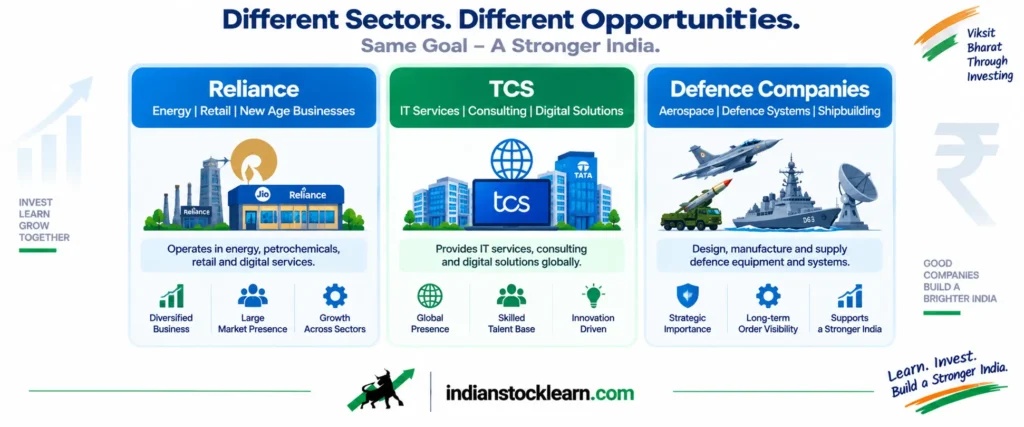
Reliance
- Diversified across energy, retail, telecom
- Broad consumer and industrial exposure
- Often studied as a blue-chip stock
TCS
- Technology and IT services
- Large global customer base
- Revenue recognised through ongoing service contracts
Defence Companies
- Specialised manufacturing
- Government procurement-driven
- Revenue tied to long-duration projects
None of these three should be judged with exactly the same checklist. That’s exactly why sector analysis matters – different sectors need different operating measures, alongside company-level and valuation analysis.
Why Investors Study Defence Stocks
Defence manufacturing output grew from Rs 1.50 lakh crore in FY 2024-25 to Rs 1.78 lakh crore in FY 2025-26.
Exports rose from Rs 23,622 crore in FY 2024-25 to Rs 38,424 crore in FY 2025-26, widening the customer base beyond government contracts.
Policies favouring domestic production can help component and equipment manufacturers, though the effect varies company to company.
Large, multi-year contracts make the order book worth studying – though a big order book doesn’t guarantee an equally big profit.
The defence theme has drawn strong market attention lately, and that creates its own lesson: a popular sector and a good business aren’t automatically the same thing. A company can sit inside a fast-growing industry and still carry weak execution, expensive valuation or thin margins.
Advantages of Defence Sector Stocks
- Strong domestic demand: India’s size, geography and security needs create significant, ongoing defence requirements.
- Large order sizes: Defence contracts often run far larger than typical orders in consumer businesses.
- Export opportunity: India supplied defence products to around 80 countries, per a 2025 Ministry of Defence statement, giving manufacturers demand beyond domestic orders.
- Wider private-sector participation: More private companies and smaller suppliers are becoming active across electronics, aerospace components, engineering, software and manufacturing.
- A genuinely useful learning sector: Order books, government procurement, project execution, capex, margins, working capital and export markets are concepts worth understanding well beyond defence stocks alone.
Studying defence sector stocks in India, even without buying a single share, is a solid way to get comfortable reading a company’s fundamentals before applying the same discipline elsewhere.
Limitations and Risks
Defence stocks carry real risks a beginner should weigh before getting interested in the sector.
- Government dependence: Changes in procurement plans, approvals or budgets can shift business timing for many companies.
- Long project cycles: Winning a contract doesn’t mean the revenue shows up immediately – large projects can take years to execute.
- Order delays: An impressive order book can look great on paper, but execution is what actually matters; delays push revenue recognition into later years.
- Valuation risk: A popular defence name can trade at a high valuation on future-growth expectations. If earnings growth falls short, the price can react even while the underlying business keeps operating normally.
- Concentration risk: Some companies lean heavily on a small number of customers or major projects, so a delay in one large programme can matter a lot. This is exactly the kind of risk that diversification across sectors is meant to reduce.
- Technology and competition: Defence technology moves fast, and companies need to keep pace with new systems, electronics and manufacturing standards.
- Defence sector stocks in India span aerospace, electronics, missiles, shipbuilding, engineering and more – not one uniform business type.
- Government procurement drives much of the revenue, and contracts run over years, not days.
- An order book shows future work in the pipeline – not booked profit, and not a guarantee against delays.
- Revenue growth, profit margin, PE ratio and order-book coverage are useful starting points, not final answers.
- India’s defence production and exports have both grown strongly – Rs 1.78 lakh crore in production and Rs 38,424 crore in exports in FY 2025-26.
- A growing sector doesn’t automatically make every stock inside it a strong business.
Frequently Asked Questions
What are defence sector stocks in India?
Which companies are considered defence stocks in India?
Why are defence stocks getting attention in India right now?
Is a large defence order book always a good sign?
Are all defence companies in India government-owned?
What should a beginner study before analysing a defence stock?
Can defence stocks be compared directly with Nifty 50 stocks?
Conclusion
Defence sector stocks in India have become an interesting corner of the equity market because domestic production, exports and private-sector participation have all expanded together. Recent government data puts a number on that shift – Rs 1.78 lakh crore in defence production for FY 2025-26.
Understanding this sector takes more than remembering names like HAL, BEL or BDL, though. It means knowing how procurement actually works, where a company sits in the supply chain, how large its order book really is, how quickly it converts that order book into revenue, and whether its profits and cash flows support its current valuation. A strong sector doesn’t guarantee every stock inside it performs well – the business behind the share is what’s worth studying, not the popularity of the theme it belongs to.