
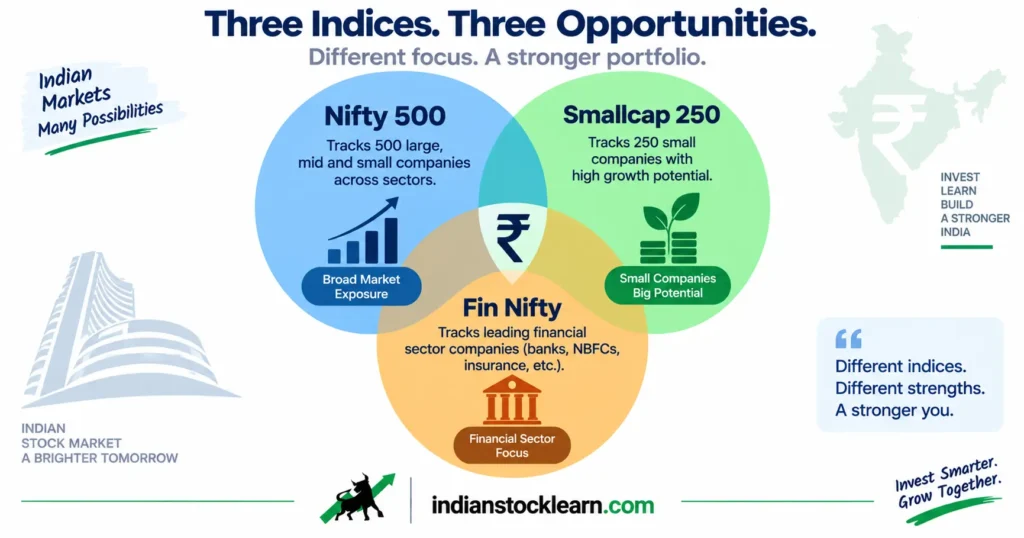
India’s stock market runs on more than one index. Once you go past Nifty 50, you’ll run into the wider family: Nifty 500, Nifty Smallcap 250, and Fin Nifty (officially the Nifty Financial Services Index). Learning the types of Nifty indexes in India isn’t just trivia – it decides which index fund you pick, and which number you should actually be watching on a red or green day.
This guide walks through what each of these three indexes covers, how they’re built, and where beginners usually get confused between them. By the end, you should be able to look at any of the types of Nifty indexes in India and know instantly what it’s actually measuring.
What Are Nifty 500, Smallcap 250 and Fin Nifty?
These are three of the many types of Nifty indexes in India, and each one answers a different question about the market.
Nifty 500 – the broad market view
Nifty 500 tracks the top 500 companies listed on the NSE, including all the Nifty 50 names plus 450 others. Between them, these 500 companies represent close to 92% of the total market capitalisation on the exchange. If you want one number that reflects “how is the Indian stock market doing today,” this is closer to it than Nifty 50.
Nifty Smallcap 250 – the smaller half
This index picks up where the big names stop – companies ranked 251 to 500 by market cap, the smaller slice of the Nifty 500 universe. Smallcap 250 represents roughly 8.9% of NSE’s free-float market cap. It’s the index to watch if you care about large cap, mid cap and small cap performance specifically at the small end.
Fin Nifty – the financial sector index
Fin Nifty, officially the Nifty Financial Services Index, sticks to one sector: banks, insurers, NBFCs and housing finance companies. Names like HDFC Bank, ICICI Bank and Bajaj Finance sit here. It tells you how the finance sector is doing, separate from tech, pharma or FMCG.
NSE maintains dozens of indexes beyond these three – Nifty Next 50, Nifty Midcap 150, Nifty IT, Nifty Pharma, and more. Nifty 500, Smallcap 250 and Fin Nifty are simply three of the most-tracked types of Nifty indexes in India, because between them they cover the whole market, the small-cap segment, and the country’s largest single sector by market value.
How These Indexes Work
Every one of these indexes is a basket of stocks selected under NSE’s published rules, weighted by free-float market capitalisation – the value of shares actually available for public trading, excluding promoter holdings.
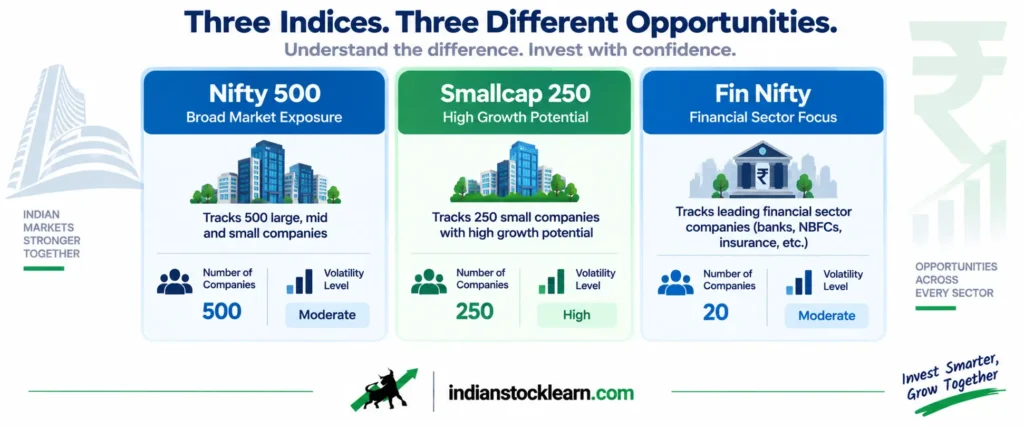
- Selection: Nifty 500 picks the top 500 companies by size and trading volume. Smallcap 250 takes those ranked 251 to 500. Fin Nifty selects around 20 leading financial companies.
- Weighting: A company’s share price move affects the index in proportion to its size. Reliance moves Nifty 500 more than a small logistics firm would.
- Review cycle: NSE, under SEBI‘s regulatory framework, reviews index composition twice a year – using data through end-January and end-July, with changes taking effect from the last trading day of March and September. A four-week notice goes out before any change, so it’s never a surprise announcement.
When most Nifty 500 stocks rise, the index rises – and because it covers so much of the market, the moves tend to be smoother. Smallcap 250, built from smaller and less liquid stocks, swings harder in both directions. Fin Nifty moves mostly with bank and finance stock sentiment, regardless of what’s happening elsewhere.
This is the practical difference between the types of Nifty indexes in India: a broad index absorbs one company’s bad day without much drama, while a narrow index – whether that’s Smallcap 250 because of size, or Fin Nifty because of sector concentration – can swing hard on news about just one or two constituents.
How the Index Value Is Calculated
Each index uses a free-float market-cap weighted formula. Here’s the version without the heavy math:
- Take each company’s market cap (share price x shares available for public trading).
- Strip out promoter-held shares that rarely trade.
- Add up the adjusted market caps of every company in the index.
- Divide by a fixed base value set when the index launched.
Index Level = (Current market cap of all constituents / Base market cap) x Base index value. If the combined market cap of the basket doubles from where it started, the index value roughly doubles too. Big companies like TCS or HDFC Bank pull more weight than smaller ones because their market cap is larger.

Real Examples: Reliance, TCS, HDFC Bank and More
Reliance Industries and TCS are large enough to sit in both Nifty 50 and Nifty 500, and their price moves carry real weight in both. Nifty 50 alone covers about 54% of total market cap; Nifty 500 stretches that to roughly 92%, pulling in far more mid-sized names alongside the giants.
Smallcap 250 works differently. It holds companies ranked 251 to 500 – smaller, less established names that aren’t household brands yet but still trade actively. In strong growth years, these stocks can rally hard as investors chase higher returns; in weak years, they tend to fall harder too.
Fin Nifty leans on a small set of heavyweight names. As of mid-2026, HDFC Bank, ICICI Bank, Axis Bank, Kotak Mahindra Bank and State Bank of India account for a large share of the index’s weight. A 5% move in HDFC Bank alone can shift Fin Nifty noticeably, even if every other sector is flat.
Put side by side, these examples show what separates the types of Nifty indexes in India from each other: Nifty 500 spreads its risk across 500 companies and dozens of sectors, Smallcap 250 concentrates risk in company size, and Fin Nifty concentrates risk in one sector regardless of company size.
| Index | What It Covers | Approx. Market Cap Share | Typical Behaviour |
|---|---|---|---|
| Nifty 500 | Top 500 NSE companies | ~92% | Broad, smoother moves |
| Nifty Smallcap 250 | Companies ranked 251-500 | ~8.9% | More volatile, sharper swings |
| Fin Nifty | ~20 banks, insurers, NBFCs | Sector-specific | Tracks financial sector sentiment |
Why Investors Track These Indexes
Indexes work as a shortcut. Instead of checking thousands of stocks one by one, you glance at one number and get a read on a market or sector.
- Market barometer: A rising Fin Nifty usually means most finance stocks are up that day.
- Comparison: Watching Nifty 50 against Nifty 500 shows whether large caps or the broader market are leading.
- Diversification: An index fund tracking Nifty 500 spreads your money across 500 companies at once – see how this fits into overall diversification.
- Passive investing: Index funds aim to mirror these numbers rather than beat them, which keeps costs low.
- Sector tracking: Fin Nifty is the number to watch specifically for banking and finance sentiment.
Fund managers use this the same way. A large-cap fund manager might benchmark against Nifty 500 and report whether they beat or trailed it that quarter. A finance-sector fund would benchmark against Fin Nifty instead. Knowing which of the types of Nifty indexes in India a fund is measured against tells you a lot about what kind of risk that fund is actually taking on.
Advantages of Using Nifty Indexes
Nifty 500 gives a near-complete view of the listed market in one number.
One index fund spreads risk across hundreds of companies instead of a handful of picks.
NSE publishes exactly how stocks are selected and weighted – no guesswork.
ETFs and funds built on these indexes are easy to buy and sell on any trading day.
Limitations and Risks
None of these indexes protect you from a falling market. When the broader market drops, Nifty 500 drops with it – there’s no built-in cushion.
Smallcap 250 carries its own risk profile: lower liquidity and sharper price swings than Nifty 50 or Nifty 500. And because index funds must hold whatever the index holds, you can’t drop a stock you’re uneasy about – unlike active stock picking.
There’s also a small ongoing cost with any passive approach. Index-tracking funds charge an expense ratio, and even a well-run fund can lag its benchmark slightly over time because of fees and rebalancing costs. None of the types of Nifty indexes in India come with a guarantee – they’re tools for tracking the market, not for beating it.
- Nifty 500 covers the top 500 NSE companies – about 92% of total market cap.
- Nifty Smallcap 250 covers companies ranked 251-500 – the smaller, more volatile segment.
- Fin Nifty tracks roughly 20 leading financial companies – banks, insurers, NBFCs.
- All three use free-float market-cap weighting, so larger companies carry more influence.
- Knowing the types of Nifty indexes in India helps you pick the right index fund or ETF for your goal, whether that’s broad exposure, small-cap growth, or sector-specific tracking.
Frequently Asked Questions
What is the difference between Nifty 50 and Nifty 500?
What exactly is Fin Nifty?
Can beginners invest directly in these indexes?
How often do these indexes change their components?
Why is Smallcap 250 kept separate from Nifty 500?
Is Fin Nifty the same as Bank Nifty?
What is free-float market capitalisation?
Do all types of Nifty indexes in India use the same weighting method?
Which index should a beginner track first?
Conclusion
Nifty 500, Smallcap 250 and Fin Nifty each answer a different question about the market: how is everything doing, how are the smaller companies doing, and how is the finance sector doing. Once you know the types of Nifty indexes in India and what each one actually measures, reading a red or green day on your broker app gets a lot less confusing – and picking between a broad fund, a small-cap fund, or a sector fund becomes a much clearer decision.