

Multibagger stocks are shares that return many times the price you first paid. If a stock you bought grows to 10 times its price, it’s called a 10-bagger. Fund manager Peter Lynch popularized the term in his book One Up on Wall Street, and in India, companies such as Reliance Industries and TCS have rewarded patient shareholders over many years.
This guide covers how multibagger returns build up, the formulas behind them and the risks, without recommending any stock.
What are Multibagger Stocks
A multibagger stock is a share that grows to several times the price you first paid. A 2-bagger doubles your money, a 100% gain. A 10-bagger grows 10-fold.
The word “bagger” comes from baseball, where bases are sometimes called bags. Lynch borrowed it to count how many times a stock multiplies your money.
The label only works in hindsight. A stock becomes a multibagger after it has already multiplied an investor’s money, and nobody can confirm it in advance. That’s why people link multibagger stocks with high growth: the businesses behind them usually expanded quickly for many years. Big past gains don’t guarantee future ones.
How Multibagger Stocks Work
Multibagger returns usually come from 3 forces working together.
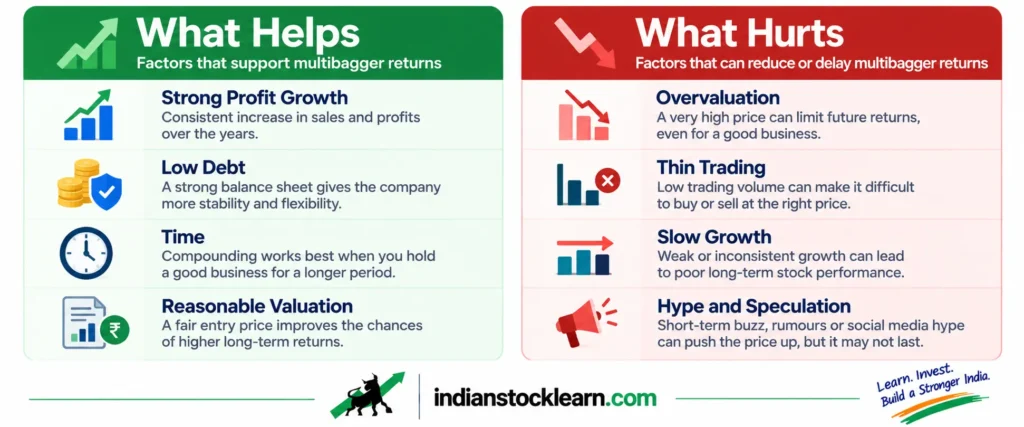
Sales and profits grow steadily, often 15–25% a year, for several years.
Investors notice the growth and pay more for each rupee of earnings, which shows up as a higher PE ratio.
Even moderate growth adds up when it continues year after year.
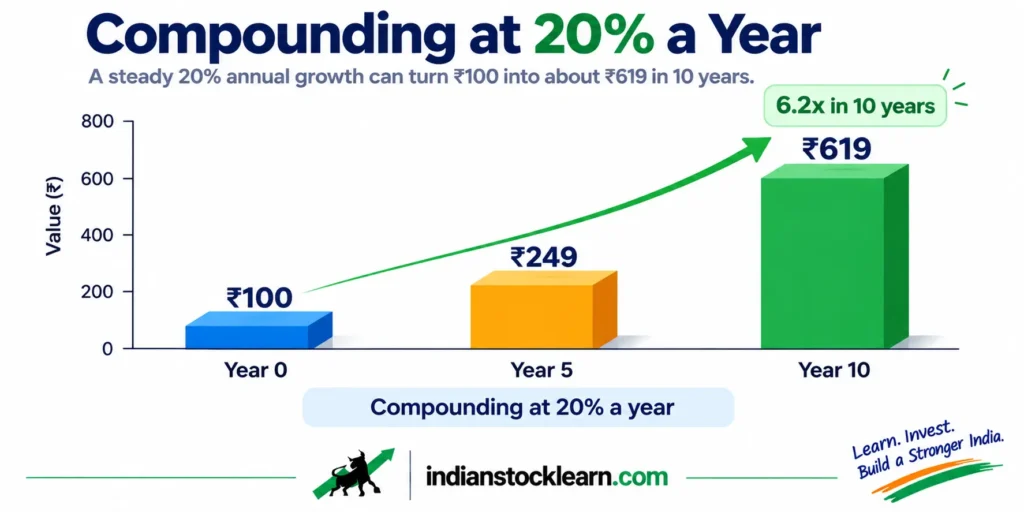
Take a stock that rises 20% a year. After 10 years, your money is roughly 6 times larger, since 1.2 multiplied by itself 10 times is about 6.2. Most real multibaggers needed 5–10+ years to get there.
Share price also depends on how much investors pay for each rupee of earnings. If earnings per share (EPS) rise 5x and the PE ratio moves from 10 to 20, the price rises 10x (5 × 2). Part of that gain comes from the business earning more, and part from the market paying more. The advanced guide to multibagger stock analysis breaks this split down with full worked numbers.
Media reports sometimes label a quick 2x or 3x jump as a multibagger. A BusinessToday headline on 21 September 2026 gave the label to Indo-MIM, a stock that listed in late July 2026 and was up about 140% within 2 months of its debut. That’s a 2.4x move in weeks, a very different journey from the decade-long climbs of Titan or Bajaj Finance.
Formula or concept explanation
3 simple calculations measure multibagger returns.
- Bag count (times): current price ÷ purchase price. Buy at ₹50 and the price reaches ₹200, and 200 ÷ 50 = 4, a 4-bagger.
- Percentage return: ((final price − initial price) ÷ initial price) × 100. In the same example, (150 ÷ 50) × 100 = 300%.
- CAGR (compound annual growth rate): ((final ÷ initial)^(1 ÷ years) − 1) × 100. Going from ₹50 to ₹200 in 10 years gives about 14.9% a year.
Bag count and percentage return connect through a simple rule: bag count = 1 + (percentage return ÷ 100). A 300% gain is a 4-bagger, and a 900% gain is a 10-bagger.
| Label | Price after (bought at ₹50) | Percentage gain | CAGR over 10 years |
|---|---|---|---|
| 2-bagger | ₹100 | 100% | 7.2% |
| 5-bagger | ₹250 | 400% | 17.5% |
| 10-bagger | ₹500 | 900% | 25.9% |
The table shows why a 10-bagger in 10 years is demanding: it needs about 26% growth every year. You can pull any listed company’s price history from the NSE website and run these numbers yourself.
Real stock market example
Several Indian stocks became multibaggers over long periods. Bajaj Finance grew from a small NBFC into India’s largest non-banking lender. Its split-adjusted share price rose from around ₹6 in 2010 to roughly ₹1,000 by 2025–26, a gain of more than 100x for shareholders who held throughout.
Titan Company, the jewellery and watch retailer, went from about ₹3 per share in 2002–03 (adjusted for its 2011 split and bonus) to around ₹4,000 in late 2025. That’s more than 1,000x in roughly 23 years.
Page Industries, the company behind the Jockey brand in India, moved from a few hundred rupees in 2007 to tens of thousands of rupees by 2024, well over 100x.
“Split-adjusted” means old prices are restated after stock splits and bonus issues, so charts compare like with like. All 3 businesses expanded fast and stayed profitable for years, which let compounding do the work. These are past examples, not recommendations.
Why investors use it
Investors focus on multibagger stocks because a few big winners can drive most of a portfolio’s gains. Finding 1 or 2 of them can matter more than owning many average stocks. For beginners, the pull is obvious: a small amount in a future multibagger could grow into a large sum.
Savings accounts and other low-risk options rarely offer such multiples, so investors look to stocks that can beat inflation over long periods.
Goal-setting plays a role too. Talking about 10x returns motivates people to research high-growth companies. Experienced investors tend to stress patience and discipline, since wealth in markets is usually built by holding a few strong businesses for years.
Advantages
- High return potential: A multibagger can turn a small investment into a much larger amount if you hold it from an early stage.
- Concentrated gains: A small number of winners can lift overall portfolio returns.
- Compounding: Even moderate annual growth, sustained for years, multiplies money many times.
- Inflation protection: These stocks have often grown faster than inflation and traditional assets, which helps preserve purchasing power.
- Proof from history: Titan and Bajaj Finance show that patient holding of strong companies has worked in the past.
Limitations
- Higher risk: Multibaggers are often smaller or newer companies. Prices can swing widely, fundamentals can change quickly, and many stocks never become multibaggers or lose value.
- Overvaluation: Hype around “the next big winner” can push prices far above true value and lead to sharp drops later.
- Long time needed: A stock usually needs years to multiply, so you have to hold through market ups and downs.
- Value traps: Some companies look cheap or promising but never deliver growth. If fundamentals don’t improve, even a rising stock can disappoint.
- Liquidity issues: Many past multibaggers were thinly traded. If you need to sell quickly, low volume can force you to accept a worse price.
- No guarantees: Fast growth doesn’t guarantee a multiplied share price. Competition, regulation or management problems can hit any business.
Multibagger Myths vs Reality
Beginners often carry a few beliefs into the search for multibagger stocks. The table sets 8 common ones against what the numbers show.
| Myth | Reality |
|---|---|
| A share priced at ₹50 is cheap and has more room to multiply than a ₹5,000 share. | Share price alone says nothing about value. Market cap and earnings decide whether a ₹50 share is cheaper than a ₹5,000 share. |
| A 10x stock means the business grew 10x. | Price depends on EPS and the PE ratio. EPS rising 5x while PE doubles from 10 to 20 gives a 10x price, so part of the gain came from the market paying more. |
| Stock splits and bonus issues create multibaggers. | A split or bonus issue changes the number of shares and the price per share. It doesn’t change what the company is worth, and split-adjusted charts already remove the effect. |
| A low PE ratio means big upside. | A low PE can reflect slow growth or a weak business. Read it alongside growth, debt and the industry. |
| High ROE always means a great business. | ROE rises when a company borrows heavily, because debt shrinks the equity base. Check debt and ROCE too. |
| Multibaggers rise in a straight line. | Big falls happen along the way, as the next section shows. |
| Past multibaggers give a repeatable formula. | Past winners show patterns. No formula guarantees the next one, and the same traits can appear in stocks that later fail. |
| Multibagger tips on social media are a shortcut. | In India, only SEBI-registered advisers may give investment advice, and you can check any adviser’s registration on the SEBI website before trusting a tip. |
A great business can still be a poor stock if you pay a very high price for it.
Drawdowns Inside Multibagger Journeys
Long-term charts of winners look like smooth staircases. The journey was rougher, and 2 stocks from this guide show it.
| Stock | Record high | Low | Fall | What was happening |
|---|---|---|---|---|
| Bajaj Finance | ₹4,923.20 (20 Feb 2020) | ₹2,105 (24 Mar 2020) | About 57% | COVID-19 market sell-off |
| Titan | ₹313.60 (30 Nov 2012) | ₹200 (13 Jun 2013) | About 36% | RBI rule on gold imports |
Prices in the table are as traded at the time, not adjusted for later splits and bonus issues. Both stocks later reached new highs, but a holder who sold during the fall never collected those later gains. The bagger label also leaves out every stock that fell like this and never recovered.
A big fall doesn’t always mean the business broke. Titan’s 2013 drop followed an RBI rule on gold imports, an outside event. A fall can also start a long decline, so check what changed in sales, profit and debt before deciding which case you’re looking at.c
Key Takeaways
- Definition: Multibagger stocks multiply your investment 2x, 5x, 10x or more, and you can confirm the label only after the gains have happened.
- Growth drivers: Strong sales and profit growth, high returns on capital and a growing industry, compounded over time.
- Screening: Investors commonly filter for profit growth above 15% a year, high ROE and low debt, then review business quality, market position and management.
- Examples: Bajaj Finance rose more than 100x from 2010 to 2025–26. Titan rose more than 1,000x from 2002–03 to late 2025.
- Risk: High rewards come with high risk. Many multibagger hunts fail, and popular stocks can become overvalued.
- Drawdowns: Bajaj Finance fell about 57% in 5 weeks in 2020, and Titan fell about 36% between 2012 and 2013. Long-term winners still take big hits on the way.
- Patience: Most take 5–10+ years, including bumpy stretches along the way.
Frequently Asked Questions
What exactly is a multibagger stock?
How can beginners find multibagger stocks?
Are multibaggers only small companies?
How long does it take for a stock to become a multibagger?
What are the risks of investing in multibagger stocks?
Can a multibagger stock fall 50% along the way?
Is the Nifty 50 index itself a multibagger?
Conclusion
Multibagger stocks are shares that multiply your investment many times over long periods. They appear when businesses grow fast and the market rewards that growth over years. Bajaj Finance and Titan show how patient holding of strong companies has paid off in the past.
Anyone looking for multibagger stocks should study company fundamentals, financial health and industry growth, and expect volatility along the way. Most stocks never return 10x, and the risks are real. Spreading money across several companies limits the damage when a stock fails, and the diversification guide covers how. Knowing how the term works helps you read the next “10-bagger” headline with a clear eye.