
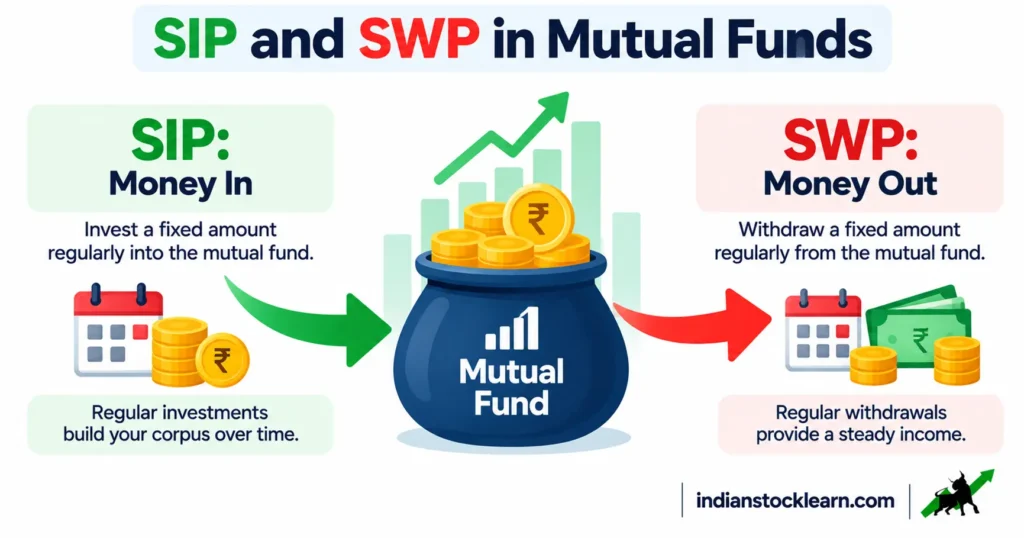
For most investors, the first part of the journey is putting money to work. A SIP invests regularly while the money has years to compound. Retirement asks a different question: how do you take money out in a planned way, without treating the whole portfolio like a bank account? That’s the SWP vs SIP question.
SIP and SWP aren’t competing products. They solve opposite cash-flow problems. NSE describes a SIP as investing a fixed amount at regular intervals; a Systematic Withdrawal Plan works the other way, paying out a chosen amount through scheduled redemption of mutual fund units. SIP builds a corpus; SWP draws from one.
- What Is SWP (Systematic Withdrawal Plan)
- How SWP Works
- SWP vs SIP: The Core Difference
- SWP vs SIP: When Should You Switch
- Safe Withdrawal Rate
- Sequence of Returns Risk in Withdrawals
- How Much Corpus Do You Need
- A Worked SWP Example
- Why Investors Use SWP
- Advantages
- Limitations
- Key Takeaways
- Frequently Asked Questions
- Conclusion
What Is SWP (Systematic Withdrawal Plan)
A Systematic Withdrawal Plan (SWP), the withdrawal half of the SWP vs SIP comparison, is a mutual fund facility that pays out a chosen amount at regular intervals. The cash comes from redeeming units in the holding. An SWP isn’t a special interest payment; part of the investment is being sold each time to create that payout.
Take a ₹50 lakh mutual fund holding with an SWP of ₹30,000 a month. Units are redeemed periodically, subject to the scheme’s rules and the NAV on the redemption date, to generate that cash.
SWP is regular cash coming out of an existing investment. During the years you’re building wealth, money goes in; during retirement, money needs to come out, and SWP is one structured way to do that.
SWP doesn’t guarantee the balance keeps rising. If withdrawals run high relative to actual returns, the corpus can shrink, and a market fall means more units have to be sold to generate the same rupee amount.
How SWP Works
New contributions may reduce or stop, and withdrawals may begin. There’s no universal age this has to happen.
Depending on the scheme, you choose a withdrawal amount, frequency and date. Minimums and options vary by scheme.
The fund doesn’t pay “interest.” Units are redeemed, and how many depends on the requested amount and that day’s NAV.
What remains invested after each redemption then depends on future market performance, the same way any other equity or mutual fund holding does.
SWP vs SIP: The Core Difference
The easiest way to understand SWP vs SIP is the direction money moves.
| Feature | SIP | SWP |
|---|---|---|
| Main purpose | Regular investing | Regular withdrawals |
| Cash flow | Money goes in | Money comes out |
| Typical phase | Accumulation | Decumulation |
| Units | New units purchased | Units redeemed |
| Main question | How much should I invest? | How much can I withdraw? |
NSE describes a SIP as investing a fixed amount regularly; SEBI-filed scheme documents describe SWP as periodic redemption of units. Neither is “better” in the abstract; they answer different questions at different points in the journey.
With a SIP, each instalment gets a different amount of time to grow, and earlier instalments compound for longer than later ones, a point our power of compounding guide covers in detail. With an SWP, a fixed corpus needs a scheduled way to pay out, rather than a series of manual, ad-hoc redemptions.
SWP vs SIP: When Should You Switch
There’s no universal retirement age for making this switch. One person stops the SIP and starts an SWP on the same day. Another keeps investing from one income source while withdrawing from a separate bucket. A third winds the SIP down gradually.
The decision depends on:
- retirement expenses
- pension or other income
- corpus size
- taxes and costs
- expected retirement duration
- how the portfolio is invested
- emergency cash needs
2 people can each hold a ₹1.5 crore portfolio and need very different withdrawals, purely because one has pension income and the other doesn’t. “Start SWP at 60” is too simple a rule. The better question is when the portfolio needs to start funding regular expenses, a decision that sits alongside the diversification and large cap, mid cap and small cap choices made years earlier.
Safe Withdrawal Rate
A safe withdrawal rate (SWR) links the first year’s retirement withdrawal to the starting portfolio value: Safe Withdrawal Rate = First-Year Withdrawal ÷ Starting Corpus × 100.
Starting corpus of ₹1 crore with a first-year withdrawal of ₹4 lakh gives a 4% withdrawal rate.
The well-known “4% rule” isn’t a universal Indian retirement rule. Safe-withdrawal research depends heavily on its own assumptions about asset allocation, inflation, retirement length and the target probability that the money lasts. Morningstar’s 2025 State of Retirement Income research estimated a 3.9% starting rate for a 30-year retirement with a 90% success target, using its own US-market return and inflation assumptions, down from 4.0% in its 2023 estimate and up slightly from 3.7% in 2024.
That figure comes from a US study built on US capital-market assumptions; it isn’t an Indian number, and Indian inflation, returns and tax rules are different. India-specific research on this exact question is thinner, so treat any single percentage, foreign or Indian, as a planning assumption to stress-test, not a rule to copy.
Sequence of Returns Risk in Withdrawals
This is the bridge between compounding and retirement withdrawals. Take 2 portfolios earning the same average return over several years. If one gets strong returns early and weak returns late, and the other gets weak returns early and strong returns late, the retirement outcome can look very different once withdrawals are happening, even with an identical average.
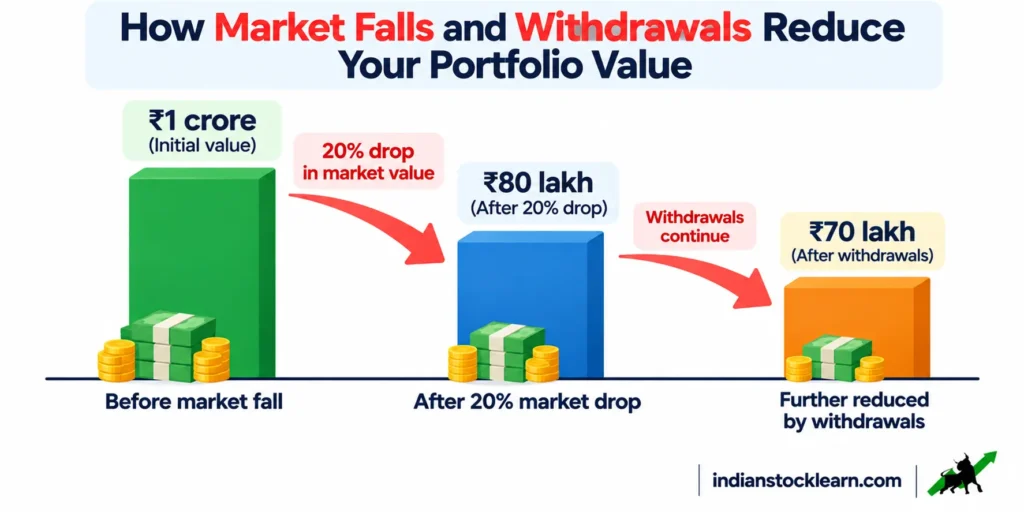
Withdrawals turn market timing into a cash-flow problem. A ₹1 crore portfolio that falls 20% soon after retirement becomes roughly ₹80 lakh before any withdrawals are even considered. If money is also being withdrawn during that fall, the remaining portfolio shrinks further, and a later recovery starts from that smaller base rather than the original ₹1 crore.
That’s sequence of returns risk. Our advanced guide to CAGR, XIRR and compounding covers this same mechanism with a worked 10-year example, showing why the long-term average return alone never describes the path an investor actually lives through.
How Much Corpus Do You Need
The SWP vs SIP framing helps here too: once you know withdrawals (SWP) are the goal, the next question is how large the corpus needs to be before that switch makes sense.
A simple planning equation:
Required Corpus = Annual Withdrawal ÷ Assumed Withdrawal Rate
| Desired annual withdrawal | Assumed withdrawal rate | Required corpus |
|---|---|---|
| ₹6 lakh | 4% | ₹1.5 crore |
| ₹6 lakh | 3% | ₹2 crore |
These are arithmetic examples, not recommended retirement targets. A real calculation also needs:
- Current and future spending: base this on what you expect to spend, not today’s salary.
- Inflation: ₹50,000 a month today won’t buy the same basket of goods many years later.
- Other income: pension, rent or annuity income reduces how much the corpus itself needs to supply.
- Retirement duration: a 20-year retirement and a 40-year retirement create very different withdrawal challenges.
- Return assumptions: a calculator can assume a steady 10% a year, but the market never delivers returns in a straight line, the same distinction our compounding guide makes about accumulation.
A Worked SWP Example
Take a purely hypothetical case: a ₹50 lakh starting corpus, a ₹30,000 monthly SWP, an assumed 8% annual return, and no tax or exit load included in the arithmetic.
Annual withdrawal: ₹30,000 × 12 = ₹3.6 lakh. First-year withdrawal rate: ₹3.6 lakh ÷ ₹50 lakh × 100 = 7.2%.
Now change one thing: the portfolio falls 15% soon after the SWP starts. ₹50 lakh × 85% = ₹42.5 lakh. The ₹30,000 monthly withdrawal hasn’t changed, but the base supporting it has.
This is why a portfolio can’t be judged by taking an average return and simply subtracting the annual withdrawal. Real returns arrive in a sequence, not a smooth average, and “8% average return” and “8% every year” are 2 completely different assumptions.
Why Investors Use SWP
Away from the SWP vs SIP comparison itself, it helps to know why people choose this tool at all. An SWP suits an investor who wants a structured way to draw cash from an existing mutual fund holding, similar in spirit to how a dividend provides periodic cash from a stock without selling the underlying shares. Common reasons include a regular cash flow for expenses, fewer manual redemption requests, a defined withdrawal schedule, and combining portfolio withdrawals with other income sources.
SEBI-filed scheme documents describe SWP as a facility for withdrawing a specified amount at set intervals. It’s only a transaction method though; it removes none of the underlying market risk, inflation risk, tax or longevity risk.
Advantages
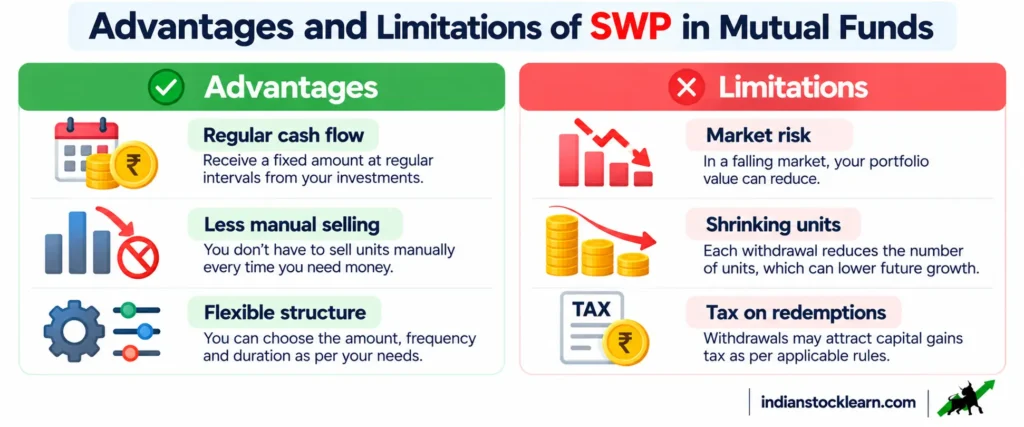
- Regular cash flow: a scheduled withdrawal can make monthly budgeting easier.
- Less manual selling: once set up, the plan generates recurring redemptions on its own terms.
- Flexible structure: depending on the scheme, you can typically choose the amount, frequency and start date.
- The rest stays invested: an SWP redeems only what’s withdrawn each time, so the remaining units stay invested and exposed to further growth or loss.
Limitations
- Market risk remains: a scheduled withdrawal doesn’t protect the portfolio from a fall.
- The corpus loses units over time: every redemption permanently removes units from the holding.
- High withdrawals can shorten portfolio life: weak returns, high inflation or a long retirement all make a high withdrawal rate harder to sustain.
- Tax can apply: SWP is a series of redemptions, so capital gains tax can arise depending on the fund type and holding period. For equity-oriented mutual funds, current rules set short-term gains (units held 12 months or less) at 20% and long-term gains (held over 12 months) at 12.5% above a ₹1.25 lakh annual exemption, effective for redemptions from 23 July 2024 onward. Other fund categories, such as debt-oriented schemes, can carry different tax treatment.
- Exit load may apply: some funds charge an exit load on certain early redemptions, and the exact rule is scheme-specific.
Key Takeaways
Every section above answers a piece of the same SWP vs SIP question: which direction should your money be moving right now?
- SWP vs SIP: SIP generally builds the corpus; SWP generally draws from it.
- Mechanics: SWP works through periodic redemption of mutual fund units, not a special interest payment.
- No fixed switch age: the move from SIP to SWP depends on expenses, other income, corpus size and retirement length.
- SWR is an estimate: safe withdrawal rates are planning assumptions, not promises, and a foreign study’s number shouldn’t be copied directly into an Indian plan.
- The 4% rule isn’t universal: Morningstar’s own 2025 estimate for a 30-year US retirement was 3.9%, and it changes most years.
- Sequence matters: once withdrawals begin, the order of good and bad years matters more than the long-term average.
- Real drags exist: inflation, taxes and exit loads all change how long a corpus actually lasts.
- Calculators illustrate, they don’t predict: a steady assumed return is a modelling choice, not a forecast of what the market will do.
Frequently Asked Questions
What’s the main difference between SWP vs SIP?
When should I start an SWP after a SIP?
Is SWP better than SIP?
Is SWP taxable in India?
What is a safe withdrawal rate?
Can I run an SWP from an equity mutual fund?
Does SWP stop compounding?
Conclusion
The simplest way to remember the SWP vs SIP choice: SIP is mainly about building an investment, and SWP is mainly about taking money out of one. That makes SWP a natural fit for the decumulation phase that follows years of saving and compounding.
The SWP vs SIP problem changes once money starts leaving the portfolio. The sequence of market returns, the withdrawal rate, inflation, taxes and retirement length can all affect how long a corpus lasts. No single percentage makes a retirement plan automatically safe. A calculator shows what happens under one chosen assumption; it can’t remove the market uncertainty sitting underneath it. The more useful question isn’t only “SIP or SWP?” It’s how much needs to be invested, how much needs to be withdrawn, and what happens if actual returns don’t match the assumption.