
Last Updated: August 24, 2026
So what is buyback of shares, exactly? It’s one of the most common corporate actions in the Indian stock market — used by companies like Reliance Industries, TCS, Infosys, and plenty of smaller listed businesses. Once you understand how it works, an announcement like this stops being confusing and starts being useful information.
This guide covers how the process works, the types of buybacks companies use in India, real 2026 examples, the tax angle, and what beginners should know before deciding whether to participate.
- What is Buyback of Shares?
- How Does Buyback of Shares Work?
- Types of Buyback of Shares
- Buyback Record Date vs Ex-Date
- The Buyback Formula and EPS
- Understanding Acceptance Ratio
- Before You Tender: Practical Notes
- Real Buyback Examples
- Why Companies Buy Back Shares
- Why Investors Participate
- What Promoter Participation Tells You
- Myth vs Reality
- Advantages of Buyback of Shares
- Limitations of Buyback of Shares
- When It Might Be a Red Flag
- Key Takeaways
- Frequently Asked Questions
- Conclusion
What is Buyback of Shares?
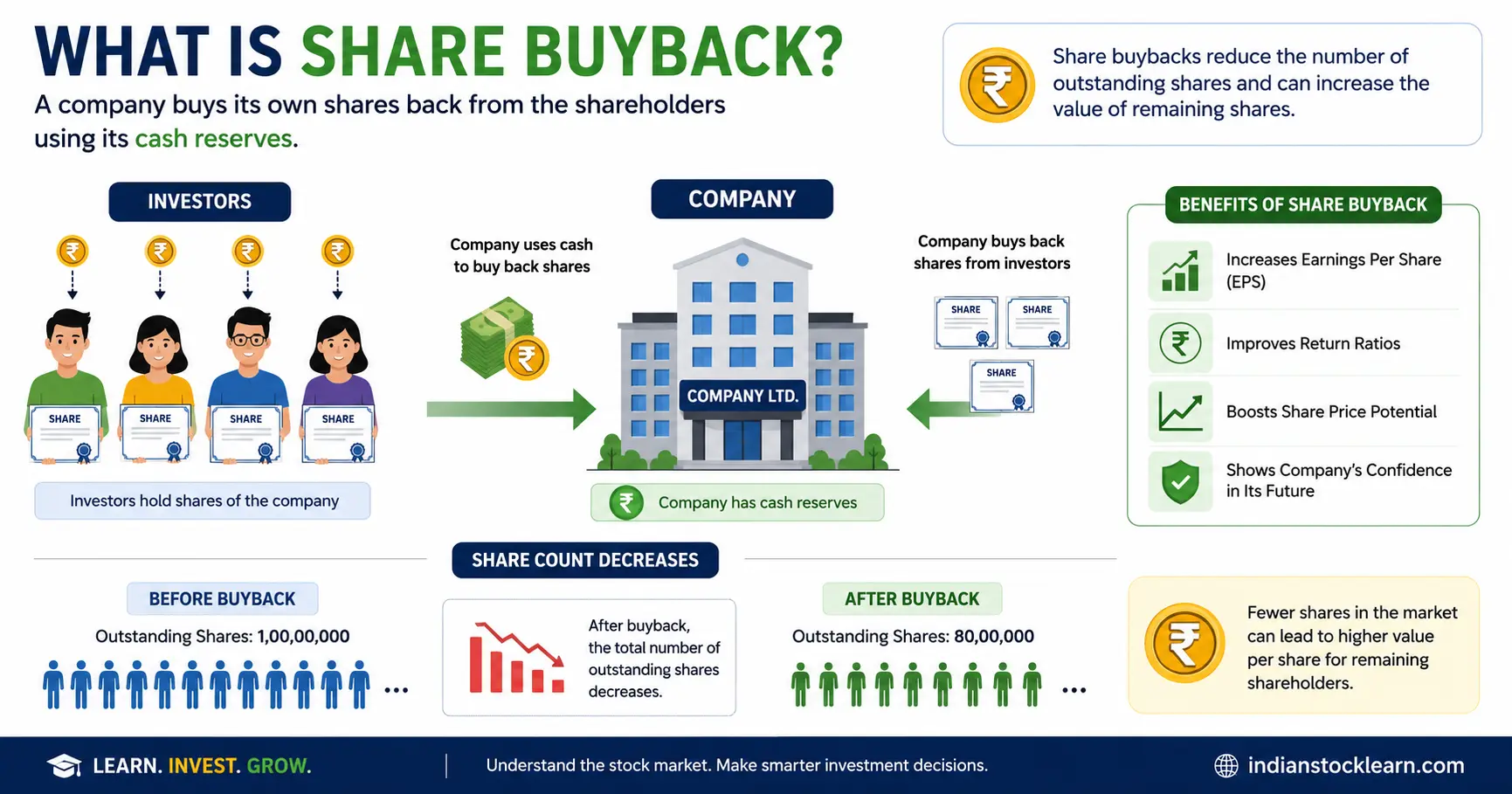
A buyback of shares is a process where a company purchases its own shares from existing shareholders. Instead of raising money by issuing new shares, the company spends its available cash to reduce the number of shares available in the market.
Picture a company with 100 shares outstanding. If it buys back 10 shares, only 90 remain in circulation. Since there are fewer shares, each remaining shareholder owns a slightly larger slice of the company.
A buyback doesn’t automatically mean the company’s business has improved — it simply changes the number of shares available, and that can affect financial ratios like Earnings Per Share (EPS), which we’ll get to shortly.
Buyback of Shares Meaning in Simple Words
In plain English: a buyback means a company is buying its own shares from investors. The company usually announces the buyback price, the record date, who’s eligible, the buyback method, and the timeline. Shareholders then decide whether they want to participate.
A Quick Example
Suppose ABC Ltd has 1 crore shares outstanding, trading at a current market price of ₹500. The company announces a buyback price of ₹600 for 10 lakh shares. Eligible shareholders can now offer their shares during the buyback window, depending on the rules the company sets.
Why Buyback Counts as a Corporate Action
A buyback is a corporate action because it’s an official decision by the company’s Board of Directors that directly affects shareholders. Other common corporate actions include dividend, stock split, bonus shares, rights issue, merger, and demerger. A buyback is simply another way a company interacts with its shareholders.
How Does Buyback of Shares Work?
The buyback process follows 5 steps, from announcement to payment.
The company informs the stock exchanges of the buyback size, price, method, and important dates.
The Record Date decides which shareholders qualify. Anyone holding shares before this date is eligible.
Participation is voluntary — offer your shares for buyback, or simply keep holding them as usual.
If more shares are offered than the company wants, only a portion is accepted — based on the acceptance ratio.
Accepted shares are purchased and paid for. Unaccepted shares stay exactly where they were, in your demat account.
Every eligible shareholder gets 2 choices once a buyback opens: participate, or keep the shares and continue investing as normal. Nobody is forced into either option.
Types of Buyback of Shares
Buyback of shares happens through 2 common methods in India.
Tender Offer Buyback
This is the most common method in India. The company announces a fixed buyback price, invites eligible shareholders, and purchases the shares offered during the buyback window. If too many investors participate, only part of the submitted shares may be accepted.Open Market Buyback
Here, the company purchases shares directly from the stock market over a set period. Instead of offering one fixed price to shareholders, it buys shares through stock exchange transactions, subject to applicable regulations.Tender Offer vs Open Market: Quick Comparison
| Tender Offer | Open Market Buyback |
|---|---|
| Fixed buyback price | Market-based purchase |
| Shareholders voluntarily submit shares | Company buys through the stock exchange |
| Acceptance ratio may apply | No tender submission required |
| Common in India | Also permitted under regulations |
Buyback Record Date vs Ex-Date
Beginners often mix up these 2 terms.
Record Date
The Record Date is the date a company uses to check its shareholder register and decide who’s eligible for the buyback. If your name is on the list as of this date, you qualify to participate.
Ex-Date
The Ex-Date is the date from which a stock trades without the entitlement tied to a corporate action. Buy shares on or after the Ex-Date, and you generally won’t be eligible for that particular buyback — only shareholders who already held the stock before this date, and who show up on the company’s records by the Record Date, qualify. In practice, this matters more for open-market buybacks than tender offers, since tender offers work off the Record Date directly.
The Buyback Formula and How It Affects EPS
There’s no single formula for a buyback itself, but understanding the basic math makes it much easier to see why companies announce them. Unlike a dividend, where a company hands out cash directly, a buyback reduces the total number of shares in the market — which changes ownership percentages and can improve certain financial ratios.
Shares Outstanding After Buyback
Remaining Shares = Total Outstanding Shares − Shares Bought Back. Suppose XYZ Ltd has 100 crore total outstanding shares and buys back 10 crore. Remaining shares = 100 crore − 10 crore = 90 crore. Fewer shares remain in the market after the buyback.
How Buyback Affects EPS
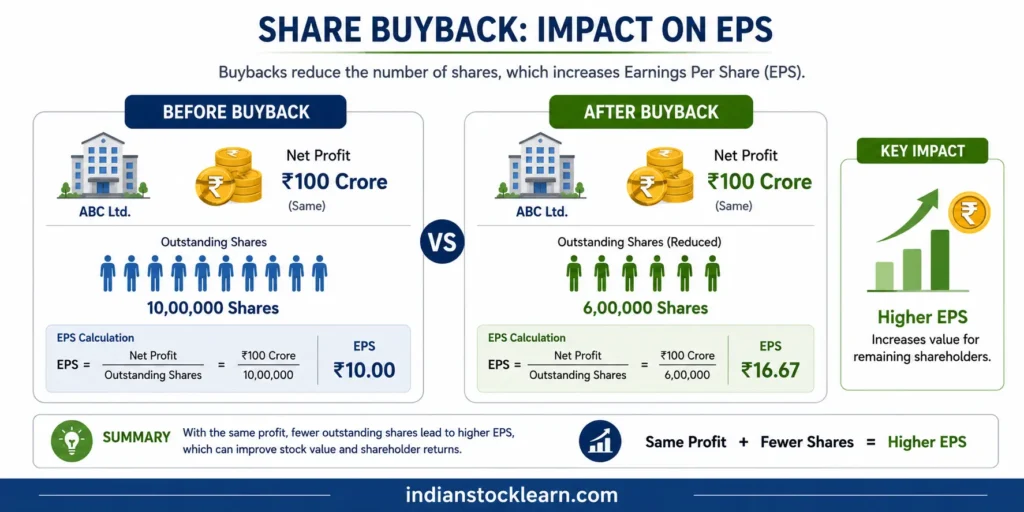
EPS = Net Profit ÷ Total Outstanding Shares. A buyback shrinks the bottom half of that equation. If profit stays flat while the share count drops, EPS goes up — even though the business itself hasn’t changed.
- Before buyback: ₹900 crore profit ÷ 90 crore shares = ₹10 EPS
- After buyback: ₹900 crore profit ÷ 75 crore shares = ₹12 EPS
The profit didn’t move. Only the share count did. A higher EPS alone doesn’t mean the business improved — always check revenue growth, debt, and cash flow too.
Understanding Acceptance Ratio
One of the biggest questions beginners ask: if I apply for a buyback, will all my shares get accepted? Not always. When more shareholders participate than the company plans to purchase, only some shares get accepted — and that’s where the acceptance ratio comes in.
What is Acceptance Ratio?
The acceptance ratio is the percentage of shares the company accepts from an investor during a tender offer buyback. Say you submit 100 shares and the company accepts 40 — your acceptance ratio is 40%. The remaining 60 shares stay in your demat account, untouched.Does Everyone Get the Same Ratio?
Not necessarily. The actual acceptance depends on the total number of shares offered by all investors, the buyback size the company announced, the category of shareholder you fall into, and applicable SEBI regulations.
The 15% Small Shareholder Reservation
Not every shareholder competes in the same pool. In a tender offer, SEBI requires companies to reserve 15% of the buyback size — or your proportionate entitlement, whichever is higher — specifically for “small shareholders”: anyone holding shares worth ₹2 lakh or less in that company. This retail category is often less heavily oversubscribed than the general category, so acceptance ratios inside it tend to run considerably higher.
Your category is set by your holding value on the record date, not when you bought. If your shares are worth ₹1,90,000 today but a price rally pushes them to ₹2,10,000 by the record date, you get bumped out of the small shareholder pool and into the general category — where you’re competing against institutions, and your acceptance ratio can drop sharply. Keep an eye on your holding value as the record date approaches if you’re close to the ₹2 lakh line.
A Few Practical Things to Know Before You Tender
A handful of operational details trip up even experienced investors. None of these are complicated once you know them.
Two more things worth knowing: if your entitlement works out to a fraction of a share — say 2.5 shares — Indian depositories round down, not up, so very small holdings can end up with a zero entitlement. And once the buyback settles, unaccepted shares typically stay locked for a day or two before they’re free to trade again — don’t panic if they don’t show as tradeable immediately.
Real Buyback Examples in India
Looking at real companies makes all of this easier to picture. 2026 gave Indian investors plenty to look at.
Wipro’s Buyback
Wipro’s 2026 buyback stood out for its size — around ₹15,000 crore, one of the largest buyback announcements of the year. Investors compared the buyback price against the market price, weighed whether participating made financial sense, and paid attention largely because of the company’s size and market presence.
Bajaj Auto’s Buyback
Bajaj Auto followed with a buyback worth roughly ₹5,632 crore. Investors asked the same questions they always do: What’s the buyback price? Who’s eligible? What will the acceptance ratio look like? Should long-term holders even bother participating, or just keep their shares?
Looking Beyond India: Apple Inc.
Buybacks aren’t unique to India. Globally, companies like Apple have regularly run large share buyback programs of their own — the same core idea, just at a different scale and under different rules.
Why Do Companies Buy Back Their Own Shares?
If a company has spare cash, why not just keep it? A few common business reasons explain why companies choose a buyback instead.
1. Reducing the Number of Shares
Buying back shares shrinks the outstanding share count, which — as covered above — can improve ratios like EPS.
2. Returning Cash to Shareholders
Some companies generate more cash than the business currently needs. Instead of a dividend, they return part of that cash through a buyback.
3. Signaling the Stock is Undervalued
Sometimes management believes the market price doesn’t fully reflect the company’s value. A buyback can signal that confidence — though it’s not a guarantee the price will rise.
4. Improving Capital Structure
A buyback can help a company rebalance the mix between cash and shareholders’ equity on its books.
5. Raising Ownership Percentage for Remaining Shareholders
With fewer shares left after a buyback, investors who keep holding automatically own a slightly larger slice of the company.
Why Do Investors Participate in a Buyback?
Retail investors join a buyback for different reasons: the announced price may sit above the current market price, some investors want to book part of their holding, others prefer to keep what remains after the buyback, and long-term holders often weigh a buyback against alternatives like dividends or bonus shares before deciding.
Every investor’s situation looks different. A buyback announcement is worth evaluating alongside the company’s financial performance, its business outlook, and your own investment goals — not in isolation.
What Promoter Participation Tells You
Retail investors aren’t the only ones deciding whether to tender. Watching what a company’s promoters do with their own shares can be more revealing than the announcement itself.- Promoters tender heavily: can suggest they see the stock as fully valued, or want to exit part of their holding at a premium without pressuring the market price.
- Promoters tender nothing: lets their ownership percentage rise automatically as retail shares get extinguished, without spending a rupee — often read as confidence, though it can also simply reflect control-consolidation goals.
You can check this yourself in the company’s Letter of Offer, under the number of shares the promoter group has proposed to tender.
Myth vs Reality: Common Buyback Misconceptions
A few beliefs about buybacks circulate as common knowledge, even though they don’t hold up in practice.
| Myth | Reality |
|---|---|
| The buyback price is a guarantee of what you’ll get | It’s a ceiling for the tender offer, not a promise — and it says nothing about where the stock trades afterward. |
| A rising EPS after a buyback means the business improved | The share count fell, not necessarily the profit. Check revenue and profit growth separately before reading EPS as good news. |
| A buyback always signals management’s confidence | Sometimes it reflects payout pressure from shareholders, compensation-plan incentives, or a simple lack of better uses for the cash — not conviction about the business. |
| Buyback proceeds are tax-free | They’re currently taxed in the shareholder’s hands, not exempt — check current rules before assuming otherwise. |
| You should always tender if the price looks attractive | If your likely acceptance ratio is low, most of your holding stays exposed to whatever happens to the stock after the window closes — the premium on the small accepted portion may not make up for that. |
Advantages of Buyback of Shares
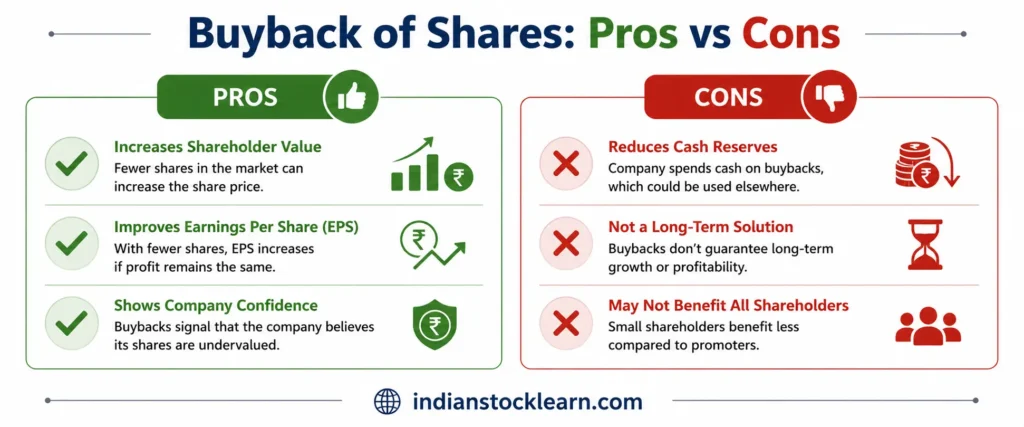
A buyback can benefit both the company and its shareholders, though the actual impact depends on the company’s financial position, the buyback price, and market conditions.
1. A Shot at Selling Above Market Price
In a Tender Offer Buyback, the announced price is often higher than the current market price. If your shares are accepted, you get that higher price instead of selling on the open market — though not every submitted share is guaranteed acceptance.
2. EPS May Increase
As covered earlier, fewer outstanding shares against the same profit can push EPS higher — a ratio many investors track closely when analyzing a company.
3. Larger Ownership for Existing Shareholders
Investors who hold on through a buyback automatically own a slightly bigger percentage of the company, without buying a single additional share.
4. Signals Management Confidence
A buyback sometimes reflects management’s belief that the market price undersells the company’s real value. Some investors read this as a positive sign — though it’s never proof the price will climb.
5. Efficient Use of Excess Cash
Well-established companies sometimes sit on more cash than the business needs. A buyback puts part of that idle money back into shareholders’ hands instead of letting it sit unused.
6. Can Improve Key Financial Ratios
Along with EPS, ratios like Return on Equity (ROE) can improve as the outstanding share count drops. Study these alongside revenue, profit growth, debt, and cash flow — never in isolation.
Limitations of Buyback of Shares
Buybacks come with real limitations too. Understanding both sides helps you read an announcement clearly instead of reacting to the headline number.
1. Not All Shares Get Accepted
One of the biggest misconceptions beginners have is assuming every submitted share gets purchased. In reality, the company may accept only part of what’s offered — governed by the acceptance ratio covered earlier.
2. No Guarantee of a Higher Share Price
Some investors assume a buyback always pushes the share price up. It doesn’t. Price depends on company performance, industry conditions, investor sentiment, the broader economy, and plain demand and supply.
3. Company Cash Balance Drops
A buyback uses the company’s own cash. Spend too much on repurchases without keeping enough for future business needs, and financial flexibility can take a hit.
4. Short-Term Market Expectations
Some investors buy in purely because a buyback was announced. Once the buyback window closes, activity tends to settle back into whatever the underlying business performance actually supports.
5. Tax Rules Can Change
This is one area where reading an old article — including this one, months from now — can lead you astray if you take a specific number at face value instead of confirming it’s still current.
When a Buyback Might Be a Red Flag
A buyback isn’t automatically bullish. A few patterns are worth watching for — on their own they don’t prove anything, but together they’re worth a second look.
Key Takeaways
- A buyback means a company purchases its own shares from existing shareholders.
- Buybacks reduce the total number of outstanding shares.
- Companies generally use either the Tender Offer method or the Open Market method.
- Participation in a buyback is voluntary.
- Not all submitted shares are guaranteed to be accepted.
- Buybacks may improve ratios like EPS, but that alone doesn’t make a company better.
- Small shareholders (holding ₹2 lakh or less) get a reserved 15% quota with better acceptance odds.
- What promoters do with their own shares is often more telling than the announcement itself.
- Watch for debt-funded buybacks, shrinking growth spending, or timing right before weak results.
- Always weigh a buyback against the company’s overall financial performance.
- Tax rules change over time — always check the latest official information.
Frequently Asked Questions
Why do companies buy back their own shares?
Is a share buyback good or bad for investors?
What happens to the share price after a buyback?
How can I apply for a buyback in India?
Is buyback of shares taxable in India?
What happens if I don’t participate in a buyback?
Should I participate in a buyback?
Conclusion
Understanding what is buyback of shares is a useful step for anyone starting out in the stock market. At its core, it’s simply a process where a company purchases its own shares from existing shareholders — but that simple idea can move the number of outstanding shares, EPS, and shareholder ownership in ways worth understanding before you act.
Companies announce buybacks for different business reasons, from returning excess cash to adjusting their capital structure. For investors, deciding whether to participate is a personal call that deserves real research, not just a reaction to the announced price.
Treat a buyback announcement as one part of a company’s larger story. Check its financial performance, its future prospects, and the official announcement itself before making any investment decision.