
Last Updated: July 20, 2026
Zerodha, Groww, Upstox — three names that show up on every beginner’s search. They all claim to be free. They all say they’re the best. So which one do you actually open a demat account with?
If you want to invest in the Indian stock market — buy shares of Reliance, invest in a Nifty 50 ETF, or apply for an IPO — a demat account is the first thing you need. There is no shortcut around it. Every share you buy gets stored electronically in your demat account, the same way your savings sit in a bank account.
This guide covers everything: what a demat account actually is, how the account opening process works step by step, a clear comparison of Zerodha, Groww, and Upstox, the real charges most beginners miss, and a straight answer on which broker fits which type of investor.
- What a demat account is and how it works
- Exactly which documents you need to open one in 2026
- Step-by-step account opening process (all 3 brokers)
- Real charge comparison — AMC, DP fees, brokerage
- Which broker suits you based on your investor type
- 5 common mistakes to avoid before submitting your application
- What Is a Demat Account?
- Demat vs Trading Account
- How a Demat Account Works
- Who Can Open a Demat Account?
- Documents Required (2026 Checklist)
- How to Open Demat Account — Step by Step
- Demat Account Charges Explained
- Zerodha, Groww, and Upstox — What Each Does Best
- Which Broker Should You Choose?
- Real Cost Comparison by Investor Type
- 5 Mistakes to Avoid
- Advantages and Limitations
- Frequently Asked Questions
- Conclusion
What Is a Demat Account?
A demat account — short for dematerialised account — is a digital account that holds your investments electronically. Before demat accounts existed, buying shares meant receiving physical paper certificates. Those certificates could be lost, damaged, or forged. Selling them took weeks.
Today, every share you buy gets credited directly to your demat account in electronic form. No paper. No courier. No waiting for certificates to arrive.
The simplest way to understand it: your bank account holds cash, your demat account holds shares.
What Can a Demat Account Hold?
A single demat account can store:
- Equity shares (Reliance, TCS, Infosys, etc.)
- Exchange Traded Funds (ETFs)
- Mutual Fund units (with select brokers)
- Government Securities and Bonds
- Sovereign Gold Bonds (SGBs)
- REITs and InvITs
All ownership records are maintained electronically by two official depositories — NSDL (National Securities Depository Limited) and CDSL (Central Depository Services Limited). Your broker acts as the Depository Participant (DP) — a registered agent of either NSDL or CDSL.
Demat Account vs Trading Account — What’s the Difference?
Many beginners treat these as the same thing. They’re not — they perform different jobs, though brokers usually open both together when you register.
| Feature | Demat Account | Trading Account |
|---|---|---|
| Main purpose | Stores shares and securities | Places buy and sell orders |
| Holds investments | Yes | No |
| Active during trading | After purchase (settlement) | At the moment of buying or selling |
| Required for investing? | Yes | Yes |
| Linked to | NSDL or CDSL | NSE or BSE via broker |
Think of it this way: your trading account places the order, the stock exchange processes it, and your demat account stores the result. Both come together automatically when you open an account with a broker like Zerodha, Groww, or Upstox.
How a Demat Account Works — Step by Step
Here’s what actually happens between clicking “Buy” in your app and seeing shares in your portfolio.
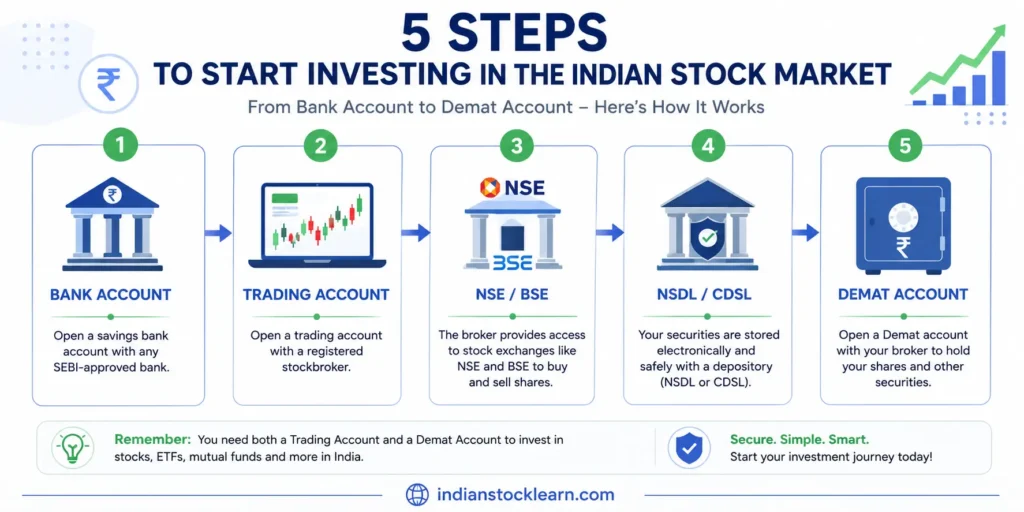
Rahul transfers ₹10,000 to his trading account. He buys 5 shares of Reliance Industries at ₹1,600 each (₹8,000 total). By the next trading day, those 5 shares appear in his demat account. If Reliance rises to ₹2,000 and he sells, the ₹10,000 proceeds return to his trading account — and he transfers it back to his bank.
Who Can Open a Demat Account in India?
Almost any Indian resident can open one. Common examples:
- College students (18+ with valid PAN and Aadhaar)
- Salaried employees
- Business owners and self-employed individuals
- Homemakers
- Retired individuals
- First-time investors with no prior market experience
Minors can hold a demat account operated by a guardian, subject to the broker’s rules. The account converts to a standard account when the minor turns 18.
NRIs can open a demat account in India, but the process differs. Of the 3 brokers covered here, only Zerodha currently supports NRI demat accounts (NRE/NRO). Groww and Upstox do not, as of 2026. NRIs must follow applicable RBI and FEMA guidelines.
Documents Required to Open a Demat Account in India (2026 Checklist)
Keep these ready before you start the application. Missing even one can delay activation by 24–48 hours. For a deeper look at each document, see our full guide on documents required for demat account in India.
| Document | Purpose | Mandatory? |
|---|---|---|
| PAN Card | Identity + tax linking | Mandatory |
| Aadhaar Card | Address proof + eSign | Mandatory |
| Aadhaar-linked Mobile Number | OTP for eSign and verification | Mandatory |
| Bank Account Details | Fund transfers in and out | Mandatory |
| Cancelled Cheque / Bank Statement | Bank verification (if UPI fails) | Sometimes |
| Live Selfie / Photograph | In-person verification (IPV) | Mandatory |
| Income Proof (salary slip, ITR) | F&O segment activation only | F&O only |
| NRI Documents (PIO card, NRE/NRO passbook) | NRI account only — Zerodha only | NRIs only |
Edge Cases That Break the Standard Account Opening Advice
Most guides assume a perfect applicant: matching documents, a salaried income, and a single clean PAN. In reality, a noticeable share of applications hit friction because of situations standard advice never covers. Here are the ones that come up most often.
How to Open a Demat Account in India — Step by Step
The process is fully online for all 3 brokers. Most applicants finish in under 20 minutes if documents are ready. Here’s the general flow, followed by broker-specific notes.
Step 1 — Choose a SEBI-Registered Broker
Pick one of the three brokers covered in this guide — or any other SEBI-registered broker. Don’t open the first account you see advertised. Compare charges, platform, and which suits your investment style (covered in detail below).
Step 2 — Enter Mobile Number and Verify OTP
Visit the broker’s website or download the app. Enter your mobile number. An OTP is sent to verify your number. This mobile number should ideally be the same one linked to your Aadhaar.
Step 3 — Enter PAN Details
Enter your 10-digit PAN. The broker fetches your name from the Income Tax database. Confirm the details match your Aadhaar exactly.
Step 4 — Complete Aadhaar eSign
Enter your Aadhaar number. An OTP is sent to your Aadhaar-linked mobile. Enter it to digitally sign the account opening form. This replaces the physical signature and eliminates the need to courier documents.
Step 5 — Link Bank Account
Add your bank account details — account number and IFSC. The broker verifies this via a small penny-drop transfer (₹1 sent and reversed). Some brokers also accept a UPI ID for instant verification.
Step 6 — Take a Live Selfie
Most brokers require a live selfie or short video for In-Person Verification (IPV). This confirms you’re a real person applying for your own account. Poor lighting or a blurry image can cause this step to fail — retry in natural light if it does.
Step 7 — Wait for Activation
The broker reviews your application. If everything matches, the account is activated within 24–48 hours. You’ll receive login credentials by email and SMS. Groww typically activates fastest — sometimes within hours during business days.
Demat Account Charges Explained — AMC, DP Fees, Brokerage
Most beginners compare only brokerage. That’s a mistake. The charges that catch people off guard are AMC and DP fees — and they show up even if you’ve “picked a free broker.”
| Charge | Zerodha | Groww | Upstox | What It Is |
|---|---|---|---|---|
| Account Opening | ₹0 | ₹0 | ₹0 | One-time fee to create your account |
| AMC (Annual Maintenance) | ₹300/yr Free yr 1 | ₹0 | ₹300/yr Free yr 1 | Annual fee to keep your demat account active |
| Equity Delivery Brokerage | ₹0 | ₹0 | ₹0 | Fee for buying and holding shares (non-intraday) |
| Intraday Brokerage | ₹20 or 0.03% (lower) | ₹20 or 0.05% (lower) | ₹20 or 0.05% (lower) | Fee per trade for same-day buy-sell |
| DP Charges (per sell) | ₹13.5 + GST | ₹13.5 + GST | ₹13.5 + GST | Charged by depository each time you sell delivery shares |
| F&O Brokerage | ₹20 per order | ₹20 per order | ₹20 per order | Fee per futures or options order |
The BSDA Rule — How to Avoid AMC Legally
Most articles stop at “Zerodha and Upstox charge ₹300/year from Year 2.” What they skip is SEBI’s Basic Services Demat Account (BSDA) classification, which can waive or reduce that AMC entirely — and almost no broker actively advertises it because it cuts into their revenue.
If your holdings value stays under ₹4 lakh (combined across equity and debt), your account qualifies for BSDA status. Under BSDA, AMC is either waived completely or capped far below the standard ₹300/year rate, depending on your holding value slab.
BSDA classification is supposed to apply automatically based on your holding value, but in practice brokers don’t always proactively convert eligible accounts. If your portfolio is under ₹4 lakh and you’re still being charged full AMC, raise a request with your broker’s support team to check your BSDA status.
Zerodha, Groww, and Upstox — What Each Does Best
Zerodha
India’s largest discount broker by active client count. Zerodha’s trading platform — Kite — is widely considered the benchmark for retail trading apps in India. It offers advanced charting, full F&O support, and a large educational resource library through Zerodha Varsity. The interface takes a few days to get used to for first-timers, but most serious investors prefer it for its depth.
Best for: Active traders, F&O traders, long-term investors who want a full-featured platform. The only broker of the 3 that supports NRI demat accounts.
Groww
Groww built its reputation by making investing feel as simple as a UPI payment. The app is clean, the onboarding is fast, and the zero AMC model means no annual fees eating into small portfolios. It’s the go-to for first-time investors, students, and anyone who starts with SIP investing before moving to direct stocks.
Best for: Complete beginners, SIP investors, college students, and anyone who wants the fastest and simplest path to opening their first demat account in India.
Upstox
Backed by Ratan Tata and RKSV, Upstox offers TradingView charts built directly into the platform — a big advantage for active traders who prefer professional charting tools without paying extra. It’s slightly more feature-rich than Groww while remaining accessible to new investors.
Best for: Investors who want better charting than Groww offers, but prefer a simpler experience than Zerodha’s full ecosystem.
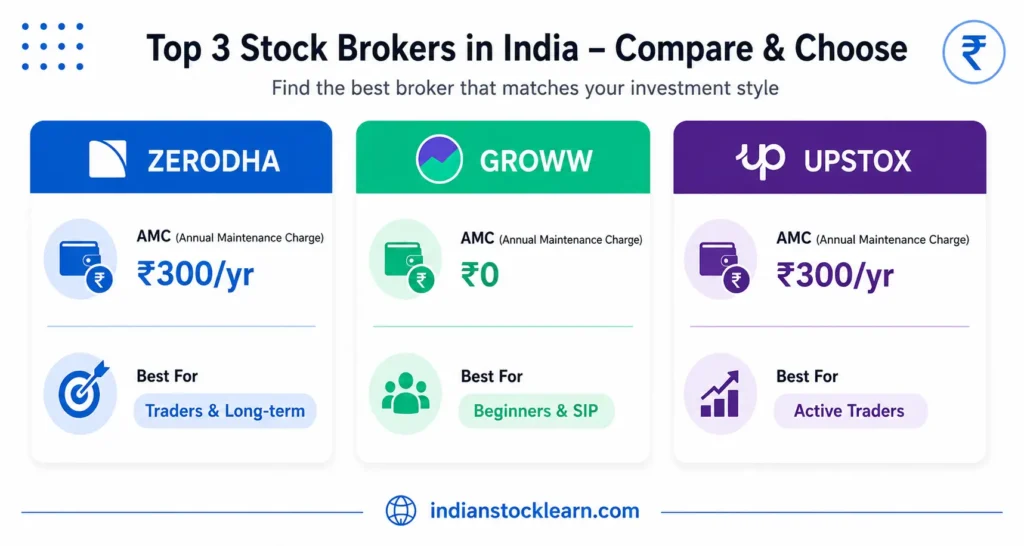
| Feature | Zerodha | Groww | Upstox |
|---|---|---|---|
| Account Opening Fee | ₹0 | ₹0 | ₹0 |
| AMC (from Year 2) | ₹300/yr | ₹0 | ₹300/yr |
| Mobile App | Kite — Excellent | Groww — Very Easy | Upstox Pro — Excellent |
| Advanced Charts | Yes | Basic only | TradingView |
| F&O Trading | Yes | Yes | Yes |
| Mutual Funds | Yes | Yes | Yes |
| ETFs | Yes | Yes | Yes |
| NRI Demat Account | Yes | No | No |
| Depository | NSDL + CDSL | CDSL | CDSL |
| Beginner Friendliness | ⭐⭐⭐⭐ | ⭐⭐⭐⭐⭐ | ⭐⭐⭐⭐ |
Which Broker Should You Choose? — Decision by Investor Type
Here’s the direct verdict most comparison articles refuse to give. Pick your profile:
| Your Investor Type | Best Choice | Why |
|---|---|---|
| Complete beginner — first demat account ever | Groww | Simplest app, zero AMC, fastest activation |
| College student starting with ₹500–₹2,000/month SIP | Groww | Zero fees on small portfolios, simple UI |
| Salaried professional — SIP + some direct stocks | Groww or Zerodha | Groww for simplicity; Zerodha if you plan to expand into F&O |
| Long-term investor — building a serious portfolio | Zerodha | Stronger ecosystem, Varsity education, broader platform depth |
| Active trader — intraday and swing trading | Zerodha or Upstox | Kite and Upstox Pro both offer professional charting tools |
| F&O trader | Zerodha | Most popular F&O platform in India, most stable execution |
| Wants TradingView charts without switching platforms | Upstox | TradingView built in natively — no separate subscription needed |
| NRI investor opening demat account in India | Zerodha only | Only broker of the 3 that supports NRE/NRO demat accounts |
Myth vs Reality — What Beginners Get Wrong About Demat Accounts
A lot of advice floating around about demat accounts is outdated, half-true, or simply assumed without verification. Here are the misconceptions that cause the most confusion.
| Myth | Reality |
|---|---|
| Zero brokerage means the trade costs nothing | Government charges still apply — STT, stamp duty, exchange transaction charges, and GST. These show up on every contract note regardless of broker. |
| Faster account activation means a better broker | Speed and compliance depth aren’t the same thing. A same-day activation says nothing about platform stability or how the broker handles disputes later. |
| All CDSL demat accounts work identically | Brokers under the same depository can still differ in how they process corporate actions, margin pledges, and offline service requests. |
| You can switch brokers anytime at no cost | Switching involves a formal transfer process through CDSL Easiest or an offline DIS, and can take days for large portfolios. It isn’t instant. |
| One person can have only one demat account | Multiple demat accounts are completely legal in India, as long as each one is opened with valid KYC under your own PAN. |
| Closing the broker app closes your demat account | Deleting an app does nothing to the account itself. It stays active — and AMC can keep accruing — until you formally request closure. |
Real Cost Comparison — What You’ll Actually Pay in Year 1 vs Year 2
Forget the headline “free” claims for a moment. Here’s a practical rupee breakdown based on 3 common investor profiles:
| Scenario | Zerodha | Groww | Upstox |
|---|---|---|---|
| Profile A — SIP-only investor, ₹2,000/month, no stock selling in Year 1 | |||
| Year 1 cost | ₹0 (AMC waived, no sell = no DP) | ₹0 | ₹0 (AMC waived, no sell = no DP) |
| Year 2 cost | ₹300 (AMC only) | ₹0 | ₹300 (AMC only) |
| Profile B — Active investor, sells 10 different stocks across the year | |||
| DP charges (10 sell txns) | ~₹159 (10 × ₹15.9) | ~₹159 | ~₹159 |
| Year 2 total (DP + AMC) | ~₹459 | ~₹159 | ~₹459 |
| Profile C — Intraday trader, 50 trades/month (buy + sell same day) | |||
| Monthly brokerage (₹20/trade) | ~₹1,000 | ~₹1,000 | ~₹1,000 |
| Note on DP charges | Intraday trades do NOT attract DP charges — shares never enter your demat account. DP charges apply only on delivery (overnight) sells. | ||
All 3 brokers charge zero account opening fee and zero delivery brokerage. The difference from Year 2 is AMC — Groww wins here at ₹0. For small investors with portfolios under ₹2 lakh, this ₹300/year difference is real money. For large portfolios and active traders, AMC matters far less than platform quality and execution speed.
6 Common Mistakes Beginners Make When Opening a Demat Account
Why Closing a Demat Account Is Harder Than Opening One
Every guide explains how to open an account. Almost none mention what happens when you want to close one — and the process has a few traps worth knowing before you need them.
Advantages and Limitations of a Demat Account
Why Demat Accounts Work Well for Indian Investors
- No physical certificates — shares can’t be lost, damaged, or forged.
- T+1 settlement — shares are credited to your account the next trading day, not weeks later.
- One account, multiple instruments — stocks, ETFs, bonds, SGBs, REITs all in one place.
- Corporate benefits automatically credited — dividends, bonus shares, and stock splits are processed without paperwork.
- 100% online account opening — the entire process from KYC to activation can be done from your phone.
Points Every Beginner Should Know
- AMC from Year 2 — Zerodha and Upstox charge ₹300/year after the free first year. Factor this into your choice.
- DP charges on every delivery sell — regardless of broker, you pay ₹13.5 + GST each time you sell shares from your demat account.
- Internet required — all transactions need an active connection. Plan accordingly during market hours.
- Market risk remains — a demat account stores your investments. It doesn’t protect them from price falls. Understanding the basics of investing matters more than which broker you choose.
- A demat account stores your shares electronically — it’s a digital locker for investments, not a place to keep cash.
- You need both a demat account and a trading account to buy stocks — most brokers open both together.
- Documents needed: PAN, Aadhaar, Aadhaar-linked mobile, bank account, and a live selfie.
- Groww: best for beginners and SIP investors. Zero AMC. Fastest setup. Zerodha: best for traders and serious long-term investors. Upstox: strong middle ground with TradingView built in.
- DP charges (₹13.5 + GST per sell) apply on all 3 platforms — this is not brokerage, it’s a depository fee.
- From Year 2, Zerodha and Upstox charge ₹300/year AMC. Groww does not.
- NRIs can only use Zerodha among these 3 brokers for demat account opening in India.
Frequently Asked Questions
Which is better for beginners — Zerodha, Groww, or Upstox?
How long does it take to open a demat account in India?
Does Groww charge AMC for a demat account?
What documents are required to open a demat account in India?
What are DP charges and why does every broker charge them?
Can I have more than one demat account?
Is it safe to open a demat account with Groww or Upstox?
Can an NRI open a demat account in India?
Is a demat account the same as a trading account?
Conclusion
Opening a demat account in India is straightforward — if you know what to prepare, which broker suits you, and what charges to expect from Year 2 onwards. The process is entirely online, takes under 20 minutes with the right documents, and your account is typically active within 24 hours.
On the broker question: if you’re a beginner or SIP investor, Groww’s zero AMC and simple interface make it the practical starting point. If you plan to trade actively or eventually move into F&O, Zerodha’s platform depth is worth the ₹300/year from Year 2. Upstox fits the space between — capable charting, clean app, solid execution.
The demat account you open matters far less than the knowledge you build after opening it. Start with the basics of investing in India, understand how SIP works through our SIP vs Lump Sum comparison, and take your first step when you’re ready — not when you’ve found the “perfect” broker.
1 thought on “Zerodha vs Groww vs Upstox — Which Demat Account is Best? (2026)”