
This article is designed for intermediate and professional investors who already understand the basics of share buybacks. If you’re new to this topic, we recommend reading our What is Buyback of Shares guide first.
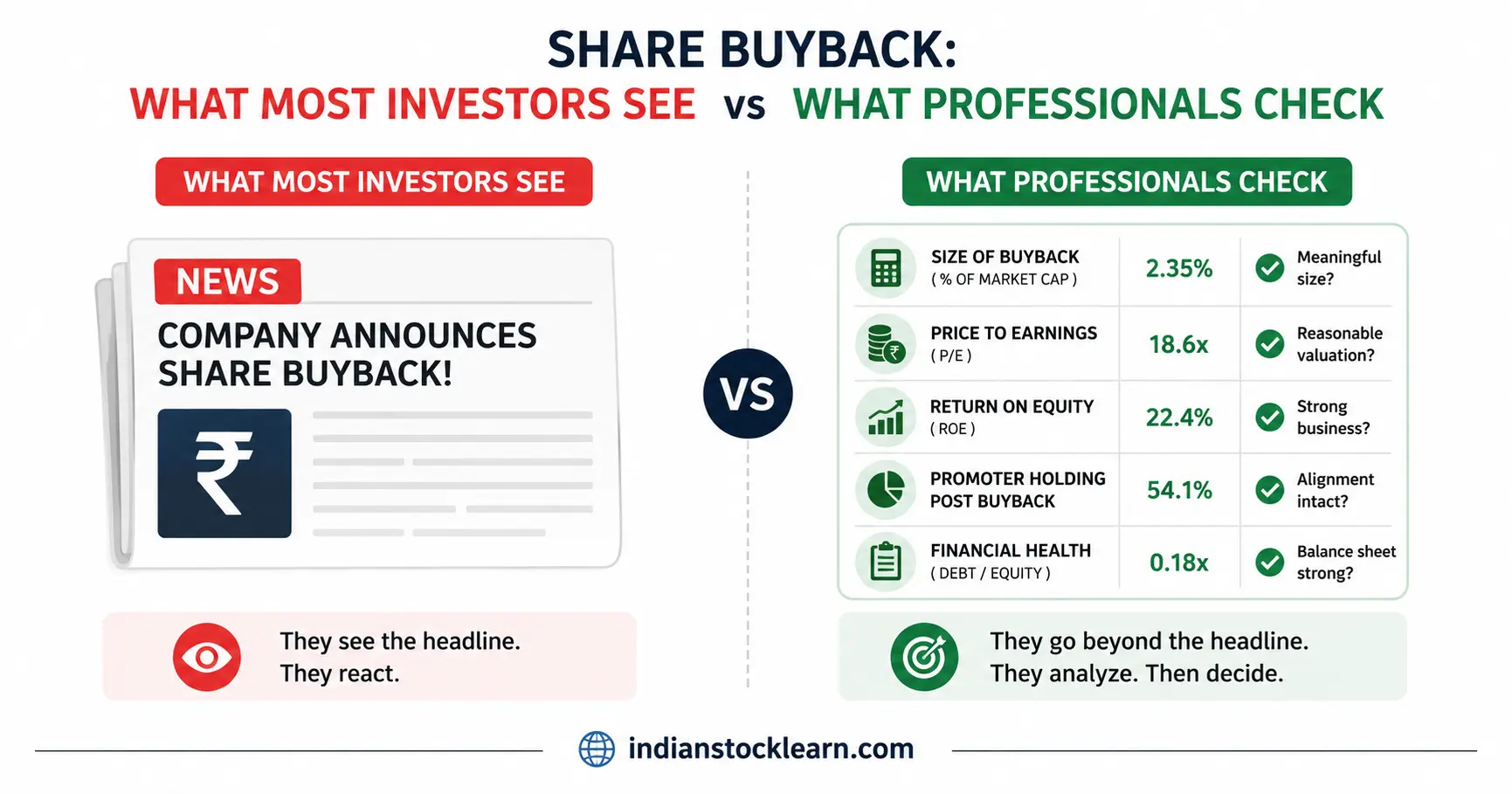
Nothing here is a recommendation to buy, sell, or tender any specific stock. It’s a set of frameworks and questions that separate a surface-level reaction to a buyback announcement from a genuine analysis of one.
- How Companies Actually Decide to Launch a Buyback
- The Value Creation vs Value Destruction Test
- How Professional Investors Evaluate a Buyback
- Why It Reads Differently by Industry
- Reading Promoter and Institutional Behaviour
- The Category Game
- Myth vs Reality: What Even Experienced Investors Get Wrong
- Situations Where Tendering Can Work Against You
- The Buyback Ghost
- The Buyback “Arbitrage” Question
- F&O and ESOP Ripple Effects
- The Tax Mechanics Behind Participation
- Key Takeaways
- Frequently Asked Questions
- Conclusion
How Companies Actually Decide to Launch a Buyback
A buyback isn’t a spontaneous decision — it typically follows a fairly structured internal process, even if the public only sees the final announcement.
Cash reserve analysis comes first: the finance team assesses how much surplus cash the business genuinely doesn’t need for operations, debt servicing, or planned expansion. From there, management weighs a buyback against the alternatives — a dividend, reinvesting in the business through capital expenditure, an acquisition, a rights issue avoided in favour of using existing cash, or paying down debt. Each option carries a different signal and a different tax and accounting effect.
If a buyback wins out, the board has to approve it, legal and compliance teams draft the required regulatory filings, and the company appoints — or, since the SEBI rules changed in August 2026, can now choose whether to appoint — a merchant banker to manage the process. None of this is free: legal fees, registrar coordination, and investor-relations time all add a real, if rarely discussed, cost. Timing matters too — a well-run buyback is usually announced when the undervaluation case is clear, not as a reaction to bad news.
The Value Creation vs Value Destruction Test
The most sophisticated investors don’t just ask whether a company is buying back shares — they ask whether the buyback is likely to create value or destroy it. Three checks separate the two.
The Valuation Check
If a company buys back stock at a rich Price-to-Earnings ratio, it’s effectively paying a premium price for its own shares. When a company’s earnings yield (roughly the inverse of its P/E) sits below its cost of capital, the buyback can quietly work against future EPS growth rather than for it.
The Funding Source Check
A buyback funded from free cash flow is a very different decision from one funded by fresh borrowing. Debt-funded buybacks add financial risk, and that risk grows if interest rates are rising at the time the debt is taken on.
The ROIC vs Cost of Capital Check
A buyback tends to create value only when the company’s Return on Invested Capital (ROIC) is meaningfully higher than its Weighted Average Cost of Capital (WACC). If the core business already earns strong returns on capital, using excess cash to buy back shares — rather than funding uncertain new projects — can be the disciplined choice. The reverse pattern can suggest management has simply run out of profitable ideas.
ADD IMAGE: buyback-value-creation-destruction-2026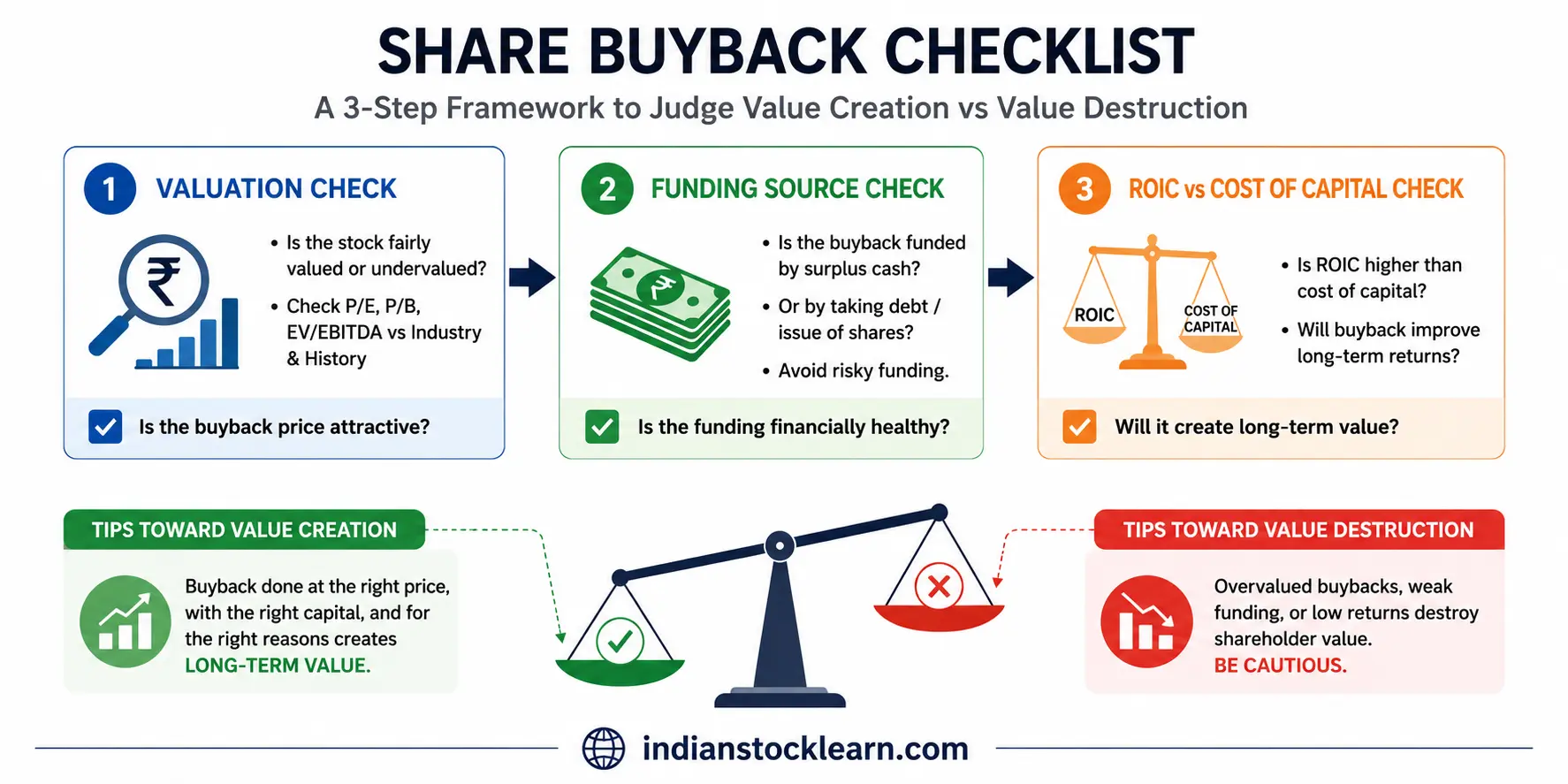
How Professional Investors Evaluate a Buyback
Beyond the announcement itself, analysts typically run through a short list of ratios before forming a view.
- Buyback size vs Free Cash Flow: a buyback that consumes a small slice of annual free cash flow is far more sustainable than one that stretches the company’s cash generation.
- Buyback yield vs Dividend yield: comparing the two shows how a company is choosing to return cash, and whether one route is being favoured for tax or signalling reasons.
- Buyback size as a % of market capitalization: a small buyback barely moves the ownership math; a large one can meaningfully shift EPS and ownership percentages.
- Impact on ROE and ROCE: since these ratios also have outstanding shares or equity in the denominator, a buyback can flatter them without any real operational improvement — worth checking against revenue and profit trends directly.
- Management’s track record: some companies have a history of buying back shares at sensible valuations; others have a history of doing it near market peaks. Past behaviour is a reasonable, if imperfect, guide.
Put together, these checks shift the question from “did the company announce a buyback” to “is this a well-priced, well-funded capital allocation decision.”
Why the Same Buyback Reads Differently by Industry
None of the checks above apply identically everywhere. The same buyback size and premium can mean something quite different depending on the sector.
| Sector | What Usually Shapes the Read |
|---|---|
| IT services | Typically cash-rich with limited capex needs, so buybacks are often a genuinely efficient use of surplus cash. |
| Banks & NBFCs | Capital adequacy rules and regulatory approvals make large buybacks rarer and slower to execute. |
| Manufacturing | Ongoing capex and expansion needs mean a large buyback can directly compete with growth investment. |
| Commodity & cyclical businesses | Cash surpluses are often temporary and tied to the commodity cycle, so timing relative to the cycle matters more than usual. |
| High-growth or newly listed companies | Worth extra scrutiny — it can mean genuine excess cash, or that growth opportunities are drying up faster than expected. |
Reading Promoter and Institutional Behaviour
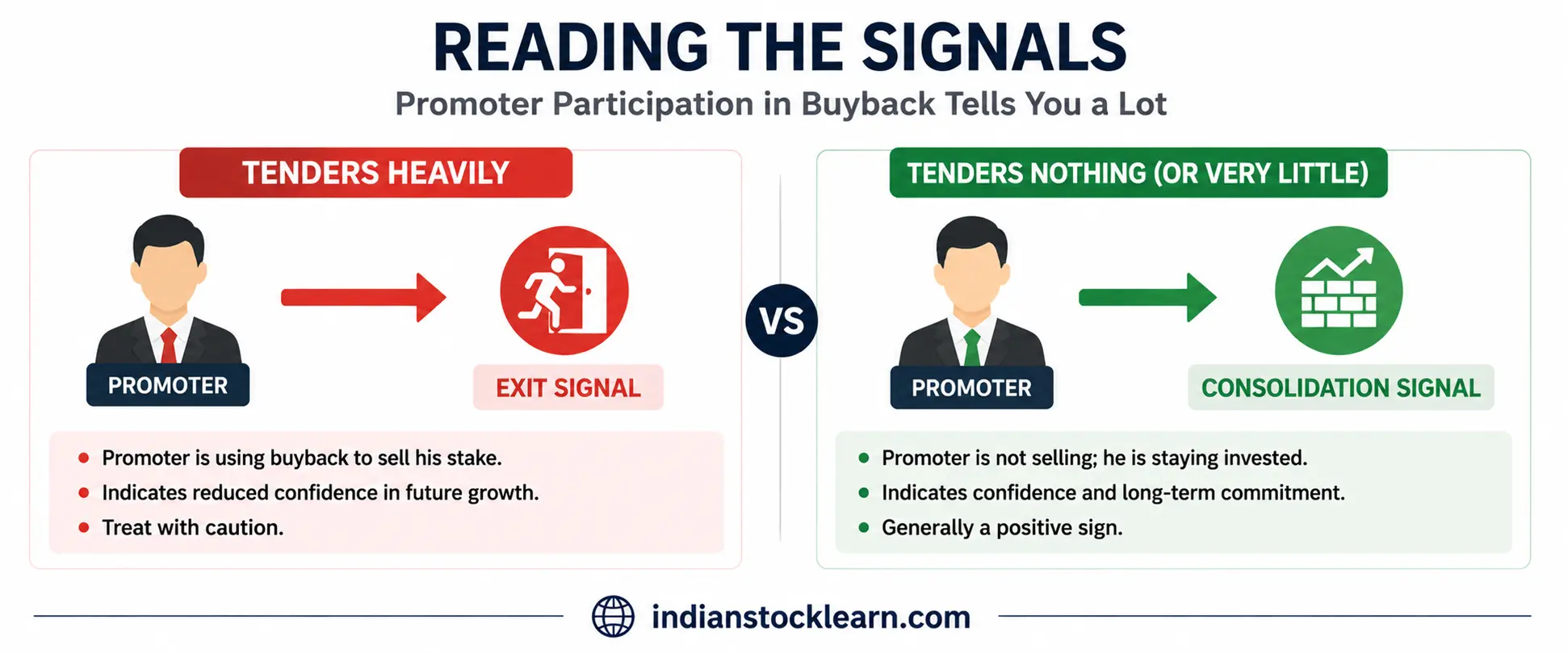
What promoters and large institutional holders do with their own shares often carries more information than the announcement itself.
The Promoter Signal
If promoters tender a large chunk of their own holding, it can mean they see the stock as fully valued, or that they’re using the buyback to exit part of their stake at a premium without pressuring the market price by selling on the exchange. If promoters tender nothing, their ownership percentage rises automatically as other shareholders’ shares get extinguished — without them spending a rupee. You can check exactly what promoters proposed to tender in the company’s Letter of Offer, usually available through your broker platform. One nuance worth knowing: promoters occasionally tender through group entities or family trusts rather than in their own name, so the headline “promoter participation” figure isn’t always the complete picture.
The Promoter Structure Maze
“Promoter participation” is rarely one clean number. The Letter of Offer breaks the promoter group into sub-categories — individual promoters, corporate bodies, family trusts, HUFs, and other entities acting in concert. A headline like “promoter group tenders 8%” can mean the named individual promoters barely participated at all, while a family trust or group company tendered on their behalf. It’s worth checking which specific entity type is actually tendering before reading too much into the headline figure — and note that promoters typically remain locked in for a period after the buyback closes on whatever they don’t tender, which shapes their own incentives around timing.
Why Institutional Holders Change the Math
When mutual funds and other institutions hold a large chunk of a stock, they often skip tendering entirely — fund mandates and tax considerations can make participation unattractive, especially when the buyback price sits close to the market price. When large holders sit out, the shares they would have tendered effectively get reallocated across the shareholders who did apply, which is one reason actual acceptance ratios can end up meaningfully higher than a simple back-of-envelope estimate suggests.
Estimating Your Real Acceptance Ratio
The entitlement ratio in the offer document is what you’re guaranteed at minimum. The final acceptance ratio — announced after the window closes — is usually higher, because a portion of eligible shareholders forget to apply or choose not to. Checking a company’s Shareholding Pattern, freely available on the NSE and BSE websites, for how much is held by promoters, mutual funds, and other institutions gives a rough sense of how much of the eligible pool is likely to actually compete for shares.
The Category Game
Our beginner guide covers the basic 15% small-shareholder reservation. A few more nuances matter once you’re looking closely.
A very low acceptance ratio in the general category isn’t unusual and doesn’t necessarily mean anything is wrong — it simply reflects heavy demand relative to the buyback size. A surprisingly high acceptance ratio, on the other hand, can sometimes be worth a second look: it can mean the offer isn’t attracting much competition, occasionally because sophisticated investors see limited value in participating at that price.
Some institutional participants also spread holdings across multiple demat accounts specifically to maximise how much gets tendered and accepted in aggregate — a scale advantage individual retail investors don’t have. None of this changes what you personally can do about it, but it’s useful context for why your actual acceptance ratio can look different from the headline number in the announcement.
One more mechanical detail worth knowing: Indian depositories don’t allow fractional shares, so any entitlement below 0.5 of a share rounds down to zero, while 0.5 and above rounds up to a full share. For very small holdings sitting right at that boundary, the exact number of shares you hold going into the record date can be the difference between a guaranteed minimum acceptance and a guaranteed zero.
Myth vs Reality: What Even Experienced Investors Get Wrong
A few beliefs persist even among investors who’ve been through several buyback cycles.
| Myth | Reality |
|---|---|
| Open Market buybacks are as good as Tender Offers | Companies sometimes announce an open-market buyback mainly to support a falling price, and don’t always complete the full authorised amount. |
| A very high acceptance ratio is always good news | It can also mean the offer wasn’t attractive enough to draw much competition in the first place. |
| Promoters never tender their own shares | They sometimes do, occasionally through group entities or family trusts, which doesn’t always show up clearly in headline coverage. |
| Fewer outstanding shares is always good for shareholder democracy | A smaller, more concentrated shareholder base can also mean fewer independent voices and less public-shareholder pressure on management. |
| The tax treatment changed once, so it’s settled now | Buyback taxation has already been restructured more than once in recent years, and can be again with a future budget. |
| Buying shares on the record date makes you eligible | Settlement takes a day, so you typically need to buy at least one trading day before the record date to actually qualify. |
| The 15% small-shareholder reservation guarantees full acceptance | It reserves 15% of the buyback size for that category, not 100% acceptance per shareholder — if demand within the category itself is high, pro-rata reduction still applies. |
Situations Where Tendering Can Work Against You
A handful of real scenarios exist where the rational choice is to sit out, or to sell in the open market before the record date rather than tender.
The Buyback Ghost: When It Doesn’t Fully Happen
An announced buyback isn’t always a completed one. Open-market buybacks in particular aren’t required to purchase the entire authorised amount — a company can announce a large buyback and end up purchasing only a portion of it, entirely within the rules. Tender offers are more binding for the shares actually accepted, but timelines can still shift due to regulatory approvals or other conditions.
When a buyback ends up smaller than announced, or lapses without much explanation, it’s worth treating that outcome itself as information about the company’s follow-through — not just a footnote to skip past.
The Buyback “Arbitrage” Question
A strategy sometimes pitched as close to risk-free: buy shares just before the record date, tender them, and sell whatever isn’t accepted. In practice, the friction costs are easy to underestimate.
Once the tender window closes, the artificial demand from the buyback disappears, and the stock can drift lower — partly because the company’s own cash reserves have shrunk by the buyback amount. If your acceptance ratio is low, the small premium earned on the accepted portion has to cover any decline on the much larger unaccepted portion, and it often doesn’t fully offset it. Fewer outstanding shares can also mean thinner trading volumes afterward, making a large position harder to exit without moving the price against yourself. And if the shares were bought purely for this purpose and sold within a year, short-term capital gains tax eats further into whatever margin remains.
None of this means participation is a bad idea for someone who wants to hold the stock anyway — it means treating it as a standalone trading strategy, separate from an actual intention to hold, is where the “free money” framing tends to fall apart.
How a Buyback Ripples Into F&O and ESOPs
For stocks in the futures and options segment, or companies with active employee stock option pools, a buyback’s effects reach further than the cash market.
The F&O Angle
Unlike a stock split or bonus issue, exchanges typically don’t adjust options strike prices for a buyback. Holding F&O positions through a buyback announcement is largely a volatility event layered on top of the corporate action itself, separate from the buyback’s underlying value. And as covered earlier, shares locked as margin collateral for an options position generally can’t be tendered without freeing them up first.The ESOP Angle
Some companies buy back shares around the same time large employee stock option tranches vest — the buyback can help absorb selling pressure from employees exercising and selling shares to cover taxes, rather than letting that selling hit the open market directly. It’s also worth knowing that a buyback which reduces the share count can be partially offset if the company issues fresh ESOPs around the same time — the headline “shares reduced” number and the real net dilution picture aren’t always the same thing.
The Tax Mechanics Behind Participation
This is a description of the mechanism, not a set of numbers — exact rates have changed before and can change again. Confirm the current position with the Income Tax Department or a tax professional, especially given how directly this affects the real return on any buyback decision, and weigh it alongside how the proceeds fit your own portfolio and tax situation.
Key Takeaways
- A buyback isn’t automatically good or bad — check how it’s funded and what price is being paid relative to the business’s real value.
- Compare ROIC to cost of capital, and buyback size to free cash flow, before treating a buyback as a sign of strength.
- What promoters and institutions do with their own shares often says more than the announcement.
- Your effective acceptance ratio depends on category and on how many other eligible shareholders choose to participate.
- A few real situations exist where tendering can leave you worse off than simply holding.
- Open-market buybacks aren’t always fully executed — tracking exchange disclosures beats assuming the announcement equals completion.
- F&O positions and ESOP pools can be affected by a buyback in ways the headline number doesn’t show.
- Buyback “arbitrage” carries real friction costs that are easy to underestimate.
- Tax treatment has changed before and will likely change again — always verify current rules.
- Nothing in this article is personalised investment advice.
Frequently Asked Questions
Is a bigger buyback always a stronger signal?
Does a high acceptance ratio mean the buyback was a good deal?
Should I always check what promoters are doing before deciding?
Why might my acceptance ratio differ from the headline number?
Is buyback arbitrage really risk-free?
How is this different from the beginner guide?
Conclusion
Reading a buyback announcement the way professionals do means asking different questions than most headline coverage does: how is it funded, what price is being paid relative to the business’s real value, what are promoters and institutions actually doing, and which category do you fall into. None of these questions have a single universal answer — they depend on the specific company, the specific offer, and your own financial situation.