
If you’ve already read the beginner guide to these indexes, you know Nifty 500, Smallcap 250 and Fin Nifty are free-float market-cap weighted. That explanation is correct, but it’s the simplified version. Understanding how Nifty index weighting works in practice means going past that one line – into capping rules, the gap between the index number you see and the one your fund actually tracks, and what “free float” really means to NSE.
None of this changes what you should do with your money. It changes how accurately you read the numbers you’re already looking at – and once you understand how Nifty index weighting works underneath the surface formula, factsheets and news headlines stop being confusing.
- The Capping Rule: Why One Stock Can’t Take Over Fin Nifty
- TRI vs PRI: The Index Number Isn’t What Your Fund Tracks
- Free Float Is Not Just “Market Cap Minus Promoter Shares”
- The Rebalancing Window: What Happens Between Announcement and Effective Date
- How Nifty 50, Nifty 500 and Fin Nifty Overlap
- Myth vs Reality
- Key Takeaways
- FAQs
- Conclusion
The Capping Rule: Why One Stock Can’t Take Over Fin Nifty
Free-float weighting on its own has no ceiling. In a purely uncapped index, a single stock that keeps rallying could eventually dominate the entire basket. Sector indexes like Fin Nifty (Nifty Financial Services) don’t allow that. NSE applies a capping methodology: no single stock can exceed 33% of the index, and the top three constituents combined can’t exceed 62%.
Here’s what that looks like in practice. Say HDFC Bank’s free-float market cap grows fast enough that, uncapped, it would represent 38% of Fin Nifty. At the next quarterly review, NSE trims its weight back down to the 33% ceiling and redistributes the excess proportionally across the index’s other constituents. The stock itself hasn’t been sold by NSE – but any fund replicating Fin Nifty now has to adjust its own holdings to match the capped weights.
Capping exists so a sector index still behaves like a basket of 20 companies, not a single-stock bet wearing a sector label. Broad indexes like Nifty 500 don’t need this rule as urgently, since no one stock realistically gets close to 33% of the entire market – but concentrated sector indexes do.
This is one of the clearest examples of how Nifty index weighting works differently depending on how concentrated an index is. A 500-company basket can absorb one stock’s rally without much fuss. A 20-company sector basket can’t, so NSE builds a mechanical safety valve directly into the methodology instead of leaving it to chance.
TRI vs PRI: The Index Number Isn’t What Your Fund Tracks
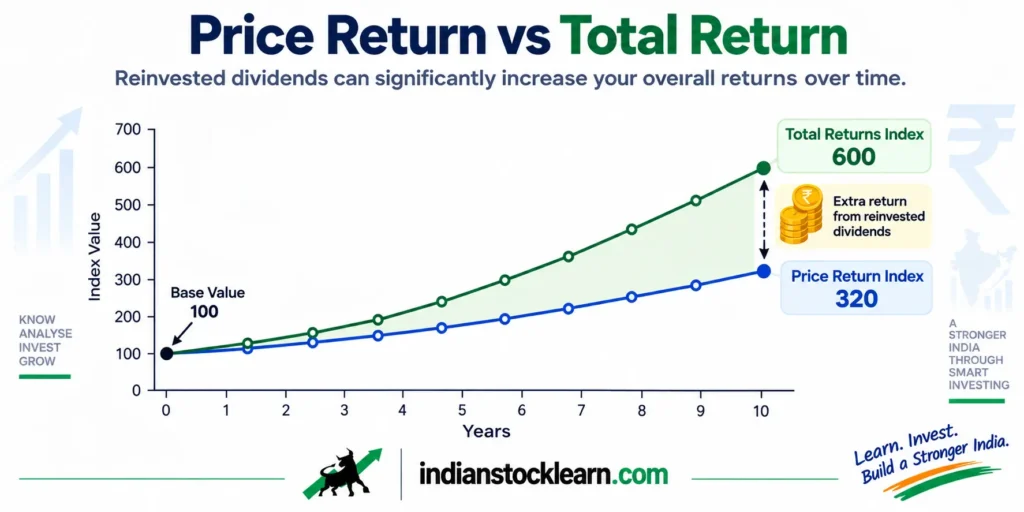
The Nifty 500 or Fin Nifty value you see quoted on a broker app or news ticker is almost always the Price Return Index (PRI) – it reflects share price movement only. Dividends paid out by the underlying companies aren’t added back in.
Since February 2018, SEBI has required mutual funds to benchmark their performance against the Total Returns Index (TRI) instead, which does account for reinvested dividends. Over long periods, TRI runs meaningfully ahead of PRI simply because it captures a return stream the PRI ignores. This is exactly why a well-run index fund can appear to have “beaten” the index number you’re used to seeing quoted – it isn’t outperforming, it’s being measured against a more complete benchmark.
The fund’s own expense ratio works in the opposite direction – fees are subtracted from returns, so even against TRI, a fund will typically trail its benchmark by a small margin each year. Between TRI adding a dividend boost and the expense ratio subtracting a cost, the fund’s real return sits somewhere between the PRI and TRI numbers, closer to TRI minus fees.
This gap compounds. In any single month it’s barely noticeable, but stretched across five or ten years, the difference between a fund’s TRI benchmark and the PRI number quoted in headlines can add up to a meaningfully different-looking return – even though the fund did exactly what it was supposed to do. Not knowing this is one of the most common ways beginners misjudge whether their fund is actually tracking well.
Free Float Is Not Just “Market Cap Minus Promoter Shares”
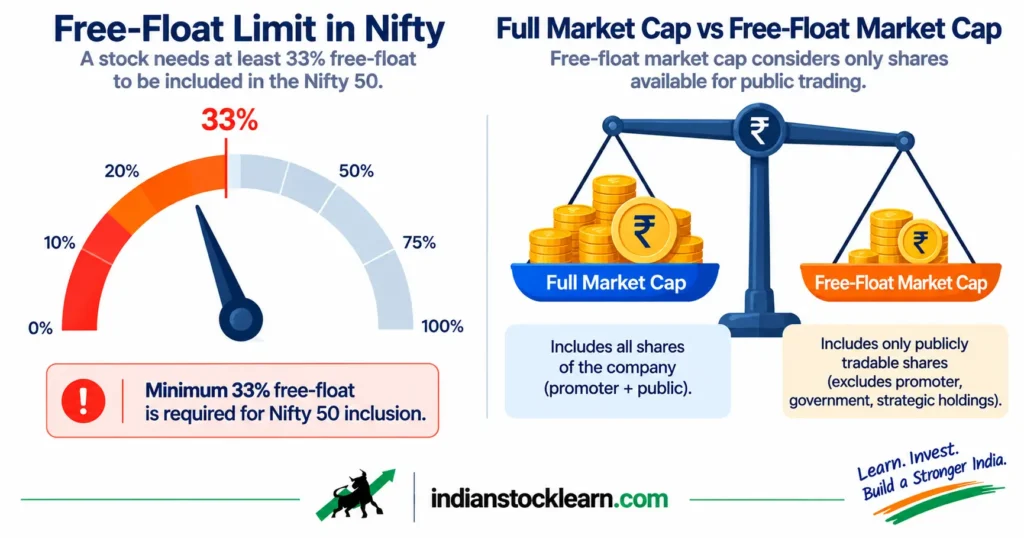
The beginner explanation – free float excludes promoter holdings – is directionally right but incomplete. NSE calculates an Investible Weight Factor (IWF) for every constituent: the proportion of a company’s shares actually available for public trading, based on disclosed shareholding patterns. This isn’t identical to a simple “100% minus promoter %” subtraction, since it also accounts for other locked-in or strategic holdings beyond promoters.
NSE assigns companies into free-float bands rather than tracking the free-float percentage down to the decimal, and revisits these bands during the same semi-annual review that resets index composition. Two companies with near-identical total market caps can end up with different index weights if their investible portions differ.
This band-based approach is another piece of how Nifty index weighting works that rarely makes it into beginner explanations. A company doesn’t get re-priced in the index every time one shareholder sells a small block of shares – its free-float band only shifts when disclosed shareholding patterns cross into a different band at the next review. Between reviews, the band stays fixed even if the underlying ownership shifts slightly.
The Rebalancing Window: What Happens Between Announcement and Effective Date
NSE reviews Nifty 500, Smallcap 250 and Fin Nifty twice a year, using data through end-January and end-July. Changes take effect from the last trading day of March and September, but NSE announces them roughly four weeks ahead of that date – so the market knows a stock is entering or leaving an index well before it actually happens.
That gap between announcement and effective date is well documented in market literature as the “index effect”: passive funds tracking the index are required to buy or sell the affected stock on the effective date to match the new composition, which can create temporary price pressure around that date. This is background knowledge for understanding index mechanics – not a signal to trade around. Trying to time individual stock moves around index inclusion carries real execution risk and isn’t something this article is suggesting as a strategy.
For an ordinary investor holding an index fund, the rebalancing window is mostly invisible – the fund handles the buying and selling on your behalf. Where it matters is expectations: if you check your portfolio the week an index is reconstituted and see a small, unexplained shift in holdings, that’s very likely routine rebalancing rather than anything your fund manager decided independently.
How Nifty 50, Nifty 500 and Fin Nifty Overlap
These aren’t three unrelated baskets. Every Nifty 50 constituent is also in Nifty 500, since Nifty 500 is built from the same larger universe. And because Fin Nifty’s largest constituents – HDFC Bank, ICICI Bank, Axis Bank, Kotak Mahindra Bank, State Bank of India – are also among the highest market-cap companies on the exchange, they naturally carry substantial weight inside Nifty 500 as well, not just inside Fin Nifty.
The practical implication: holding a Nifty 500 index fund alongside a Fin Nifty index fund doesn’t give you two cleanly separate exposures. You’re doubling up on the same handful of large financial names, just measured against two different benchmarks. This matters for diversification – counting index names isn’t the same as counting genuinely independent exposures.
The same logic applies one level down: large cap, mid cap and small cap categories aren’t separate universes either. Smallcap 250 is drawn directly from ranks 251-500 inside Nifty 500 – it’s a slice of the same universe, not a different one. Understanding how Nifty index weighting works across these layers is what lets you look at two fund names and judge whether they’re actually diversifying you, or just repackaging the same large companies under a different label.
| Myth | Reality |
|---|---|
| “Nifty 500 gives every company an equal say in the index.” | It’s free-float market-cap weighted – larger companies move the index far more than smaller ones. |
| “A stock in Fin Nifty can grow to any weight the market gives it.” | Capped at 33% for a single stock and 62% for the top three combined; excess weight is trimmed at rebalance. |
| “The index number on my broker app matches my fund’s benchmark.” | Broker apps typically show the Price Return Index; SEBI requires funds to benchmark against the Total Returns Index, which includes dividends. |
| “Free float is just market cap minus promoter shares.” | NSE applies an Investible Weight Factor based on full shareholding disclosures, assigned in bands – not a simple one-line subtraction. |
| “Index changes happen overnight with no warning.” | NSE announces changes roughly four weeks before they take effect, always from the last trading day of March or September. |
- Fin Nifty caps any single stock at 33% and the top three combined at 62%, so no one bank can dominate the index.
- Your broker’s index number is usually PRI (price only); SEBI mandates TRI (price + dividends) as the mutual fund benchmark – the two drift apart over time.
- Free float uses NSE’s Investible Weight Factor, assigned in bands – not a simple promoter-holding subtraction.
- Reconstitution happens twice a year, announced about four weeks before it takes effect each March and September.
- Nifty 50, Nifty 500 and Fin Nifty overlap structurally – the same large banks carry weight across more than one of these indexes at once.
- None of this changes what to buy – it changes whether you’re reading a factsheet, a comparison, or a headline correctly.
Frequently Asked Questions
Why does Fin Nifty need a capping rule if Nifty 500 doesn’t emphasise one?
Does understanding how Nifty index weighting works change how I should invest?
Where can I check whether a comparison is using TRI or PRI?
Can a stock get removed from an index before the next scheduled review?
Does the capping rule mean Fin Nifty funds sell winning stocks?
Is this level of detail relevant for a beginner investor?
Does a stock split affect how Nifty index weighting works for that company?
Conclusion
How Nifty index weighting works comes down to more than one formula. Capping keeps sector indexes from being hijacked by a single stock, TRI vs PRI explains why your fund’s return and the index number you see rarely match exactly, free float is a disclosure-based calculation rather than simple subtraction, and rebalancing runs on a predictable but not instant calendar. None of it changes what index fund is right for you – it just means you can read a factsheet or a news headline without being misled by the surface-level number.
The next time a broker app headline says “Nifty 500 hit a new high” or a fund factsheet claims to have “beaten its benchmark,” you’ll know exactly which number is being quoted, why a sector index can’t be hijacked by one stock, and what to check before taking either claim at face value.