
Investing in a mutual fund means paying a small annual fee known as the expense ratio. This is one of the first things worth understanding about expense ratio in mutual funds, because it applies to every scheme you’ll ever consider, from an index fund to an actively managed equity fund.
The fee covers the cost of running the fund – manager salaries, administration, marketing and compliance. It’s shown as a percentage of the fund’s assets and is deducted from the fund’s NAV daily, not billed to you separately. A 1% expense ratio means roughly ₹1 of every ₹100 invested goes toward fees each year.
This guide covers how the expense ratio actually works, the formula behind it, a real example using an index fund, and why the difference between a direct and regular plan matters more than most beginners realise.
What Is Expense Ratio in Mutual Funds?
The expense ratio – sometimes called Total Expense Ratio or TER – is the yearly fee a mutual fund charges its investors. Under SEBI rules, this can include the fund’s operating costs: fund manager fees, administrative costs, marketing, transaction charges, custodian fees and audit fees. These combined costs are expressed as a percentage of the fund’s assets, and every scheme has to disclose its current TER.
If a fund has an expense ratio of 1%, it removes about 1% of its value – spread out daily – for fees each year. The lower the expense ratio, the more of the fund’s underlying returns actually reach you as an investor.
How the Expense Ratio Is Shown Now (SEBI’s 2026 Update)
From 1 April 2026, SEBI changed how this fee gets displayed. Earlier, TER was one bundled number covering everything. Now, funds must break it into three visible parts:
The core fee the fund house charges for managing your money – fund manager pay, admin, research.
What the fund pays to buy and sell shares inside its own portfolio.
Taxes and charges like GST, STT and stamp duty – set by the government, not the fund house.
Add these three together and you get the same Total Expense Ratio (TER) you’re used to seeing. The number itself isn’t necessarily lower – you can just now see what it’s made of, instead of one bundled figure.
How It Works
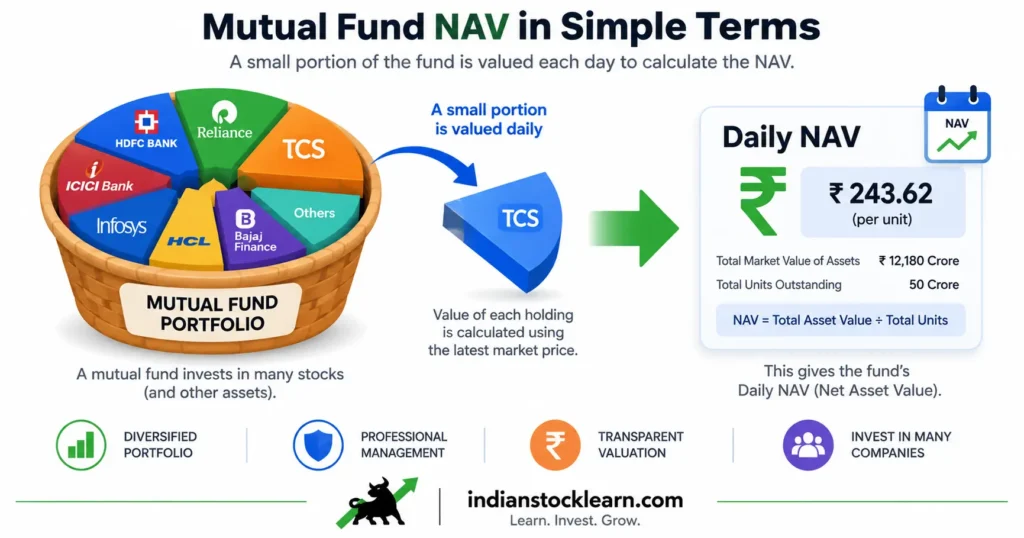
The asset management company (AMC) deducts the expense ratio every day before publishing the fund’s NAV, so your returns already reflect the market’s gains minus the expense ratio – never a separate bill from your bank account.
For an index fund, the relationship is simple: fund return is roughly benchmark return minus expenses. If the Nifty 50 rises 10% in a year, a Nifty 50 index fund with a 0.10% expense ratio would net close to 9.90%. An actively managed equity fund charging 1% would net closer to 9%. That gap looks small on paper, but it compounds every single year you stay invested.
Expense Ratio Formula
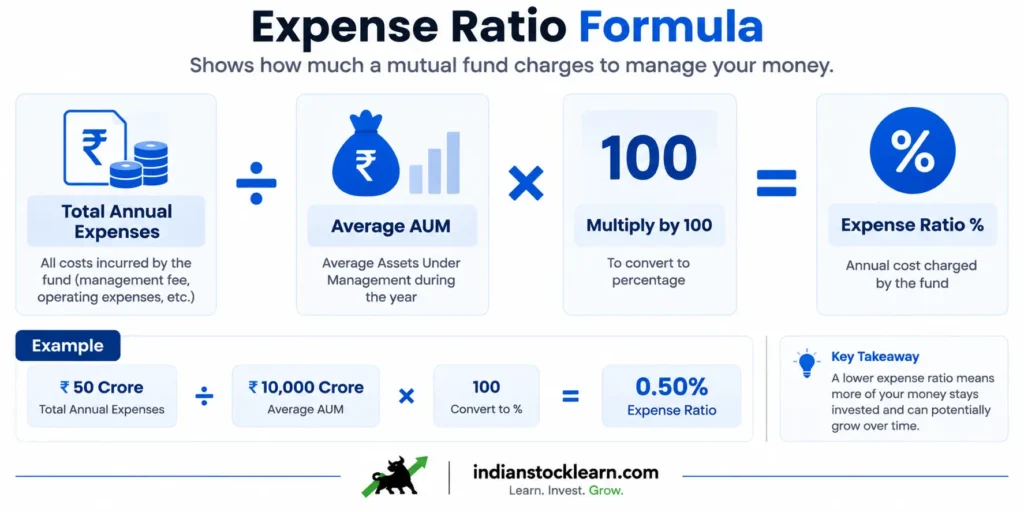
Expense Ratio (%) = (Total Annual Expenses of the Fund ÷ Average Assets Under Management) × 100
Total annual expenses cover every routine cost of running the fund – management and research fees, administrative and record-keeping costs, marketing and distributor commissions, and compliance, audit and legal fees. Average AUM is the average market value of all money invested in the fund over the year.
For example, a hypothetical fund with ₹700 crore in assets and ₹14 crore in annual costs works out to (₹14 Cr ÷ ₹700 Cr) × 100 ≈ 2%. That 2% isn’t charged all at once – the fund spreads it across every day of the year and subtracts a small slice from the NAV daily.
Every mutual fund’s factsheet and its AMC’s website list the current expense ratio, so you can always check the exact number before investing.
Real Fund Example
Consider an index fund tracking the Nifty 50. As of early September 2026, the SBI Nifty 50 ETF carries an expense ratio of around 0.04% – one of the lowest costs available in the Indian market for this kind of exposure. If the Nifty 50 rose 10% in a year, an investor in this ETF would net close to 9.96% after costs, before accounting for any tracking difference.
Now compare that with actively managed large-cap equity funds. Aggregated factsheet data across hundreds of Indian schemes shows direct-plan active equity funds averaging roughly 0.55%-0.70%, with some individual funds charging closer to 1%-1.5% depending on size and strategy. Regular plans of the same funds typically run about 0.3-0.95 percentage points higher, since they include a distributor commission that direct plans skip.
| Fund Type | Typical Expense Ratio Range (Direct Plan) |
|---|---|
| Nifty 50 index funds/ETFs | 0.04%-0.15% |
| Actively managed large-cap equity funds | ~0.55%-1.5% |
| Actively managed small-cap equity funds | Tends to run higher than large-cap, often 0.6%-2% |
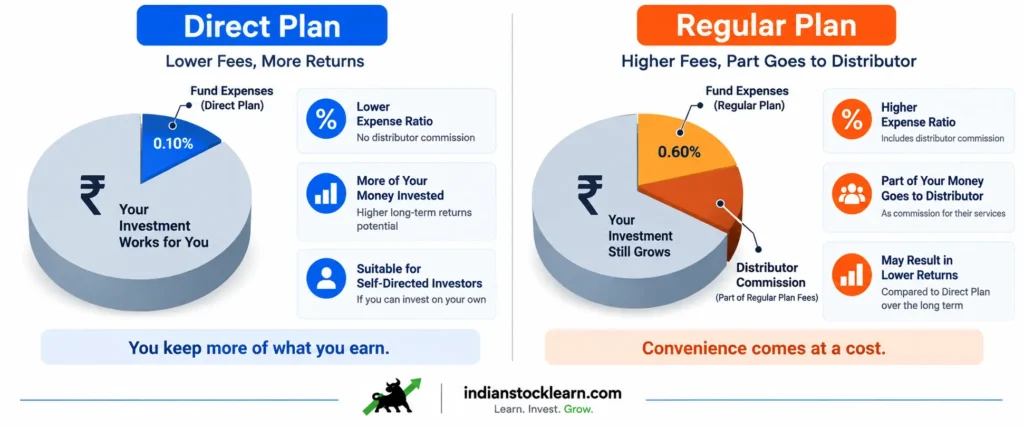
Over a long SIP horizon, even a fraction-of-a-percent difference compounds into a meaningfully different corpus – which is exactly why the direct-versus-regular plan choice matters as much as picking the fund itself.
Why Investors Care About It
Expense ratio matters because it directly reduces net returns – a cheaper fund simply lets you keep more of the market’s gains. This is a large part of why many investors lean toward direct plans and index funds, since both typically carry lower costs than regular, actively managed alternatives.
Direct plans skip the distributor commission built into regular plans, which is why, by regulation, a fund’s direct plan expense ratio must always be lower than its regular plan version of the same scheme. SEBI and AMFI require every fund to publish its current TER, making it straightforward to compare costs across similar funds before choosing where to invest, whether through a platform like Zerodha, Groww or Upstox.
Advantages of a Low Expense Ratio
What a Low Ratio Gets You
- More of the fund’s return stays with you
- Fee differences compound meaningfully over 15-20 year horizons
- Easy to compare across funds since TER is published daily
- Index funds and ETFs often offer the lowest available costs
Limitations to Keep in Mind
- A low expense ratio doesn’t guarantee better performance
- Exit loads, transaction taxes and portfolio turnover aren’t part of the published TER
- A modest ratio can still be significant on a low-return fund category, like some debt funds
- TER can change over time as an AMC revises pricing
Limitations of Expense Ratio
Expense ratio is useful, but it’s only one factor among several worth checking. A fund with a lower TER isn’t automatically the better choice – a cheap fund can still deliver weak returns if its underlying strategy or stock selection underperforms, and a higher-cost fund can occasionally justify itself with a more differentiated approach.
The published TER also doesn’t capture every cost. Exit loads charged on early redemption, short-term transaction taxes, and the cost of high portfolio turnover inside the fund aren’t reflected in the headline expense ratio number.
Myth vs Reality: Expense Ratio
| Myth | Reality |
|---|---|
| “I’m charged the expense ratio from my bank account every year.” | You’re never billed separately. It’s deducted from the fund’s NAV daily, spread across the year. |
| “The expense ratio covers every cost of owning the fund.” | It doesn’t include everything – brokerage the fund pays on its own trades and certain statutory levies are now shown as separate line items under SEBI’s 2026 disclosure rules. |
| “The lowest expense ratio is always the best fund to pick.” | A cheap fund can still underperform its own benchmark or category. Expense ratio is one factor to check alongside a fund’s track record and objective. |
| “Expense ratio stays the same forever once I invest.” | It can change over time as an AMC revises pricing or as the fund’s AUM crosses a SEBI slab, which changes the maximum allowed TER. |
- Expense ratio is the annual fee, expressed as a percentage of assets, that a mutual fund charges for its operating costs.
- It’s deducted from the fund’s NAV every day – never billed separately.
- Since April 2026, SEBI requires this fee to be shown as three separate parts: Base Expense Ratio, brokerage/transaction costs, and statutory levies.
- Index funds and ETFs typically carry far lower expense ratios than actively managed equity funds.
- Direct plans always charge less than regular plans of the same scheme, since they skip the distributor commission.
- SEBI caps the maximum TER a fund can charge based on its size.
- A lower expense ratio doesn’t guarantee better returns – check it alongside a fund’s strategy and track record.
- Every fund’s current TER is published on its factsheet and the AMC’s website.
Frequently Asked Questions
What is the expense ratio in mutual funds?
How is the expense ratio calculated?
Why do direct plans have a lower expense ratio than regular plans?
What is a good expense ratio for a mutual fund?
How often is the expense ratio actually charged?
Does a lower expense ratio always mean a better fund?
What is the Base Expense Ratio (BER), and how is it different from TER?
Where can I check a mutual fund’s current expense ratio?
Conclusion
Expense ratio in mutual funds is the fee you pay for a fund’s management and operations, automatically deducted from its NAV. Understanding it matters because a lower expense ratio means a larger share of the market’s gains actually reaches your account.
Whether you’re comparing a Nifty 50 index fund or an actively managed equity scheme, checking the expense ratio – and whether you’re looking at a direct or regular plan – is a habit worth building before you invest, alongside the fund’s track record and objective.
1 thought on “Expense Ratio in Mutual Funds: A Simple Beginner’s Guide”