
The NSE pre-open session rules changed on September 7, 2026. The 15-minute window before regular trading (9:00 AM to 9:15 AM) still exists, but market orders are now accepted for only the first 5 minutes instead of the full entry period. After 9:05 AM, only limit orders go through.
This guide breaks down exactly what changed, why NSE made the change, and what it means for how you place orders before the market opens.
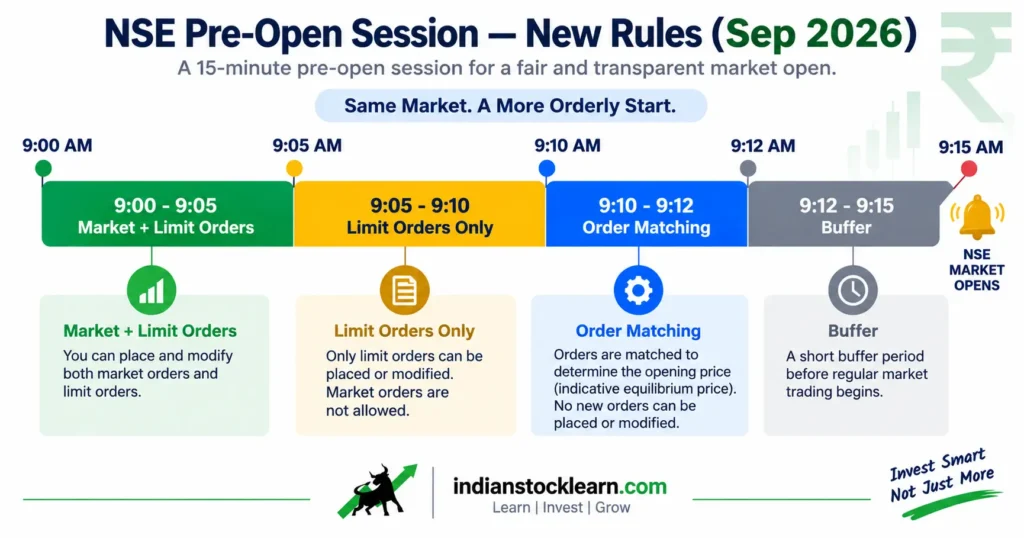
What Changed in the Pre-Open Session
NSE’s pre-open call auction still runs for 15 minutes, from 9:00 AM to 9:15 AM. What changed is how those 15 minutes are split. Earlier, both market and limit orders could be placed for almost the entire order-entry window. Now, market orders are locked out after the first 5 minutes.
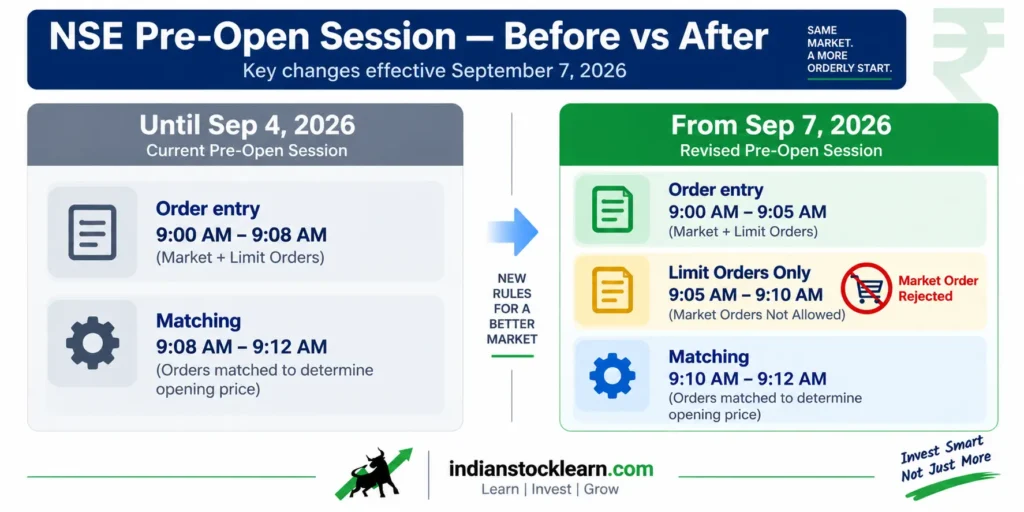
Old vs New Timing — Side by Side
| Phase | Until Sep 4, 2026 | From Sep 7, 2026 |
|---|---|---|
| Order entry (market + limit) | 9:00 AM – ~9:08 AM | 9:00 AM – 9:05 AM |
| Order entry (limit only) | Not applicable | 9:05 AM – 9:10 AM* |
| Random closure window | 9:07 AM – 9:08 AM | 9:08 AM – 9:10 AM |
| Order matching | 9:08 AM – 9:12 AM | 9:10 AM – 9:12 AM |
| Buffer period | 9:12 AM – 9:15 AM | 9:12 AM – 9:15 AM |
*Random closure means NSE cuts off order entry at an unpredictable point within the last 2 minutes, so no one can time an order to land right before the cutoff.
Why NSE Made This Change
SEBI introduced a Closing Auction Session (CAS) in August 2026 to make the closing price harder to manipulate in the last few minutes of trading. NSE’s pre-open change brings the opening auction closer to that same structure — consistent, phased price discovery at both ends of the trading day, with less room for last-second market orders to swing the opening price.
What This Means for You
If you place market orders near the open: you now have 5 minutes, not the full entry window. After 9:05 AM, NSE rejects any new market order, and existing ones placed before 9:05 AM can no longer be modified or cancelled.
If you use limit orders: nothing changes in terms of window length. You can still place, modify, or cancel limit orders until the random closure point between 9:08–9:10 AM.
What Hasn’t Changed
- The market still opens at 9:15 AM sharp.
- The pre-open window is still 15 minutes total.
- Stop-loss, IOC, and disclosed-quantity orders remain disallowed in pre-open, same as before.
- A pre-open trade still cannot be cancelled once it executes.
- Market orders still get matching priority over limit orders once matching begins.
For the full breakdown of every session in the trading day, see our complete share market timings guide.
- Market orders in the pre-open session now work only 9:00–9:05 AM
- Limit orders remain valid until random closure (9:08–9:10 AM)
- Matching happens 9:10–9:12 AM, buffer 9:12–9:15 AM
- The market still opens at 9:15 AM — only the internal phases changed
- The change aligns pre-open with SEBI’s August 2026 Closing Auction Session framework
Frequently Asked Questions
When did the NSE pre-open session rules change?
Can I still place a market order after 9:05 AM in pre-open?
Does this apply to all stocks on NSE?
Does this affect the F&O pre-open session too?
What happens if my market order is rejected at 9:06 AM?
Why did NSE change the pre-open session rules?
Conclusion
The NSE pre-open session rules now split order entry into two phases instead of one continuous window — market and limit orders until 9:05 AM, limit orders only after that. The market still opens at 9:15 AM, and the total 15-minute window hasn’t changed. If you trade near the open, the practical shift is simple: place market orders early, or switch to limit orders after 9:05 AM.
Related reading: how the stock market works and how to buy your first stock in India. Official source: NSE India and SEBI.