
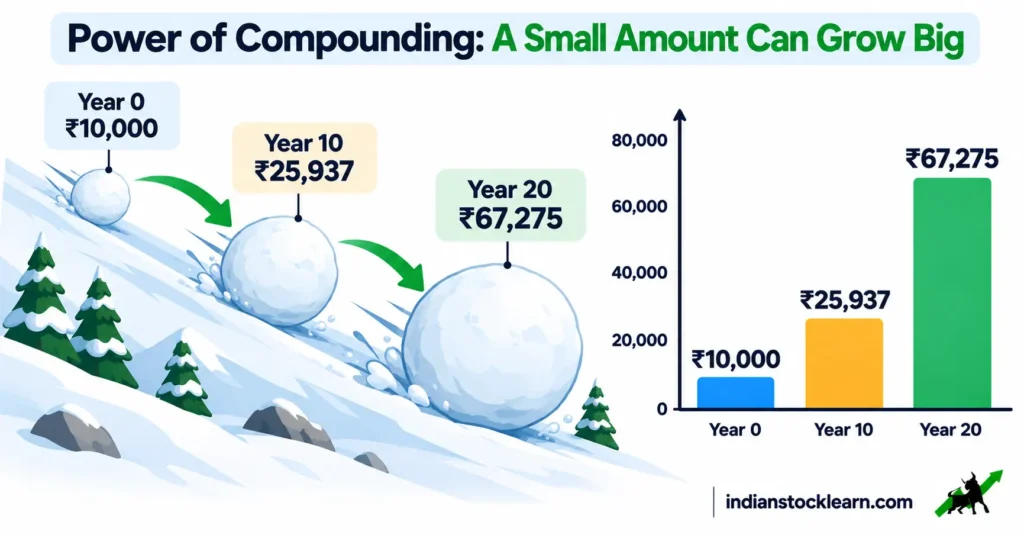
The power of compounding means earning returns on both your original investment and the returns that have already accumulated. You invest ₹10,000, it earns a return, and instead of taking that return out, you leave it invested. The next return is then earned on the original ₹10,000 plus whatever was already added.
A compounding calculator can make this look almost magical over 20 or 30 years. Real investments don’t grow at the same rate every year: stock prices move up and down, dividends change, taxes and costs reduce what’s left, and money gets added or withdrawn at different times. Understanding the power of compounding means understanding both the mathematics and where that mathematics stops matching reality.
- What Is the Power of Compounding
- How Does Compounding Work
- Formula for the Power of Compounding
- Compound Interest vs Simple Interest
- Compounding in the Stock Market
- Real Stock Market Example
- How a Compounding Calculator Works
- It Depends: Compounding in Different Scenarios
- Why Investors Focus on Compounding
- Advantages of Compounding
- Limitations of Compounding
- Myth vs Reality: The True Face of Compounding
- Key Takeaways
- Frequently Asked Questions
- Conclusion
What Is the Power of Compounding
The power of compounding means earning returns on both your original investment and the returns that have already accumulated. Picture a small snowball rolling down a hill: it starts tiny, collects more snow as it moves, and the larger snowball then collects snow faster than before. Money can behave in a similar mathematical way when returns stay invested.
Suppose ₹10,000 grows at an assumed 10% a year:
| After | Approximate value |
|---|---|
| 1 year | ₹11,000 |
| 2 years | ₹12,100 |
| 5 years | ₹16,105 |
| 10 years | ₹25,937 |
| 20 years | ₹67,275 |
The ₹1,000 earned in the first year also participates in every year of growth that follows. That’s why time matters so much to the power of compounding.
Price Is Not the Same as Return
Compounding is about the growth of money, not the number of shares you own. A person buying 1 share of a ₹1,000 company and another buying 100 shares of a ₹10 company have both invested ₹1,000. If both investments double, both become ₹2,000. The number of shares alone never tells you how much wealth is being created.
How Does Compounding Work
Compounding rests on 3 ingredients.
The money you begin with, for example ₹10,000.
The assumed percentage the money grows at, for example 10% a year.
How long the money stays invested, for example 20 years.
In year 1, ₹10,000 × 10% = ₹1,000, so the balance becomes ₹11,000. In year 2, the 10% is calculated on ₹11,000 rather than the original ₹10,000: ₹11,000 × 10% = ₹1,100, taking the balance to ₹12,100. The return itself has started producing a return. That’s compounding.
The early years look ordinary. The growth becomes far more visible after many years, because the base the return is calculated on keeps getting larger. Two people can invest the same amount and end up with very different results simply because one left the money invested for longer.
Formula for the Power of Compounding
For a lump-sum investment, the standard formula is:
A = P(1 + r)ⁿ
A = final amount, P = starting principal, r = annual rate of return, n = number of years.
With P = ₹10,000, r = 10% and n = 10 years: ₹10,000 × (1.10)¹⁰ ≈ ₹25,937. This is a mathematical illustration, not a promise that any stock or mutual fund will actually deliver 10% every year.
What Happens When the Rate Changes
The assumed rate has a large effect on the final number. Take ₹10,000 invested for 20 years:
| Assumed annual return | Approximate value after 20 years |
|---|---|
| 5% | ₹26,533 |
| 8% | ₹46,610 |
| 10% | ₹67,275 |
| 12% | ₹96,463 |
| 15% | ₹1,63,666 |
The gap widens as the years increase. That’s one reason a calculation can look very different when the assumed return changes by only a few percentage points.
Compound Interest vs Simple Interest
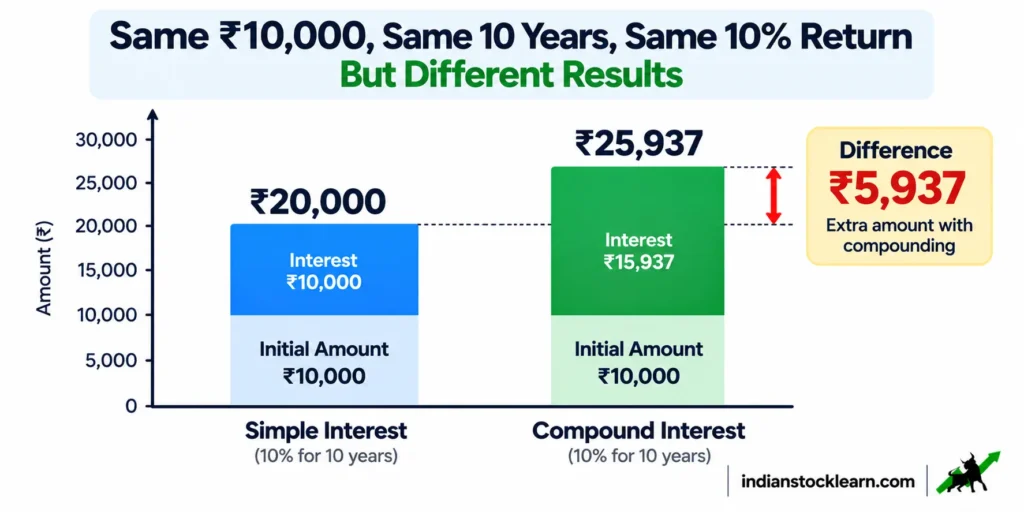
Simple interest calculates the return only on the original principal. Compound interest adds returns to the balance, so future returns are calculated on that larger balance.
Take ₹10,000 at an assumed 10% a year for 10 years:
| Simple interest | Compound interest | |
|---|---|---|
| Annual interest | ₹10,000 × 10% = ₹1,000 every year | Calculated on a growing balance each year |
| Over 10 years | ₹1,000 × 10 = ₹10,000 | Compounds year over year |
| Final amount | ₹20,000 | ≈ ₹25,937 |
The ₹5,937 difference is what compound interest vs simple interest actually means in practice. The same principle explains reinvested returns in investing, though actual stock market returns aren’t fixed like the rate used in this example.
Compounding in the Stock Market
Compounding in the stock market works differently from a fixed-interest calculation. A stock such as Reliance Industries or TCS doesn’t promise a fixed annual return. The share price can rise sharply one year, fall the next, and move sideways after that. Long-term stock market compounding generally means an investment growing over a long period while returns stay invested and participate in future growth, not a fixed year-on-year rate.
A few ways this shows up:
- Business growth: if a company grows revenue, profits and cash flows over many years, the market may value the business differently over time, which is part of what a rising PE ratio can reflect, though not every growing company delivers a particular share price return.
- Reinvested dividends: using a dividend payout to buy additional investments gives that money its own chance to grow further.
- Mutual funds and index investing: a fund holding many securities can let an investor’s overall position keep participating in growth when distributions are reinvested. For an index like the Nifty 50, the long-term return reflects its constituent companies and how the index is built, not a fixed compounding rate. Our Nifty 50 index fund guide covers this in more depth.
Real Stock Market Example
Take a purely mathematical example: ₹1,00,000 invested at an assumed average annual return of 10%.
| After | Approximate value |
|---|---|
| 5 years | ₹1.61 lakh |
| 10 years | ₹2.59 lakh |
| 20 years | ₹6.73 lakh |
| 30 years | ₹17.45 lakh |
The investment doesn’t add the same rupee amount every year. The first year’s assumed growth is ₹10,000. Around year 10, the annual increase at the same assumed rate would be much larger, because the balance has grown.
Reliance Industries, TCS and the companies inside the Nifty 50 are useful for one reason here: they show the gap between company performance and a fixed compounding formula. A calculator assumes 10% every year; the stock market doesn’t. A real stock can produce +25% in one year, -12% the next, +8% after that, and still end up with a positive long-term CAGR across the period. A calculator’s assumed rate should never be mistaken for a guaranteed annual market return.
How a Compounding Calculator Works
A compounding calculator performs the arithmetic for you. You typically enter the initial investment, expected annual return, investment period, and a contribution amount and frequency if you’re adding money regularly.
A lump-sum calculation is straightforward. A monthly SIP calculation is different, since money enters at different points in time and each contribution compounds for a different length of time.
It Depends: Compounding in Different Scenarios
Generic advice like “start early, invest monthly” is true, but how the power of compounding plays out changes with the type of investment, the time horizon and how money moves in and out.
- Investment type: a fixed-income instrument like a PPF or FD compounds at a set, guaranteed rate, while equity compounds at a variable rate that can be higher or lower in any given year. Guaranteed and variable aren’t better or worse in every situation; they trade consistency against potential, which is one reason the diversification guide suggests holding more than one kind.
- SIP vs lump sum: a SIP spreads contributions over time, so each instalment compounds for a different length of time, while a lump sum gives the full amount the maximum time to grow from day one.
- Time horizon: compounding needs time to show its effect. Over a 5-year goal, year-to-year market swings tend to dominate the outcome; over 20+ years, the mathematics of compounding has more room to work.
- Tax-advantaged accounts: instruments like PPF, ELSS or NPS carry their own tax treatment on contributions, growth or withdrawal, which changes the effective compounding compared with a plain taxable account. The exact rules and rates change, so check current details on the relevant scheme’s own page rather than relying on a fixed number here.
- Varying contributions: constant contributions, a SIP that increases with your salary, and occasional lump-sum top-ups all compound differently, since each rupee’s growth period depends on when it went in.
Why Investors Focus on Compounding
People pay attention to compounding mainly because of how time, returns and retained money interact.
- Starting early increases the available time: someone starting at 25 has more years available than someone starting at 40, though that doesn’t mean a later start can’t build wealth, just that the time period is shorter.
- Regular contributions add another layer: each new contribution gets its own period to potentially grow, rather than relying only on the original investment.
- Reinvestment keeps the process going: money that’s withdrawn and spent stops generating future returns within the investment; money that stays invested keeps participating in growth.
Advantages of Compounding
- Time can magnify growth: a return earned today can become part of the base producing future returns.
- Small contributions can accumulate: regular contributions can add up to something meaningful over long periods, which is why SIP projections often look very different over 5, 10, 20 and 30 years.
- Reinvestment creates a growth cycle: a return stays invested, the larger balance can earn further returns, and the cycle continues.
- It rewards patience mathematically: the mathematics is based on letting the accumulated amount stay invested, not on trading it every day.
Limitations of Compounding
Compounding is powerful mathematically, and it has real limits once you apply it to an actual investment.
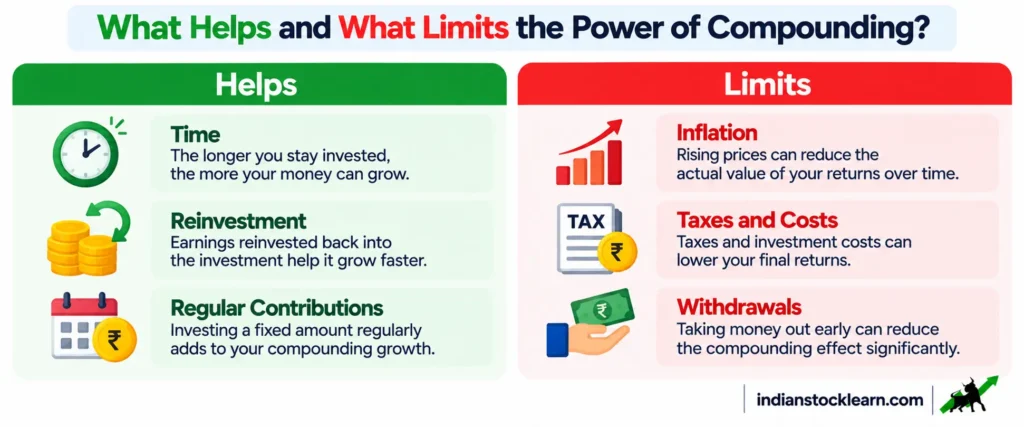
- Returns aren’t guaranteed: a calculator might assume 10%; a real stock market investment can deliver 10% one year and a negative return the next.
- Inflation reduces purchasing power: ₹10 lakh in the future won’t necessarily buy what ₹10 lakh buys today, so the growth of money and the growth of purchasing power are 2 different things.
- Taxes and costs reduce the effective return: brokerage, fund expenses and taxes all take a share of what would otherwise stay invested and keep compounding. Our expense ratio guide covers how fund costs specifically eat into returns.
- Withdrawals interrupt the process: money repeatedly taken out is money that stops compounding, which shrinks the base available for future growth.
- Time can’t fix a poor investment automatically: a weak business doesn’t become a good one just because it’s held for 20 years. Long holding periods aren’t a substitute for understanding what you own.
Myth vs Reality: The True Face of Compounding
| Myth | Reality |
|---|---|
| Small money automatically becomes a large fortune. | The result depends on the return, the time, the contributions and the costs, not on the starting amount alone. |
| A 12% calculator assumption means 12% every year. | Actual market returns can vary widely from one year to the next, even when the long-term average lands near the assumption. |
| Compounding guarantees wealth if you wait long enough. | Time helps the mathematics work, but it can’t guarantee the performance of the underlying investment. |
| Starting late makes compounding useless. | A shorter period changes the numbers, but compounding can still work; it just has less time to do it in. |
| A compounding calculator predicts the future. | It calculates an outcome from the assumptions you feed it, nothing more. |
| More frequent trading creates better compounding. | Trading activity and compounding are different concepts; compounding needs returns to stay invested, not to be traded. |
| A low-priced stock has more compounding potential. | Share price alone doesn’t determine a company’s future growth, as the market cap point earlier in this guide covers. |
| Starting 5 years later always leaves you behind someone who started earlier. | A later start can catch up if the monthly amount is enough higher. Someone investing ₹5,000/month from 25 to 60 reaches about ₹1.91 crore; someone investing ₹15,000/month from 30 to 60 reaches about ₹3.42 crore, despite starting 5 years later, because they put in more each month. |
| A SIP calculator’s final number means every rupee grew for the full period. | Only the very first instalment gets the full period. An instalment made in year 19 of a 20-year SIP has grown for about 1 year, not 20. |
Compounding is not a return. It’s what happens when returns stay invested and generate further returns. The quality and consistency of the underlying return still matter more than the formula.
Key Takeaways
- Definition: the power of compounding means earning returns on accumulated returns, not just on the original amount.
- Time matters: the effect grows much larger the longer money stays invested.
- Compound vs simple: compound interest calculates on a growing balance; simple interest doesn’t.
- Calculators use assumptions: a compounding calculator works from the inputs you give it; it doesn’t predict actual market returns.
- Stock returns are variable: unlike a calculator’s fixed rate, real returns move up and down year to year.
- Reinvestment keeps it going: returns that stay invested keep participating in future growth.
- Real-world drags exist: inflation, taxes, fees and withdrawals all reduce the result a calculator shows.
- Holding period isn’t a fix: a long holding period can’t turn a weak investment into a strong one.
Frequently Asked Questions
What is the power of compounding?
How does a compounding calculator work?
What’s the difference between compound interest and simple interest?
Does the power of compounding work in the stock market?
Is a 10% annual return guaranteed?
Can compounding overcome inflation?
Where can I go deeper into CAGR, XIRR and return calculations?
Conclusion
The power of compounding is one of the simplest ideas in investing, and one of the most overstated by a calculator screen. The mathematics itself is straightforward: when returns stay invested, those accumulated returns participate in future growth, and over long periods that produces a much larger result than adding the same return to the original amount every year.
Real investing doesn’t follow a fixed calculator rate. Stock prices move, businesses change, dividends vary, and taxes and costs take their share. A compounding calculator is useful for understanding possible outcomes under different assumptions; the harder, more useful skill is knowing which assumptions you’re making and how far actual market performance can stray from them.