

Rahul is 24 years old. Software engineer. Pune. Every month, ₹5,000 sits idle in his savings account earning 3.5% interest — less than inflation.
His colleague mentions Zerodha. He searches online. Finds jargon-filled articles about PE ratios and circuit breakers. Gets overwhelmed. Closes the tab.
Six months later, that ₹5,000/month is still sitting there. ₹30,000 that did nothing.
His first goal was not finding the next multibagger. It was simply understanding how investing actually works. That is exactly what this guide will do for you.
In 2015, opening a Demat account meant visiting a broker’s office, filling paper forms, and waiting two weeks. Today, it takes less time than ordering food on Swiggy. Yet millions of Indians still haven’t placed their first investment — not because they can’t, but because nobody explained it clearly.
If you have been searching for how to start investing in stock market India for beginners, you are in the right place. This guide covers everything — how the Indian market actually works, how to open a Demat account in minutes, how to buy your first stock, the hidden fees nobody warns you about, and the exact mistakes that cost beginners the most money.
You do not need thousands of rupees or a finance degree to begin. You need a PAN card, an Aadhaar card, and 10 minutes. That is it.
- What is Stock Market Investing?
- How the Indian Stock Market Works
- The Finfluencer Trap — What Social Media Gets Wrong
- Before You Start Investing
- How to Open a Demat Account
- Step-by-Step Investing Process
- What Happens After You Buy Your First Stock?
- Your First ₹1,000 — A Practical Example
- The Power of Compounding
- Real Indian Stock Market Example
- Why Investors Use the Stock Market
- Advantages of Investing in Stocks
- Hidden Fees and Taxes Beginners Miss
- 7 Mistakes That Cost Beginners the Most
- Limitations and Risks
- Key Takeaways
- Frequently Asked Questions
- Conclusion
What is Stock Market Investing?
Stock market investing means buying small ownership stakes in companies listed on stock exchanges. When you buy shares of a company, you become a shareholder. Your investment can grow or shrink depending on the company’s performance and broader market conditions.
Two simple examples:
- Buying 10 shares of Reliance Industries means you own a tiny part of Reliance.
- Buying shares of TCS means you participate in the company’s growth as a part-owner.
The stock market allows companies to raise capital from the public while giving investors a chance to benefit from business growth over time. To understand this more deeply, read our guide on what is the stock market.
Stock Market Basics for Beginners India
The Indian stock market operates through two main exchanges:
The two most-watched market indices are the Nifty 50 and Sensex. These track the performance of India’s largest companies and give you a pulse of the overall market.
Understanding these basics is the foundation of learning how to start investing in stock market India for beginners. Confused about NSE vs BSE? We’ve explained the difference between NSE and BSE in detail.
How the Indian Stock Market Works
Think of the stock market as a massive, regulated marketplace — like a bazaar — but instead of vegetables and electronics, people trade ownership stakes in companies. Here is how the stock market works step by step:
- A company lists its shares on an exchange (NSE or BSE).
- Investors place buy and sell orders through a broker app.
- The broker executes those orders on the exchange.
- Shares are transferred electronically through your Demat account.
Key Participants You Should Know
- Investors — People who buy and hold shares for growth over time.
- Companies — Businesses that issue shares to raise funds.
- Stock Exchanges — NSE and BSE are the two main platforms where trading happens.
- SEBI — The Securities and Exchange Board of India (SEBI) regulates the entire market and protects investor interests.
Trading vs Investing — Know the Difference
Many beginners mix these up. They are very different activities:
| Aspect | Investing | Trading |
|---|---|---|
| Time horizon | Long-term (years) | Short-term (days or hours) |
| Goal | Wealth creation | Profit from price movements |
| Activity level | Low — hold and monitor | High — frequent buying and selling |
| Focus | Business fundamentals | Charts and price patterns |
| Best for beginners? | ✅ Yes | ❌ Not recommended |
If you are just starting out, focus on investing. Trading requires experience, discipline, and a high risk tolerance. Master the basics first.
The Finfluencer Trap — What Social Media Gets Wrong
Before you open any app, there is one thing you must understand. Instagram reels, YouTube shorts, and Telegram channels have created a dangerous illusion about what stock market investing actually looks like.

Here is the reality check most beginners never get:
| What Social Media Tells You | The Hard Reality |
|---|---|
| “This penny stock will give 10x returns” | Most penny stocks are illiquid — when you try to sell, there are no buyers. You are stuck. |
| “Buy the dip — always works” | Buying a falling index (Nifty 50) during dips can work. Buying a falling individual company (like Yes Bank in 2020) can mean permanent loss. |
| “Copy this celebrity investor’s portfolio” | You don’t know their entry price, exit plan, or hedge positions. Copying blindly is gambling, not investing. |
| “I made ₹50,000 in one week” | They never show the weeks they lost ₹80,000. Survivorship bias is real and dangerous. |
| “Stock tips in this Telegram group — guaranteed profit” | These are often pump-and-dump schemes. SEBI has filed cases against several such operators. Never follow unverified tips. |
The investors who quietly build wealth over decades are not the ones making viral reels. They are boring, consistent, and patient. Quiet, unglamorous index fund SIPs have beaten most active traders over any 10-year period in India.
Before You Start Investing
Most beginner guides skip straight to “open an account and buy stocks.” That is a mistake. The smartest investors prepare before they put a single rupee to work.
1. Build an Emergency Fund First
Before investing, set aside money for unexpected expenses — medical bills, job loss, urgent repairs. A commonly suggested guideline is 3 to 6 months of your living expenses kept in a savings account or liquid fund. Never invest money you might need urgently.
2. Clear High-Interest Debt
If you are paying 24% interest on a credit card or personal loan, paying that off first is mathematically better than earning 12% in the market. Reduce expensive debt before you begin investing.
3. Define Your Goal
Before opening an app, ask yourself:
- Why am I investing? (Retirement, house, child’s education?)
- How long can I stay invested?
- How much loss can I handle without panicking?
Clear goals make every investment decision easier and calmer.
Think of your investment money like a pot of chai on the stove. It needs consistent, uninterrupted heat to brew properly. Constantly lifting the lid — panic-selling or checking prices every hour — only delays the result.
How to Open a Demat Account in India Step-by-Step
A Demat account stores your shares electronically — like a digital locker for your investments. Without one, you cannot hold stocks in India.
Documents Required to Open a Demat Account
| Document | Purpose |
|---|---|
| PAN Card | Tax identity — mandatory |
| Aadhaar Card | Address + identity proof |
| Bank Account Details | Fund transfers |
| Mobile Number | OTP verification |
| Email ID | Account communication |
| Signature | Digital agreement |
Popular Platforms for Indian Beginners
Step-by-Step Demat Account Opening Process
- Choose a SEBI-registered broker from the list above.
- Download their app or visit their website and register with your mobile number.
- Upload your PAN card and Aadhaar card photos.
- Complete e-KYC — Aadhaar OTP verification takes under 2 minutes.
- Link your bank account for fund transfers via UPI or NEFT.
- Receive your Demat account credentials by email within 24–48 hours.
The entire process is online. You do not need to visit any office or submit physical documents in most cases.
How to Start Investing in Stock Market India for Beginners (Step-by-Step)
Your account is ready. Here is the exact process to make your first investment.
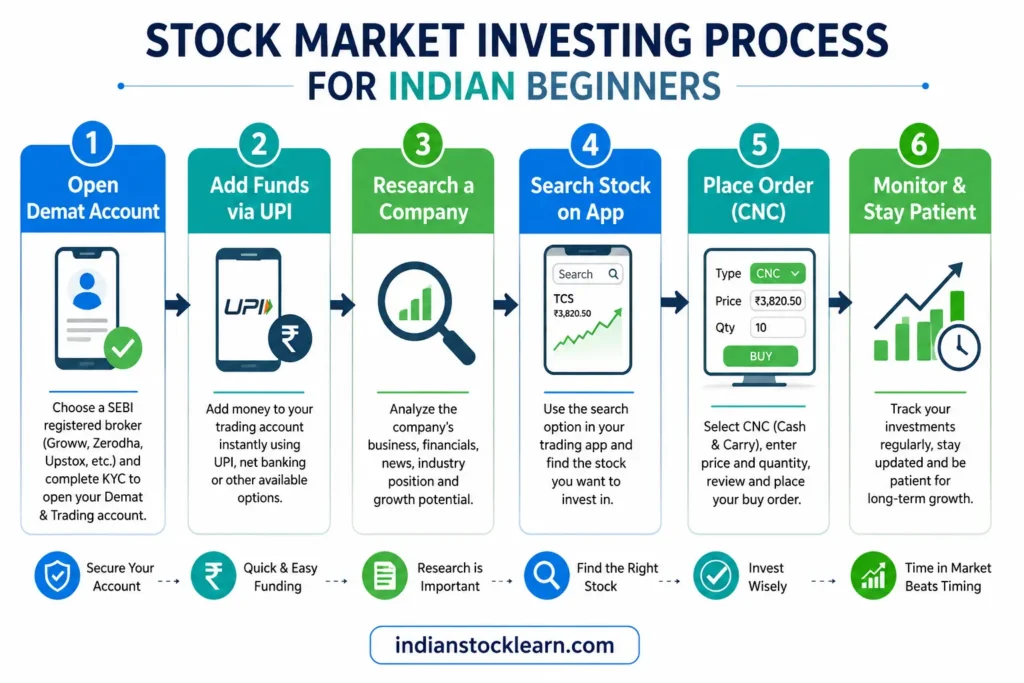
Transfer ₹500, ₹1,000, or any amount from your bank via UPI. Instant, free, and simple.
Look at the business model, revenue growth, debt levels, and industry position before buying.
Type the company name in your broker app — Reliance, TCS, Infosys — and see current price.
Choose quantity, select order type (CNC for delivery), and confirm. Done in under 30 seconds.
Check quarterly results, not daily prices. Avoid checking your portfolio every hour.
Invest a fixed amount every month. Consistency beats timing the market — every time.
What Happens After You Buy Your First Stock?
Most guides stop at “place the order.” Nobody explains what happens next. Here is the complete picture:
| What Happens | Timeline | Where to See It |
|---|---|---|
| Order confirmation | Instant | App notification + order book |
| Settlement (T+1) | Next trading day | Shares appear in your Demat holdings |
| Portfolio view | After settlement | Holdings tab in your broker app |
| Average price shown | After settlement | Your buy price + any charges |
| Profit / Loss display | Live after settlement | P&L tab — shows unrealised gain/loss |
One important note: the profit or loss shown in your portfolio is unrealised until you actually sell. A stock showing +20% in your portfolio means nothing unless you sell. Until then, it is a paper number — it can go up or down.
Do not check your portfolio every hour. Check your holdings once a week at most. Watching minute-by-minute price movements triggers emotions that lead to bad decisions. Set a calendar reminder instead.
Your First ₹1,000 — A Practical Example
Abstract advice is useless. Here is exactly what a sensible beginner does with ₹1,000:
| Amount | Where | Why |
|---|---|---|
| ₹500 | Nifty 50 Index ETF (e.g., Nippon India ETF Nifty 50 or UTI Nifty 50 ETF) | Instant diversification across India’s 50 largest companies. Low risk for a first investment. |
| ₹500 | Keep in your trading account as a reserve | Avoid investing everything at once. Learn how the app works with half first. |
Why not buy an individual stock with ₹1,000? Because one company’s share price can drop 30–40% on bad news in a single day. An index ETF spreads that risk across 50 companies simultaneously. For a beginner, boring and safe wins every time.
Once you are comfortable — after 2–3 months of watching how the market moves — you can start a monthly SIP of ₹500 in the same index fund. That is the foundation of building a diversified portfolio from scratch.
The Power of Compounding — Why Starting Early Matters
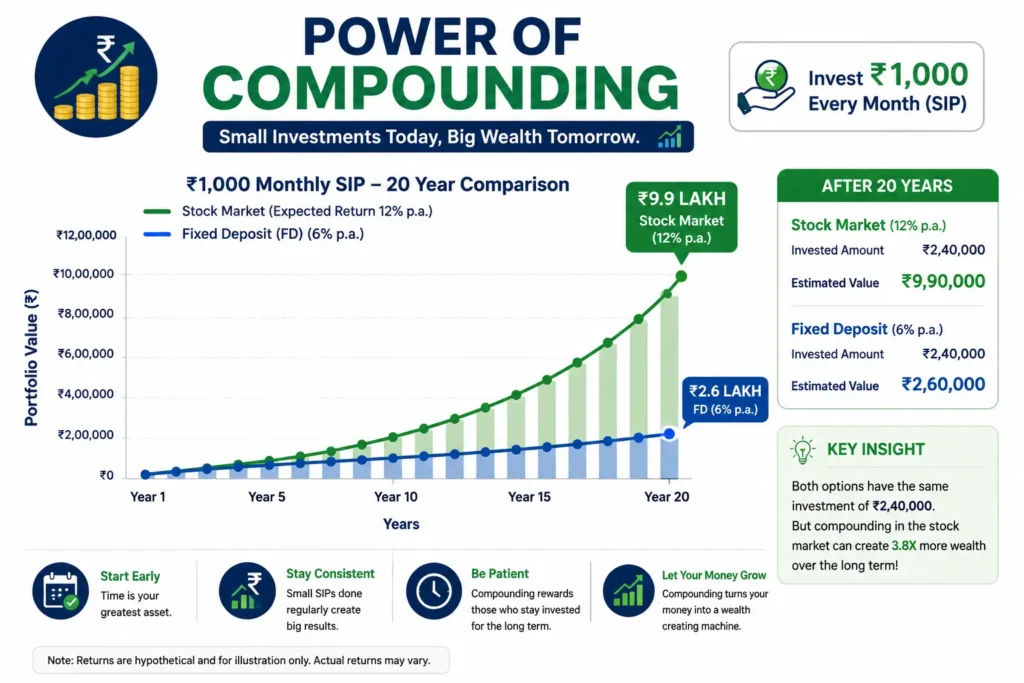
One of the most important concepts in investing is compounding — earning returns on your previous returns over time. It is how small amounts become large ones.
The formula behind it:
Even ₹1,000 invested every month for 20 years at a 12% annual return grows to approximately ₹9.9 lakh. The total amount you put in? Only ₹2.4 lakh. The rest is compounding at work.
This is why starting early matters more than starting big. Time in the market beats timing the market.
Real Indian Stock Market Example
Consider an investor who purchased shares of Tata Consultancy Services (TCS) several years ago. As TCS grew — more revenue, larger global contracts, higher profits — its share price reflected that growth over time. Long-term shareholders benefited from both price appreciation and dividends.
Similarly, investors in Reliance Industries have experienced different market cycles — strong upswings and temporary corrections — but long-term shareholders have seen meaningful wealth creation over decades.
This is not a promise or prediction. It illustrates how business performance, investor patience, and compounding can work together over time. Stock prices reflect reality — not hope.
Understanding stock classifications also helps. Large-cap, mid-cap, and small-cap stocks each carry different risk and return profiles. Beginners typically start with large-cap companies because they are more stable and transparent.
Why Investors Use the Stock Market
People invest in stocks for several reasons — and none of them is “to get rich quick.”
- Wealth creation: Stocks have historically been one of the most effective long-term wealth-building tools available to regular people.
- Inflation protection: Inflation quietly erodes the value of money sitting idle. Investing helps your money grow faster than inflation over time.
- Business ownership: Buying shares gives you real participation in a company’s success — including dividends, bonus shares, and IPO opportunities.
- Diversification: You can spread your money across banking, technology, pharma, FMCG, and manufacturing — reducing risk through variety.
Advantages of Investing in Stocks
| Advantage | What it Means for You |
|---|---|
| Long-term growth potential | Companies grow, and shareholders benefit from that growth over time. |
| Easy access | Apps like Groww and Zerodha let you invest in minutes from your phone. |
| Liquidity | Unlike property or gold, stocks can be bought and sold on any trading day. |
| Transparency | Listed companies publish quarterly results, audited financials, and disclosures. |
| Wide choice | Invest across sectors — banking, IT, pharma, FMCG, infrastructure, and more. |
| Low entry barrier | Start with ₹500. No need for large capital to begin. |
Hidden Fees and Taxes Beginners Miss
Your broker says “zero brokerage on delivery.” That is true — but it is only part of the picture. Every trade you make has government-mandated charges that quietly reduce your actual returns.
| Charge | What It Is | Approx. Amount |
|---|---|---|
| STT (Securities Transaction Tax) | Government tax on every buy and sell transaction | 0.1% on delivery trades |
| DP Charges (CDSL/NSDL) | Flat fee charged every time you sell a stock line item — regardless of trade size | ₹13–₹20 per sell transaction |
| Stamp Duty | State government charge on share purchases | 0.015% on buy trades |
| SEBI Turnover Fee | Regulatory fee on total traded value | Very small — ₹10 per crore traded |
| LTCG Tax (Budget 2026) | 12.5% tax on equity gains above ₹1.25 lakh if held over 12 months | Only on profits above ₹1.25L threshold |
| STCG Tax (Budget 2026) | Flat 20% tax if you sell within 12 months of buying | Applied on entire short-term profit |
If you buy ₹200 worth of a stock and sell it — the DP charge alone can be ₹15–₹20. That is 7–10% of your trade value gone in fees before any profit calculation. This is why frequent buying and selling of tiny amounts destroys capital even when the broker charges zero commission.
The takeaway for beginners: Invest for the long term (12+ months) whenever possible. LTCG tax gives you a ₹1.25 lakh annual exemption — meaning most beginners with small portfolios pay zero tax on gains. STCG at 20% penalises short-term selling heavily.
Limitations and Risks of Stock Market Investing
Every investment carries risk. Understanding these risks is just as important as understanding the rewards. This section is not meant to scare you — it is meant to prepare you.
Market Risk
Stock prices move every single day. Even strong companies in the Nifty 50 can see significant short-term price drops during economic slowdowns, global events, or sudden interest rate changes. Understanding the difference between a bull and bear market helps you stay calm during corrections. Long-term investors stay invested through both.
Company-Specific Risk
A company’s share price can fall sharply if profits decline, debt increases, or management issues arise. This is why research matters. Checking the PE ratio and understanding business fundamentals helps you make more informed decisions.
Emotional Decision-Making
This is the number one reason beginners lose money. They buy stocks when everyone is excited (prices are high) and sell when everyone is panicking (prices are low). Discipline and a written investment plan help control emotional responses.
Lack of Knowledge
Investing without understanding what you are buying increases risk. Start with basics. Learn what a company does before you buy its shares. Avoid tips from Telegram groups and social media — we covered exactly why in the Finfluencer Trap section above. Also understand how upper and lower circuits work — they can prevent you from selling when you want to exit.
No Guaranteed Returns
Unlike a fixed deposit, the stock market offers no guaranteed returns. Your investment can increase or decrease in value. Only invest money you can afford to keep invested for at least 3–5 years.
7 Mistakes That Cost Indian Beginners the Most
These are not theoretical warnings. These are the exact patterns that send thousands of new investors back to fixed deposits every year.
| # | Mistake | Why It Happens | What to Do Instead |
|---|---|---|---|
| 1 | Buying penny stocks | Low price looks “cheap.” ₹2 stock feels affordable. | Price per share means nothing. Focus on business quality, not share price. |
| 2 | Following Telegram tips | Feels like an insider secret. Fear of missing out. | SEBI has penalised dozens of tip operators. No verified track record = no trust. |
| 3 | Checking portfolio every hour | Anxiety. Normal human behavior. | Set a weekly review. Daily price noise is irrelevant to long-term investing. |
| 4 | Investing borrowed money | Confidence after a few early wins. | Never invest money with a repayment deadline. Markets can stay irrational longer than you can stay solvent. |
| 5 | Panic selling during a correction | Watching the portfolio go red triggers fear. | Corrections of 10–20% are normal. |
| 6 | Investing before an emergency fund | Eagerness to start. Nobody warns about this. | Fund first, invest second. |
| 7 | Accidentally placing intraday (MIS) instead of delivery (CNC) | Wrong tab selected on broker app. | Always double-check order type before confirming. |
Key Takeaways
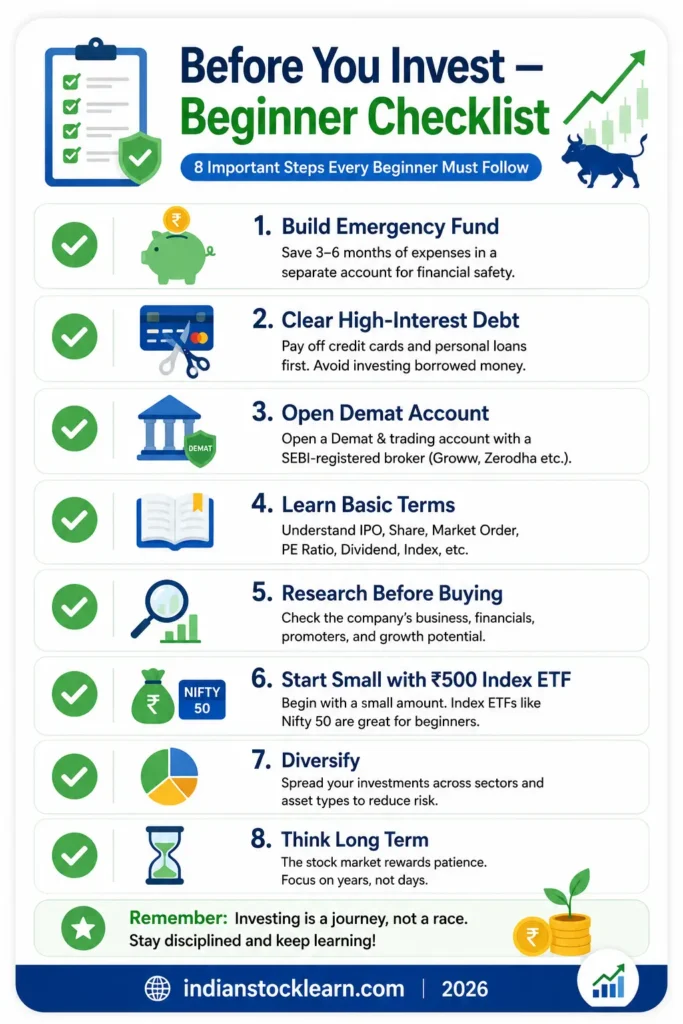
- The stock market lets you buy ownership in companies — you share in their growth.
- You need a Demat account and a trading account to invest in India.
- NSE and BSE are India’s two primary stock exchanges. SEBI protects investors.
- Build an emergency fund and reduce high-interest debt before you invest.
- Investing and trading are different. Beginners should start with investing.
- Consistency beats timing. Invest regularly, even in small amounts.
- Diversification reduces risk. Do not put everything in one company or sector.
- Returns are never guaranteed. Invest only what you can stay committed to long-term.
- The earlier you start, the more compounding works in your favour.
Frequently Asked Questions
Conclusion
Learning how to start investing in stock market India for beginners does not have to be complicated or intimidating. The path is straightforward when broken into steps:
- Learn the basics — understand what stocks are and how exchanges work.
- Prepare your finances — emergency fund, debt, clear goals.
- Open a Demat account on a SEBI-registered platform.
- Research companies you understand before investing a single rupee.
- Make your first investment — even if it is ₹500.
- Stay patient, stay consistent, and keep learning.
The Indian stock market includes some of the world’s most well-known companies — Reliance Industries, Tata Consultancy Services, HDFC Bank, Infosys, and many more in the Nifty 50. These businesses serve hundreds of millions of customers every day. As an investor, you can participate in that growth.
Remember: every experienced investor once sat exactly where you are right now — uncertain, curious, and wondering where to begin. The difference between those who build wealth and those who do not is simply this: they started.
Download Groww or Zerodha today. Keep your PAN and Aadhaar card ready. Open your Demat account. It takes 10 minutes. Everything else follows from there.