
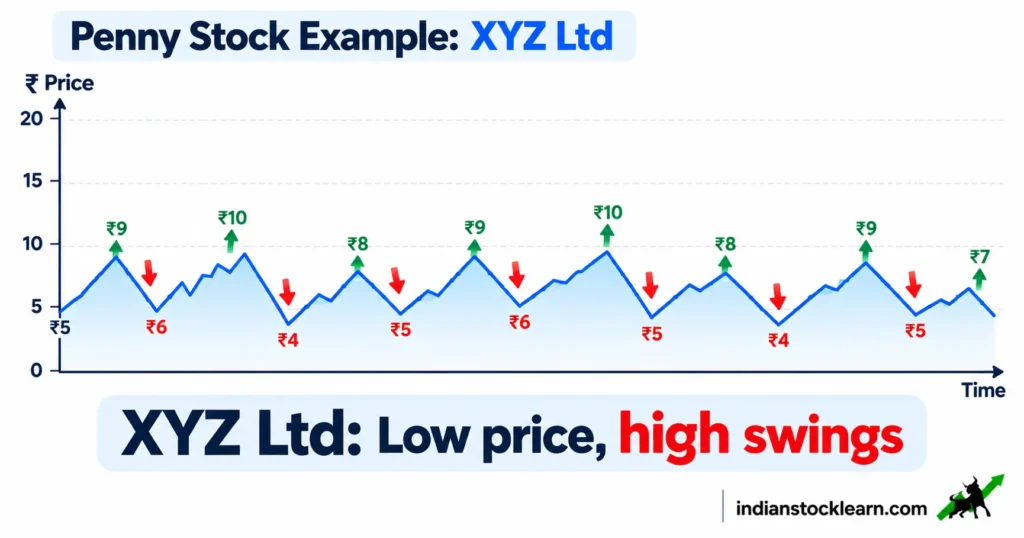
Anyone researching penny stocks in India eventually asks the same question: is the low price an opportunity or a trap? Penny stocks in India are shares of small, often young companies that trade at very low prices, commonly under ₹10. There’s no official SEBI definition by price. The term simply describes a low share price, a small market cap and thin trading volume together.
A low price makes these shares attractive to new or budget-conscious investors, since a small amount of money buys many shares. That same low price comes with sharp swings, thin liquidity and, often, limited public information about the company.
This guide covers what penny stocks are, how trading them actually works, a real example and the risks worth knowing before you consider one, without recommending any stock.
What Are Penny Stocks in India
Penny stocks are the cheapest shares on the market. In India, no regulator sets a price cutoff, so investors use the term loosely for any listed company whose share price sits very low, often below ₹10. These companies are typically small or early-stage, with a small market cap and low trading volume.
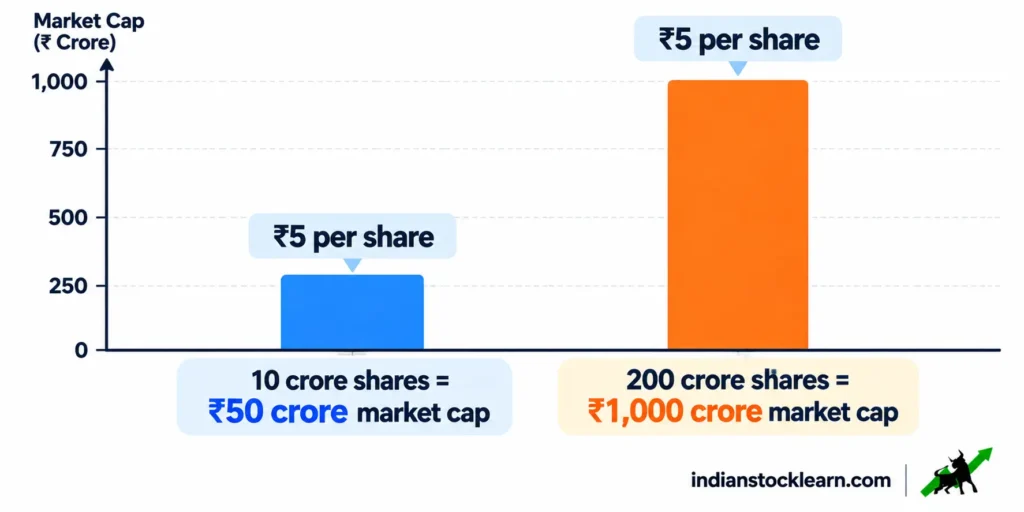
A low price alone doesn’t mean a company is small. A company with 10 crore shares at ₹5 each has a market cap of ₹50 crore. Another company with 200 crore shares at the same ₹5 price has a market cap of ₹1,000 crore, 20 times larger. Market capitalization, share price multiplied by the number of shares, is what actually measures size.
Once a stock’s price rises well above the low range that earned it the “penny stock” label, people usually stop calling it one, even though nothing about the company changed on that day.
How Penny Stocks Work
Penny stocks trade on the NSE and BSE like any other listed share. You need the same trading and demat account, and you place buy and sell orders through the same broker app.
Liquidity is where the difference shows up. Fewer buyers and sellers mean a large order can go unfilled, or fill only partly. Place an order for 1,000 shares, and you might get 400 at your price and no more, because there aren’t enough sellers at that level. The bid-ask spread, the gap between the highest buy offer and the lowest sell offer, also tends to run wider, so your entry and exit prices sit further apart.
That thin liquidity is also why penny stocks can jump sharply on small news. A modest order can move the price when there’s little depth on either side of the order book.
Many traders use limit orders, which set the exact price you’re willing to accept, instead of market orders, which fill at whatever price is available. Before placing any order, check the company’s basic fundamentals, revenue, profit and debt, along with recent news.
Any broker works, since penny stocks trade on the same NSE and BSE platforms as other shares. Our Zerodha vs Groww vs Upstox comparison can help you pick one.
Revenue, profit, debt and promoter holding tell you more than the price does. The face value guide explains one number that often confuses beginners here.
A limit order sets the exact price you’ll accept, so a thin order book can’t fill your trade far from where you intended.
Treat it as money you can afford to lose completely, given the liquidity and business risks covered below.
Key Concepts: Market Cap and Returns
A few ideas make penny stocks easier to read.
| Concept | What it means | Example |
|---|---|---|
| Market capitalization | Share price × number of shares | 10 crore shares at ₹5 = ₹50 crore |
| Return on investment (ROI) | ((Sell price − buy price) ÷ buy price) × 100 | Buy at ₹5, sell at ₹10 = 100% gain |
| Downside | Same formula, in reverse | Buy at ₹5, price falls to ₹2.50 = 50% loss |
| Volatility | How sharply the price swings | A stock moving 10–20% in a single session isn’t unusual |
High-percentage gains look striking mainly because the starting price is small. The same rupee amount of profit on a large-cap stock produces a smaller percentage, and the same rupee amount of loss on a penny stock produces a larger percentage. Read the percentage next to the price, not on its own.
This is also where most penny stocks in India get oversold as opportunities. A headline that says a stock “doubled in a week” sounds identical whether the stock moved from ₹500 to ₹1,000 or from ₹2 to ₹4. The percentage is the same, but the second move needed far less buying pressure to happen, and it can unwind just as fast.
Real Stock Market Example
In September 2026, SpiceJet, an airline stock, traded around ₹8 a share. With ₹10,000, that buys about 1,250 shares. If the price doubled to ₹16, that holding would be worth about ₹20,000, a profit of ₹10,000.
Compare that to Reliance Industries, trading around ₹1,400 in 2026. The same ₹10,000 buys about 7 shares. If Reliance also doubled, to ₹2,800, the holding would again be worth about ₹20,000, the same ₹10,000 profit.
Both scenarios return the same rupee profit for the same rupee investment; doubling your money doubles it whether the shares cost ₹8 or ₹1,400. What differs is the number of shares you hold and how each company might realistically get there. SpiceJet and Reliance are used here only to illustrate the arithmetic, not as investment suggestions, and their prices will have moved by the time you read this.
Why Investors Consider Penny Stocks
A few reasons draw people toward penny stocks despite the risk.
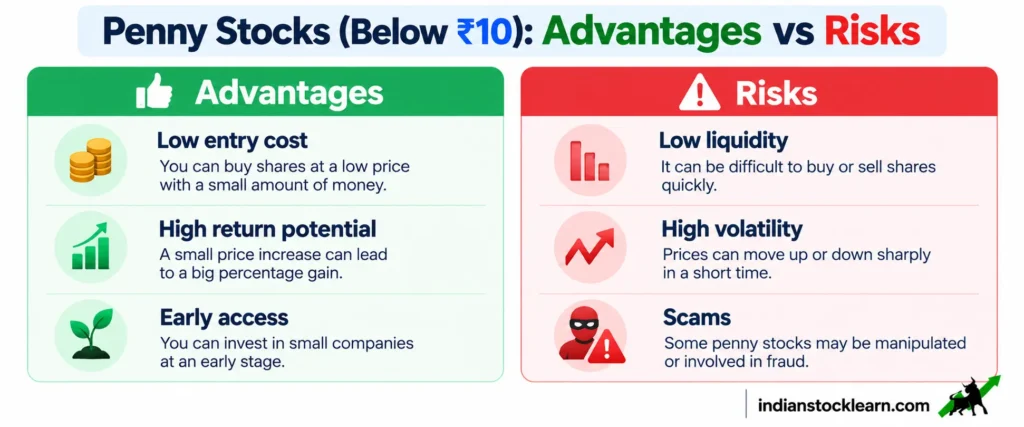
- Low entry cost: A small amount of money buys many shares, which makes the market feel more accessible.
- High return potential: A small company that grows quickly can deliver a large percentage gain from a low starting price.
- Early access: Buying a small company early means benefiting fully if it succeeds, though very few do.
- A small, deliberate allocation: Some investors set aside a very small slice of a portfolio for higher-risk, higher-upside bets, alongside blue chip stocks in India and other steadier holdings.
The pull is speculative by nature: a small bet with a small chance of a large payoff, similar to how people describe a stock becoming a multibagger, except the odds here run even longer.
Blue Chip Stock
- Established business, longer track record
- Higher liquidity, tighter bid-ask spread
- More public information available
- Smaller percentage swings, on average
Penny Stock
- Small or early-stage business, shorter track record
- Lower liquidity, wider bid-ask spread
- Less public information available
- Larger percentage swings, in both directions
Neither column is automatically the right choice. Blue chip stocks in India suit most beginners as a foundation, and penny stocks, where used at all, work better as a small addition once that foundation is in place.
Advantages
Set against their risks, penny stocks in India do offer a few genuine upsides for the investors who understand what they’re taking on.
- Very low entry cost: Even a small amount of money buys dozens or hundreds of shares.
- High return potential: A low base price means a real business improvement can show up as a large percentage move.
- Early exposure: A handful of small companies do eventually become large, well-known ones, and early shareholders benefit most.
- Room for quick moves: The same volatility that creates risk also creates short-term opportunities for traders who watch these stocks closely.
- A small diversification slice: A limited allocation alongside index funds or large caps adds asymmetric upside without risking the whole portfolio. The diversification guide covers how spreading money around works.
Limitations
- Low liquidity: Few buyers and sellers make it hard to exit a position at a fair price, or at all.
- High volatility: Prices can swing sharply on rumours or minimal news, in both directions.
- Limited transparency: Smaller companies often report less and attract less coverage, so reliable information can be hard to find.
- Manipulation risk: Low-volume, low-price stocks are a common target for pump-and-dump activity, where a stock is hyped, bought up and then dumped on late investors.
- Risk of total loss: Many penny stock companies are unproven or financially weak. If the business fails, the stock can go to zero.
Delisting is another edge case worth knowing. A company can be delisted from the exchange for failing compliance rules or through a promoter buyout offer, and holders sometimes find their shares harder to sell during that process, well before any formal exit price is set. Reading a company’s shareholding pattern and past corporate actions on the NSE website before buying can flag some of this risk early.
Penny Stock Myths vs Reality
A few beliefs about penny stocks in India circulate widely and cost people real money. The table sets 7 of them against what actually happens.
| Myth | Reality |
|---|---|
| A low price means the stock has more room to grow. | Price alone doesn’t decide return potential. A ₹5 stock and a ₹1,500 stock can both double or both go to zero; growth depends on the business, not the starting price. |
| A stock under ASM or GSM surveillance is now safe to trade. | ASM and GSM are surveillance labels, not safety certificates. They usually mean the price moved oddly and needs closer scrutiny, not that any regulator has approved the stock. |
| High trading volume means bigger investors are buying in. | In many penny stocks, a volume spike with a low delivery percentage (shares actually taken for delivery, not squared off the same day) points to short-term trading activity rather than fresh buying. NSE and BSE publish delivery percentage data for any stock. |
| High promoter holding always means a stable business. | Promoter shares can be pledged as loan collateral. If the price falls, lenders can sell those pledged shares, adding pressure exactly when the stock is already weak. |
| You can always exit by placing a lower price order. | In a genuine liquidity drought, there can be no buyers at any price inside that day’s circuit band. That’s exactly what happened with Uttam Value Steels above. |
| Buying several penny stocks instead of one spreads out the risk. | Penny stocks often move together, in speculative rallies and in liquidity droughts alike, so several of them can turn illiquid on the same day, which undercuts the diversification. |
| Multibaggers only come from penny stocks. | Multibaggers have also come from small and mid-cap stocks with far better liquidity and governance. The penny stock universe just has many more failures for every winner. Our multibagger stocks guide covers how those returns actually build up. |
Key Takeaways
- Definition: Penny stocks in India are low-priced shares, often under ₹10, of small or early-stage companies, with no official price cutoff.
- Size check: Market cap, not share price, measures how big a company actually is.
- Trading: Same demat and broker setup as any stock, but thinner liquidity and wider bid-ask spreads.
- Returns: High percentage swings run in both directions, up and down.
- Risk: Low liquidity, weak transparency, manipulation risk and the chance of total loss are all real.
- Position: Where used at all, penny stocks fit as a small, deliberate slice of a portfolio, not a starting point for beginners.
- Myths: Low price, high promoter holding, high volume and ASM/GSM status are all easy to misread. Check the reality behind each before acting on it.
Frequently Asked Questions
What are penny stocks in India?
Is there an official definition of a penny stock in India?
Which are the best penny stocks to buy in India?
Are penny stocks risky?
Can I lose all my money in penny stocks?
Should beginners invest in penny stocks?
Is there a reliable “penny stocks in India list” to follow?
What does it mean if a penny stock is under ASM or GSM?
Do penny stocks pay dividends?
Conclusion
Penny stocks in India appeal to small investors because a modest amount of money buys many shares, with the chance of a large percentage gain if the business grows. The other side of that coin is real: low liquidity, sharp volatility and, for some companies, a genuine risk of losing everything invested. Understanding how the stock market works and what SEBI regulates gives you the footing to judge any penny stock claim on its own, rather than on a tip.
For most beginners, established, liquid stocks are the steadier place to start, with a large cap, mid cap and small cap understanding underneath. If you do explore penny stocks, size the position as money you can afford to lose, and check the company’s fundamentals before checking the price.